
Community
Chakras und Kshetras
The Chakras and Kshetras and the Ancient Yogic Path of Energy and Consciousness

Throughout the history of spiritual exploration, human beings have searched for a deeper understanding of the relationship between the physical body, the mind, and the mysterious nature of consciousness. Ancient Indian traditions developed sophisticated philosophical systems to describe this relationship, often presenting the human being as possessing both a visible physical structure and a subtle dimension of experience. Within the diverse traditions of yoga and tantra, the chakra system emerged as one of the most recognizable symbolic representations of spiritual development. Yet beyond the familiar illustrations of seven energy centers extending along the spine lies a more detailed understanding of how these centers may be contemplated through corresponding points in the front of the body. This relationship is expressed through the traditional concepts of Chakras and Kshetras, which together provide a symbolic map for exploring awareness, meditation, and the movement of vital energy.
The Sanskrit word Chakra is commonly translated as wheel or circle, reflecting the traditional image of a center through which subtle forces operate. In various yogic systems, chakras are associated with different dimensions of human existence, including instinct, emotional experience, personal identity, compassion, communication, insight, and spiritual awareness. Their positions and meanings vary across historical texts and lineages, and the widely recognized seven-chakra system represents only one of several traditional arrangements. Nevertheless, the idea that consciousness can be contemplated through a sequence of subtle centers has become an influential feature of yoga philosophy.
The word Kshetra carries a different but complementary meaning. In Sanskrit, it refers to a field, region, or domain. Within certain yogic meditation systems, particularly traditions that employ chakra projection points, a Kshetra may be understood as a corresponding field of awareness situated toward the front of the body. While the chakras are often symbolically placed along the central axis of the spine, their Kshetras provide additional points through which attention can be directed during contemplative practice. The relationship between these two arrangements creates a more complex representation of the subtle body, suggesting that spiritual awareness is not limited to a single vertical sequence but may involve a continuing relationship between different regions of embodied experience.
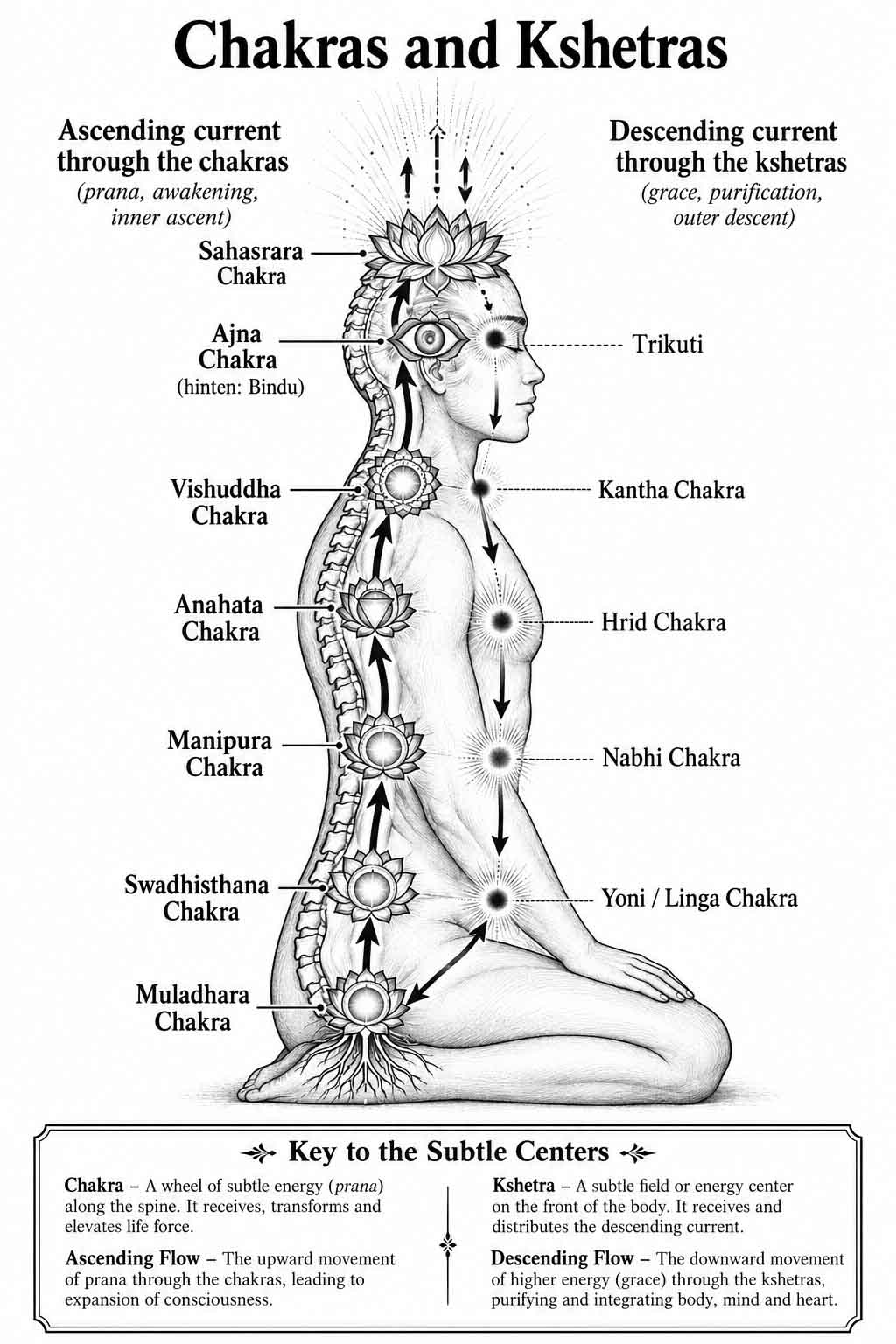
The traditional illustration of Chakras and Kshetras shows a seated human figure viewed from the side, with a sequence of symbolic centers extending upward along the spinal region and corresponding points located toward the front of the body. Arrows indicate a rising current behind the body and a descending current toward the front. The upward movement is commonly interpreted as a symbol of spiritual ascent, while the downward movement can represent the return or integration of awareness through the frontal centers. This particular arrangement provides a useful way of contemplating the relationship between inner transformation and embodied life, although it should not be mistaken for a scientifically established system of physical energy circulation.
To understand the significance of this symbolism, it is helpful to begin with the concept of Prana. In yogic philosophy, Prana is traditionally described as the vital principle associated with living activity, breath, and the subtle processes of existence. The term is sometimes loosely translated as life force, but its traditional meaning cannot be reduced to any single modern physiological concept. Prana is not scientifically established as an independently measurable substance moving through invisible bodily channels. Instead, it belongs to a spiritual framework through which ancient practitioners explored the relationship between breathing, attention, bodily experience, and states of consciousness.
According to traditional subtle-body teachings, Prana is associated with channels known as Nadis. These channels are described as pathways of subtle activity rather than the nerves and blood vessels recognized by modern anatomy. Among the most frequently discussed are Ida, Pingala, and Sushumna. Ida is often connected with lunar, receptive, and cooling qualities, while Pingala is associated with solar, active, and warming qualities. Sushumna occupies a central position in many yogic descriptions and is particularly important in accounts of Kundalini awakening and spiritual ascent. The precise relationships among these channels differ between texts and practices, but their symbolism contributes to the wider understanding of balance and inner development.
Within the Chakras and Kshetras diagram, the ascending current along the spinal axis can be contemplated in relation to the central path associated with Sushumna. This current represents a symbolic movement from the foundations of embodied existence toward increasingly subtle states of awareness. The descending current along the front of the body provides a complementary movement, suggesting that consciousness is not simply directed upward and away from ordinary life but may also be experienced through the different dimensions of human existence. Such an interpretation emphasizes integration rather than escape, connecting spiritual contemplation with the continuing reality of physical, emotional, and psychological experience.
The journey traditionally begins at Muladhara Chakra, commonly known as the root chakra. The Sanskrit name combines ideas associated with the root and foundation, reflecting its position near the base of the subtle-body system. Muladhara is frequently connected with stability, grounding, survival, and the basic conditions of embodied existence. Its symbolism is closely associated with the earth element, which represents solidity, structure, and the capacity to remain established despite changing circumstances. In many traditional descriptions, Muladhara also plays an important role as the symbolic resting place of Kundalini, the spiritual power represented as dormant at the foundation of the subtle system.
The spiritual significance of Muladhara extends beyond the ordinary desire for physical safety. Stability is also a psychological and philosophical quality. A person who lacks a sense of grounding may become easily overwhelmed by uncertainty, while someone who develops a more balanced relationship with the conditions of life may experience greater steadiness. The root chakra symbolizes the importance of establishing a foundation before pursuing increasingly subtle forms of contemplation. It reminds the practitioner that spiritual development need not involve neglecting physical needs, ordinary responsibilities, or the natural relationship between the body and the environment.
Kundalini, traditionally represented as a coiled serpent, is closely associated with this foundational region in many tantric and yogic systems. Its awakening is described in spiritual literature as a process through which subtle power moves upward through the central channel, passing through or transforming the different chakras. The symbolism of the serpent conveys both potential energy and transformation, suggesting a movement from latent possibility toward a more expansive recognition of consciousness. Accounts of Kundalini differ considerably across traditions, and the concept should be understood within its religious and philosophical setting rather than interpreted as a medically verified mechanism.
Moving upward from Muladhara, the next important center is Swadhisthana Chakra, commonly associated with the lower abdominal or pelvic region. The Sanskrit name is often interpreted through the idea of one's own abode or dwelling place. In contemporary chakra interpretations, Swadhisthana is frequently connected with emotion, creativity, pleasure, sexuality, and the ability to experience life through changing relationships. Traditional symbolic associations also connect it with the water element, reflecting movement, adaptability, and fluidity.
Water provides a useful metaphor for this dimension of human existence. Unlike the solidity of earth, water changes shape according to the environment in which it moves. Emotional life possesses a similar quality. Feelings arise, develop, and gradually change, sometimes responding to circumstances in unexpected ways. The symbolism of Swadhisthana encourages contemplation of the relationship between emotional sensitivity and inner stability. The purpose is not necessarily to suppress feeling or remain permanently calm but to develop an understanding of emotions without allowing every temporary reaction to determine the direction of one's life.
The corresponding frontal region is identified in the illustration through the traditional terms Yoni and Linga. These Sanskrit words possess important meanings within Hindu religious and tantric symbolism. Yoni can refer to a source, womb, or generative principle and is often associated with feminine creative power. Linga carries several meanings, including mark or sign, and in Shaiva traditions it serves as an important symbol associated with Shiva. When these terms are used in subtle-body diagrams, they may indicate symbolic associations with the generative and pelvic regions. Their exact relationship with the Swadhisthana Kshetra depends upon the tradition being represented.
The pairing of Swadhisthana with its frontal projection brings attention to the deeper symbolism of creation and manifestation. Human beings continually participate in creative processes, not only through reproduction but also through imagination, relationships, artistic expression, and the capacity to bring new possibilities into existence. Within a spiritual interpretation, creative power does not exist independently of awareness. It becomes meaningful through the way it is understood, directed, and integrated into life. The pelvic symbolism in the diagram therefore represents more than a fixed physical location. It invites reflection on the relationship between instinctive experience and conscious intention.
The next center in the ascending sequence is Manipura Chakra, traditionally associated with the region of the navel and the symbolism of fire. Its name is often translated as the city of jewels or jeweled city, suggesting a place of transformative potential. In modern chakra interpretations, Manipura is frequently associated with willpower, confidence, personal identity, and the capacity to act. The traditional connection with the fire element gives this center particular significance because fire transforms the substances with which it comes into contact, providing a metaphor for the processes through which experience becomes understanding.
Manipura can be contemplated as a symbol of the relationship between intention and action. Human beings possess the ability to make decisions, pursue goals, overcome difficulties, and influence their surroundings. Yet the same capacities can become unbalanced when driven entirely by fear, pride, or the need for control. The symbolism of the navel region encourages reflection on the difference between purposeful action and constant internal struggle. Strength does not always require aggression, and confidence does not necessarily depend on dominating others. A more balanced expression of personal power can involve responsibility, discipline, and the ability to act without being completely controlled by immediate emotional reactions.
The frontal counterpart of Manipura is traditionally identified as Nabhi Kshetra, the navel field. The Sanskrit word Nabhi refers to the navel and carries additional symbolic associations with centrality and connection. The navel is a natural point of bodily reference, and its position near the middle of the torso makes it a prominent focus in numerous contemplative and cultural traditions. Within systems that employ chakra and Kshetra visualization, the relationship between Manipura and Nabhi provides two corresponding regions for awareness, one associated with the subtle spinal center and the other with its anterior projection.
The significance of the navel region also extends toward the relationship between physical life and psychological experience. The abdomen often becomes noticeably affected during periods of excitement, nervousness, or emotional tension. These familiar bodily sensations help explain why many traditional systems employ the abdominal region as a focus for meditation. Although such sensations can be examined through modern physiological understanding, the spiritual significance assigned to Manipura and Nabhi belongs to the symbolic language of yoga.
Continuing upward, the ascending current reaches Anahata Chakra, traditionally associated with the heart region. The Sanskrit word Anahata is commonly translated as unstruck, a term connected with a sound or resonance not produced through ordinary physical contact. This concept has deep significance within certain Indian contemplative traditions, where subtle sound becomes a symbol of awareness beyond ordinary sensory activity. The heart center is also widely associated with compassion, love, openness, and the relationship between the individual and others.
The symbolic transition from Manipura to Anahata suggests a movement from personal power toward a broader recognition of relationship. Individual action remains important, but it becomes increasingly meaningful when guided by understanding and compassion. The heart chakra represents the possibility that strength and sensitivity can coexist. A person does not need to abandon personal boundaries in order to act with kindness, just as compassion does not require the absence of discernment. Within spiritual contemplation, Anahata encourages a more integrated relationship between personal identity and the wider human community.
The corresponding frontal point is identified as Hrid Kshetra or Hrid Chakra, associated with the heart area. Hrid is related to the Sanskrit word for heart and appears in numerous Indian philosophical and devotional contexts. The term can refer not only to the physical heart but also to the symbolic center of inner experience. In spiritual literature, the heart frequently represents an inward dimension of awareness, sincerity, or the deepest sense of being. Its use does not necessarily imply that consciousness is biologically located within the cardiac organ. Rather, it reflects a symbolic association between the heart and the experience of inner life.
The relationship between Anahata and Hrid becomes particularly meaningful when considered through the ascending and descending movements shown in the diagram. The upward path can symbolize the development of awareness through the heart's traditional qualities, while the frontal point provides a corresponding location through which those qualities may be contemplated within embodied experience. Compassion is not merely a concept to be understood intellectually. It becomes meaningful when expressed through action, communication, and the way an individual responds to suffering. The heart's position within the symbolic cycle therefore emphasizes the connection between spiritual ideals and everyday relationships.
Above Anahata lies Vishuddha Chakra, commonly associated with the throat and the element of space or ether. The Sanskrit name is connected with purity or purification, reflecting its association with clarity and transformation. In many contemporary interpretations, Vishuddha represents communication, truthfulness, expression, and the ability to bring inner understanding into spoken or creative form. The throat occupies a distinctive position because it connects the movement of breath with the formation of sound, making it an important symbol within traditions that employ mantra and sacred chanting.
The human voice is capable of expressing an extraordinary range of experiences. Words can communicate knowledge, comfort another person, establish relationships, or contribute to misunderstanding and conflict. Speech reflects the relationship between inner thought and external action because ideas that remain private can become part of the shared world once they are expressed. The symbolism of Vishuddha therefore encourages attention not only to what is spoken but also to the intention, awareness, and responsibility surrounding communication.
The frontal correspondence of Vishuddha is commonly identified as Kantha Kshetra, or the throat field. Kantha is a Sanskrit term associated with the throat or neck. In the illustration, this point appears at the front of the neck, opposite the spinal location of Vishuddha. Within certain meditation systems, such a correspondence offers a symbolic relationship between the posterior subtle center and its anterior field. The act of directing attention toward the throat may be used as a contemplative reference, although the traditional claims surrounding subtle energies and purification are not established anatomical facts.
The connection between sound and consciousness is especially important in understanding Vishuddha. Many Indian spiritual traditions make use of mantra, the repetition of sacred syllables or phrases. Mantra practice can involve vocal chanting, quiet repetition, or purely mental recitation. Within traditional contexts, mantras possess religious and philosophical significance that extends beyond their acoustic properties. From the perspective of ordinary experience, however, repetitive sound can also serve as an object of attention, providing a stable focus around which distracting thoughts become less prominent.
The ascending current next reaches Ajna Chakra, commonly represented near the forehead or between the eyebrows. The Sanskrit name Ajna is associated with command, perception, or authority, and the center has become widely known as the Third Eye in modern spiritual literature. Within various yogic traditions, Ajna is connected with concentration, insight, and the capacity to direct awareness beyond habitual mental activity. Its symbolism is particularly significant because the forehead and the space between the eyebrows have long served as important points of concentration in meditation.
Human perception is not simply a passive reception of information. Experience is constantly interpreted through memory, expectation, emotion, and learned patterns of thought. The same event may be understood differently by two individuals because each brings a particular history and perspective to it. Ajna can therefore be contemplated as a symbol of the capacity to recognize these interpretive processes. Insight does not necessarily mean obtaining supernatural knowledge. It may involve becoming aware of assumptions that normally operate unnoticed, recognizing the limitations of a personal viewpoint, or developing greater clarity before responding to a situation.
The corresponding frontal point shown in the diagram is Trikuti, commonly associated with the region between the eyebrows. The term appears in several Indian contemplative traditions, although its interpretation varies between lineages. In practices that distinguish posterior and frontal centers, Trikuti can function as a focus of concentration corresponding to the forehead region. The exact location and philosophical significance should be understood according to the particular teaching system rather than assumed to be identical across all forms of yoga.
The illustration also includes Bindu, traditionally associated in some yogic systems with a region toward the back or upper part of the head. The Sanskrit word Bindu means point or drop and possesses a wide range of symbolic meanings within tantra, yoga, and Indian philosophy. It may represent a seed of manifestation, a subtle point of concentration, or an important principle in teachings concerning sound and consciousness. Bindu should not simply be treated as another name for Ajna because some traditions distinguish the two centers and assign them different roles. Their close representation within certain diagrams reflects the complexity of subtle-body symbolism rather than a universally agreed anatomical arrangement.
In the upward movement of the diagram, the relationship between Ajna, Bindu, and the crown region suggests a transition from concentrated awareness toward increasingly subtle spiritual contemplation. The mind ordinarily operates through concepts, distinctions, and interpretations. Meditation may invite the practitioner to notice the activity of thought without remaining completely absorbed in its contents. Within the traditional language of yoga, this movement can be described through the development of concentration, meditative absorption, and the possibility of a more expansive relationship with awareness.
At the highest point of the chakra sequence appears Sahasrara, the crown center. The Sanskrit name is commonly associated with the thousand-petaled lotus, one of the most recognizable symbols of spiritual realization in later yogic and tantric traditions. Sahasrara is often represented at or above the crown of the head, expressing the possibility of a state beyond ordinary limitations of identity and perception. In some traditional systems, the crown is distinguished from the six principal chakras rather than counted as an ordinary seventh center. Nevertheless, its significance as a symbol of spiritual completion has become widely recognized.
The image of the thousand-petaled lotus conveys a sense of unfolding awareness. A lotus develops through gradual growth, opening its petals in response to the conditions surrounding it. Within spiritual symbolism, this process provides a metaphor for the movement from limited identification toward a broader recognition of consciousness. The many petals suggest multiplicity contained within unity, while the flower's position above the head indicates a dimension of awareness that transcends the usual boundaries of individual thought.
Sahasrara also plays a central role in many accounts of Kundalini awakening. The ascent of Kundalini through the subtle system is traditionally interpreted as a process culminating in spiritual realization or union with a higher principle of consciousness. The exact philosophical meaning of this realization varies between Shaiva, Shakta, tantric, and other yogic traditions. Some emphasize the union of Shiva and Shakti, while others describe liberation through recognition of the Self or the realization of ultimate reality. The symbolic significance of the crown chakra lies in its association with this culmination of spiritual development.
The upward current shown in the diagram can therefore be understood as an image of the journey from the foundations of embodied existence toward the highest spiritual awareness. Beginning at Muladhara, it passes symbolically through centers associated with creativity, transformation, compassion, expression, and insight before reaching Sahasrara. Each center represents a dimension of human experience that may be brought into greater awareness. Rather than viewing these stages as a mechanical process, they can be contemplated as a progression of qualities through which spiritual understanding becomes increasingly integrated.
The descending current along the front of the body introduces an equally important dimension to this interpretation. In the particular model represented by the illustration, the movement downward through the Kshetras completes the symbolic relationship between the centers along the spinal axis and their frontal counterparts. Certain contemporary explanations associate such a descent with grace, integration, or the return of spiritual awareness into embodied existence. These meanings should be understood as interpretive rather than universal descriptions shared by every historical yoga tradition.
The symbolism of descending awareness challenges the assumption that spiritual development must always involve moving away from the body or the material world. Human existence includes physical needs, relationships, responsibilities, creativity, uncertainty, and change. Even profound philosophical insight must eventually find expression within these conditions if it is to influence the way a person lives. The downward movement can therefore be contemplated as the process through which inward understanding becomes connected with everyday behavior.
From this perspective, the ascending and descending currents represent complementary dimensions of spiritual life. One movement directs attention toward greater subtlety and transcendence, while the other returns awareness toward the familiar realities of physical and psychological existence. The symbolism does not necessarily imply that invisible energy travels through a precisely defined circular route inside the body. It provides a contemplative structure through which the relationship between spiritual aspiration and human experience can be considered.
Breathing often becomes associated with such visualizations because it naturally alternates between inhalation and exhalation. Across many yogic traditions, Pranayama, or the disciplined regulation of breathing, occupies an important place in contemplative practice. The relationship between breathing and attention can be experienced directly, since the rhythm of respiration often influences the sense of bodily steadiness and mental activity. However, advanced breathing techniques may involve specialized methods and should not be improvised through forceful breath retention or attempts to produce unusual energetic sensations.
A simple approach to contemplative awareness does not require complex techniques. A person can sit comfortably, allow the spine to remain naturally upright, and observe the ordinary movement of breathing without attempting to manipulate it. Attention may gradually become more familiar with bodily sensations, emotional reactions, and the changing movement of thought. The symbolic chakra and Kshetra positions can be studied as part of the philosophical tradition without assuming that sensations at those locations prove the existence of subtle energy currents.
The relationship between meditation and self-understanding is especially important because the mind frequently identifies itself with its current experiences. A person who feels anxious may momentarily experience anxiety as though it defines their entire existence. Someone who achieves success may become attached to that success as a permanent source of identity. Yet emotions, circumstances, and thoughts continually change. Meditation and philosophical reflection can provide opportunities to observe these movements rather than remaining completely absorbed in them.
The sequence of Chakras and Kshetras can be interpreted as a symbolic representation of different aspects of this process. Muladhara invites contemplation of stability. Swadhisthana represents the changing nature of emotional and creative life. Manipura draws attention toward intention and personal responsibility. Anahata emphasizes compassion and connection. Vishuddha concerns expression and truthfulness. Ajna introduces reflection and clarity, while Sahasrara symbolizes the possibility of awareness beyond ordinary self-identification.
The corresponding Kshetras deepen this symbolism by giving attention additional points through which the body can be contemplated. Yoni or Linga concerns the generative region, Nabhi the navel, Hrid the heart, Kantha the throat, and Trikuti the forehead. These locations connect spiritual imagery with familiar bodily regions without establishing that they contain independently measurable energy centers. The system's purpose is best understood within the traditional relationship between symbolic anatomy, contemplative attention, and spiritual philosophy.
One of the most significant features of the chakra tradition is its recognition that different dimensions of human life are interrelated. Physical discomfort can influence emotional experience, while emotional tension may affect concentration and decision-making. Communication shapes relationships, and relationships influence the sense of personal security. The symbolic centers provide a way of contemplating these connections, even though their traditional energetic explanations should not be confused with scientifically established physiological mechanisms.
The historical diversity of chakra systems also deserves recognition. Modern illustrations frequently present seven centers as though their exact arrangement and meanings had remained unchanged throughout the history of Indian spirituality. In reality, different tantric and yogic traditions developed systems containing different numbers of chakras, distinctive visualizations, and varied philosophical interpretations. The Kshetra model represents a particular approach within this broader history rather than a universally accepted map of the human body.
This diversity reflects the fact that spiritual traditions are not static collections of diagrams. They develop through texts, ritual practices, philosophical discussion, teacher-student relationships, and changing cultural contexts. A chakra may carry one symbolic meaning within a particular lineage and a different emphasis within another. Similarly, a frontal projection point may have considerable significance in one meditation system while receiving little attention elsewhere. Understanding these differences allows traditional teachings to be studied with greater historical care and intellectual honesty.
It is also essential to distinguish spiritual symbolism from medical science. Modern anatomy recognizes the spinal cord, peripheral nerves, autonomic nervous system, endocrine glands, and other structures involved in bodily function. The chakras, Kshetras, Nadis, and circulating Prana described in yogic subtle-body traditions have not been established as corresponding physical structures or independently measurable biological energies. Their significance belongs primarily to the philosophical, contemplative, and religious systems in which they developed.
This distinction does not prevent meaningful engagement with yoga philosophy. People may study the symbolism of the chakras, practice comfortable meditation, reflect on their own emotional experience, and appreciate the cultural history of the teachings without assuming that every traditional explanation represents a scientific discovery. Spiritual inquiry and critical understanding can coexist, allowing symbolic practices to be approached with curiosity while maintaining appropriate distinctions between personal experience and objective evidence.
The image of the seated figure is especially meaningful when viewed from this perspective. The practitioner remains physically grounded while attention is directed toward an imagined sequence of subtle centers. The ascending current suggests the possibility of transcending habitual limitations, while the descending current emphasizes connection with embodied life. The two movements create a visual relationship between stillness and activity, contemplation and expression, individuality and the search for a wider understanding of consciousness.
The arrangement also reminds us that awareness is experienced within the changing conditions of everyday life. A person may understand the philosophical concept of compassion while struggling to respond patiently during an argument. Another may recognize the importance of inner balance while becoming overwhelmed by responsibilities. The existence of such difficulties does not invalidate the value of reflection. Instead, they demonstrate that spiritual understanding, if it is to influence life, must be examined through ordinary situations rather than remaining confined to abstract descriptions.
The symbolism of the frontal Kshetras can become particularly useful as a reminder of this relationship between inner awareness and outward expression. The heart's traditional qualities become meaningful through kindness and respect. The throat's association with communication becomes relevant when words are chosen carefully. The navel's symbolism of personal power can encourage responsible action, while the forehead's connection with clarity can remind the individual to examine assumptions before reaching conclusions. These interpretations are contemporary reflective applications of traditional symbols rather than literal descriptions of energy flowing through the body.
The relationship between ascent and descent may ultimately be understood as a metaphor for the rhythm of personal development. Human beings move repeatedly between exploration and return, reflection and action, uncertainty and understanding. Insight often emerges when familiar assumptions are questioned, but its practical value becomes apparent only when it changes the way experiences are approached. A person may spend time in quiet contemplation and then return to ordinary responsibilities with a more balanced perspective. In this sense, the symbolic cycle of Chakras and Kshetras expresses an enduring relationship between inward examination and participation in the world.
The ancient yogic idea of spiritual ascent can also be considered through the concept of transformation rather than physical elevation. Higher consciousness need not be imagined as occupying a literal place above the body. Within the philosophical language of yoga, height often symbolizes increasing subtlety, insight, or freedom from limited identification. The crown represents a culmination because it expresses qualities that exceed the immediate concerns of personal survival and psychological reaction. The symbolism is spatial, but the underlying question concerns the nature of awareness.
The descending movement complements this vision by reminding the practitioner that insight cannot be separated completely from the conditions of human existence. The world continues to present choices, relationships, difficulties, and opportunities for understanding. Spiritual contemplation becomes meaningful not merely through the pursuit of extraordinary inner states but also through the development of patience, discernment, and a more responsible relationship with life.
The Chakras and Kshetras illustration therefore offers more than a familiar presentation of the seven principal chakras. It portrays a symbolic relationship between subtle spinal centers and their corresponding frontal fields, using directional arrows to express a complete cycle of contemplative movement. Each center contributes a particular dimension to this structure, while the relationship between the rising and descending currents provides an image of integration.
From Muladhara at the foundation of the body to Sahasrara at the crown, the upward movement expresses the traditional journey toward expanding awareness. Through the frontal fields of Trikuti, Kantha, Hrid, Nabhi, and Yoni or Linga, the descending movement returns attention toward embodied existence. Bindu contributes an additional subtle dimension within some traditional systems, enriching the symbolism of the head and the relationship between awareness, concentration, and spiritual realization.
Taken together, these elements form a philosophical image of the human being as both a participant in material life and a seeker of deeper understanding. The body provides the setting in which experience unfolds, while consciousness continually encounters the changing patterns of thought, emotion, perception, and identity. The traditional subtle-body model offers one way of reflecting on these dimensions, suggesting that spiritual development may involve recognizing their relationship rather than treating them as entirely separate.
Perhaps the most enduring value of the Chakras and Kshetras teaching lies in its reminder that inner awareness and everyday life belong to the same human journey. A person cannot understand existence solely through physical description, yet contemplation also does not remove the practical importance of the body, relationships, and personal responsibility. The symbolism of the rising and descending currents invites a balanced perspective in which spiritual aspiration and embodied experience remain connected.
The journey toward greater consciousness is rarely a straight path. It involves moments of clarity and confusion, periods of effort and rest, experiences of connection and separation. Ancient spiritual diagrams express such complexities through the language of centers, channels, symbols, and sacred movements. Their purpose is not always to provide literal information about the body but to create a structured way of contemplating the deeper questions of existence.
Ultimately, the Chakras and Kshetras stand as a symbolic representation of the relationship between the human body, inner awareness, and the traditional yogic search for spiritual realization. The ascending current reflects the aspiration to move beyond habitual limitations, while the descending current symbolizes the integration of contemplative understanding with the world of lived experience. The individual remains at the center of this process, continually encountering the relationship between thought and silence, action and reflection, individuality and the possibility of deeper unity.
The ancient wisdom represented in this diagram invites us to consider that spiritual development may not be defined by escaping the ordinary world or reaching a permanent state of extraordinary awareness. It may instead involve learning to experience life with greater clarity, responsibility, compassion, and understanding. Through the symbolic relationship between the chakras and their corresponding fields, the tradition offers a vision of consciousness in which the journey inward and the movement outward are not opposing directions, but complementary aspects of the continuing search for the deepest nature of the Self.
The Sanskrit word Chakra is commonly translated as wheel or circle, reflecting the traditional image of a center through which subtle forces operate. In various yogic systems, chakras are associated with different dimensions of human existence, including instinct, emotional experience, personal identity, compassion, communication, insight, and spiritual awareness. Their positions and meanings vary across historical texts and lineages, and the widely recognized seven-chakra system represents only one of several traditional arrangements. Nevertheless, the idea that consciousness can be contemplated through a sequence of subtle centers has become an influential feature of yoga philosophy.
The word Kshetra carries a different but complementary meaning. In Sanskrit, it refers to a field, region, or domain. Within certain yogic meditation systems, particularly traditions that employ chakra projection points, a Kshetra may be understood as a corresponding field of awareness situated toward the front of the body. While the chakras are often symbolically placed along the central axis of the spine, their Kshetras provide additional points through which attention can be directed during contemplative practice. The relationship between these two arrangements creates a more complex representation of the subtle body, suggesting that spiritual awareness is not limited to a single vertical sequence but may involve a continuing relationship between different regions of embodied experience.
The traditional illustration of Chakras and Kshetras shows a seated human figure viewed from the side, with a sequence of symbolic centers extending upward along the spinal region and corresponding points located toward the front of the body. Arrows indicate a rising current behind the body and a descending current toward the front. The upward movement is commonly interpreted as a symbol of spiritual ascent, while the downward movement can represent the return or integration of awareness through the frontal centers. This particular arrangement provides a useful way of contemplating the relationship between inner transformation and embodied life, although it should not be mistaken for a scientifically established system of physical energy circulation.
To understand the significance of this symbolism, it is helpful to begin with the concept of Prana. In yogic philosophy, Prana is traditionally described as the vital principle associated with living activity, breath, and the subtle processes of existence. The term is sometimes loosely translated as life force, but its traditional meaning cannot be reduced to any single modern physiological concept. Prana is not scientifically established as an independently measurable substance moving through invisible bodily channels. Instead, it belongs to a spiritual framework through which ancient practitioners explored the relationship between breathing, attention, bodily experience, and states of consciousness.
According to traditional subtle-body teachings, Prana is associated with channels known as Nadis. These channels are described as pathways of subtle activity rather than the nerves and blood vessels recognized by modern anatomy. Among the most frequently discussed are Ida, Pingala, and Sushumna. Ida is often connected with lunar, receptive, and cooling qualities, while Pingala is associated with solar, active, and warming qualities. Sushumna occupies a central position in many yogic descriptions and is particularly important in accounts of Kundalini awakening and spiritual ascent. The precise relationships among these channels differ between texts and practices, but their symbolism contributes to the wider understanding of balance and inner development.
Within the Chakras and Kshetras diagram, the ascending current along the spinal axis can be contemplated in relation to the central path associated with Sushumna. This current represents a symbolic movement from the foundations of embodied existence toward increasingly subtle states of awareness. The descending current along the front of the body provides a complementary movement, suggesting that consciousness is not simply directed upward and away from ordinary life but may also be experienced through the different dimensions of human existence. Such an interpretation emphasizes integration rather than escape, connecting spiritual contemplation with the continuing reality of physical, emotional, and psychological experience.
The journey traditionally begins at Muladhara Chakra, commonly known as the root chakra. The Sanskrit name combines ideas associated with the root and foundation, reflecting its position near the base of the subtle-body system. Muladhara is frequently connected with stability, grounding, survival, and the basic conditions of embodied existence. Its symbolism is closely associated with the earth element, which represents solidity, structure, and the capacity to remain established despite changing circumstances. In many traditional descriptions, Muladhara also plays an important role as the symbolic resting place of Kundalini, the spiritual power represented as dormant at the foundation of the subtle system.
The spiritual significance of Muladhara extends beyond the ordinary desire for physical safety. Stability is also a psychological and philosophical quality. A person who lacks a sense of grounding may become easily overwhelmed by uncertainty, while someone who develops a more balanced relationship with the conditions of life may experience greater steadiness. The root chakra symbolizes the importance of establishing a foundation before pursuing increasingly subtle forms of contemplation. It reminds the practitioner that spiritual development need not involve neglecting physical needs, ordinary responsibilities, or the natural relationship between the body and the environment.
Kundalini, traditionally represented as a coiled serpent, is closely associated with this foundational region in many tantric and yogic systems. Its awakening is described in spiritual literature as a process through which subtle power moves upward through the central channel, passing through or transforming the different chakras. The symbolism of the serpent conveys both potential energy and transformation, suggesting a movement from latent possibility toward a more expansive recognition of consciousness. Accounts of Kundalini differ considerably across traditions, and the concept should be understood within its religious and philosophical setting rather than interpreted as a medically verified mechanism.
Moving upward from Muladhara, the next important center is Swadhisthana Chakra, commonly associated with the lower abdominal or pelvic region. The Sanskrit name is often interpreted through the idea of one's own abode or dwelling place. In contemporary chakra interpretations, Swadhisthana is frequently connected with emotion, creativity, pleasure, sexuality, and the ability to experience life through changing relationships. Traditional symbolic associations also connect it with the water element, reflecting movement, adaptability, and fluidity.
Water provides a useful metaphor for this dimension of human existence. Unlike the solidity of earth, water changes shape according to the environment in which it moves. Emotional life possesses a similar quality. Feelings arise, develop, and gradually change, sometimes responding to circumstances in unexpected ways. The symbolism of Swadhisthana encourages contemplation of the relationship between emotional sensitivity and inner stability. The purpose is not necessarily to suppress feeling or remain permanently calm but to develop an understanding of emotions without allowing every temporary reaction to determine the direction of one's life.
The corresponding frontal region is identified in the illustration through the traditional terms Yoni and Linga. These Sanskrit words possess important meanings within Hindu religious and tantric symbolism. Yoni can refer to a source, womb, or generative principle and is often associated with feminine creative power. Linga carries several meanings, including mark or sign, and in Shaiva traditions it serves as an important symbol associated with Shiva. When these terms are used in subtle-body diagrams, they may indicate symbolic associations with the generative and pelvic regions. Their exact relationship with the Swadhisthana Kshetra depends upon the tradition being represented.
The pairing of Swadhisthana with its frontal projection brings attention to the deeper symbolism of creation and manifestation. Human beings continually participate in creative processes, not only through reproduction but also through imagination, relationships, artistic expression, and the capacity to bring new possibilities into existence. Within a spiritual interpretation, creative power does not exist independently of awareness. It becomes meaningful through the way it is understood, directed, and integrated into life. The pelvic symbolism in the diagram therefore represents more than a fixed physical location. It invites reflection on the relationship between instinctive experience and conscious intention.
The next center in the ascending sequence is Manipura Chakra, traditionally associated with the region of the navel and the symbolism of fire. Its name is often translated as the city of jewels or jeweled city, suggesting a place of transformative potential. In modern chakra interpretations, Manipura is frequently associated with willpower, confidence, personal identity, and the capacity to act. The traditional connection with the fire element gives this center particular significance because fire transforms the substances with which it comes into contact, providing a metaphor for the processes through which experience becomes understanding.
Manipura can be contemplated as a symbol of the relationship between intention and action. Human beings possess the ability to make decisions, pursue goals, overcome difficulties, and influence their surroundings. Yet the same capacities can become unbalanced when driven entirely by fear, pride, or the need for control. The symbolism of the navel region encourages reflection on the difference between purposeful action and constant internal struggle. Strength does not always require aggression, and confidence does not necessarily depend on dominating others. A more balanced expression of personal power can involve responsibility, discipline, and the ability to act without being completely controlled by immediate emotional reactions.
The frontal counterpart of Manipura is traditionally identified as Nabhi Kshetra, the navel field. The Sanskrit word Nabhi refers to the navel and carries additional symbolic associations with centrality and connection. The navel is a natural point of bodily reference, and its position near the middle of the torso makes it a prominent focus in numerous contemplative and cultural traditions. Within systems that employ chakra and Kshetra visualization, the relationship between Manipura and Nabhi provides two corresponding regions for awareness, one associated with the subtle spinal center and the other with its anterior projection.
The significance of the navel region also extends toward the relationship between physical life and psychological experience. The abdomen often becomes noticeably affected during periods of excitement, nervousness, or emotional tension. These familiar bodily sensations help explain why many traditional systems employ the abdominal region as a focus for meditation. Although such sensations can be examined through modern physiological understanding, the spiritual significance assigned to Manipura and Nabhi belongs to the symbolic language of yoga.
Continuing upward, the ascending current reaches Anahata Chakra, traditionally associated with the heart region. The Sanskrit word Anahata is commonly translated as unstruck, a term connected with a sound or resonance not produced through ordinary physical contact. This concept has deep significance within certain Indian contemplative traditions, where subtle sound becomes a symbol of awareness beyond ordinary sensory activity. The heart center is also widely associated with compassion, love, openness, and the relationship between the individual and others.
The symbolic transition from Manipura to Anahata suggests a movement from personal power toward a broader recognition of relationship. Individual action remains important, but it becomes increasingly meaningful when guided by understanding and compassion. The heart chakra represents the possibility that strength and sensitivity can coexist. A person does not need to abandon personal boundaries in order to act with kindness, just as compassion does not require the absence of discernment. Within spiritual contemplation, Anahata encourages a more integrated relationship between personal identity and the wider human community.
The corresponding frontal point is identified as Hrid Kshetra or Hrid Chakra, associated with the heart area. Hrid is related to the Sanskrit word for heart and appears in numerous Indian philosophical and devotional contexts. The term can refer not only to the physical heart but also to the symbolic center of inner experience. In spiritual literature, the heart frequently represents an inward dimension of awareness, sincerity, or the deepest sense of being. Its use does not necessarily imply that consciousness is biologically located within the cardiac organ. Rather, it reflects a symbolic association between the heart and the experience of inner life.
The relationship between Anahata and Hrid becomes particularly meaningful when considered through the ascending and descending movements shown in the diagram. The upward path can symbolize the development of awareness through the heart's traditional qualities, while the frontal point provides a corresponding location through which those qualities may be contemplated within embodied experience. Compassion is not merely a concept to be understood intellectually. It becomes meaningful when expressed through action, communication, and the way an individual responds to suffering. The heart's position within the symbolic cycle therefore emphasizes the connection between spiritual ideals and everyday relationships.
Above Anahata lies Vishuddha Chakra, commonly associated with the throat and the element of space or ether. The Sanskrit name is connected with purity or purification, reflecting its association with clarity and transformation. In many contemporary interpretations, Vishuddha represents communication, truthfulness, expression, and the ability to bring inner understanding into spoken or creative form. The throat occupies a distinctive position because it connects the movement of breath with the formation of sound, making it an important symbol within traditions that employ mantra and sacred chanting.
The human voice is capable of expressing an extraordinary range of experiences. Words can communicate knowledge, comfort another person, establish relationships, or contribute to misunderstanding and conflict. Speech reflects the relationship between inner thought and external action because ideas that remain private can become part of the shared world once they are expressed. The symbolism of Vishuddha therefore encourages attention not only to what is spoken but also to the intention, awareness, and responsibility surrounding communication.
The frontal correspondence of Vishuddha is commonly identified as Kantha Kshetra, or the throat field. Kantha is a Sanskrit term associated with the throat or neck. In the illustration, this point appears at the front of the neck, opposite the spinal location of Vishuddha. Within certain meditation systems, such a correspondence offers a symbolic relationship between the posterior subtle center and its anterior field. The act of directing attention toward the throat may be used as a contemplative reference, although the traditional claims surrounding subtle energies and purification are not established anatomical facts.
The connection between sound and consciousness is especially important in understanding Vishuddha. Many Indian spiritual traditions make use of mantra, the repetition of sacred syllables or phrases. Mantra practice can involve vocal chanting, quiet repetition, or purely mental recitation. Within traditional contexts, mantras possess religious and philosophical significance that extends beyond their acoustic properties. From the perspective of ordinary experience, however, repetitive sound can also serve as an object of attention, providing a stable focus around which distracting thoughts become less prominent.
The ascending current next reaches Ajna Chakra, commonly represented near the forehead or between the eyebrows. The Sanskrit name Ajna is associated with command, perception, or authority, and the center has become widely known as the Third Eye in modern spiritual literature. Within various yogic traditions, Ajna is connected with concentration, insight, and the capacity to direct awareness beyond habitual mental activity. Its symbolism is particularly significant because the forehead and the space between the eyebrows have long served as important points of concentration in meditation.
Human perception is not simply a passive reception of information. Experience is constantly interpreted through memory, expectation, emotion, and learned patterns of thought. The same event may be understood differently by two individuals because each brings a particular history and perspective to it. Ajna can therefore be contemplated as a symbol of the capacity to recognize these interpretive processes. Insight does not necessarily mean obtaining supernatural knowledge. It may involve becoming aware of assumptions that normally operate unnoticed, recognizing the limitations of a personal viewpoint, or developing greater clarity before responding to a situation.
The corresponding frontal point shown in the diagram is Trikuti, commonly associated with the region between the eyebrows. The term appears in several Indian contemplative traditions, although its interpretation varies between lineages. In practices that distinguish posterior and frontal centers, Trikuti can function as a focus of concentration corresponding to the forehead region. The exact location and philosophical significance should be understood according to the particular teaching system rather than assumed to be identical across all forms of yoga.
The illustration also includes Bindu, traditionally associated in some yogic systems with a region toward the back or upper part of the head. The Sanskrit word Bindu means point or drop and possesses a wide range of symbolic meanings within tantra, yoga, and Indian philosophy. It may represent a seed of manifestation, a subtle point of concentration, or an important principle in teachings concerning sound and consciousness. Bindu should not simply be treated as another name for Ajna because some traditions distinguish the two centers and assign them different roles. Their close representation within certain diagrams reflects the complexity of subtle-body symbolism rather than a universally agreed anatomical arrangement.
In the upward movement of the diagram, the relationship between Ajna, Bindu, and the crown region suggests a transition from concentrated awareness toward increasingly subtle spiritual contemplation. The mind ordinarily operates through concepts, distinctions, and interpretations. Meditation may invite the practitioner to notice the activity of thought without remaining completely absorbed in its contents. Within the traditional language of yoga, this movement can be described through the development of concentration, meditative absorption, and the possibility of a more expansive relationship with awareness.
At the highest point of the chakra sequence appears Sahasrara, the crown center. The Sanskrit name is commonly associated with the thousand-petaled lotus, one of the most recognizable symbols of spiritual realization in later yogic and tantric traditions. Sahasrara is often represented at or above the crown of the head, expressing the possibility of a state beyond ordinary limitations of identity and perception. In some traditional systems, the crown is distinguished from the six principal chakras rather than counted as an ordinary seventh center. Nevertheless, its significance as a symbol of spiritual completion has become widely recognized.
The image of the thousand-petaled lotus conveys a sense of unfolding awareness. A lotus develops through gradual growth, opening its petals in response to the conditions surrounding it. Within spiritual symbolism, this process provides a metaphor for the movement from limited identification toward a broader recognition of consciousness. The many petals suggest multiplicity contained within unity, while the flower's position above the head indicates a dimension of awareness that transcends the usual boundaries of individual thought.
Sahasrara also plays a central role in many accounts of Kundalini awakening. The ascent of Kundalini through the subtle system is traditionally interpreted as a process culminating in spiritual realization or union with a higher principle of consciousness. The exact philosophical meaning of this realization varies between Shaiva, Shakta, tantric, and other yogic traditions. Some emphasize the union of Shiva and Shakti, while others describe liberation through recognition of the Self or the realization of ultimate reality. The symbolic significance of the crown chakra lies in its association with this culmination of spiritual development.
The upward current shown in the diagram can therefore be understood as an image of the journey from the foundations of embodied existence toward the highest spiritual awareness. Beginning at Muladhara, it passes symbolically through centers associated with creativity, transformation, compassion, expression, and insight before reaching Sahasrara. Each center represents a dimension of human experience that may be brought into greater awareness. Rather than viewing these stages as a mechanical process, they can be contemplated as a progression of qualities through which spiritual understanding becomes increasingly integrated.
The descending current along the front of the body introduces an equally important dimension to this interpretation. In the particular model represented by the illustration, the movement downward through the Kshetras completes the symbolic relationship between the centers along the spinal axis and their frontal counterparts. Certain contemporary explanations associate such a descent with grace, integration, or the return of spiritual awareness into embodied existence. These meanings should be understood as interpretive rather than universal descriptions shared by every historical yoga tradition.
The symbolism of descending awareness challenges the assumption that spiritual development must always involve moving away from the body or the material world. Human existence includes physical needs, relationships, responsibilities, creativity, uncertainty, and change. Even profound philosophical insight must eventually find expression within these conditions if it is to influence the way a person lives. The downward movement can therefore be contemplated as the process through which inward understanding becomes connected with everyday behavior.
From this perspective, the ascending and descending currents represent complementary dimensions of spiritual life. One movement directs attention toward greater subtlety and transcendence, while the other returns awareness toward the familiar realities of physical and psychological existence. The symbolism does not necessarily imply that invisible energy travels through a precisely defined circular route inside the body. It provides a contemplative structure through which the relationship between spiritual aspiration and human experience can be considered.
Breathing often becomes associated with such visualizations because it naturally alternates between inhalation and exhalation. Across many yogic traditions, Pranayama, or the disciplined regulation of breathing, occupies an important place in contemplative practice. The relationship between breathing and attention can be experienced directly, since the rhythm of respiration often influences the sense of bodily steadiness and mental activity. However, advanced breathing techniques may involve specialized methods and should not be improvised through forceful breath retention or attempts to produce unusual energetic sensations.
A simple approach to contemplative awareness does not require complex techniques. A person can sit comfortably, allow the spine to remain naturally upright, and observe the ordinary movement of breathing without attempting to manipulate it. Attention may gradually become more familiar with bodily sensations, emotional reactions, and the changing movement of thought. The symbolic chakra and Kshetra positions can be studied as part of the philosophical tradition without assuming that sensations at those locations prove the existence of subtle energy currents.
The relationship between meditation and self-understanding is especially important because the mind frequently identifies itself with its current experiences. A person who feels anxious may momentarily experience anxiety as though it defines their entire existence. Someone who achieves success may become attached to that success as a permanent source of identity. Yet emotions, circumstances, and thoughts continually change. Meditation and philosophical reflection can provide opportunities to observe these movements rather than remaining completely absorbed in them.
The sequence of Chakras and Kshetras can be interpreted as a symbolic representation of different aspects of this process. Muladhara invites contemplation of stability. Swadhisthana represents the changing nature of emotional and creative life. Manipura draws attention toward intention and personal responsibility. Anahata emphasizes compassion and connection. Vishuddha concerns expression and truthfulness. Ajna introduces reflection and clarity, while Sahasrara symbolizes the possibility of awareness beyond ordinary self-identification.
The corresponding Kshetras deepen this symbolism by giving attention additional points through which the body can be contemplated. Yoni or Linga concerns the generative region, Nabhi the navel, Hrid the heart, Kantha the throat, and Trikuti the forehead. These locations connect spiritual imagery with familiar bodily regions without establishing that they contain independently measurable energy centers. The system's purpose is best understood within the traditional relationship between symbolic anatomy, contemplative attention, and spiritual philosophy.
One of the most significant features of the chakra tradition is its recognition that different dimensions of human life are interrelated. Physical discomfort can influence emotional experience, while emotional tension may affect concentration and decision-making. Communication shapes relationships, and relationships influence the sense of personal security. The symbolic centers provide a way of contemplating these connections, even though their traditional energetic explanations should not be confused with scientifically established physiological mechanisms.
The historical diversity of chakra systems also deserves recognition. Modern illustrations frequently present seven centers as though their exact arrangement and meanings had remained unchanged throughout the history of Indian spirituality. In reality, different tantric and yogic traditions developed systems containing different numbers of chakras, distinctive visualizations, and varied philosophical interpretations. The Kshetra model represents a particular approach within this broader history rather than a universally accepted map of the human body.
This diversity reflects the fact that spiritual traditions are not static collections of diagrams. They develop through texts, ritual practices, philosophical discussion, teacher-student relationships, and changing cultural contexts. A chakra may carry one symbolic meaning within a particular lineage and a different emphasis within another. Similarly, a frontal projection point may have considerable significance in one meditation system while receiving little attention elsewhere. Understanding these differences allows traditional teachings to be studied with greater historical care and intellectual honesty.
It is also essential to distinguish spiritual symbolism from medical science. Modern anatomy recognizes the spinal cord, peripheral nerves, autonomic nervous system, endocrine glands, and other structures involved in bodily function. The chakras, Kshetras, Nadis, and circulating Prana described in yogic subtle-body traditions have not been established as corresponding physical structures or independently measurable biological energies. Their significance belongs primarily to the philosophical, contemplative, and religious systems in which they developed.
This distinction does not prevent meaningful engagement with yoga philosophy. People may study the symbolism of the chakras, practice comfortable meditation, reflect on their own emotional experience, and appreciate the cultural history of the teachings without assuming that every traditional explanation represents a scientific discovery. Spiritual inquiry and critical understanding can coexist, allowing symbolic practices to be approached with curiosity while maintaining appropriate distinctions between personal experience and objective evidence.
The image of the seated figure is especially meaningful when viewed from this perspective. The practitioner remains physically grounded while attention is directed toward an imagined sequence of subtle centers. The ascending current suggests the possibility of transcending habitual limitations, while the descending current emphasizes connection with embodied life. The two movements create a visual relationship between stillness and activity, contemplation and expression, individuality and the search for a wider understanding of consciousness.
The arrangement also reminds us that awareness is experienced within the changing conditions of everyday life. A person may understand the philosophical concept of compassion while struggling to respond patiently during an argument. Another may recognize the importance of inner balance while becoming overwhelmed by responsibilities. The existence of such difficulties does not invalidate the value of reflection. Instead, they demonstrate that spiritual understanding, if it is to influence life, must be examined through ordinary situations rather than remaining confined to abstract descriptions.
The symbolism of the frontal Kshetras can become particularly useful as a reminder of this relationship between inner awareness and outward expression. The heart's traditional qualities become meaningful through kindness and respect. The throat's association with communication becomes relevant when words are chosen carefully. The navel's symbolism of personal power can encourage responsible action, while the forehead's connection with clarity can remind the individual to examine assumptions before reaching conclusions. These interpretations are contemporary reflective applications of traditional symbols rather than literal descriptions of energy flowing through the body.
The relationship between ascent and descent may ultimately be understood as a metaphor for the rhythm of personal development. Human beings move repeatedly between exploration and return, reflection and action, uncertainty and understanding. Insight often emerges when familiar assumptions are questioned, but its practical value becomes apparent only when it changes the way experiences are approached. A person may spend time in quiet contemplation and then return to ordinary responsibilities with a more balanced perspective. In this sense, the symbolic cycle of Chakras and Kshetras expresses an enduring relationship between inward examination and participation in the world.
The ancient yogic idea of spiritual ascent can also be considered through the concept of transformation rather than physical elevation. Higher consciousness need not be imagined as occupying a literal place above the body. Within the philosophical language of yoga, height often symbolizes increasing subtlety, insight, or freedom from limited identification. The crown represents a culmination because it expresses qualities that exceed the immediate concerns of personal survival and psychological reaction. The symbolism is spatial, but the underlying question concerns the nature of awareness.
The descending movement complements this vision by reminding the practitioner that insight cannot be separated completely from the conditions of human existence. The world continues to present choices, relationships, difficulties, and opportunities for understanding. Spiritual contemplation becomes meaningful not merely through the pursuit of extraordinary inner states but also through the development of patience, discernment, and a more responsible relationship with life.
The Chakras and Kshetras illustration therefore offers more than a familiar presentation of the seven principal chakras. It portrays a symbolic relationship between subtle spinal centers and their corresponding frontal fields, using directional arrows to express a complete cycle of contemplative movement. Each center contributes a particular dimension to this structure, while the relationship between the rising and descending currents provides an image of integration.
From Muladhara at the foundation of the body to Sahasrara at the crown, the upward movement expresses the traditional journey toward expanding awareness. Through the frontal fields of Trikuti, Kantha, Hrid, Nabhi, and Yoni or Linga, the descending movement returns attention toward embodied existence. Bindu contributes an additional subtle dimension within some traditional systems, enriching the symbolism of the head and the relationship between awareness, concentration, and spiritual realization.
Taken together, these elements form a philosophical image of the human being as both a participant in material life and a seeker of deeper understanding. The body provides the setting in which experience unfolds, while consciousness continually encounters the changing patterns of thought, emotion, perception, and identity. The traditional subtle-body model offers one way of reflecting on these dimensions, suggesting that spiritual development may involve recognizing their relationship rather than treating them as entirely separate.
Perhaps the most enduring value of the Chakras and Kshetras teaching lies in its reminder that inner awareness and everyday life belong to the same human journey. A person cannot understand existence solely through physical description, yet contemplation also does not remove the practical importance of the body, relationships, and personal responsibility. The symbolism of the rising and descending currents invites a balanced perspective in which spiritual aspiration and embodied experience remain connected.
The journey toward greater consciousness is rarely a straight path. It involves moments of clarity and confusion, periods of effort and rest, experiences of connection and separation. Ancient spiritual diagrams express such complexities through the language of centers, channels, symbols, and sacred movements. Their purpose is not always to provide literal information about the body but to create a structured way of contemplating the deeper questions of existence.
Ultimately, the Chakras and Kshetras stand as a symbolic representation of the relationship between the human body, inner awareness, and the traditional yogic search for spiritual realization. The ascending current reflects the aspiration to move beyond habitual limitations, while the descending current symbolizes the integration of contemplative understanding with the world of lived experience. The individual remains at the center of this process, continually encountering the relationship between thought and silence, action and reflection, individuality and the possibility of deeper unity.
The ancient wisdom represented in this diagram invites us to consider that spiritual development may not be defined by escaping the ordinary world or reaching a permanent state of extraordinary awareness. It may instead involve learning to experience life with greater clarity, responsibility, compassion, and understanding. Through the symbolic relationship between the chakras and their corresponding fields, the tradition offers a vision of consciousness in which the journey inward and the movement outward are not opposing directions, but complementary aspects of the continuing search for the deepest nature of the Self.
Comments
Comments appear after approval.
Log in to comment