
Exploring The Justice Card in Ethical Decision Making and Personal Integrity
The Justice card in the Tarot deck is a profound symbol of fairness, truth, and accountability. This article explores how to interpret Justice in various contexts such as love, career, money, advice, challenges, personal identity, outcome, and spiritual reflection. By anchoring the discussion in the detailed Rider-Waite-Smith imagery of the supplied Justice card, readers will learn practical methods to incorporate ethical decision-making and personal integrity into their Tarot practice. The article emphasizes the importance of context-sensitive reading, common interpretive pitfalls, and how to navigate upright and reversed positions without fear or oversimplification.
Cards explored in this article
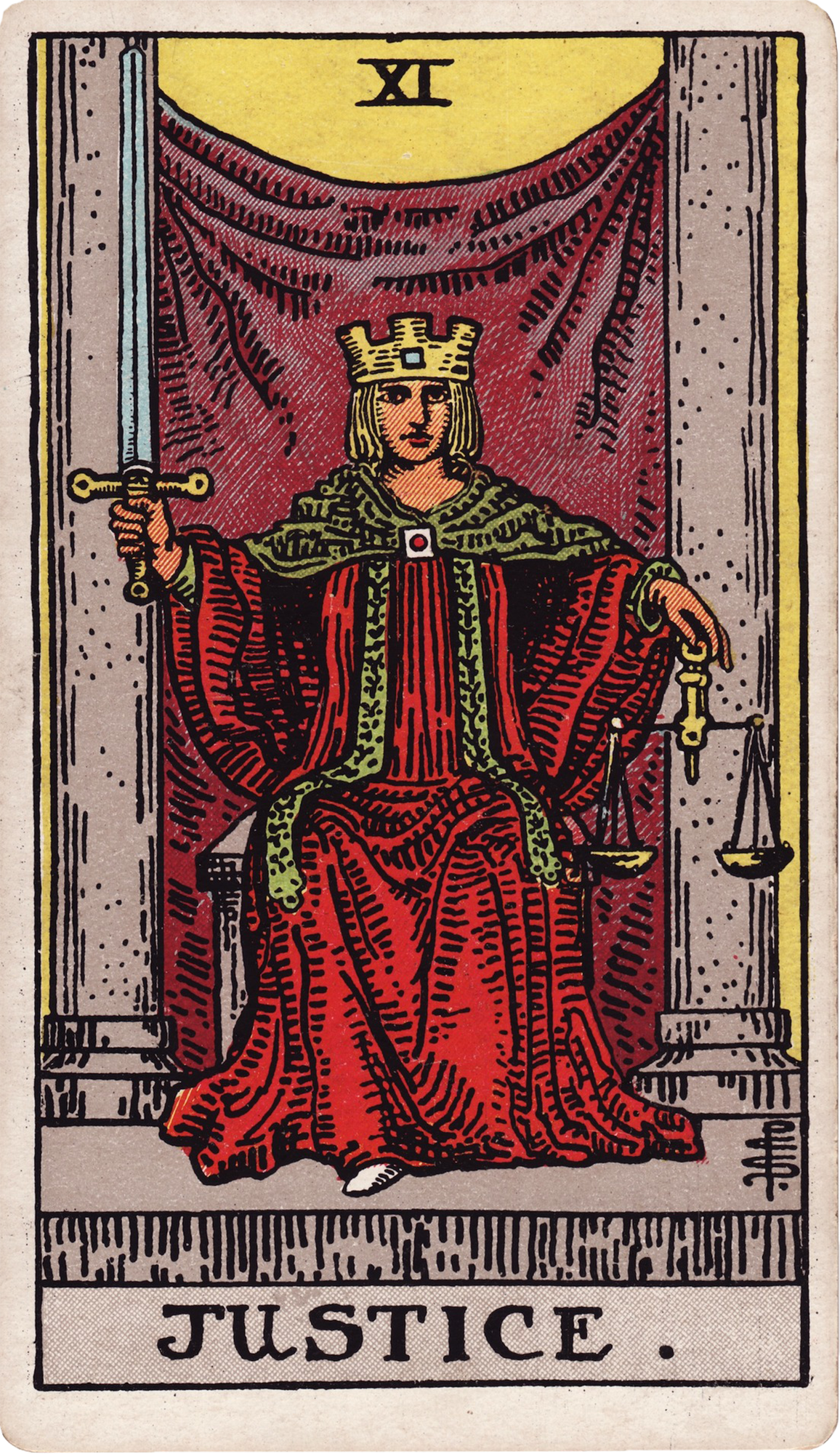 Justice
Introduction to Justice and Its Symbolism
The Justice card, typically numbered XI in the Major Arcana of the Rider-Waite-Smith deck, embodies the principle of fairness, balance, and moral clarity. Visually, the card shows a seated figure holding a sword in the right hand and scales in the left. The sword represents clear, decisive truth cutting through confusion, while the scales signify weighing evidence and consequences with impartiality. The figure’s red robe symbolizes passion aligned with reason, and the throne’s pillars echo the balance of law and order. Understanding these symbols is essential to grasp how Justice guides ethical decision-making and personal integrity. Upright, it urges facing facts, accepting consequences, and making fair decisions, even if challenging. Reversed, it highlights distortions such as bias, denial, or evasion of accountability. This foundational symbolism will anchor our exploration across multiple reading contexts.
Technique for Reading Justice in Single-Card Contexts
Reading a single card like Justice requires focusing on its core message while allowing the context to shape nuances. Start by observing the card’s imagery and the upright or reversed position. Ask what ethical or fairness issues are emerging in the querent’s life right now. Consider where clear boundaries, accountability, or honesty may be needed. Avoid deterministic interpretations; instead, treat Justice as highlighting the quality or approach that can be applied. When reversed, seek to identify distortions or blocks to fairness and integrity. In practice, take note of your immediate intuitive impressions, then refine them by relating the card’s symbolism to the specific context: love, career, money, and so forth. This method helps keep the reading grounded and avoids overgeneralization.
Justice in the Context of Love
When Justice appears in a love reading, it signals a need for fairness, honesty, and balance within relationships. Upright, it suggests the importance of clear communication, mutual accountability, and accepting consequences of past actions. The scales remind us to weigh emotional truth carefully, not favoring wishful thinking. For example, it might encourage addressing imbalances in effort or commitment. The sword demands cutting through illusions to see reality as it is. Reversed, Justice points to bias or denial—perhaps ignoring red flags, avoiding difficult conversations, or clinging to unfair power dynamics. The card invites reflection on how personal integrity influences relationship health and challenges the reader to act with honesty rather than denial. Common mistakes include interpreting the card as a guarantee of relationship harmony rather than a call to ethical engagement.
Justice in Career and Professional Life
In career contexts, the Justice card emphasizes ethical decision-making, fairness in workplace dynamics, and accountability for one’s actions. Upright, it encourages facing challenges with integrity, acknowledging mistakes, and making judicious choices that withstand scrutiny. The sword’s symbolism is especially relevant here as it suggests clarity amid complex situations, while the scales recommend balanced negotiations or fair contracts. A querent may need to establish clearer boundaries or make decisions based on facts rather than office politics. Reversed, Justice highlights potential biases, unfair treatment, or evasion of responsibility—such as favoritism, denial of wrongdoing, or unjust practices. For readers, it is important not to jump to conclusions of external injustice but to also consider internal blocks to fairness, such as personal denial or distorted perceptions.
Justice Regarding Money and Financial Decisions
Financial readings featuring Justice focus on fairness, transparency, and responsible management. Upright, the card advises working with available resources and being honest about financial realities. The scales suggest weighing options carefully before committing, ensuring agreements and transactions are equitable. The sword’s presence advises decisive action grounded in truth rather than wishful thinking. This card can also signify legal or contractual matters requiring attention to detail and ethical considerations. Reversed, Justice warns against denial of financial issues, biased judgments, or unfair dealings either by the querent or others involved. It may signal a need to confront hidden debts or imbalances or to correct distorted financial behaviors. Practitioners should avoid interpreting Justice as mere luck or guarantee of success; instead, it emphasizes conscious and fair stewardship.
Justice as Advice and Guidance
As advice, Justice calls on the querent to embody personal integrity, act with honesty, and accept responsibility for their choices. It suggests asking where a direct response or clearer boundary could move the situation forward. Upright Justice demands deliberate and conscious decision-making rather than avoidance or procrastination. It invites questioning assumptions and removing biases to see the whole truth. Reversed Justice as advice highlights the need to recognize where denial or partiality is distorting perception. It encourages deeper honesty with self and others, and warns against reactive or unbalanced actions. Practically, this can mean reviewing evidence before making judgments or confessing mistakes to restore balance. Avoid simplistic readings that reduce this card’s advice to “just be fair” without considering complexity or consequences.
Justice as a Challenge or Obstacle
When appearing as a challenge, Justice points to struggles with fairness, accountability, or seeing the truth clearly. Upright, the obstacle may be the difficulty of facing consequences or making decisions that require sacrifice and integrity. The querent might wrestle with unclear facts or murky ethical dilemmas. Reversed, the challenge often involves denial, bias, avoidance of responsibility, or unfair treatment—either self-imposed or external. This position can indicate internal resistance to embracing the ethical lessons of the situation or distorted perceptions that block resolution. Readers should help querents identify where these dynamics manifest and support them in finding balanced, conscious responses. A common misreading is to equate Justice reversed with inevitable injustice rather than an invitation to recognize and correct imbalance.
Justice Representing a Person in the Querent’s Life
Justice may personify someone embodying fairness, wisdom, or legal authority. Upright, this individual often acts as a mediator, judge, or moral guide—someone who insists on honesty and clear boundaries. They help expose truth and encourage accountability. The figure’s sword and scales symbolize precision and balance, reflecting this person’s approach to conflict or decisions. Reversed, Justice as a person may indicate bias, unfairness, or denial—someone who evades responsibility or distorts facts. Such a figure might be obstructive or unwilling to engage honestly. Readers should consider the querent’s relationship dynamics and whether this person challenges or supports ethical growth. Avoid stereotyping this card’s figure as a rigid authoritarian; the focus is on balanced, conscious fairness.
Justice as an Outcome or Resolution
When Justice appears as an outcome card, it suggests that the situation will resolve through fairness, accountability, and truth coming to light. Upright, the resolution may involve accepting consequences, clarifying facts, or reaching equitable agreements. The imagery of the sword cutting through confusion and the scales balancing opposing forces implies that fairness will ultimately prevail, though it may require effort and honesty. Reversed, the outcome warns of distorted justice: delays, biases, or partial truths may complicate resolution. It invites the querent to remain vigilant against denial or unfair influences and to seek conscious correction. Practically, Justice as an outcome encourages patience and ethical diligence rather than expecting quick fixes.
Justice in Spiritual Reflection and Personal Integrity
Spiritually, Justice calls for alignment between inner values and outer actions. It asks for deep honesty with oneself and the courage to face uncomfortable truths. The card’s symbolism invites reflection on where personal integrity is strong or compromised. Upright, Justice encourages conscious choices consistent with one’s ethical beliefs and acceptance of karmic consequences. The sword represents clear insight cutting illusions, while the scales symbolize inner balance and harmony. Reversed, Justice may highlight shadow aspects such as denial, self-deception, or hypocrisy that must be acknowledged for growth. This card challenges the reader to integrate fairness and accountability as cornerstones of spiritual development. Avoid superficial interpretations that reduce Justice to mere moralizing; instead, embrace its invitation to profound self-examination.
Common Mistakes and How to Avoid Them
A frequent mistake with Justice is oversimplifying it as a ‘good’ or ‘bad’ omen. Upright does not guarantee easy outcomes, nor does reversed mean catastrophe. Both positions describe qualities or energies that may be active or blocked. Another error is ignoring the context or the querent’s unique situation, leading to generic advice divorced from lived reality. Readers sometimes neglect the card’s complexity by focusing solely on legalistic interpretations, missing its broader ethical and personal integrity themes. To avoid these pitfalls, always anchor interpretations in the card’s detailed imagery and consider the specific question or area of life. Ask clarifying questions about fairness, truth, and accountability relevant to the querent’s situation, and remember that Justice guides conscious decision-making rather than predicting fate.
Practical Methods for Incorporating Justice into Your Readings
To work effectively with Justice, start each reading by carefully observing the scales and sword in the card image and reflecting on their meaning relative to the querent’s question. Practice asking where clearer boundaries, direct responses, or deeper honesty can make a difference. When Justice appears reversed, explore possible distortions or internal blocks rather than assuming external injustice. Use journaling or dialogue prompts focused on accountability and ethical clarity to deepen understanding. In multi-card spreads, compare Justice with neighboring cards to clarify whether upright or reversed qualities are dominant and how they interact. Finally, encourage querents to see Justice as a tool for empowerment: the card invites them to take conscious, proportionate steps toward fairness and integrity in their lives.
Practice questions
• Where in my life am I currently facing a decision that requires clear, fair judgment?
• How do I respond to situations where accountability and honesty are challenging?
• In what ways might I be avoiding or distorting the truth in a current issue?
• How can I create clearer boundaries or be more deliberate in my choices?
• Who represents the qualities of Justice in my personal or professional circles?
• Am I willing to accept the consequences of my actions with integrity?
• How does my understanding of fairness influence my spiritual or ethical beliefs?
Comments
Sign in to comment.
Continue learning
Interpreting the Dance of Justice and The Devil: Balancing Morality and Temptation in Tarot Readings
The combination of Justice and The Devil in tarot presents a profound exploration of morality, temptation, and personal accountability. This article unpacks how these cards influen...
Mastering Decision Making with the Five Card Cross Tarot Spread
The Five Card Cross Tarot Spread is a powerful tool for deepening decision-making skills by examining the present situation, past influences, future possibilities, challenges, and...
Enhancing Clarity in Complex Choices with the Five Card Cross Tarot Spread
The Five Card Cross Tarot Spread is a practical tool designed to clarify complex choices by breaking down the decision into manageable parts. This article explores each position in...
Using the Five Card Cross Spread to Make Confident Life Decisions
The Five Card Cross spread is a practical and insightful tarot layout designed to assist with complex life decisions by clarifying the situation, presenting options, uncovering hid...
Making Confident Life Choices with the Five Card Cross Tarot Spread
The Five Card Cross Tarot Spread is a powerful tool designed to aid practical decision-making, particularly within family or life-altering situations. This article explains the spr...
Using the Five Card Cross Tarot Spread to Gain Confidence in Difficult Decisions
The Five Card Cross spread is a powerful practical tool for navigating difficult decisions with confidence. By placing cards in positions representing Situation, Option A, Option B...
Using the Five Card Cross Spread to Gain Clarity in Difficult Life Decisions
The Five Card Cross Spread is a structured tarot layout designed to help clarify challenging life decisions by examining the situation, options, hidden influences, and advice. This...
Using the Five Card Cross Spread to Clarify Complex Decisions
The Five Card Cross Spread is a practical tarot method designed to clarify complex decisions by laying out the situation, contrasting options, hidden factors, and advice. This arti...
Using the Five Card Cross Spread to Gain Insight into Relationship Dynamics
This article provides an in-depth guide to using the Five Card Cross Spread for gaining clarity on relationship dynamics, especially within family contexts. Anchored by a worked ex...
Using the Five Card Cross Spread to Make Balanced and Informed Life Decisions
The Five Card Cross Spread is a powerful Tarot layout designed to aid balanced and informed decision-making. This article teaches learners how to use this spread effectively, focus...