
Layered Clarifier Method to Expand One Card Readings into Full Narratives
The Layered Clarifier Method is a practical technique for turning a single-card draw into a multi-dimensional, actionable narrative without overreaching or inventing meaning. Using the supplied card imagery—the High Priestess, The Emperor, and the 2 of Swords—this article teaches a repeatable three-layer clarifier process: Surface Clarifier (what is present now), Structural Clarifier (what organizes or resists the situation), and Decision Clarifier (what next step, choice, or block matters). Each layer is read as a short, specific answer rather than a sweeping fate statement; then the layers are woven into a narrative that respects symbolism, timing, and the querent's agency. The guide includes step-by-step reading method, multiple sample reads anchored to the actual cards, common pitfalls, practice drills, and ethics around interpretation. Readers will come away with a clear method for expanding one-card readings into responsible, compelling stories they can test in follow-up readings and real life.
Cards explored in this article
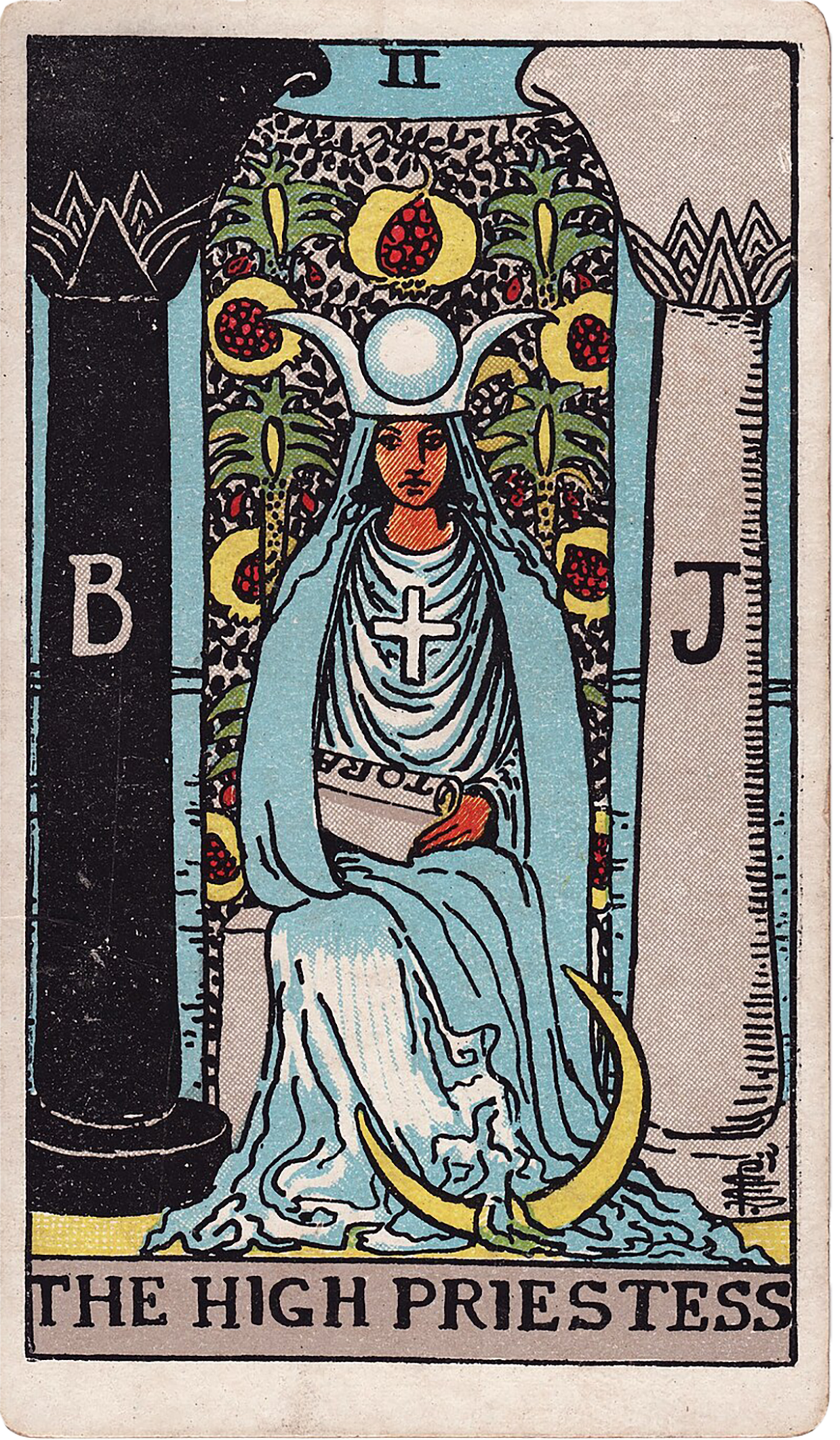 The High Priestess
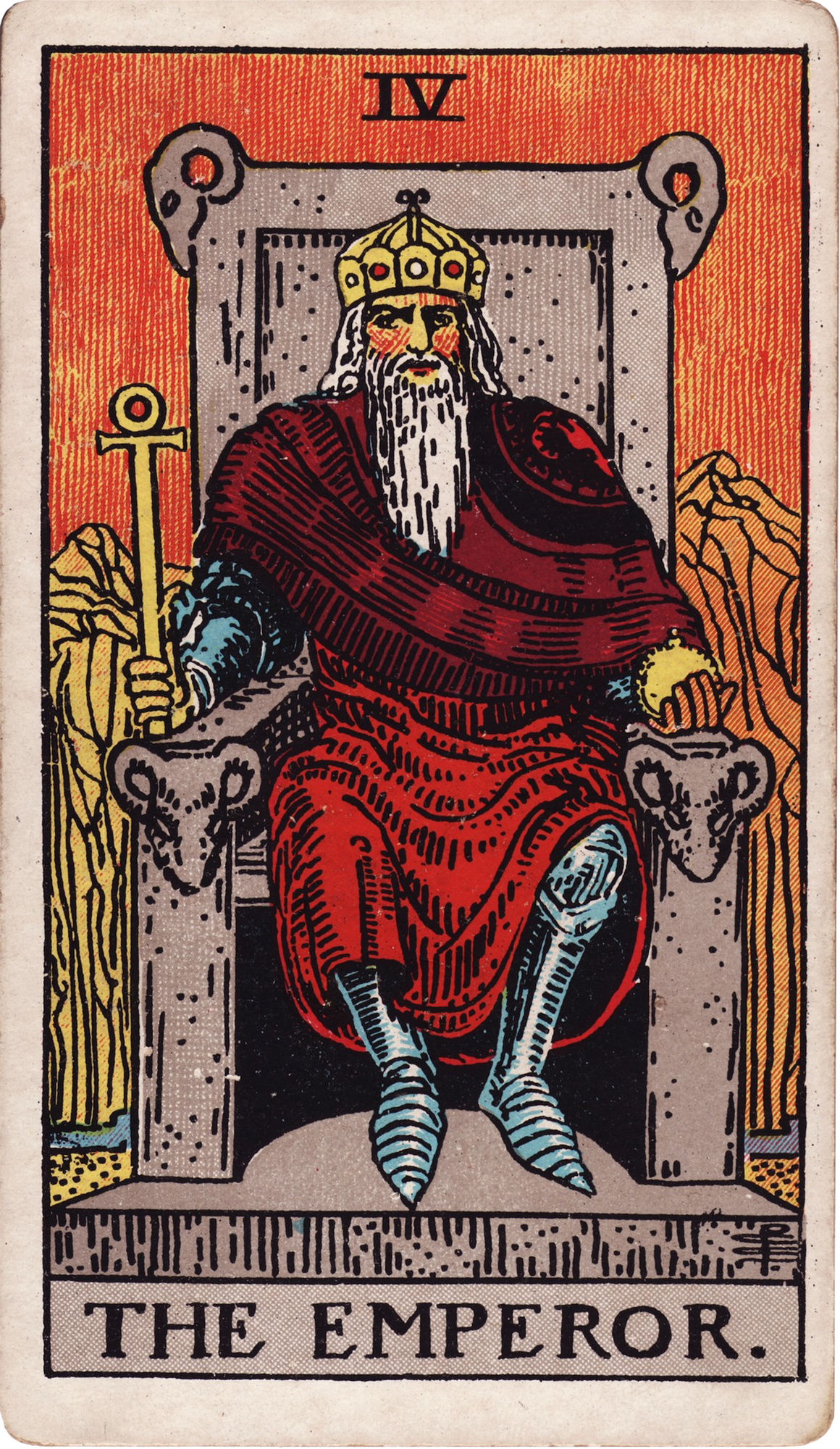 The Emperor
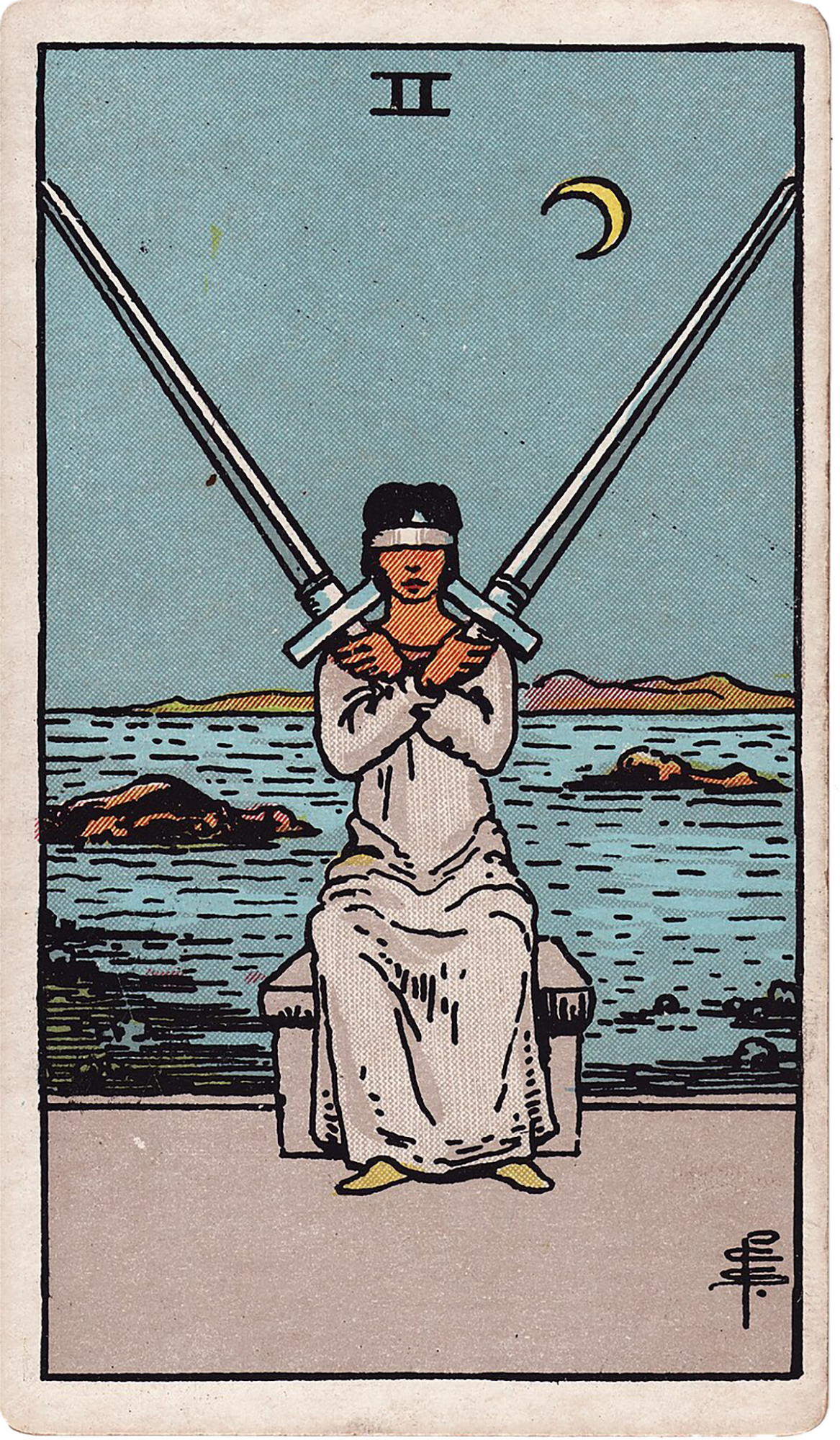 2 of Swords
Introduction to the Layered Clarifier Method
One-card readings are a powerful tool: they can be quick, focused, and surprisingly rich. But the challenge for learners is how to take that single image beyond a short label and into a usable story without fabricating detail. The Layered Clarifier Method answers that need. Rather than pulling multiple random cards, the method uses a structured set of clarifier lenses—surface, structure, and decision—to read depth into one initial card. This produces a compact spread that functions like a miniature narrative: what is happening now, what is shaping it, and what practical next step or barrier matters. This article anchors the method to three supplied cards and their supplied meanings: The High Priestess, The Emperor, and the 2 of Swords. Wherever possible, you will be asked to look at the RWS imagery—the veiled scroll and crescent moon of the High Priestess, the ram-headed throne and mountains of The Emperor, and the blindfolded figure with crossed swords beside water in the 2 of Swords—and to use those visual cues as primary evidence. The method is both beginner-friendly and adaptable for advanced readers who want disciplined narrative practice.
Why expand a one-card reading
One-card draws succeed because they force clarity: one symbol, one focal point. But they can feel incomplete if the querent asks a multi-layered question. Expanding a one-card reading helps you: - Ground interpretation in evidence rather than projection. - Offer practical next steps that match the querent's current capacity. - Test the reading over time with specific actions or observations. Importantly, the Layered Clarifier Method does not promise hidden facts. It reframes: given this card's present message, what three short clarifiers produce a coherent, testable narrative? The supplied definitions for each card model how to phrase that. For example, the upright High Priestess in the supplied text emphasizes "listening beneath surface appearances" and trusting quiet discernment; reversed, it points to secrecy or disconnection from intuition. Those wordings become literal phrases you can use in the surface clarifier.
Core logic of the method
The method uses three clarifier roles that you place around your initial card. Read them in order and then weave them into a narrative: 1) Surface Clarifier (what's present now): short, immediate, descriptive. This answers the question 'what is already visible or available for use?' 2) Structural Clarifier (what organizes or resists): identifies systems, patterns, or internal structures that give shape or block movement. This is often where The Emperor imagery is useful: rulership, boundaries, and order. 3) Decision Clarifier (what choice, barrier, or small next step matters): focused on the near-term action or blockage, often echoing the 2 of Swords archetype of suspended choice or avoided truth. Read each clarifier with the initial card image in mind, then combine them into a two-sentence narrative and a one-step practical suggestion. Keep language testable: 'try this for two weeks and report back' rather than 'this will happen.'
Step 1 Surface Clarifier: noticing what the High Priestess shows
If your single card is the High Priestess, start by describing the surface layer using the card's supplied upright and reversed definitions and its Rider-Waite imagery. The supplied upright description says: 'Upright, The High Priestess emphasizes listening beneath surface appearances, allowing information to emerge, and trusting quiet discernment.' Visually, the High Priestess sits between two pillars, with a veil patterned with pomegranates behind her, a crescent moon at her feet, and a partially hidden scroll. Those details suggest themes of privacy, inner knowing, things not yet spoken, and a measured, receptive stance. A succinct surface clarifier might be: 'Information is present but not fully spoken; the immediate resource is quiet observation.' If the High Priestess appears reversed, use the supplied reversed wording: 'toward secrecy, disconnection from intuition, passive avoidance, or mistaking anxiety and projection for inner knowing.' The surface clarifier then becomes: 'Emotional noise or avoidance is obscuring clear listening right now.' Keep the surface clarifier short (one line) and grounded in visible symbols—veil, scroll, moon, posture. That keeps you from broad storytelling and roots your reading in what the querent can verify.
Step 2 Structural Clarifier: bringing The Emperor's architecture into the reading
Next, place The Emperor as the structural clarifier. In the Rider-Waite image, The Emperor sits on a throne adorned with ram heads, holding a scepter and an orb; mountains rise behind him. The supplied upright meaning emphasizes 'setting clear boundaries, taking responsibility, creating systems, and choosing disciplined leadership over chaos.' Reversed, it highlights 'rigidity, domination, control for its own sake, fear of vulnerability, or structures that no longer serve.' Ask: What kind of order, rule, or protective structure is shaping this situation? The Emperor's role can be literal (a parent, boss, legal system) or internal (rules the querent imposes on themselves). Example short structural clarifiers: 'A need for clearer boundaries and structure is present' (upright) or 'A rigid approach or over-control is blocking responsiveness' (reversed). When the High Priestess is your initial card, framing The Emperor as structure helps you see whether inner listening is happening inside a helpful container or against a constraining system. Is the querent listening because they have safety and rules to rely on, or are they constrained by authority that muffles intuition? The visual contrast—soft veil versus stone throne—creates a direct interpretive tension to explore.
Step 3 Decision Clarifier: using 2 of Swords to locate choice and blockage
Finish the three-layer set with the 2 of Swords as the decision clarifier. The 2 of Swords shows a blindfolded figure holding two crossed swords while water and a moon suggest emotional pressure and hidden currents. The supplied upright text: 'a decision is being held in suspension because available information or emotional readiness feels incomplete.' Reversed: 'avoidance, denial, decision fatigue, forced choice or a stalemate beginning to break.' As a clarifier, the 2 of Swords narrows the reading to: what choice is poised, or what avoidance is keeping the querent stuck? Your short decision clarifier should be practical: 'A choice is suspended; more information or emotional naming is needed' (upright) or 'Avoidance is escalating; a small forced choice will break the stalemate' (reversed). Because the 2 of Swords is visually blindfolded, ask whether the querent is refusing to look at a fact or whether external confusion is preventing a clear decision. Link that to the High Priestess surface: is the quiet discernment blocked by avoidance, or is it being applied correctly but waiting for structural support from The Emperor?
Weaving the three layers into a narrative
Once you have the three clarifiers—Surface (High Priestess), Structure (The Emperor), Decision (2 of Swords)—combine them into a short narrative. Keep to three parts: description, tension, and suggestion. Example formula: - Description (Surface): 'Right now, information or intuitive signals are present but not spoken.' - Tension (Structure): 'Leadership or systems are required but are either absent or too rigid.' - Suggestion (Decision): 'A small, time-limited choice or an information-gathering step will break the stalemate.' Concretely: 'The High Priestess shows that intuitive signals are present but quiet; The Emperor suggests a need for clearer boundaries or a practical structure to receive that information; the 2 of Swords warns that a decision is being held—so try naming one small question to test the intuition for one week.' This produces a compact narrative that is testable: does naming a single question for a week clarify the intuition? If yes, the reading gains confirmatory data the next time you work with the querent.
Practical reading method and script
Use this practical process when a querent asks for an expanded one-card read: 1) Pull the single card the querent draws and describe it briefly. If it's the High Priestess, read the supplied upright/reversed wording and point to visual symbols (veil, scroll, moon). 2) Lay two clarifier cards (or imagine them): place The Emperor as structural clarifier and the 2 of Swords as decision clarifier. If you do not physically draw them, keep their images in mind and apply their supplied meanings. 3) For each clarifier, state a one-line phrase anchored in the imagery: Surface (High Priestess) — 'quiet information available'; Structure (The Emperor) — 'need for boundaries or structure'; Decision (2 of Swords) — 'choice is paused or avoidance present.' Use upright vs reversed shades from the supplied texts. 4) Synthesize: combine into a two-sentence narrative and a one-step suggestion. Example script: 'You have an inner signal that hasn’t been voiced (High Priestess). The situation needs a clearer boundary or plan so that signal can be heard rather than dismissed (The Emperor). The practical next step is to choose one small test—ask a specific question or record your impressions for three days (2 of Swords).' 5) Close with a verification step: 'Try this for a fixed short period and we’ll check back to see what changed.' This keeps readings experimental and avoids deterministic language.
Worked examples anchored to the supplied cards
Example 1 — High Priestess upright + Emperor upright + 2 of Swords upright: - Surface: 'There is useful quiet knowledge or a subtle pattern ready to be noticed.' - Structure: 'A stable boundary or practical routine will help make that knowledge actionable.' - Decision: 'A decision is paused because full information is lacking—collect one kind of data.' Narrative and action: 'You’re sensing something important; set a small rule (daily 10-minute reflection or a single safe boundary) so you can test that sense, then commit to one specific observation for seven days.' Example 2 — High Priestess reversed + Emperor upright + 2 of Swords reversed: - Surface: 'Inner signals are noisy or blocked; there’s secrecy or projection.' - Structure: 'There is a call for responsible structure, but it may be uneven.' - Decision: 'Avoidance is rising; the stalemate may break with a forced small decision.' Narrative and action: 'You may be confusing fear for intuition; create a clear, small rule (e.g., tell one trusted person one fact) and then force a minor decision that surfaces the truth—this will reveal whether your intuition is grounded.' In every example, link interpretations to imagery: mention veil, pomegranates, throne, rams, blindfold, moon and water. That visual anchoring keeps readings evidence-based.
Common mistakes and how to avoid them
1) Over-verbosity: Avoid turning each clarifier into a mini-essay. Keep each clarifier one line. The narrative is compact and testable. 2) Projection disguised as intuition: If you’re supplying details not supported by imagery (ages, specific actions, dates), step back. Ask for verification steps instead: 'Check whether this feels true for you by observing X for a week.' 3) Mixing archetypes without visual evidence: Because you are using only the supplied cards as anchors, don’t import other card personalities to explain behavior. Use the High Priestess for listening/hidden content, The Emperor for structure/boundaries, and the 2 of Swords for choice/avoidance. 4) Skipping reversal nuance: Reversed meanings often indicate distortion, internalization, or needed correction rather than absolute catastrophe. Use the supplied reversed text wording to shape cautious, non-alarmist language. 5) Ignoring querent agency: Always end with a specific, voluntary action. The method’s power comes from testable steps—not pronouncements. For example, suggest a three-day check-in or one concrete boundary to try, then evaluate results.
Advanced variations and sequencing
Advanced readers can adapt the method in several ways: - Time layering: Read each clarifier on a time axis (now, two weeks, one month). The High Priestess becomes 'now,' The Emperor 'two weeks' for structural changes, and the 2 of Swords 'decision horizon' for when a choice will likely demand action. - Polarity reading: If two clarifiers are reversed, read them as tension poles (e.g., High Priestess reversed vs The Emperor upright suggests inner noise meeting external order). - Role mapping: Map clarifiers to inner parts (High Priestess = observer-self, The Emperor = organizer-self, 2 of Swords = chooser-self). This helps psychological readings where the querent wants to know internal dynamics. - Minimal clarifier test: For rapid practice, use only a verbal invocation of The Emperor and 2 of Swords rather than physically placing them. This trains you to apply the method without extra cards.
Practice drills and prompts for development
Drills to internalize the method: 1) Three-line journal: Pull a single card (or imagine the High Priestess). Write three lines: surface phrase, structure phrase, decision phrase. Repeat daily for a week and note differences. 2) Role-play test: With a partner, perform a five-minute Layered Clarifier read and then the querent follows the one-step action for three days. Compare notes. 3) Imagery focus: Spend five minutes studying the High Priestess image: count visual motifs (pillars, veil, moon, scroll). Practice deriving three short phrases from those motifs. 4) Reversals drill: Shuffle meanings—read the High Priestess upright but the 2 of Swords reversed—and practice phrasing cautious, corrective language. These drills build precision and prevent drift into storytelling without evidence.
Putting it into an ethical reading practice
The Layered Clarifier Method encourages short, testable suggestions. Ethically, this reduces the risk of dependency or harmful instruction. Key practices: - Avoid medical, legal, or mental-health directives. Use supportive, non-prescriptive language. - Frame suggestions as experiments: 'Try X for Y days' rather than 'You must.' - Encourage autonomy: Ask the querent whether the suggested action is feasible and whether they want it. - Follow up: Offer a check-in to see what changed; failure to follow through is not a moral failing but data about whether the advice fit. These safeguards maintain the method’s practical value while protecting querent well-being.
Conclusion and next steps
The Layered Clarifier Method is a disciplined way to expand a single image into a compact narrative that respects symbolism, querent agency, and testability. By anchoring the reading to the supplied card images and meanings—the listening veil of the High Priestess, the organizing throne of The Emperor, and the suspended choice of the 2 of Swords—you create a clear, repeatable structure for readings that reveal a pathway forward rather than a laundry list of possibilities. Next steps: practice the method with the drills above; keep language short and anchored to imagery; and build a short follow-up routine to measure whether your suggestions produced real results. Over time, this method strengthens both your interpretive clarity and your ethical practice.
Practice questions
• When you look at the High Priestess image, what single phrase best captures the immediate feeling you notice?
• How would a practical boundary or system (The Emperor) change the way you hear the High Priestess’s message?
• What small decision could you make in the next 72 hours that would test whether your current hesitation (2 of Swords) is avoidance or prudent suspension?
• Which of the three clarifiers feels easiest to translate into action for you personally?
• How can you keep a follow-up check simple and nonjudgmental when testing a Layered Clarifier suggestion?
Comments
Sign in to comment.
Continue learning
Understanding the Synergy Between The Empress and The Emperor in Tarot Card Combinations
This article delves into the intricate synergy between The Empress and The Emperor cards in Tarot, focusing on how their combined energies modify and enrich readings across various...
Mastering Decision Making with the Five Card Cross Tarot Spread
The Five Card Cross Tarot Spread is a powerful tool for deepening decision-making skills by examining the present situation, past influences, future possibilities, challenges, and...
Using the Career Five Card Spread to Identify Growth Opportunities and Challenges
This article explores the Career Five Card Spread, a practical tarot method designed to spotlight growth opportunities, strengths, and obstacles within a career context. By analyzi...
Balancing Ambition and Compassion with The Emperor and Queen of Cups in Tarot Combinations
This article delves into the nuanced Tarot card combination of The Emperor and Queen of Cups, emphasizing how their energies complement and challenge each other. By analyzing their...
Unlocking Personal Insight with the Seven Card Horseshoe Spread
The Seven Card Horseshoe Spread is a practical and insightful Tarot layout ideal for exploring personal and family dynamics. This article breaks down each position—Past, Present, H...
Using the Career Five Card Spread to Uncover Professional Strengths and Opportunities
This article presents a comprehensive guide to the Career Five Card Spread, designed to help learners explore professional strengths and opportunities using five specific Tarot car...
Using the Three Card Spread to Gain Clarity on Past Present and Future Influences
This article guides learners through the practical use of the Three Card Spread to gain clarity on past, present, and future influences. Using the specific cards The Emperor in the...
Using the Five Card Cross Spread to Gain Insight into Personal Challenges
The Five Card Cross spread offers a structured yet flexible approach to examine personal challenges through tarot. This article unpacks the significance of each position—Present, P...
Making Confident Career Decisions with the Five Card Cross Tarot Spread
This article presents an in-depth guide to the Five Card Cross Tarot Spread designed specifically to aid confident career decision-making. By exploring the symbolism and interplay...
Using the Five Card Cross Spread to Gain Clarity in Difficult Life Decisions
The Five Card Cross Spread is a structured tarot layout designed to help clarify challenging life decisions by examining the situation, options, hidden influences, and advice. This...