
Uncovering the Historical Origins Common Questions and Enduring Mysteries of the Justice Card
This article delves into the Justice card's historical origins and its symbolic roots in family and cultural traditions. By examining the upright and reversed Justice cards, it clarifies common questions and misunderstandings. Practical reading techniques and interpretation logic are presented to help learners engage confidently with this complex Major Arcana card.
Cards explored in this article
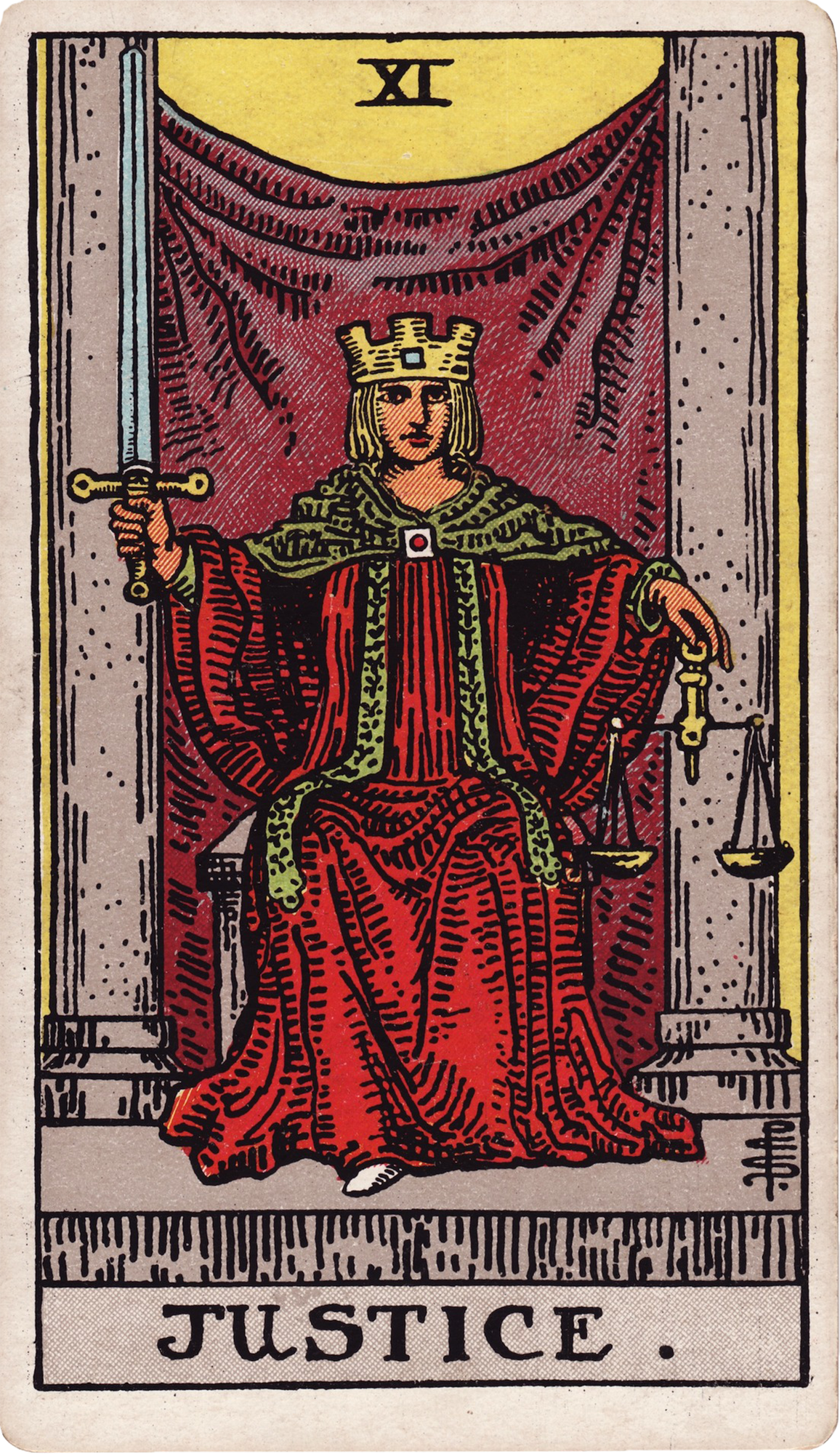 Justice
Historical Origins of the Justice Card
The Justice card is one of the oldest and most symbolically rich cards in the Tarot deck, rooted in centuries of philosophical, religious, and societal traditions. Its heritage traces back to early European playing cards and the iconography of medieval and Renaissance art, where Justice was often personified as a woman holding scales and a sword—symbols representing fairness, balance, and decisive authority. In the Rider-Waite-Smith deck, the Justice card continues this lineage, depicting a seated female figure holding a double-edged sword upright in her right hand and balanced scales in her left. This reflects classical ideas of judicial authority, impartiality, and the weighing of evidence. The sword signifies the power of reason and truth to cut through confusion, while the scales symbolize equilibrium and the need to balance competing interests fairly. Recognizing this historical and artistic context roots the card in a long tradition of moral and legal philosophy, reminding readers that Justice embodies a universal principle rather than a personal judgment.
Family Traditions and Symbolism
The Justice card belongs to the Major Arcana, a suite that often represents archetypal forces and universal lessons within the family of Tarot cards. Within this family, Justice is closely related to cards like The Emperor and The Hierophant, which also deal with authority, order, and law. Unlike these cards, however, Justice emphasizes the quality of fairness rather than command or tradition. The scales are a direct symbol of measurement and balance, a motif seen in many family traditions across cultures, such as the Egyptian goddess Ma'at whose feather represented truth and order. The sword’s double edge underlines that justice can be sharp and definitive but must always be wielded with integrity. In family-centered readings or traditions, Justice invites reflection on inherited values around fairness, accountability, and the consequences of actions within kinship networks. It calls for honesty and clear boundaries—qualities crucial to healthy family dynamics.
Common Questions About the Justice Card
Many learners ask what it means when Justice appears in a reading, especially regarding whether it predicts legal outcomes or moral judgments. It is important to understand that Justice does not guarantee fairness in external events but highlights the need to approach situations clearly and responsibly. Upright, the card urges the querent to accept facts as they are and make deliberate decisions that withstand scrutiny. It suggests that the situation demands honesty and accountability. Reversed, Justice turns attention to distortions such as bias, denial, or avoidance of responsibility. It does not mean disaster but flags areas where fairness or clarity is blocked or internalized. Another common question involves whether Justice concerns only legal matters; in truth, it spans ethical dilemmas, personal accountability, and the consequences of choices in everyday life. The card's presence encourages a balanced perspective, not a simplistic judgment.
Interpreting Upright and Reversed Justice Cards in Practice
When working with the upright Justice card, readers should focus on where clarity, fairness, and direct responses are needed. Look closely at the card’s imagery: the scales are perfectly balanced, indicating the importance of weighing all factors carefully. The sword’s upright position suggests truth and reason cutting through confusion. Encourage querents to consider where clearer boundaries or more deliberate choices could improve their situation. This card often signals that enough information is now visible to make a conscious decision. On the other hand, the reversed Justice card often highlights imbalance or distortion. The sword and scales may still be present visually but their power or clarity is blocked or skewed. This reversal invites questions about bias, denial, or avoidance of consequences. Readers should consider whether the querent is resisting accountability, hiding from the truth, or struggling with internal conflicts related to fairness. Neighboring cards can clarify whether this is a temporary delay, a psychological process, or an excess.
Common Mistakes and How to Avoid Them
A frequent error is to treat Justice as a simple yes/no indicator of legal outcomes or moral approval. This oversimplifies the card’s nuanced message about fairness and conscious decision-making. Another mistake is ignoring the reversal’s complexity by assuming it is purely negative; instead, view the reversed card as an opportunity to explore where fairness is blocked or distorted internally. Additionally, readers sometimes overlook the importance of the card’s imagery, such as the posture of the figure or the details of the scales and sword, which hold key interpretive clues. It is also important not to impose personal biases when assessing Justice—this card calls for impartiality and balance. Finally, neglecting context is a common pitfall; the Justice card’s message must be integrated with the rest of the reading to provide a meaningful, responsible interpretation.
Practical Techniques for Using the Justice Card
To work effectively with the Justice card, engage in a step-by-step approach. First, observe the card’s imagery to identify the core themes of balance, truth, and consequence. Then, connect these themes to the querent’s question or situation. Ask where clarity or fairness is needed and what direct response or boundary might be missing. When Justice appears reversed, probe gently into where the querent may be resisting accountability or struggling with hidden biases. Use reflective questions such as “What facts am I overlooking?” or “Where might I be avoiding fairness?” to deepen insight. Combining this approach with journaling or dialogue helps integrate the card’s lessons. Practicing this method encourages readers to move beyond deterministic interpretations toward conscious choice and ethical awareness.
Enduring Mysteries of the Justice Card
Despite centuries of symbolic development, the Justice card retains enduring mysteries. One such mystery is the paradox of justice itself—how can fairness be truly achieved in a world full of subjective experiences and power imbalances? The card’s imagery of balanced scales and a double-edged sword hints at the difficult nature of true impartiality. Another mystery concerns the card’s placement in the Tarot sequence, often numbered XI or VIII, varying by tradition, which influences its relationship to other Major Arcana cards like Strength and The Hermit. This numerical ambiguity invites reflection on how justice interacts dynamically with strength and inner wisdom. Finally, the Justice card’s ability to represent both external law and internal moral compass reflects an ongoing tension in human experience between societal rules and personal ethics, a mystery that remains relevant to every generation.
Summary and Final Thoughts
The Justice card is a profound symbol steeped in historical traditions, family archetypes, and enduring philosophical questions. Through the upright and reversed cards, it encourages clarity, accountability, and fairness—not as automatic outcomes but as qualities to be consciously cultivated. Understanding the card’s origins and symbolism helps readers interpret it responsibly and avoid common pitfalls related to oversimplification or bias. By grounding readings in the imagery of the scales and sword and reflecting on where fairness is present or blocked, learners can deepen their engagement not only with this card but with Tarot as a whole. Justice challenges us to face truths, accept consequences, and make choices that withstand scrutiny, offering a timeless lesson for seekers and readers alike.
Practice questions
• How do the scales and sword in the Justice card imagery influence your understanding of fairness and balance?
• In what ways might the reversed Justice card reflect internal conflicts rather than external events?
• What personal or family traditions shape your concept of justice and accountability?
• How can recognizing bias or denial improve your practical use of the Justice card in readings?
• What challenges arise when trying to apply the principle of justice in everyday life decisions?
Comments
Sign in to comment.
Continue learning
Interpreting the Dance of Justice and The Devil: Balancing Morality and Temptation in Tarot Readings
The combination of Justice and The Devil in tarot presents a profound exploration of morality, temptation, and personal accountability. This article unpacks how these cards influen...
Mastering Decision Making with the Five Card Cross Tarot Spread
The Five Card Cross Tarot Spread is a powerful tool for deepening decision-making skills by examining the present situation, past influences, future possibilities, challenges, and...
Enhancing Clarity in Complex Choices with the Five Card Cross Tarot Spread
The Five Card Cross Tarot Spread is a practical tool designed to clarify complex choices by breaking down the decision into manageable parts. This article explores each position in...
Using the Five Card Cross Spread to Make Confident Life Decisions
The Five Card Cross spread is a practical and insightful tarot layout designed to assist with complex life decisions by clarifying the situation, presenting options, uncovering hid...
Making Confident Life Choices with the Five Card Cross Tarot Spread
The Five Card Cross Tarot Spread is a powerful tool designed to aid practical decision-making, particularly within family or life-altering situations. This article explains the spr...
Using the Five Card Cross Tarot Spread to Gain Confidence in Difficult Decisions
The Five Card Cross spread is a powerful practical tool for navigating difficult decisions with confidence. By placing cards in positions representing Situation, Option A, Option B...
Using the Five Card Cross Spread to Gain Clarity in Difficult Life Decisions
The Five Card Cross Spread is a structured tarot layout designed to help clarify challenging life decisions by examining the situation, options, hidden influences, and advice. This...
Using the Five Card Cross Spread to Clarify Complex Decisions
The Five Card Cross Spread is a practical tarot method designed to clarify complex decisions by laying out the situation, contrasting options, hidden factors, and advice. This arti...
Using the Five Card Cross Spread to Gain Insight into Relationship Dynamics
This article provides an in-depth guide to using the Five Card Cross Spread for gaining clarity on relationship dynamics, especially within family contexts. Anchored by a worked ex...
Using the Five Card Cross Spread to Make Balanced and Informed Life Decisions
The Five Card Cross Spread is a powerful Tarot layout designed to aid balanced and informed decision-making. This article teaches learners how to use this spread effectively, focus...