
Understanding The Justice Card in Balancing Ethics Accountability and Personal Decisions
The Justice card embodies themes of fairness, truth, accountability, and ethical balance. This article explores its upright and reversed meanings as shown in the supplied Rider-Waite-Smith imagery, explaining how the card’s symbolism guides conscious decision-making in different life contexts. Readers will learn practical techniques to work with Justice’s energy, avoid common interpretive errors, and apply its lessons in love, career, money, advice, challenges, personal identity, outcomes, and spiritual reflection. Anchoring interpretations in the card’s visual elements helps deepen understanding for learners seeking clarity in ethical choices and personal responsibility.
Cards explored in this article
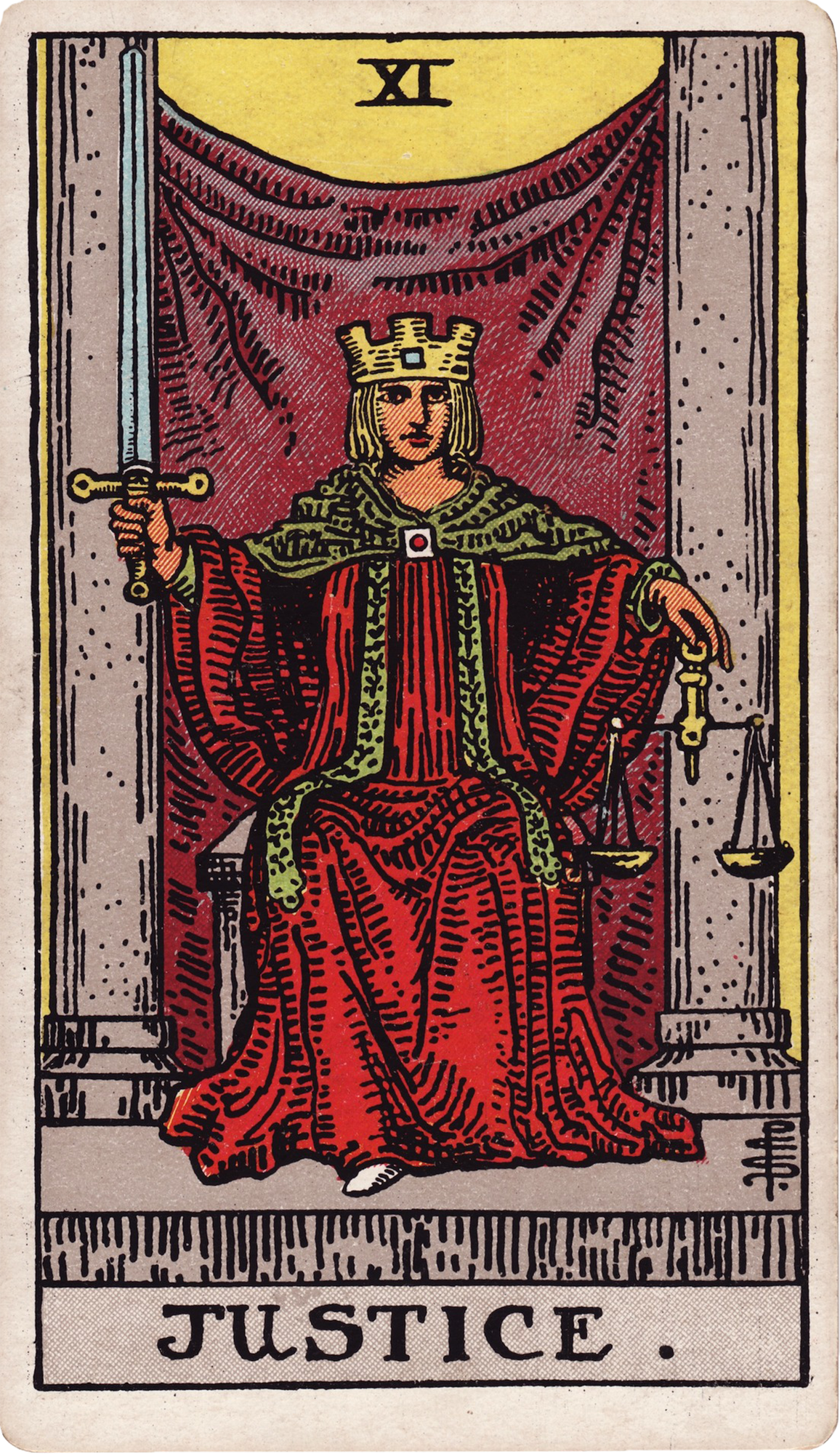 Justice
Introduction to the Justice Card and Its Symbolism
The Justice card, numbered VIII or XI in the Rider-Waite-Smith deck, portrays a regal figure seated between pillars, holding a sword in the right hand and scales in the left. The sword symbolizes clear, decisive intellect, cutting through confusion to truth. The scales represent balance, fairness, and weighing all evidence impartially. The figure’s direct gaze and upright posture emphasize honesty and accountability. The background’s red curtain suggests passion guided by discipline rather than unchecked impulse. This card’s imagery encourages us to consider the ethical dimensions of decisions and accept consequences with integrity.
Upright Justice Meaning and Practical Application
When Justice appears upright in a reading, it signals that the seeker is called to examine facts objectively, recognize accountability, and apply fairness in decision-making. This does not promise an easy path but highlights the qualities needed to navigate complexity ethically. The card invites the reader to ask: Where is a clearer boundary needed? What consequences must be accepted openly? What honest communication will move the situation forward? Practically, this means working with the information and resources currently available rather than waiting for perfect clarity. The scales remind us to weigh all sides without bias, and the sword encourages decisive, truthful action.
Reversed Justice Meaning and Navigating Challenges
In its reversed position, Justice points toward imbalance, denial of responsibility, bias, or decisions made without sufficient evidence. Rather than a doom signal, it reveals where the upright qualities are blocked, internalized, or exaggerated. This can manifest as personal denial, unfair treatment by others, or avoidance of accountability. The challenge is to identify where ethical judgment is clouded or distorted. The reversal may also indicate a psychological process where the seeker begins to recognize old patterns but has yet to enact change fully. Contextual clues from surrounding cards, if present, help determine if the reversed energy reflects resistance, a healing pause, or excess.
Applying Justice in Love and Relationships
In love contexts, upright Justice calls for honesty, clear boundaries, and fairness in partnerships. It suggests evaluating relationships based on truth rather than wishful thinking and addressing imbalances openly. For example, Justice encourages conversations about mutual responsibility or clarifying commitments. Reversed Justice in love may show denial of problems, biased judgments, or unfair treatment either by oneself or a partner. It can also highlight reluctance to accept consequences of past actions. The card teaches that ethical transparency and accountability build trust and healthier connections.
Justice in Career and Work Settings
At work, Justice upright emphasizes fairness in professional decisions, ethical conduct, and accountability for outcomes. It might suggest a legal or regulatory focus or the need to resolve conflicts through impartial judgment. The card encourages working with facts and evidence, ensuring credit and blame are assigned justly. Reversal here warns of favoritism, dishonesty, or avoidance of responsibility—perhaps a workplace injustice or internal conflict about one’s role. Justice reminds readers to maintain integrity even under pressure and to seek balanced solutions that withstand scrutiny.
Financial Interpretations of Justice
Financially, Justice upright advises careful consideration of contracts, debts, and investments with a focus on fairness and transparency. It encourages confronting financial realities honestly and taking responsibility for fiscal choices. The scales endorse balanced budgeting without impulsivity. Conversely, reversed Justice may signal financial bias, denial of debt, or unfair dealings—either by the querent or others. It highlights the need to address hidden financial issues and avoid decisions made from partial information or emotional distortion.
Justice as Advice and Guidance
When drawn for advice, Justice urges the seeker to act with integrity, embrace accountability, and base decisions on unbiased evaluation. It suggests stepping back to weigh all factors dispassionately and setting clear boundaries where needed. The sword reminds the reader to be courageous in facing consequences honestly. If reversed, the advice shifts to recognizing where ethical judgment is compromised, and to seek clarity before moving forward. It may call for introspection to uncover denial or bias that obstructs balanced decision-making.
Justice as a Challenge to Overcome
As a challenge, Justice indicates a situation demanding ethical courage, transparency, and acceptance of responsibility, even if difficult. The challenge lies in maintaining fairness to oneself and others while confronting uncomfortable truths. Reversed, the card reveals where ethical principles are compromised—such as avoiding accountability, succumbing to bias, or allowing unresolved injustices to fester. Overcoming this challenge requires conscious effort to restore balance, seek truth, and act with deliberate honesty.
Person Represented by the Justice Card
If Justice represents a person in a reading, this individual is typically fair-minded, principled, and committed to truth and accountability. They might work in law, governance, or any role requiring impartial judgment. This person values ethical clarity and expects responsibility from themselves and others. If reversed, the person may struggle with bias, denial, or unfair behavior—perhaps avoiding consequences or being overly rigid in their judgments. Recognizing these traits helps contextualize interactions and expectations.
Justice as an Outcome in a Reading
As an outcome card, upright Justice promises results based on fairness, balanced judgment, and ethical resolution. It suggests that situations will conclude with accountability honored and truth prevailing, even if not easily. The scales and sword imagery imply that decisions made will be just and withstand critical scrutiny. Reversed, the outcome may involve unresolved unfairness, bias, or avoidance of consequences. It cautions that failing to address justice properly can prolong difficulties or create new imbalances requiring future correction.
Spiritual Reflection with the Justice Card
Spiritually, Justice invites reflection on personal karma, ethical alignment, and the balance between free will and consequences. The sword symbolizes discernment cutting through illusion, while the scales remind us that all actions bear weight. Upright, the card encourages seekers to live with integrity and honesty as a path to spiritual growth. Reversed, it signals inner work is needed to overcome denial, biases, or self-deception obstructing alignment with truth. Meditation on the Justice card can reveal where deeper honesty and accountability are needed on the spiritual path.
Techniques for Reading Justice Accurately
To interpret the Justice card effectively, start by observing its visual elements: the scales, sword, throne, and posture. Ask yourself how the seeker is handling truth, accountability, and balance. Determine if the card is upright or reversed, then consider the question’s context. Avoid assuming reversal means disaster; instead, look for where balance is off or truths are obscured. Encourage clients to identify concrete actions or honest conversations that Justice’s energy suggests. Cross-reference with other cards for nuance but focus on Justice’s core themes of fairness and consequence.
Common Mistakes and Misinterpretations
A frequent error is treating Justice as an automatic promise of legal victory or external fairness, when it primarily highlights ethical qualities and conscious choice. Another mistake is fearing reversed Justice as purely negative; reversed cards often show internal or developmental dynamics rather than external fate. Avoid overgeneralizing Justice as rigid or cold—it can represent compassionate fairness rooted in honesty. Finally, interpret Justice in the reading’s context rather than forcing it into a single narrative; its meaning shifts subtly depending on the question and surrounding cards.
Practice questions
• In what areas of my life am I avoiding accountability or fair assessment?
• How can I bring clearer boundaries or greater honesty into current situations?
• Where might bias or denial be distorting my judgment or decisions?
• What consequences am I resisting, and how might accepting them lead to growth?
• How do I balance ethical principles with practical realities in my decisions?
Comments
Sign in to comment.
Continue learning
Interpreting the Dance of Justice and The Devil: Balancing Morality and Temptation in Tarot Readings
The combination of Justice and The Devil in tarot presents a profound exploration of morality, temptation, and personal accountability. This article unpacks how these cards influen...
Mastering Decision Making with the Five Card Cross Tarot Spread
The Five Card Cross Tarot Spread is a powerful tool for deepening decision-making skills by examining the present situation, past influences, future possibilities, challenges, and...
Enhancing Clarity in Complex Choices with the Five Card Cross Tarot Spread
The Five Card Cross Tarot Spread is a practical tool designed to clarify complex choices by breaking down the decision into manageable parts. This article explores each position in...
Using the Five Card Cross Spread to Make Confident Life Decisions
The Five Card Cross spread is a practical and insightful tarot layout designed to assist with complex life decisions by clarifying the situation, presenting options, uncovering hid...
Making Confident Life Choices with the Five Card Cross Tarot Spread
The Five Card Cross Tarot Spread is a powerful tool designed to aid practical decision-making, particularly within family or life-altering situations. This article explains the spr...
Using the Five Card Cross Tarot Spread to Gain Confidence in Difficult Decisions
The Five Card Cross spread is a powerful practical tool for navigating difficult decisions with confidence. By placing cards in positions representing Situation, Option A, Option B...
Using the Five Card Cross Spread to Gain Clarity in Difficult Life Decisions
The Five Card Cross Spread is a structured tarot layout designed to help clarify challenging life decisions by examining the situation, options, hidden influences, and advice. This...
Using the Five Card Cross Spread to Clarify Complex Decisions
The Five Card Cross Spread is a practical tarot method designed to clarify complex decisions by laying out the situation, contrasting options, hidden factors, and advice. This arti...
Using the Five Card Cross Spread to Gain Insight into Relationship Dynamics
This article provides an in-depth guide to using the Five Card Cross Spread for gaining clarity on relationship dynamics, especially within family contexts. Anchored by a worked ex...
Using the Five Card Cross Spread to Make Balanced and Informed Life Decisions
The Five Card Cross Spread is a powerful Tarot layout designed to aid balanced and informed decision-making. This article teaches learners how to use this spread effectively, focus...