
Understanding The Justice Card in Conflict Resolution and Ethical Decision Making
The Justice card in Tarot symbolizes fairness, truth, and accountability, making it a powerful tool for navigating conflicts and ethical dilemmas. This article explores its upright and reversed meanings, offering detailed guidance on interpreting Justice across contexts such as love, career, money, advice, challenge, person, outcome, and spiritual reflection. Grounded in traditional Rider-Waite-Smith imagery, learners will understand how to apply this card’s lessons to real-life situations, avoid common interpretive pitfalls, and use its energy for conscious decision-making.
Cards explored in this article
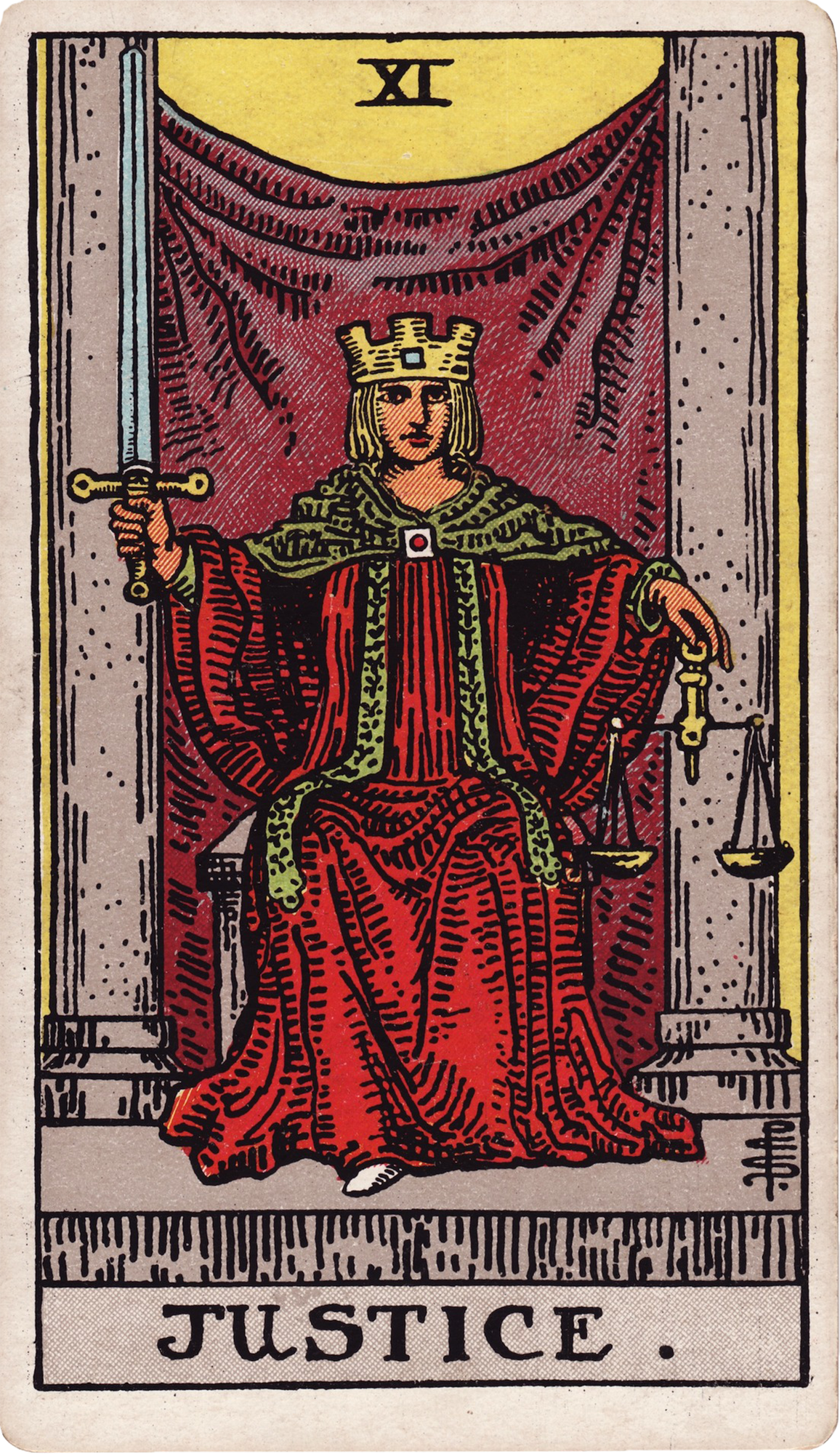 Justice
The Justice Card Upright and Reversed Meaning
The Justice card traditionally portrays a figure seated between two pillars, holding a sword in one hand and scales in the other, symbolizing balance, clarity, and the impartial application of truth. Upright, Justice emphasizes the importance of viewing facts without bias, accepting consequences responsibly, and making decisions that are fair and withstand scrutiny. It encourages engaging with the present realities to take deliberate, proportionate steps forward, rather than waiting for absolute certainty. When you see Justice upright, ask yourself where clearer boundaries, direct responses, or deeper honesty could improve the situation. Reversed, the Justice card signals distortions in these qualities. This can manifest as bias, denial, unfairness, or avoidance of accountability. The reversal is not inherently negative but indicates that the energy of fairness and truth is blocked, delayed, or out of balance. It often points to internal struggles with ethical decisions or a resistance to embracing consequences fully. When Justice appears reversed, focus on identifying where fairness is compromised, and examine if the issue is becoming more psychological or private. Neighboring cards can clarify whether the reversal indicates resistance, gradual recovery, or a temporary pause in ethical clarity.
Applying Justice in Conflict Resolution
Justice is fundamentally about balance and fairness, making it especially relevant in conflict resolution. When Justice appears, it advises facing conflicts with honesty and impartiality, seeking facts rather than emotional biases. The sword in the card symbolizes the clarity and decisiveness needed to cut through confusion, while the scales represent weighing all sides evenly. In practical terms, using Justice in conflict resolution means identifying the core issues clearly and setting boundaries that reflect fairness. It encourages taking responsibility for one’s role in the conflict and being willing to accept consequences honestly. For example, if a disagreement in a team arises, Justice urges focusing on evidence and equitable compromise rather than personal grievances. Common mistakes include trying to impose fairness prematurely without understanding all facts or confusing fairness with favoritism. Justice teaches patience and measured judgment, reminding readers to check for hidden biases before concluding. In reversed form, Justice warns that denial or refusal to face facts will prolong or deepen conflicts.
Justice Card Interpretation in Love and Relationships
In love readings, the upright Justice card encourages transparency, honest communication, and fairness between partners. It suggests that relationship issues can be resolved by addressing truths respectfully and setting clear, equitable boundaries. For singles, Justice may indicate an ethical decision about whether to pursue or end a relationship based on honest self-assessment. For example, the scales in the imagery remind us to weigh feelings and facts equally, ensuring decisions aren’t driven solely by emotion or self-interest. The sword implies the necessity of clear, sometimes tough conversations that cut through misunderstandings. Reversed Justice in love warns of imbalance — perhaps one partner is avoiding accountability or there is denial about the relationship’s reality. It suggests the need to confront hidden biases or fears blocking honest dialogue. Key teaching: Justice invites learners to reflect on fairness in emotional give-and-take and to practice courageous honesty to move relationships forward.
Justice’s Role in Career and Professional Contexts
Justice is highly relevant in career matters, especially where decisions about fairness, ethics, contracts, or accountability arise. Upright, the card signals that a fair assessment of performance, rules, or workplace dynamics is possible and needed. The sword symbolizes the need for clear-cut decisions, such as promotions, disciplinary actions, or legal considerations, while the scales underscore impartiality. For example, Justice may appear when you need to evaluate a job offer critically or when workplace disputes require balanced resolution. It encourages acting with integrity and following established protocols rather than shortcuts. When reversed, Justice points to possible unfair treatment, bias, or unethical decisions at work. It may reflect internal doubts about one’s role or denial about necessary changes. In professional readings, Justice reminds learners to approach career issues with a balanced mind and ethical clarity, avoiding impulsive or emotionally charged decisions.
Justice Card Implications in Financial Matters
Financial readings with Justice focus on fairness in transactions, legal considerations, and responsible money management. The scales symbolize weighing risks and benefits carefully, while the sword suggests the need for clear, decisive action. Upright Justice advises working pragmatically with current resources and recognizing the consequences of financial decisions. It may indicate legal or contractual matters are at the forefront and require transparent evaluation. For example, Justice might appear when settling debts, negotiating contracts, or clarifying the terms of agreements. Reversed, Justice signals possible financial unfairness, mismanagement, or denial of financial realities. It warns against ignoring evidence or delaying accountability. Learners should use Justice to practice transparency in money matters, ensuring decisions stand up to scrutiny and are ethically sound.
Advice and Challenges from the Justice Card
As advice, Justice urges readers to seek truth and fairness actively. It suggests that the best way forward involves honest self-reflection, setting clear boundaries, and accepting responsibility. The lesson is to avoid evasiveness or biased reasoning and to pursue decisions that maintain balance and integrity. Challenges connected with Justice often involve facing uncomfortable truths or the consequences of past actions. The sword’s sharpness may represent difficult but necessary cuts—ending unhealthy patterns or relationships. The scales remind us that fairness requires ongoing effort, not just one-time judgments. Reversed Justice highlights the internal or external obstacles to these processes, such as denial, prejudice, or fear of accountability. The key question is where fairness is distorted or inaccessible. Practically, readers should identify where their judgment might be clouded and strive to restore balance through conscious effort and deliberate choices.
Justice as a Person in Readings
When representing a person, the Justice card typically describes someone who is fair-minded, honest, and principled. This person values truth highly and often acts as a mediator or judge in disputes. They may be a legal professional, counselor, or someone known for balanced decision-making. The imagery of Justice—an upright figure with scales and sword—reflects a personality that seeks clarity and fairness, strives for ethical behavior, and respects rules and boundaries. If reversed, this persona may struggle with bias, denial, or unfairness, possibly being overly rigid or evasive about responsibility. The reversal suggests that the person might be experiencing internal conflict concerning ethical issues or fairness. Understanding Justice as a person helps readers anchor the card’s energy into concrete character traits or roles influencing the reading.
Justice in Outcomes and Spiritual Reflection
As an outcome card, Justice indicates resolution through fairness and accountability. It suggests that situations will conclude in ways that are just and reflect the true facts and actions taken. The sword implies clarity will prevail, and the scales ensure balanced results. However, it also cautions that fairness can come with consequences that may not be easy but are necessary for growth. Spiritually, Justice invites reflection on personal integrity, karma, and the ethical dimensions of one’s choices. It encourages honest self-assessment and alignment with universal truths. Engaging with this card spiritually means embracing responsibility for one’s actions and understanding the interconnectedness of cause and effect. Reversed in outcome or spiritual contexts, Justice challenges the seeker to confront self-deception, biases, or unresolved ethical conflicts. It marks a phase where spiritual or moral growth is needed but may be hindered by resistance or unconscious patterns. This dimension of Justice deepens learners’ appreciation of how ethical awareness shapes life paths and spiritual evolution.
Practical Techniques for Reading the Justice Card
When drawing Justice, start by observing the card’s classic symbolism: the scales, sword, pillars, and the figure’s posture. These elements remind us to focus on balance, truth, clear thinking, and structured judgment. Ask context-specific questions: - What facts need to be weighed carefully? - Where are boundaries needed? - What consequences require acceptance? - Is there bias or denial affecting the situation? Consider upright versus reversed placement carefully, not as ‘good’ or ‘bad’ but as energetic states of balance or imbalance. Use neighboring cards (if applicable) to identify whether Justice’s lessons are being resisted or embraced, and what external factors influence fairness. Avoid common mistakes such as assuming Justice means simple fairness without effort or that reversal predicts doom. Instead, see the card as a dynamic force guiding ethical clarity and conscious decision-making.
Practice questions
• In what areas of my life might I be avoiding accountability or denying important truths?
• How can I apply clearer boundaries or more honest communication to an ongoing conflict?
• Where might I be allowing bias or unfairness to influence my decisions?
• What consequences do I need to accept in order to move forward ethically?
• How do I interpret fairness and justice in my relationships and professional life?
• Am I willing to engage with difficult truths for long-term balance?
• How can I cultivate integrity and impartiality in daily choices?
Comments
Sign in to comment.
Continue learning
Interpreting the Dance of Justice and The Devil: Balancing Morality and Temptation in Tarot Readings
The combination of Justice and The Devil in tarot presents a profound exploration of morality, temptation, and personal accountability. This article unpacks how these cards influen...
Mastering Decision Making with the Five Card Cross Tarot Spread
The Five Card Cross Tarot Spread is a powerful tool for deepening decision-making skills by examining the present situation, past influences, future possibilities, challenges, and...
Enhancing Clarity in Complex Choices with the Five Card Cross Tarot Spread
The Five Card Cross Tarot Spread is a practical tool designed to clarify complex choices by breaking down the decision into manageable parts. This article explores each position in...
Using the Five Card Cross Spread to Make Confident Life Decisions
The Five Card Cross spread is a practical and insightful tarot layout designed to assist with complex life decisions by clarifying the situation, presenting options, uncovering hid...
Making Confident Life Choices with the Five Card Cross Tarot Spread
The Five Card Cross Tarot Spread is a powerful tool designed to aid practical decision-making, particularly within family or life-altering situations. This article explains the spr...
Using the Five Card Cross Tarot Spread to Gain Confidence in Difficult Decisions
The Five Card Cross spread is a powerful practical tool for navigating difficult decisions with confidence. By placing cards in positions representing Situation, Option A, Option B...
Using the Five Card Cross Spread to Gain Clarity in Difficult Life Decisions
The Five Card Cross Spread is a structured tarot layout designed to help clarify challenging life decisions by examining the situation, options, hidden influences, and advice. This...
Using the Five Card Cross Spread to Clarify Complex Decisions
The Five Card Cross Spread is a practical tarot method designed to clarify complex decisions by laying out the situation, contrasting options, hidden factors, and advice. This arti...
Using the Five Card Cross Spread to Gain Insight into Relationship Dynamics
This article provides an in-depth guide to using the Five Card Cross Spread for gaining clarity on relationship dynamics, especially within family contexts. Anchored by a worked ex...
Using the Five Card Cross Spread to Make Balanced and Informed Life Decisions
The Five Card Cross Spread is a powerful Tarot layout designed to aid balanced and informed decision-making. This article teaches learners how to use this spread effectively, focus...