
Understanding The Justice Card In Ethical Choices Accountability And Life Balance
The Justice card holds a pivotal place in Tarot as a symbol of fairness, accountability, and ethical decision-making. This article examines both the upright and reversed Justice card from the Rider-Waite-Smith deck, focusing on how its meanings shift across various life contexts. Learners will gain practical insight into reading Justice for love, career, finance, challenges, advice, and spiritual growth. Emphasizing its traditional symbolism—such as the scales, sword, and figure’s posture—readers will learn to recognize Justice's call for honesty, balance, and conscious choice while avoiding common interpretive pitfalls. This single-card study encourages Tarot enthusiasts to apply Justice’s lessons for clearer boundaries, responsible actions, and life balance.
Cards explored in this article
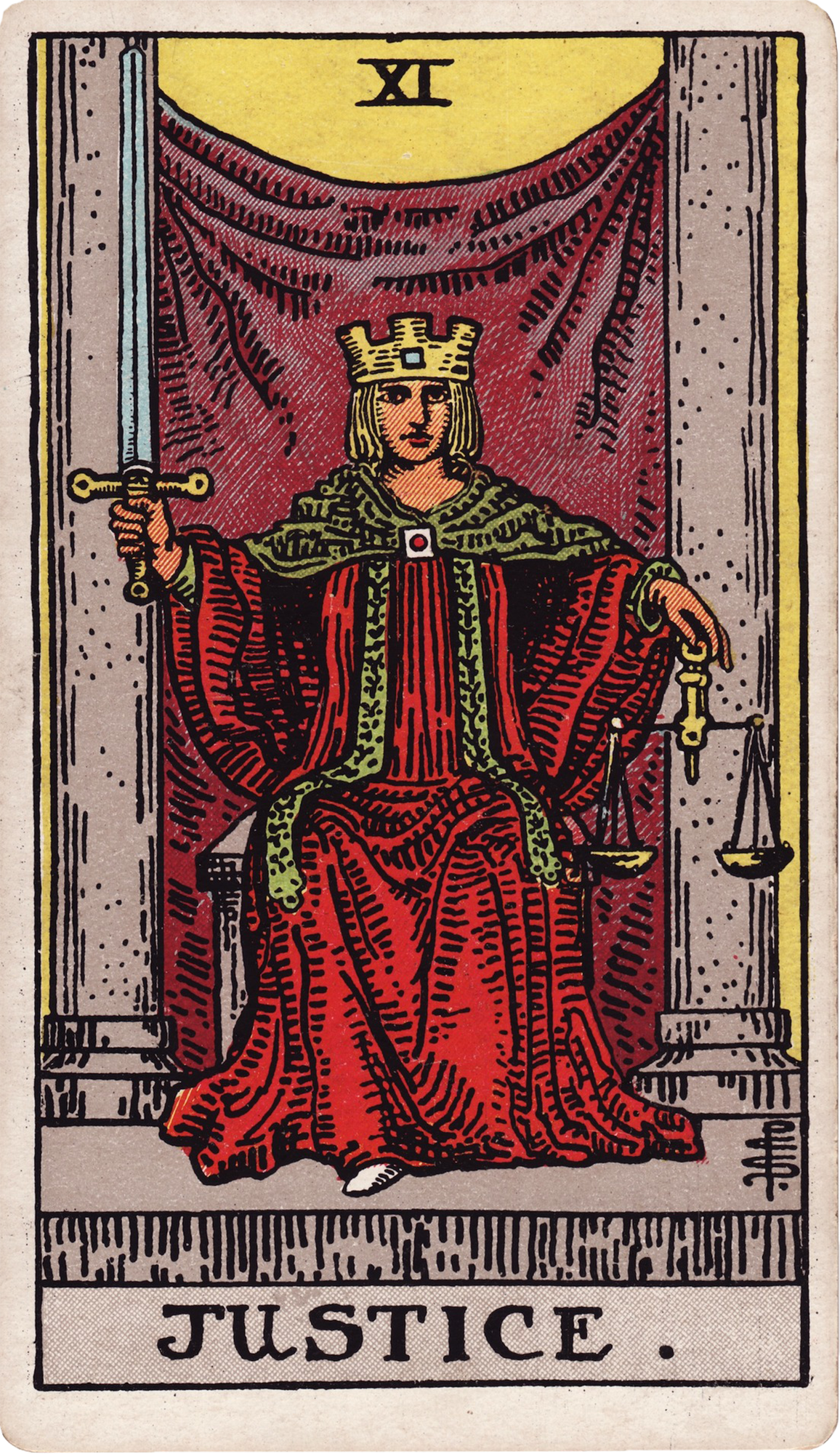 Justice
Introduction to Justice in Tarot and Its Symbolism
Justice, numbered VIII in the traditional Rider-Waite-Smith deck, visually presents a figure seated between two pillars, holding balanced scales in the left hand and an upright double-edged sword in the right. The scales symbolize fair measurement and equilibrium, while the sword denotes clear, decisive, and sometimes harsh truth. The figure’s stern gaze and forward-facing posture indicate impartial judgment and the readiness to act based on facts. This card embodies themes of ethical integrity, accountability for actions, and the need for balance in decision-making. When Justice appears upright, it affirms that clarity and fairness are accessible and necessary. In reversal, Justice signals potential distortions such as bias, denial, or evasion of responsibility. Understanding these visual and symbolic cues is foundational to interpreting the card accurately across life’s diverse situations.
Practical Reading Technique for Single-Card Justice Readings
When Justice is drawn alone, it commands focused attention to fairness and ethical standing in the querent’s question area. Begin by noting the card’s orientation: upright suggests clarity and balanced response; reversed hints at blocks or distortions of justice. Examine the scales for insights into balance—are they level or implied as weighted? The sword’s sharpness urges cutting through confusion to the heart of the matter. Ask yourself which part of the querent's life needs a direct response, clearer boundary, or honest evaluation. Avoid jumping to conclusions about immediate outcomes; instead, consider how Justice’s presence reveals the current ethical landscape and next deliberate steps. This approach helps the reader harness Justice as guidance rather than prediction, emphasizing conscious choice and accountability.
Justice Card in Love and Relationships Context
When Justice appears upright in a love or relationship reading, it calls for honest communication and fair treatment between partners. The justice figure’s balanced scales represent the need for equilibrium—whether in giving and receiving affection, sharing responsibilities, or resolving conflicts. It encourages addressing relationship truths fairly, such as boundaries or mutual expectations. The sword compels cutting through illusions or denial about feelings or fidelity. In reversal, Justice may reveal bias, inequity, or dishonesty—perhaps one partner avoiding accountability or a refusal to see the relationship clearly. This could manifest as denial of issues, unfair treatment, or imbalance. Practical advice includes fostering deeper honesty, setting clearer boundaries, and evaluating if the relationship honors fairness for all involved.
Justice Card in Career and Professional Life
In career contexts, upright Justice advises the querent to assess their work situation with clarity and integrity. It suggests decisions should be based on facts, ethical considerations, and equitable outcomes. This might mean advocating for fair treatment, negotiating contracts transparently, or taking responsibility for one’s professional actions. The sword’s presence encourages decisive action when fairness is at stake. Reversed Justice warns of possible workplace injustice, bias, or denial of responsibility—such as favoritism, unfair evaluation, or avoiding accountability for mistakes. When reading the card here, focus on where the querent might need to enforce clearer boundaries, request transparency, or make balanced decisions that withstand scrutiny.
Justice Card and Financial Decisions
Regarding money, upright Justice calls for prudent, balanced financial choices grounded in honesty and responsibility. This could involve clear budgeting, honoring debts, or making equitable agreements in financial partnerships. The scales ask the querent to weigh options carefully; the sword reminds them that financial decisions cannot be clouded by deception or wishful thinking. In reversed position, Justice signals financial bias or denial—perhaps ignoring debts, making impulsive or unbalanced spending decisions, or experiencing unfair treatment in monetary dealings. The card’s lesson here is to confront financial realities directly and strive for transparency and fairness to restore balance.
Advice and Challenge Through the Lens of Justice
When Justice appears as advice, it encourages the querent to engage with their situation ethically and transparently. This means taking ownership of choices, considering consequences carefully, and refusing to skirt uncomfortable truths. The challenge Justice highlights is often internal: confronting personal biases, avoiding denial, or overcoming resistance to accountability. A reversed card may suggest the querent is struggling with these challenges—perhaps feeling unfairly treated or unwilling to face facts. In either orientation, the card’s core message is to act with integrity and balance, recognizing that justice is a process requiring deliberation and honesty rather than instant resolution.
Interpreting Justice as a Person in the Spread
When Justice represents a person, it often describes someone who embodies fairness, clarity, and ethical standards. This individual tends to be rational, honest, and decisive—perhaps a judge, mediator, lawyer, or any figure dedicated to truth and balance. They might be a person who holds the querent accountable or influences their decisions regarding right and wrong. Reversed, this person could be biased, unfair, or unreliable—someone whose judgment may be clouded or who avoids responsibility. Recognizing these characteristics helps the reader understand relational dynamics or the influence of others involved in the querent’s situation.
Justice as an Outcome and in Spiritual Reflection
Justice as an outcome card suggests a resolution grounded in fairness and accountability. It indicates that consequences are forthcoming, and these will be proportionate and just. The querent can expect clarity and possibly legal or formal acknowledgment of truth. However, this does not guarantee ease; Justice demands facing reality with honesty and balance. In spiritual reflection, Justice invites the querent to explore their inner sense of integrity, ethical alignment, and karmic balance. It asks where they may need to accept responsibility or establish clearer personal boundaries. The sword symbolizes cutting through illusion to arrive at spiritual truth, while the scales reflect the need for equilibrium between actions and their consequences.
Common Mistakes and How to Avoid Them When Reading Justice
A frequent mistake is interpreting Justice as a simplistic 'good' or 'bad' card rather than a nuanced symbol of ethical process. Justice does not promise that things will be easy—only that fairness and accountability are key. Another error is ignoring the card’s position and context, which can distort meaning; for example, reading reversed Justice as outright misfortune without exploring internal blocks or psychological resistance. Avoid overconfidence in predicting outcomes; Justice encourages conscious decision-making rather than fatalism. Finally, overlooking the card’s Rider-Waite imagery—such as the balance of the scales or the direction of the sword—can weaken interpretation. Always anchor readings in the card’s visual symbolism and ask how its lessons apply practically in the querent’s life.
Summary and Practical Reading Method
To read the Justice card effectively in a single-card context, first determine upright or reversed orientation. Observe the scales, sword, pillars, and figure’s expression for clues about balance, truth, and ethical clarity. Identify the context (love, career, money, advice, challenge, person, outcome, spiritual reflection) and tailor the interpretation accordingly. Ask: Where is fairness needed? What boundaries should be clearer? What truths need acknowledging? Consider which parts of the querent’s behavior or situation already embody Justice’s principles and which parts require growth or correction. Use these insights to guide the querent toward deliberate, balanced choices that honor accountability. This method transforms Justice from a predictive symbol into a powerful tool for ethical self-awareness and life balance.
Practice questions
• In what areas of my life do I need to apply clearer boundaries or honest evaluation?
• Where might I be avoiding accountability or denying an uncomfortable truth?
• How do I balance my personal desires with fairness toward others?
• What decisions am I currently facing that require deeper ethical consideration?
• How can I cultivate integrity and responsibility in my daily actions?
• Are there biases or distortions affecting my perception of a situation?
• What does balanced justice mean to me spiritually and practically?
Comments
Sign in to comment.
Continue learning
Interpreting the Dance of Justice and The Devil: Balancing Morality and Temptation in Tarot Readings
The combination of Justice and The Devil in tarot presents a profound exploration of morality, temptation, and personal accountability. This article unpacks how these cards influen...
Mastering Decision Making with the Five Card Cross Tarot Spread
The Five Card Cross Tarot Spread is a powerful tool for deepening decision-making skills by examining the present situation, past influences, future possibilities, challenges, and...
Enhancing Clarity in Complex Choices with the Five Card Cross Tarot Spread
The Five Card Cross Tarot Spread is a practical tool designed to clarify complex choices by breaking down the decision into manageable parts. This article explores each position in...
Using the Five Card Cross Spread to Make Confident Life Decisions
The Five Card Cross spread is a practical and insightful tarot layout designed to assist with complex life decisions by clarifying the situation, presenting options, uncovering hid...
Making Confident Life Choices with the Five Card Cross Tarot Spread
The Five Card Cross Tarot Spread is a powerful tool designed to aid practical decision-making, particularly within family or life-altering situations. This article explains the spr...
Using the Five Card Cross Tarot Spread to Gain Confidence in Difficult Decisions
The Five Card Cross spread is a powerful practical tool for navigating difficult decisions with confidence. By placing cards in positions representing Situation, Option A, Option B...
Using the Five Card Cross Spread to Gain Clarity in Difficult Life Decisions
The Five Card Cross Spread is a structured tarot layout designed to help clarify challenging life decisions by examining the situation, options, hidden influences, and advice. This...
Using the Five Card Cross Spread to Clarify Complex Decisions
The Five Card Cross Spread is a practical tarot method designed to clarify complex decisions by laying out the situation, contrasting options, hidden factors, and advice. This arti...
Using the Five Card Cross Spread to Gain Insight into Relationship Dynamics
This article provides an in-depth guide to using the Five Card Cross Spread for gaining clarity on relationship dynamics, especially within family contexts. Anchored by a worked ex...
Using the Five Card Cross Spread to Make Balanced and Informed Life Decisions
The Five Card Cross Spread is a powerful Tarot layout designed to aid balanced and informed decision-making. This article teaches learners how to use this spread effectively, focus...