
Understanding The Justice Card in Ethical Choices Legal Matters and Personal Accountability
The Justice card in Tarot symbolizes fairness, truth, and the ethical weighing of facts. In upright position, it urges clear-headed decisions, acceptance of consequences, and deliberate action grounded in honesty and balanced judgment. Reversed, it highlights bias, denial, or distorted accountability. This article examines how Justice manifests differently across contexts such as love, career, money, advice, challenges, personal identity, outcomes, and spiritual insights. Using Rider-Waite-Smith imagery as a foundation, readers will learn practical methods for integrating Justice’s lessons into readings, avoiding common pitfalls, and applying its wisdom to ethical and legal dilemmas as well as personal growth.
Cards explored in this article
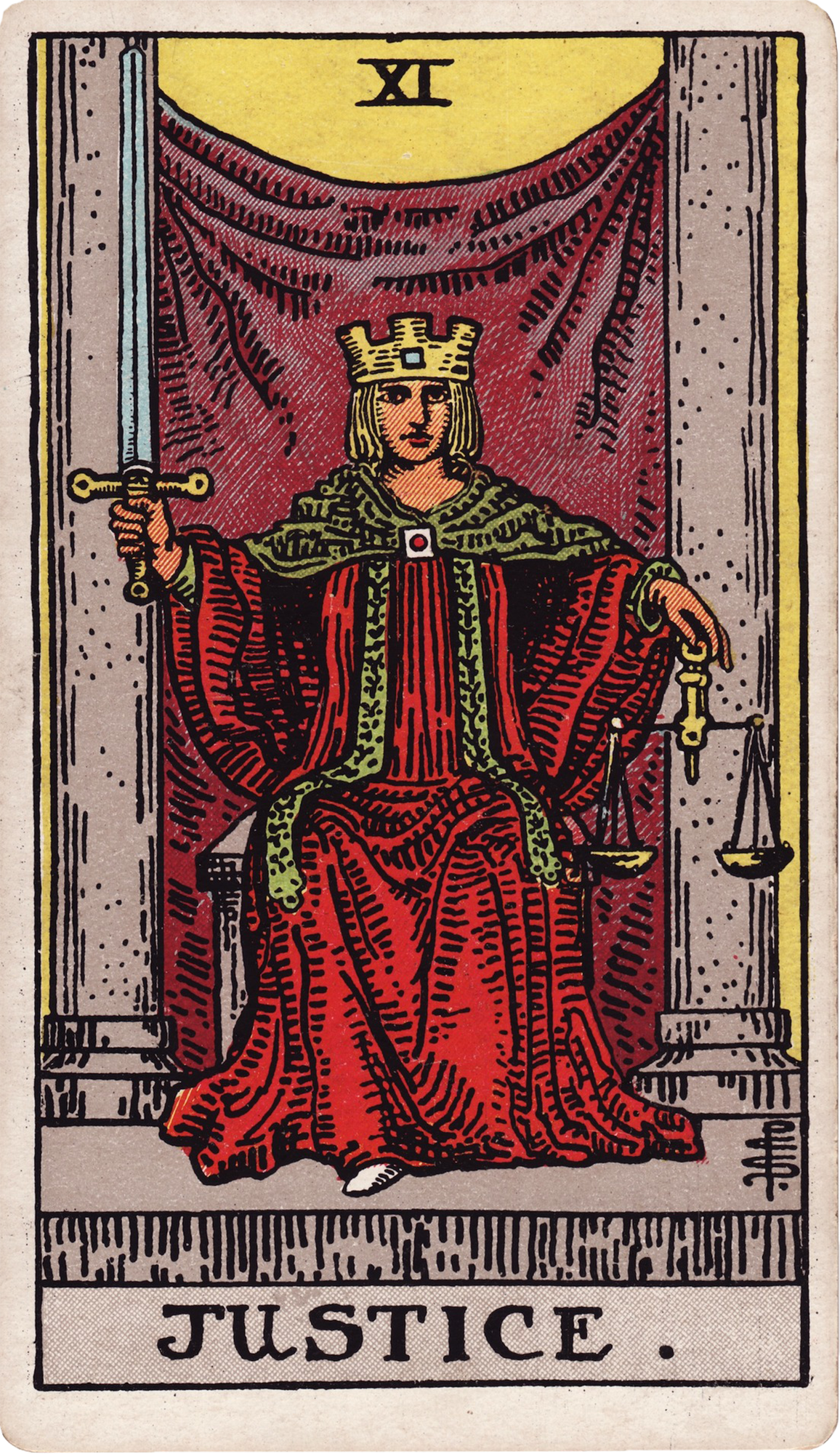 Justice
Introduction to the Justice Card and Its Symbolism
The Justice card is a key Major Arcana in the Rider-Waite-Smith Tarot deck, traditionally numbered 11 or sometimes 8 depending on the deck. The card features a seated figure holding scales in the left hand and a double-edged sword in the right. The scales symbolize balance, fairness, and objective weighing of facts, while the sword represents clarity, truth, and the power to cut through illusion. The figure wears a crown and red robes, signifying authority and the passion necessary for just decisions. The upright Justice card invites the querent to consider ethical integrity, accountability, and conscious choice. The reversed Justice card signals distortion in these areas, such as denial or imbalance.
Practical Approach to Reading the Justice Card
When Justice appears, first observe whether it is upright or reversed, as this affects interpretation significantly. Upright, focus on what facts are clear and which decisions must be faced with honesty. Reversed, look for areas where bias, unfairness, or avoidance of responsibility may be blocking progress. Always consider the querent’s situation and surrounding cards for nuance. Avoid assuming Justice means a literal legal case; instead, emphasize principles of fairness and consequence. Ask the querent what part of their life requires a clearer boundary, a direct answer, or acceptance of outcomes.
Justice in the Context of Ethical Choices
In readings centered on ethical dilemmas, Justice demands that the querent face truth without distortion. Upright, it encourages objective evaluation of all information and taking responsibility for actions. For example, in a moral conflict, this card urges stepping beyond emotional bias to see the broader impact and make a decision that can be justified fairly. Reversed Justice, by contrast, warns of rationalization, denial, or unfair judgments that may be harming self or others. It suggests the need to uncover hidden biases or avoid scapegoating. Practitioners should guide querents to ask where they might be avoiding accountability or ignoring inconvenient truths.
Justice and Legal Matters
Justice often appears in readings about legal issues or formal agreements, but it should not be simplified as predicting court outcomes. Upright Justice indicates that facts are becoming clear and that fair resolutions are possible if the querent acts with integrity and follows due process. It signals that conscious, balanced decisions can lead to just outcomes. Reversed Justice may highlight unfair treatment, legal delays, or misuse of power. It can also point to internalized guilt or resistance to accepting legal realities. Readers are advised to interpret this card as a call to transparency and ethical adherence rather than fortune-telling about court verdicts.
Personal Accountability and Self-Reflection
On a personal level, Justice asks the querent to evaluate their own role in current challenges. Upright, it encourages embracing responsibility rather than blaming external factors. The scales remind one to weigh both strengths and weaknesses honestly. The sword calls for cutting through self-deception. This card can signal a moment when the querent is ready to integrate lessons about fairness and consequence into their behavior. Reversed Justice may indicate resistance to self-examination or a tendency to deny one’s impact. It invites deeper psychological work to realign values and actions with integrity.
Love and Relationships
When Justice appears in love readings upright, it suggests the need for honesty, clear communication, and fairness in the relationship. This may mean setting boundaries or addressing imbalances in give and take. The image of the scales reminds partners to consider equality and mutual respect. The sword implies that difficult conversations may be necessary to achieve clarity. Reversed Justice warns of dishonesty, favoritism, or denial of issues within the relationship. It can also show self-deception about feelings or intentions. In both positions, Justice encourages conscious decision-making about partnership dynamics rather than passive acceptance.
Career and Professional Life
In career contexts, Justice upright signals the importance of ethical conduct, transparent dealings, and accountability for one’s work. It may also indicate recognition or reward based on merit and fairness. The card encourages the querent to make decisions based on facts and to hold to principles even when the situation is challenging. Reversed Justice suggests unfair treatment at work, bias, or conflicts arising from a lack of integrity. It might also highlight internal conflict about professional ethics or responsibility. Readers should help querents explore how to restore balance and fairness either by adjusting their approach or confronting injustice.
Money and Financial Matters
Justice in financial readings upright calls attention to the ethical management of resources and clear accountability. It can suggest that financial disputes will be fairly resolved or that honest budgeting and deliberate choices are needed. The symbolism urges transparency and working with accurate information rather than wishful thinking. When reversed, Justice may warn of financial deceit, biased advice, or denial of debts or obligations. The querent is encouraged to reassess financial decisions with a clearer, more objective lens to avoid future difficulties.
Advice and Challenge
As advice, the upright Justice card encourages the querent to embrace truthfulness, set clear boundaries, and accept consequences without evasion. It pushes for deliberate, balanced decision-making based on evidence and moral clarity. The challenge of Justice reversed involves recognizing where one’s judgment or behavior is distorted—whether through denial, bias, or avoidance. Instead of fearing these obstacles, the querent is urged to face uncomfortable realities to restore integrity and fairness.
Justice as a Person and Outcome
When Justice represents a person in a reading, it often describes someone who embodies fairness, discipline, and clear thinking—such as a judge, lawyer, mediator, or anyone committed to truth and accountability. This person may be a guiding influence requiring honest appraisal of facts. As an outcome card, upright Justice indicates a fair and balanced resolution grounded in truth and ethical standards. Reversed Justice as an outcome signals that resolution may be delayed, biased, or unfair, highlighting the need for vigilance and possibly corrective action.
Spiritual Reflection and Inner Growth
Spiritually, Justice asks for honest inner assessment and alignment with universal principles of truth and fairness. Upright, it represents karmic balance and the conscious acceptance of one’s actions and their consequences. The sword and scales remind seekers to cut through illusions and weigh their motivations carefully. Reversed Justice may indicate spiritual imbalance or avoidance of inner truths, suggesting the need for deeper introspection and correction of distorted beliefs. Reflecting on Justice’s imagery encourages a balanced integration of mind, heart, and ethics on the spiritual path.
Common Mistakes and Practical Tips
A frequent mistake is to interpret Justice solely as predicting legal outcomes; rather, it symbolizes the process and quality of fairness and accountability. Another error is neglecting the reversed meaning, which offers important insights into blocked or distorted justice energy. Practically, always ask what next deliberate step the querent can take to bring clarity or fairness into their situation. Use the card’s imagery—the scales for balance, the sword for clarity—to guide your questions and reflections. Look for where the querent might resist boundaries or truth, and help them see how embracing these can move the situation forward.
Practice questions
• Where in my life do I need to accept responsibility or face consequences more honestly?
• What biases or denials might be preventing me from making a fair decision?
• How can I apply the principles of balance and clarity symbolized by the scales and sword in my current challenges?
• In what ways am I avoiding setting necessary boundaries or having difficult conversations?
• How do I define fairness for myself and others in ethical or legal dilemmas?
• What lessons about accountability and truth is Justice encouraging me to integrate?
• How might my internal sense of justice be distorted or blocked right now?
Comments
Sign in to comment.
Continue learning
Interpreting the Dance of Justice and The Devil: Balancing Morality and Temptation in Tarot Readings
The combination of Justice and The Devil in tarot presents a profound exploration of morality, temptation, and personal accountability. This article unpacks how these cards influen...
Mastering Decision Making with the Five Card Cross Tarot Spread
The Five Card Cross Tarot Spread is a powerful tool for deepening decision-making skills by examining the present situation, past influences, future possibilities, challenges, and...
Enhancing Clarity in Complex Choices with the Five Card Cross Tarot Spread
The Five Card Cross Tarot Spread is a practical tool designed to clarify complex choices by breaking down the decision into manageable parts. This article explores each position in...
Using the Five Card Cross Spread to Make Confident Life Decisions
The Five Card Cross spread is a practical and insightful tarot layout designed to assist with complex life decisions by clarifying the situation, presenting options, uncovering hid...
Making Confident Life Choices with the Five Card Cross Tarot Spread
The Five Card Cross Tarot Spread is a powerful tool designed to aid practical decision-making, particularly within family or life-altering situations. This article explains the spr...
Using the Five Card Cross Tarot Spread to Gain Confidence in Difficult Decisions
The Five Card Cross spread is a powerful practical tool for navigating difficult decisions with confidence. By placing cards in positions representing Situation, Option A, Option B...
Using the Five Card Cross Spread to Gain Clarity in Difficult Life Decisions
The Five Card Cross Spread is a structured tarot layout designed to help clarify challenging life decisions by examining the situation, options, hidden influences, and advice. This...
Using the Five Card Cross Spread to Clarify Complex Decisions
The Five Card Cross Spread is a practical tarot method designed to clarify complex decisions by laying out the situation, contrasting options, hidden factors, and advice. This arti...
Using the Five Card Cross Spread to Gain Insight into Relationship Dynamics
This article provides an in-depth guide to using the Five Card Cross Spread for gaining clarity on relationship dynamics, especially within family contexts. Anchored by a worked ex...
Using the Five Card Cross Spread to Make Balanced and Informed Life Decisions
The Five Card Cross Spread is a powerful Tarot layout designed to aid balanced and informed decision-making. This article teaches learners how to use this spread effectively, focus...