
Understanding The Justice Card In Ethical Dilemmas And Personal Accountability
The Justice card represents fairness, clarity, and accountability, especially significant when facing ethical dilemmas or personal responsibility. Upright, it urges clear fact-based decisions and acceptance of consequences, while reversed, it warns of bias, denial, or imbalance. This article guides learners through the Justice card’s symbolism, interpretation techniques, and contextual meanings in love, career, money, advice, challenges, person, outcomes, and spiritual reflections. By anchoring insights to the card's Rider-Waite-Smith imagery, readers develop nuanced, responsible tarot reading skills.
Cards explored in this article
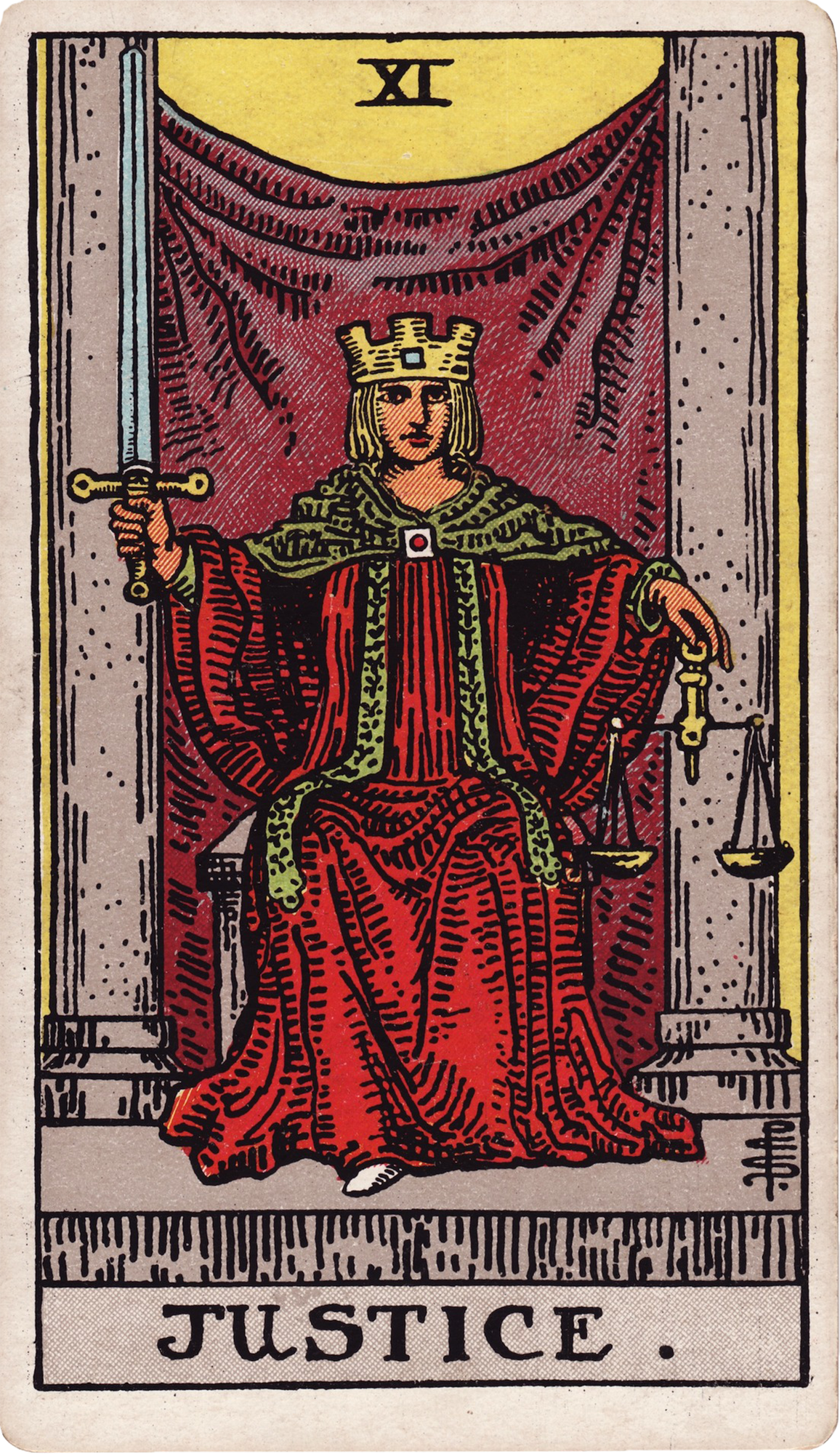 Justice
Introduction to the Justice Card and Its Core Symbolism
The Justice card in the Rider-Waite-Smith deck features a seated figure holding a sword in one hand and balanced scales in the other. The sword symbolizes a clear, decisive intellect that cuts through confusion, while the scales represent balance, fairness, and weighing evidence objectively. Traditionally, Justice is associated with law, truth, and ethical accountability. Its upright position emphasizes facing facts honestly and making decisions that uphold fairness and integrity. In contrast, the reversed Justice card signals distortion—bias, denial, or avoidance—reflecting where ethical clarity or responsibility is blocked or challenged. Central to interpreting Justice is recognizing that it does not promise ease but demands deliberate, proportionate responses based on clear perception of the situation.
Technique for Reading the Justice Card in Single-Card Contexts
When Justice appears alone, the reader must carefully consider what ethical or accountability issues are most relevant to the querent’s current life. Begin by observing the card’s imagery: the sword points upward, indicating truth and clarity; the scales suggest balance, urging an impartial approach. Assess whether the card is upright or reversed, as this sets the tone for interpretation. Next, contextualize Justice by the querent’s question or life area—for instance, love or career—and ask: Where does fairness or honesty need to be addressed? What consequences must be accepted? Avoid assumptions that Justice guarantees a ‘just’ or favorable outcome; instead, focus on its call to integrity and conscious decision-making. Reflect on which aspect of Justice—clarity, boundary-setting, accountability—is most active or needed. Finally, integrate these insights into practical advice or reflection prompts.
Justice in the Context of Love and Relationships
Upright Justice in a love context calls for honest communication and fairness. It suggests the need to weigh both partners’ perspectives impartially and to accept responsibility for personal actions affecting the relationship. This card encourages setting clear boundaries and making choices that uphold mutual respect. For example, a querent facing a decision about commitment might be reminded to consider the facts and their own true feelings rather than illusions or wishful thinking. Reversed, Justice warns of biased views, denial of relationship issues, or avoidance of accountability. It may indicate unfair treatment, imbalance in give-and-take, or hidden dishonesty. In this state, the querent is invited to examine where clarity is lacking or where distortions in perception may be causing harm. Recognizing these dynamics is the first step toward restoring fairness.
Justice’s Role in Career and Professional Decisions
At work, the upright Justice card emphasizes fairness, ethical standards, and transparency. It suggests a situation where evidence is accessible and decisions should be made based on clear, objective criteria. This might manifest as resolving workplace conflicts, negotiating contracts, or making choices about promotions or job changes that require integrity. The sword and scales remind the querent to cut through office politics or emotional bias and focus on what is just and reasonable. Reversed, Justice often signals unfair treatment, bias, or injustice—perhaps favoritism, discrimination, or unethical behavior. It may also point to a refusal to accept responsibility or denial of errors. When reversed, the card encourages the querent to look inward and honestly assess where they may be contributing to unfairness or blocking necessary corrections.
Interpreting Justice in Financial and Resource Management
In money matters, upright Justice invites the querent to balance income and expenses thoughtfully and to act with financial integrity. This card may indicate that all relevant facts about finances are now visible, enabling conscious budgeting, debt management, or transparent dealings. It encourages timely decisions rather than procrastination, backed by clear evidence and fairness to all parties involved. The sword and balanced scales symbolize the need to cut through confusion or deceptive offers and weigh options carefully. Reversed Justice in this context highlights potential financial dishonesty, mismanagement, or refusal to face financial realities. It may reveal self-deception or external exploitation. The querent is prompted to re-examine assumptions and seek balance by confronting uncomfortable truths.
Justice as Advice and Challenge in Personal Growth
When Justice appears as advice, it encourages the querent to cultivate honesty, clear boundaries, and deliberate choices. The card asks: Where in your life do you need to acknowledge facts you have been avoiding? What consequences must you accept to move forward? Upright, Justice challenges complacency by calling for active engagement with ethical responsibilities. Conversely, when Justice appears reversed as a challenge, it often signals inner resistance to accountability or imbalance in behavior. The querent might be grappling with denial, bias, or unresolved guilt. This state calls for introspection to uncover where ethical clarity is blocked and to begin the process of realignment with truth and fairness. Justice thus acts as a mirror reflecting where personal growth requires integrity.
Person Representation with the Justice Card
The Justice card may represent a person embodying fairness, integrity, and clear judgment. This individual could be a legal professional, mediator, or someone trusted to provide unbiased guidance. Upright, this person acts with honesty and upholds strong ethical standards, encouraging others to accept responsibility and face consequences without evasion. Reversed, the Justice figure might represent someone who is biased, manipulative, or unwilling to admit mistakes. They could be causing or perpetuating injustice, or alternatively, struggling internally with self-accountability. In readings, noting the card’s orientation and surrounding cards helps clarify whether the Justice person is a constructive influence or a complex challenge.
Justice as an Outcome in the Querent’s Situation
When Justice appears as a potential outcome, it suggests resolution through fairness and truth. Upright, the outcome involves decisions made with intellectual clarity, balanced judgment, and acceptance of consequences. The querent can expect that issues will be addressed openly and ethically, though not necessarily without difficulty. The sword implies that clarity will cut through confusion, while the scales promise balanced results. Reversed Justice as an outcome warns that fairness may be compromised or delayed, with bias or denial interfering with resolution. It might indicate unresolved ethical questions or the need for deeper internal work before a just outcome is achievable. The card advises patience and persistence toward honest reckoning.
Spiritual Reflection and Ethical Insight with Justice
Spiritually, Justice invites contemplation on the balance of cause and effect, karma, and moral truth. Upright, it encourages embracing accountability for one’s actions without fear, recognizing that ethical clarity supports spiritual growth. The card’s imagery reminds us to weigh our intentions and behaviors with honesty and to act in alignment with universal principles of fairness. Reversed, Justice points to spiritual imbalances—denial of lessons, resistance to truth, or internal conflicts about right and wrong. This may signal a time for deep self-examination and correction of distorted patterns. The sword and scales become tools for inner discernment, helping the querent restore harmony between their spiritual values and lived choices.
Common Mistakes When Interpreting the Justice Card
One frequent error is assuming Justice promises a ‘fair’ or ‘pleasant’ outcome, rather than a just one, which may be challenging or require sacrifice. Another mistake is ignoring the card’s reversed meaning or interpreting it as purely negative; instead, reversed Justice often signals a process in flux—where awareness is beginning but not yet complete. Readers sometimes overlook the importance of context, applying the same interpretation across all life areas without adjustment. Additionally, failing to connect the imagery—particularly the sword’s clarity and the scales’ balance—with the querent’s situation leads to superficial readings. Careful attention to whether Justice points toward action, reflection, acceptance, or correction enhances accuracy.
Practical Reading Method for Justice in Ethical Dilemmas
To use Justice effectively in ethical readings, first clarify the querent’s dilemma and identify the facts known versus those obscured. Show the card image and invite the querent to describe which parts resonate—the sword, scales, posture, or expression. Discuss the upright or reversed state and how that relates to the querent’s current approach to responsibility and fairness. Encourage naming any biases, denials, or areas where accountability feels difficult. Then, collaboratively explore the next steps that align with Justice’s call for clarity and proportionate response. Reinforce that Justice is a skillful energy to work with, not a guarantee of ease, and that embracing its lessons cultivates personal integrity and constructive outcomes.
Practice questions
• Where in my life do I need to face facts more clearly without denial or bias?
• What boundaries or responsibilities am I avoiding that Justice urges me to accept?
• How can I ensure my decisions are balanced and fair to all parties involved?
• In what ways might I be distorting or blocking my own sense of accountability?
• What consequences am I willing to accept to act with integrity in this situation?
• How does the imagery of the sword and scales speak to my current ethical challenges?
• Where could deeper honesty move my relationships or decisions forward?
• What internal patterns need correction to restore balance and clarity?
Comments
Sign in to comment.
Continue learning
Interpreting the Dance of Justice and The Devil: Balancing Morality and Temptation in Tarot Readings
The combination of Justice and The Devil in tarot presents a profound exploration of morality, temptation, and personal accountability. This article unpacks how these cards influen...
Mastering Decision Making with the Five Card Cross Tarot Spread
The Five Card Cross Tarot Spread is a powerful tool for deepening decision-making skills by examining the present situation, past influences, future possibilities, challenges, and...
Enhancing Clarity in Complex Choices with the Five Card Cross Tarot Spread
The Five Card Cross Tarot Spread is a practical tool designed to clarify complex choices by breaking down the decision into manageable parts. This article explores each position in...
Using the Five Card Cross Spread to Make Confident Life Decisions
The Five Card Cross spread is a practical and insightful tarot layout designed to assist with complex life decisions by clarifying the situation, presenting options, uncovering hid...
Making Confident Life Choices with the Five Card Cross Tarot Spread
The Five Card Cross Tarot Spread is a powerful tool designed to aid practical decision-making, particularly within family or life-altering situations. This article explains the spr...
Using the Five Card Cross Tarot Spread to Gain Confidence in Difficult Decisions
The Five Card Cross spread is a powerful practical tool for navigating difficult decisions with confidence. By placing cards in positions representing Situation, Option A, Option B...
Using the Five Card Cross Spread to Gain Clarity in Difficult Life Decisions
The Five Card Cross Spread is a structured tarot layout designed to help clarify challenging life decisions by examining the situation, options, hidden influences, and advice. This...
Using the Five Card Cross Spread to Clarify Complex Decisions
The Five Card Cross Spread is a practical tarot method designed to clarify complex decisions by laying out the situation, contrasting options, hidden factors, and advice. This arti...
Using the Five Card Cross Spread to Gain Insight into Relationship Dynamics
This article provides an in-depth guide to using the Five Card Cross Spread for gaining clarity on relationship dynamics, especially within family contexts. Anchored by a worked ex...
Using the Five Card Cross Spread to Make Balanced and Informed Life Decisions
The Five Card Cross Spread is a powerful Tarot layout designed to aid balanced and informed decision-making. This article teaches learners how to use this spread effectively, focus...