
Understanding The Justice Card in Legal Ethical and Personal Decision Contexts
This article offers an in-depth examination of the Justice card as depicted in the provided Rider-Waite-Smith Tarot image, focusing on its significance in legal, ethical, and personal decision-making contexts. It explores how upright and reversed positions influence interpretations in various life areas including love, career, money, advice, challenge, personality, outcome, and spiritual reflection. The piece highlights reading techniques, common interpretative pitfalls, and practical methods for learners to connect the card’s imagery and symbolism with nuanced readings.
Cards explored in this article
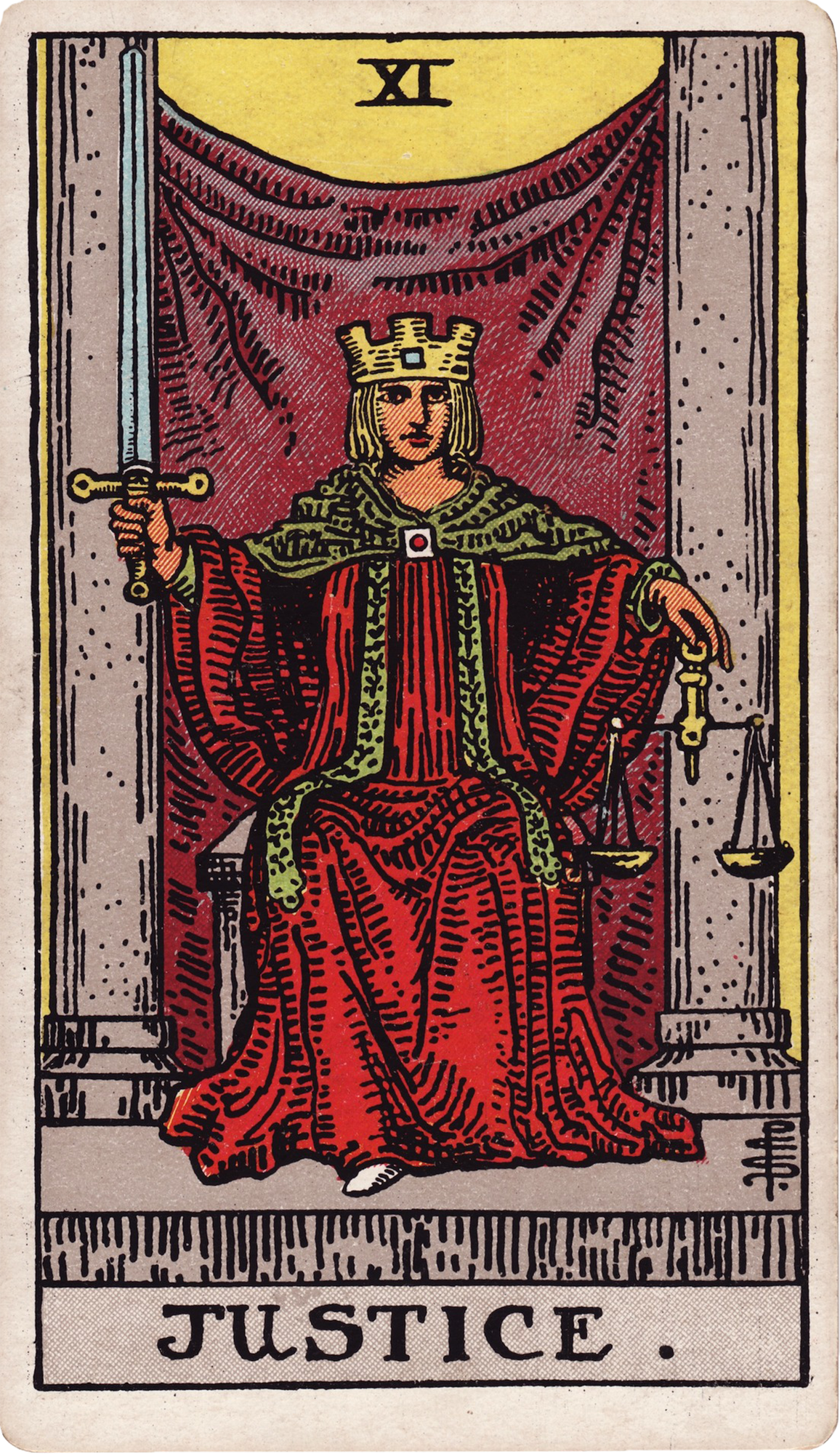 Justice
Introduction to the Justice Card Symbolism and Structure
The Justice card, traditionally numbered XI in the Major Arcana of the Rider-Waite-Smith deck, embodies the archetype of balance, truth, and fairness. Visually, it depicts a robed figure seated between two pillars, holding a sword upright in the right hand and scales in the left. The sword symbolizes clear, decisive action and intellectual clarity, while the scales represent equilibrium and weighing of evidence. The figure's gaze is direct, suggesting impartiality and the necessity of accountability. The card’s background is often a rich red curtain, symbolizing the gravity and consequence of justice delivered. This imagery sets the foundation for interpreting the card across various contexts. The upright Justice card emphasizes clarity, fairness, and accepting consequences, while the reversed position points to imbalance, bias, denial, or avoidance of accountability.
Technique for Reading the Justice Card Effectively
When Justice appears in a reading, the first step is to observe the card’s orientation—upright or reversed—and connect this with the question context. Focus on the sword and scales in the imagery as focal points representing mental clarity and balance. Notice the pillars framing the figure, which suggest structure and boundaries around decisions. A practical technique is to ask: 'Where is fairness or imbalance present in this situation?' and 'Which truths need to be acknowledged?' Avoid jumping to conclusions about outcomes; instead, treat the card as a guide to conscious decision-making processes. When reversed, ask which areas may be distorted by bias, denial, or lack of evidence. Use neighboring cards, if any, to clarify whether the reversal signals internal psychological work or external injustice. This approach helps avoid common mistakes such as assuming Justice always means legal rulings or moral absolutes—its lesson is more nuanced, emphasizing process over outcome.
Justice Card in Legal and Ethical Contexts
In legal scenarios, the Justice card upright represents a fair hearing, evidence being weighed carefully, and decisions that honor truth and responsibility. It encourages working within the system with integrity and acknowledges that consequences must be faced. The sword’s sharpness reminds the reader that decisions can cut deeply but need to be honest and clear. Reversed, Justice warns of potential miscarriages—bias, corruption, or refusal to accept legal responsibility. Ethically, the card calls for deep self-examination about fairness and accountability, urging one to address any denial or unbalanced behavior. It introduces the idea that ethical behavior is not always easy but is necessary for long-term harmony. In both arenas, the Justice card is less a predictor and more a prompt to align action with truth and responsibility.
Understanding the Justice Card in Personal Decision-Making
In personal decision contexts, Justice invites the querent to step back and weigh facts and feelings with as much objectivity as possible. The scales ask for balance—between logic and emotion, self-interest and fairness to others. The sword suggests cutting through confusion or denial to reach clarity. Upright, the card signals readiness to accept consequences and make deliberate, ethical choices. It encourages setting clear boundaries and acting with honesty. When reversed, Justice can indicate inner conflict, avoidance of responsibility, or distorted self-judgment. A practical tip is to identify what information or perspectives might be missing or suppressed. By examining the card’s imagery and symbolic elements, readers can guide querents to a more conscious, balanced approach to difficult choices.
Interpretation of Justice in Love and Relationships
In love readings, upright Justice suggests fairness, honesty, and mutual accountability within the relationship. It points to the importance of clear communication and shared values. The scales highlight balance between giving and receiving, while the sword reminds partners to address issues directly rather than avoiding conflict. This card encourages partners to create agreements that respect both parties’ needs. Reversed, the Justice card warns of unfair treatment, bias, or denial of problems in the relationship. It may expose dishonesty, imbalance in power dynamics, or avoidance of necessary conversations. The imagery encourages readers to ask where justice and fairness are lacking and what steps toward honesty and accountability can restore equilibrium.
Career and Financial Perspectives of the Justice Card
Career interpretations of Justice focus on ethical practice, fair evaluation, and responsibility. Upright, the card may reflect a performance review, contract negotiations, or decision-making that requires impartiality and clarity. It encourages working within established rules and maintaining professional integrity. The sword’s presence calls for intellectual sharpness and clear communication. Reversed, Justice might indicate workplace injustice, unfair treatment, or decisions influenced by bias or incomplete information. It serves as a reminder to seek transparency and advocate for fairness. Financially, Justice advises careful accounting and honest dealings. It cautions against shortcuts and suggests that consequences of financial actions will be felt, reinforcing the need for balance and thorough evaluation.
Justice Card as Advice and Challenge in Readings
As advice, Justice urges the querent to pursue truth and fairness in current situations. It recommends clear boundaries, direct communication, and thoughtful evaluation of facts. The card invites acceptance of consequences and a commitment to integrity, even when this path is difficult. It highlights the value of deliberate choice rather than avoidance or denial. As a challenge, Justice may appear reversed to indicate resistance to accountability, bias, or imbalance. It suggests the querent confront internal or external distortions preventing fair outcomes. The challenge lies in recognizing and addressing these blocks, whether they are psychological defenses or external pressures, to restore harmony and ethical clarity.
Representing a Person Through the Justice Card
When Justice depicts a person in a reading, it often represents someone who values fairness, honesty, and accountability—a judge, lawyer, mediator, or ethical advisor archetype. This individual is principled, balanced, and committed to truth. Upright, they exhibit integrity, clear judgment, and a willingness to face consequences. Reversed, the person may struggle with bias, denial, or manipulation, possibly avoiding responsibility or distorting facts. Visually connecting with the card’s imagery—the poised figure with scales and sword—helps the reader understand this person as a symbol of justice in embodied form, whether as a literal individual or a personality type influencing the querent’s experience.
Justice Card as Outcome and Spiritual Reflection
As an outcome, Justice signals that truth will emerge and fairness will be applied, although not always effortlessly. The sword upright promises clarity cutting through confusion, and the scales indicate eventual balance. It suggests that justice—personal or external—will be served, provided the querent acts with honesty and accountability. Reversed, the outcome warns of potential unfairness, delay, or internal resistance to accepting responsibility. Spiritually, Justice invites reflection on karma, ethical living, and the alignment of actions with universal laws. The card asks the seeker to contemplate their role in creating balance in their life and the world, emphasizing conscious choices and integrity. The figure’s centered, composed posture encourages mindfulness and deliberate action as spiritual practice.
Common Mistakes and Practical Reading Tips
Common mistakes when interpreting Justice include assuming it always signals legal outcomes or moral judgment, overlooking its emphasis on process and balance. Readers may also misinterpret the reversed card as purely negative, missing nuances such as internal psychological work or temporary delays. To avoid this, always contextualize Justice within the question and surrounding cards. Focus on the card’s key symbols—the scales, sword, pillars, and figure’s posture—to anchor interpretations. Practically, invite querents to identify how fairness and accountability manifest in their lives and what might be out of balance. Use open-ended questions to explore whether clarity is emerging or blocked. Emphasizing the card’s call for conscious, deliberate decision-making helps learners provide readings that are nuanced, ethical, and empowering.
Practice questions
• In what areas of your life are you currently called to practice greater fairness or accountability?
• How might denial or bias be affecting your ability to make clear decisions?
• What consequences are you resisting, and how could accepting them lead to growth?
• Where do you notice imbalance between logic and emotion in your personal choices?
• How do the sword and scales in the Justice card inspire you to approach conflict differently?
Comments
Sign in to comment.
Continue learning
Interpreting the Dance of Justice and The Devil: Balancing Morality and Temptation in Tarot Readings
The combination of Justice and The Devil in tarot presents a profound exploration of morality, temptation, and personal accountability. This article unpacks how these cards influen...
Mastering Decision Making with the Five Card Cross Tarot Spread
The Five Card Cross Tarot Spread is a powerful tool for deepening decision-making skills by examining the present situation, past influences, future possibilities, challenges, and...
Enhancing Clarity in Complex Choices with the Five Card Cross Tarot Spread
The Five Card Cross Tarot Spread is a practical tool designed to clarify complex choices by breaking down the decision into manageable parts. This article explores each position in...
Using the Five Card Cross Spread to Make Confident Life Decisions
The Five Card Cross spread is a practical and insightful tarot layout designed to assist with complex life decisions by clarifying the situation, presenting options, uncovering hid...
Making Confident Life Choices with the Five Card Cross Tarot Spread
The Five Card Cross Tarot Spread is a powerful tool designed to aid practical decision-making, particularly within family or life-altering situations. This article explains the spr...
Using the Five Card Cross Tarot Spread to Gain Confidence in Difficult Decisions
The Five Card Cross spread is a powerful practical tool for navigating difficult decisions with confidence. By placing cards in positions representing Situation, Option A, Option B...
Using the Five Card Cross Spread to Gain Clarity in Difficult Life Decisions
The Five Card Cross Spread is a structured tarot layout designed to help clarify challenging life decisions by examining the situation, options, hidden influences, and advice. This...
Using the Five Card Cross Spread to Clarify Complex Decisions
The Five Card Cross Spread is a practical tarot method designed to clarify complex decisions by laying out the situation, contrasting options, hidden factors, and advice. This arti...
Using the Five Card Cross Spread to Gain Insight into Relationship Dynamics
This article provides an in-depth guide to using the Five Card Cross Spread for gaining clarity on relationship dynamics, especially within family contexts. Anchored by a worked ex...
Using the Five Card Cross Spread to Make Balanced and Informed Life Decisions
The Five Card Cross Spread is a powerful Tarot layout designed to aid balanced and informed decision-making. This article teaches learners how to use this spread effectively, focus...