
Understanding The Justice Card in Legal Ethical and Personal Decision Making
The Justice card in Tarot embodies fairness, truth, and accountability, serving as a powerful symbol for balanced decision-making. This article explores its upright and reversed meanings in the context of love, career, money, advice, challenges, personal traits, outcomes, and spiritual reflection. Using traditional Rider-Waite-Smith symbolism, readers learn to connect the card’s visual cues—such as the scales and sword—to practical interpretations. Emphasis is placed on the card’s role in promoting clear boundaries, accepting consequences, and confronting bias. The article provides techniques for integrating the Justice card’s lessons into readings, common interpretive pitfalls, and reflective questions to deepen understanding. This resource guides learners in applying Justice’s energies thoughtfully and consciously across varied life domains.
Cards explored in this article
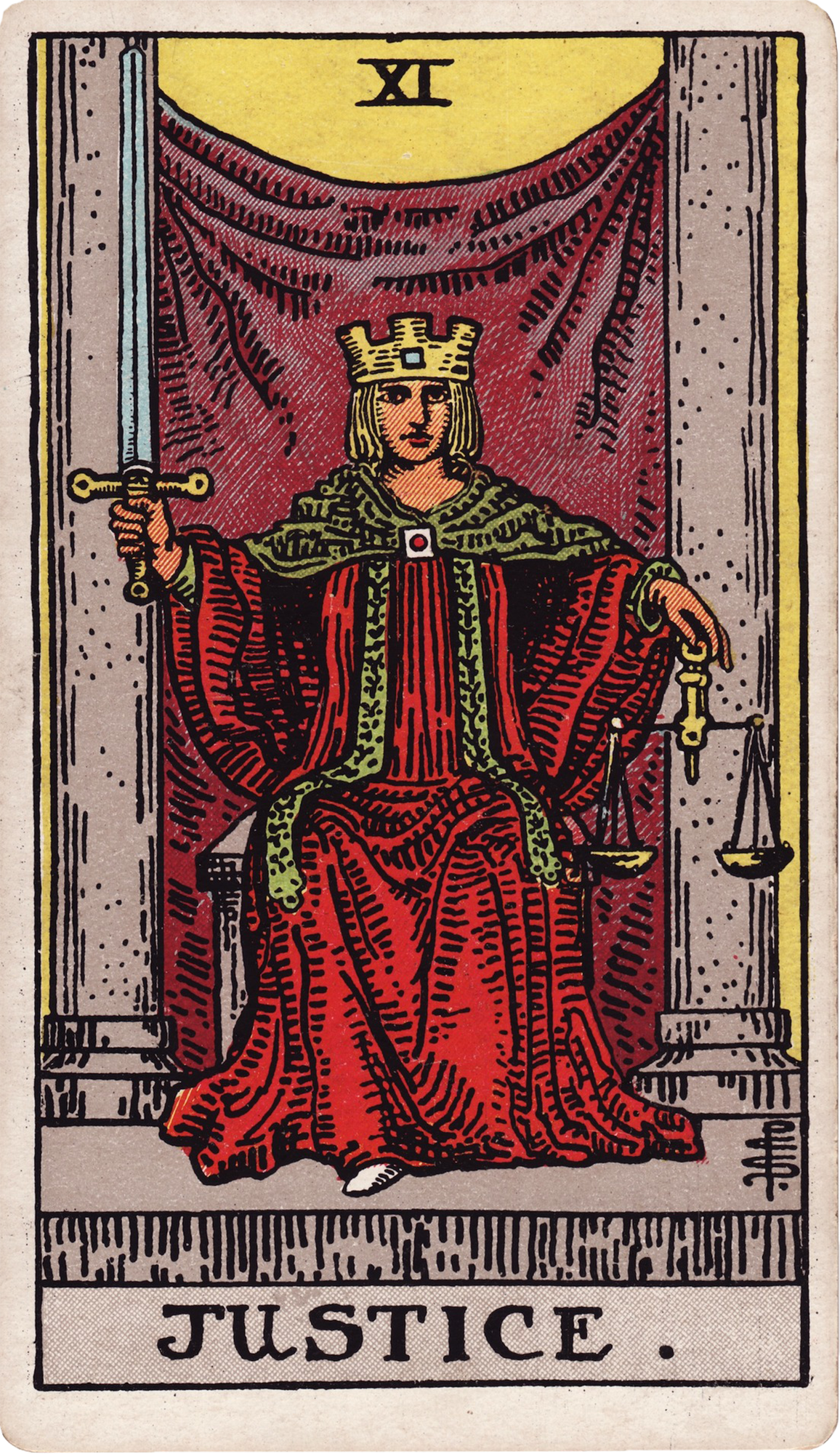 Justice
Introduction to the Justice Card and Its Symbolism
The Justice card, traditionally numbered XI in the Rider-Waite-Smith Tarot deck, is rich with symbolism that emphasizes fairness, balance, truth, and law. The imagery typically includes a seated figure holding scales in one hand and a double-edged sword in the other, representing impartial judgment and the power to enforce decisions. The scales symbolize weighing facts and evidence, while the sword denotes clarity of mind, intellect, and the consequences that follow decisions. The figure’s direct gaze and upright posture convey honesty and integrity. The Justice card invites us to consider how truth and fairness operate not only in external systems like law but also in our internal moral compass. It reminds us that decisions carry consequences and that accountability is an essential aspect of growth.
Upright Justice Card Meaning and Practical Reading Approach
When Justice appears upright, it emphasizes clarity, fairness, and the acceptance of consequences. The card encourages readers to focus on available facts and make balanced decisions without bias or avoidance. In practical readings, this means identifying where honesty, clearer boundaries, or a more deliberate choice can move a situation forward. Justice does not promise that the situation will be easy or outcomes favorable, but rather that the process will be just and stand up to scrutiny. A useful technique when Justice appears upright is to examine which part of the card’s lessons are already present in the querent’s behavior and which require strengthening. For example, is the person already fairly assessing all sides, or do they need to adopt a clearer boundary? Rather than waiting for complete certainty, the card suggests taking the next proportionate step guided by fairness and truth.
Reversed Justice Card Meaning and Interpretation Nuances
Justice reversed often signals distortions in fairness and truth. This can manifest as bias, denial, avoidance of accountability, or premature decisions made without sufficient evidence. However, a reversed Justice card is not inherently negative but rather points to blocked or delayed upright qualities. It might indicate internalized issues such as self-deception or exaggerated rigidity. In some cases, reversal highlights a psychological or private struggle with fairness and honesty, signaling the beginning of recognition of old patterns before full change. When Justice appears reversed, readers should ask where energy is becoming distorted or inaccessible. Looking at neighboring cards can clarify whether the reversal speaks to resistance, recovery, imbalance, or a pause in progress. This nuanced view helps avoid simplistic interpretations focused solely on misfortune.
Justice Card in Legal Contexts
In legal or judicial readings, the Justice card prominently reflects issues of law, contract, or ethical judgment. Upright Justice suggests that the facts are visible, and a fair, balanced decision is either being made or is imminent. This card encourages adherence to legal principles and ethical standards, signaling that the situation requires clear evaluation and acceptance of consequences. The imagery of scales and sword reminds readers of evidence weighing and the enforcement of rulings. Reversed Justice in legal contexts may indicate bias in judgment, miscarriage of justice, or denial of accountability by involved parties. It can also point to legal delays or unfair treatment. Readers should be cautious to consider whether the reversal signals internal conflict about the situation or external corruption affecting outcomes.
Justice Card in Ethical Decision Making
Ethically, the Justice card calls for honest self-reflection and the courage to face consequences fairly. Upright, it emphasizes integrity, transparency, and the need to uphold moral principles consistently. It encourages decision-makers to weigh all sides impartially and avoid shortcuts or favoritism. The sword’s symbolism highlights the necessity of clear, rational thinking devoid of emotional distortion. When reversed, the card warns of ethical blind spots such as unconscious bias, denial of wrongdoing, or failure to take responsibility. It invites the reader to identify where ethical standards may be compromised or ignored. This card’s presence in an ethical context challenges individuals or organizations to revisit their values and ensure actions align with principles of justice and fairness.
Justice Card in Personal Decision Making
On a personal level, the Justice card urges clarity and honesty in making choices that affect oneself and others. The upright card suggests the querent is positioned to evaluate situations realistically and accept the outcomes of their decisions. The scales encourage balancing emotions with reason, while the sword reminds that decisions may have consequences that require accountability. The card invites reflection on whether the person is applying consistent standards to themselves and others. When reversed, Justice signals possible self-deception, denial, or avoidance of responsibility. It may highlight internal conflicts about fairness or difficulty accessing the truth. Personal readings can use the card as a prompt to examine where bias or imbalance is affecting decisions and how to restore equilibrium.
Justice Card in Love and Relationships
In love readings, Justice upright often points to the need for fairness, honesty, and clear communication within relationships. It encourages partners to look at issues objectively, accept their roles and responsibilities, and make deliberate choices about boundaries and commitments. The card suggests that justice will prevail in relational dynamics if both parties are willing to engage with integrity. Reversed Justice in this context may highlight unfair treatment, imbalance of power, or denial of problems. It can indicate one partner avoiding accountability or biased perceptions clouding the relationship. Readers should explore where honesty is lacking and whether deeper reflection or external mediation is needed to move forward.
Justice Card in Career and Money
Justice in career readings stresses ethical conduct, transparency, and fair evaluation of work or financial matters. Upright, it may indicate that merit is being recognized or that contracts and agreements will be honored. It advises making decisions grounded in fact rather than wishful thinking. The sword and scales symbolize the need for balance between ambition and fairness to colleagues or clients. Reversed Justice can warn of workplace bias, unfair treatment, or unethical financial practices. It may also signal delays or disputes that require careful scrutiny. In money readings, the card encourages responsible management and accountability for financial choices, discouraging shortcuts or deceptive approaches.
Justice Card as Advice and Challenge
As advice, the Justice card calls for clear boundaries, honesty, and a deliberate approach to decisions. It asks the querent to face reality straightforwardly, weigh all evidence without prejudice, and act with integrity. The card challenges avoidance of accountability or emotional denial. It encourages stepping into responsibility even when outcomes are difficult. When appearing reversed as a challenge, it highlights internal resistance to fairness or external circumstances that obscure truth. The querent may need to explore unconscious biases or seek deeper clarity before proceeding. Both positions remind readers that justice is a dynamic process requiring ongoing reflection and courage.
Justice Card Representing a Person
When Justice represents a person in a reading, it often describes someone embodying fairness, integrity, and clear judgment. This individual is likely to be logical, honest, and principled, perhaps holding a profession related to law, ethics, or administration. The person will have a strong sense of responsibility and expect accountability from themselves and others. If Justice appears reversed describing a person, it could indicate someone struggling with bias, denial, or inflexibility. They may be avoiding accountability or exhibiting unfair behavior. Understanding this helps readers interpret interpersonal dynamics and the influence of such a figure in the querent’s life.
Justice Card as an Outcome and Spiritual Reflection
As an outcome card, upright Justice suggests that fairness and truth will ultimately govern the situation. The results may require acceptance of consequences, but they will be just and transparent. It encourages trust in the process of balanced judgment. Reversed, it warns that outcomes may be delayed, unfair, or obscured by bias. The querent may need to prepare for continued reflection or reassessment. Spiritually, the Justice card reflects the universal principle of karma—actions have consequences that align with truth and fairness. It invites the reader to cultivate honesty with self and others and to seek balance between heart and mind. Reversed Justice in spiritual reflection highlights inner work needed to clear distortions in perception and to restore integrity.
Common Mistakes and Practical Reading Tips
A frequent mistake when interpreting Justice is assuming it guarantees a positive or ‘fair’ outcome in the querent’s favor. Instead, Justice emphasizes the quality of the decision-making process and the integrity of outcomes regardless of whether they are personally desirable. Another error is treating the reversed card as purely negative; it often highlights subtle blocks or transitions rather than outright failure. Practically, readers should anchor interpretations in the card’s imagery—the scales and sword provide constant reminders to weigh evidence carefully and to consider consequences clearly. Always contextualize the card within the question and adjacent cards rather than isolating it. Asking reflective questions such as ‘Where is fairness blocked or needed?’ or ‘How can honesty clarify this situation?’ helps integrate Justice’s lessons constructively.
Practice questions
• Where in my life am I currently needing to apply clearer boundaries or deeper honesty?
• How do I weigh facts versus emotions when making important decisions?
• In what areas might I be avoiding accountability or denying unfairness?
• What biases might be influencing my perception of justice in a given situation?
• How can I align my personal values with the principle of fairness represented by the Justice card?
Comments
Sign in to comment.
Continue learning
Interpreting the Dance of Justice and The Devil: Balancing Morality and Temptation in Tarot Readings
The combination of Justice and The Devil in tarot presents a profound exploration of morality, temptation, and personal accountability. This article unpacks how these cards influen...
Mastering Decision Making with the Five Card Cross Tarot Spread
The Five Card Cross Tarot Spread is a powerful tool for deepening decision-making skills by examining the present situation, past influences, future possibilities, challenges, and...
Enhancing Clarity in Complex Choices with the Five Card Cross Tarot Spread
The Five Card Cross Tarot Spread is a practical tool designed to clarify complex choices by breaking down the decision into manageable parts. This article explores each position in...
Using the Five Card Cross Spread to Make Confident Life Decisions
The Five Card Cross spread is a practical and insightful tarot layout designed to assist with complex life decisions by clarifying the situation, presenting options, uncovering hid...
Making Confident Life Choices with the Five Card Cross Tarot Spread
The Five Card Cross Tarot Spread is a powerful tool designed to aid practical decision-making, particularly within family or life-altering situations. This article explains the spr...
Using the Five Card Cross Tarot Spread to Gain Confidence in Difficult Decisions
The Five Card Cross spread is a powerful practical tool for navigating difficult decisions with confidence. By placing cards in positions representing Situation, Option A, Option B...
Using the Five Card Cross Spread to Gain Clarity in Difficult Life Decisions
The Five Card Cross Spread is a structured tarot layout designed to help clarify challenging life decisions by examining the situation, options, hidden influences, and advice. This...
Using the Five Card Cross Spread to Clarify Complex Decisions
The Five Card Cross Spread is a practical tarot method designed to clarify complex decisions by laying out the situation, contrasting options, hidden factors, and advice. This arti...
Using the Five Card Cross Spread to Gain Insight into Relationship Dynamics
This article provides an in-depth guide to using the Five Card Cross Spread for gaining clarity on relationship dynamics, especially within family contexts. Anchored by a worked ex...
Using the Five Card Cross Spread to Make Balanced and Informed Life Decisions
The Five Card Cross Spread is a powerful Tarot layout designed to aid balanced and informed decision-making. This article teaches learners how to use this spread effectively, focus...