
Understanding the Many Facets of the Justice Card in Everyday Decision Making
The Justice card is a powerful symbol of fairness, accountability, and clarity in decision making. This article explores how the card's upright and reversed meanings adapt to multiple everyday contexts including love, career, money, advice, challenges, personality traits, outcomes, and spiritual reflection. Drawing on the Rider-Waite-Smith imagery, readers will learn to identify the card’s lessons about honesty, consequences, and balance. Practical techniques for reading Justice emphasize working with what is visible now and asking constructive questions rather than predicting fixed results. This single-card context lesson deepens understanding of Justice’s guidance for fair decisions that withstand scrutiny in daily life.
Cards explored in this article
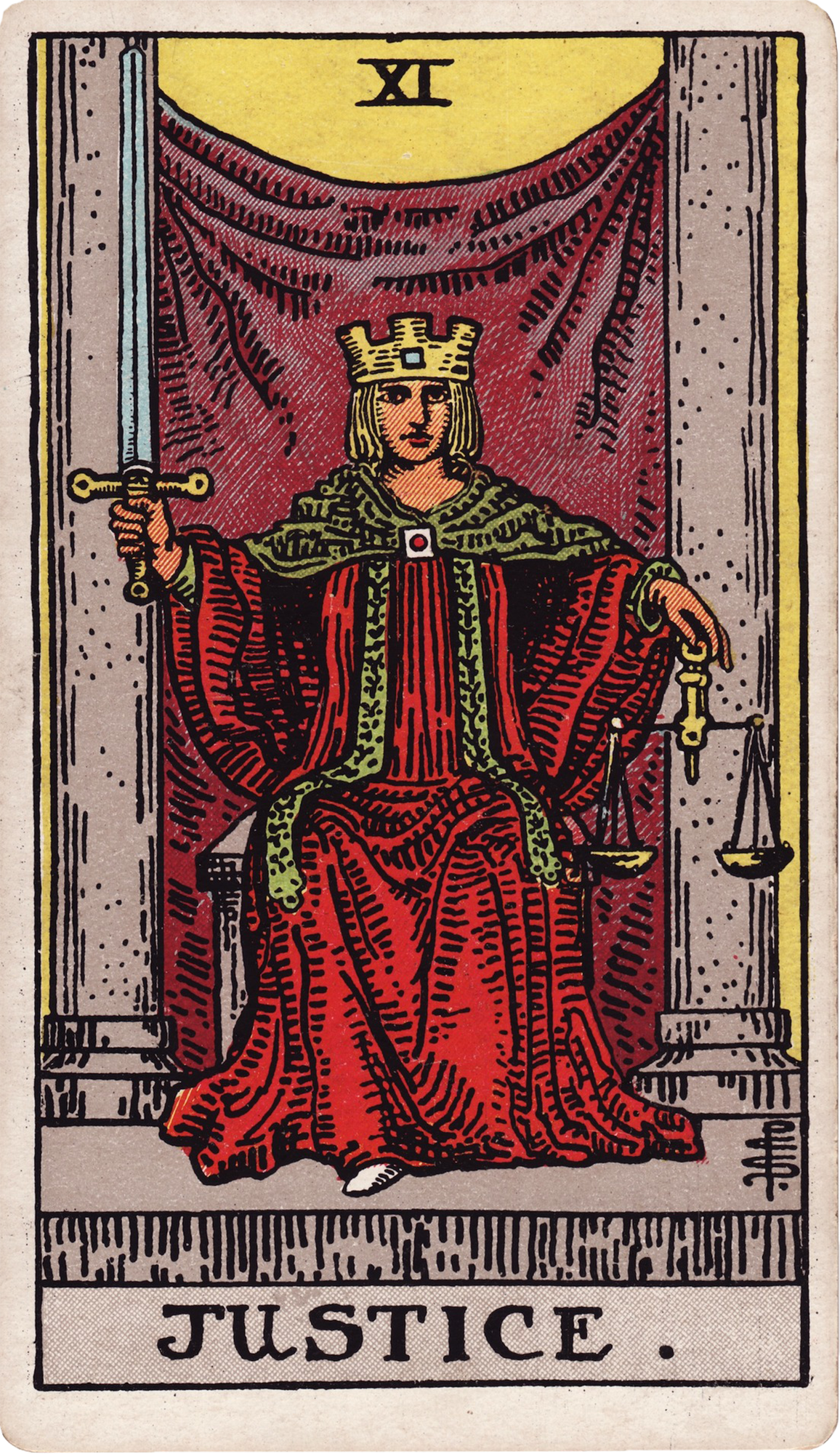 Justice
Introduction to Justice in Tarot and Everyday Decision Making
The Justice card, traditionally numbered XI in the Major Arcana of the Rider-Waite-Smith deck, represents the principles of fairness, truth, and cause and effect. Visually, it depicts a seated figure holding a balanced scale in one hand and a sword in the other, symbolizing impartial judgment and clarity. When Justice appears in a reading, it encourages us to look clearly at the facts, accept consequences, and make decisions that can stand up to scrutiny. This article explores how the Justice card’s meanings shift and deepen when applied to everyday contexts such as love, career, money, advice, challenges, personality reflections, outcomes, and spiritual growth. By focusing on the single card Justice and its upright and reversed positions, learners can build nuanced interpretations anchored in the card’s rich symbolism.
Reading Justice Upright and Reversed in Practical Terms
Upright, Justice asks you to engage with the reality of a situation using clarity and fairness. It does not promise an easy resolution but highlights the quality of balanced judgment. When upright, Justice suggests it is time to respond directly, set clear boundaries, be honest, and choose deliberately. It encourages working with the facts at hand and taking the next proportionate step toward resolution. Reversed, Justice directs attention to bias, denial, or unfair treatment. The card in reverse may show that the upright principles are blocked, internalized, or exaggerated. It often signals that accountability is being avoided or that critical information is missing. Instead of expecting a negative outcome, the reversed Justice invites the question: where is fairness or clarity distorted or difficult to access? This foundational understanding allows readers to apply Justice meaningfully across different contexts.
Justice in Love and Relationships
When Justice appears upright in a love reading, it encourages clear communication and fairness in the relationship. This means honest conversations about expectations, boundaries, and responsibilities. The balanced scales remind us that love thrives in mutual respect and accountability. The sword encourages cutting through illusions or denial regarding feelings or situation dynamics. For example, if a couple faces a conflict, Justice invites both parties to look at the facts, accept responsibility for their part, and seek a fair resolution. In reversed position, Justice may reveal bias, denial, or imbalance. Perhaps one partner is avoiding accountability or there is an unfair dynamic such as favoritism or dishonesty. This reversal urges the querent to reflect internally: Are they overlooking their own role in relationship challenges? Are they tolerating unfair treatment? Thus, Justice in love challenges us to cultivate fairness and honesty, both outwardly and inwardly.
Justice in Career and Work Decisions
In career contexts, the upright Justice card symbolizes integrity and ethical decision making. It encourages assessing situations based on clear facts, recognizing consequences, and making choices that will hold up under professional scrutiny. The imagery of the scales implies weighing options carefully and the sword suggests decisive action once the facts are clear. For example, if considering a job offer or workplace conflict, Justice asks: Are you evaluating the situation fairly and without bias? Are you ready to accept the consequences of your decision? Reversed, Justice may indicate workplace unfairness, bias, or avoidance of accountability. It could suggest a situation where information is incomplete or where favoritism or dishonesty skew perception. A reversed Justice warns against rash decisions without sufficient evidence and advises the querent to uncover hidden truths or address internal resistance before acting.
Justice and Financial Choices
When Justice appears regarding money matters, it urges responsibility, transparency, and fairness in financial decisions. The balanced scales remind us to weigh income, expenses, debts, and investments honestly and objectively. The sword symbolizes cutting through illusions such as wishful thinking or denial about financial realities. Upright Justice encourages working within current means and accepting the consequences of past financial behavior to move forward conscientiously. Reversed, the card can point to financial imbalance, denial of debts, or unfair treatment by others (such as disputes or hidden fees). It may also indicate internal resistance to facing financial truths or a tendency toward impulsive decisions without clear information. Justice reverses teaches the value of accountability and clear-eyed assessment in money matters.
Justice as Advice and Challenge
As advice, the Justice card instructs the querent to embrace honesty, seek fairness, and be willing to accept responsibility. It suggests deliberate and proportionate action based on clear evidence rather than emotion or wishful thinking. The card invites the reader to ask: What would a fair and balanced response look like in this situation? Where do I need to establish clearer boundaries or deeper honesty? As a challenge, Justice may highlight where fairness is lacking or where accountability is being avoided. It can expose bias, denial, or internal resistance to facing truths. The challenge is to confront these distortions and engage consciously with the facts. Practically, when Justice appears as a challenge, it encourages reframing from victimhood or blame to constructive ownership of one’s role.
Justice as a Person in the Reading
When Justice represents a person in a reading, it often describes someone who embodies qualities of fairness, integrity, and clear judgment. This person is likely to be logical, honest, and principled, valuing truth and balance in their interactions. They may hold roles requiring impartiality such as judge, mediator, lawyer, or counselor. The sword suggests sharp intellect and decisiveness. If reversed, this personality may be struggling with bias, denial, or internal conflict about fairness. They might avoid accountability or have difficulties being honest with themselves or others. Recognizing these traits helps the reader understand interpersonal dynamics or internal states reflected by Justice as a person.
Justice as an Outcome and in Spiritual Reflection
Justice as an outcome card signals that situations will resolve through balanced decisions, fairness, and acceptance of consequences. It emphasizes outcomes that are just and equitable rather than necessarily easy or comfortable. The sword and scales indicate clarity and moral integrity in the results. The querent is encouraged to trust the process of cause and effect and to be patient while fairness unfolds. In spiritual reflection, Justice guides the seeker to examine their personal karma, ethical values, and inner truth. It urges deeper honesty with oneself and others and conscious choice aligned with integrity. The card invites reflection on where balance is needed in life and how embracing accountability supports spiritual growth. Reversed Justice in spiritual work may reveal shadow aspects such as denial, projection, or resistance to inner truth that require healing attention.
Common Mistakes and Practical Reading Techniques
A frequent mistake with Justice is treating it as a simple 'yes or no' or 'good or bad' card. Instead, Justice is about nuanced qualities of fairness, accountability, and clarity in context. Readers should avoid predicting automatic positive or negative outcomes solely based on upright or reversed position. Instead, focus on questions like: Where is fairness present or blocked? How is accountability being accepted or avoided? Another common error is ignoring the card’s demand to work with what is visible now rather than waiting for certainty. Practically, when Justice appears, look carefully at the facts in the querent’s situation, identify where boundaries or honesty are needed, and pinpoint the next deliberate step. Anchor interpretation repeatedly to the card’s imagery: the balanced scales represent weighing facts without bias, and the sword symbolizes intellectual clarity and cutting through illusions. This visual connection grounds reading logic and enriches meaning.
Practice questions
• In what areas of my life am I currently called to embrace fairness and accountability?
• Where might I be avoiding clear judgment or denying important facts?
• How do I balance honesty with compassion in my decisions?
• What consequences am I prepared to accept to move forward constructively?
• How can I apply the principle of Justice to improve my relationships, career, or finances?
• What internal biases or distortions might be blocking my ability to be just?
• In what ways can I cultivate deeper personal integrity and clear boundaries?
Comments
Sign in to comment.
Continue learning
Interpreting the Dance of Justice and The Devil: Balancing Morality and Temptation in Tarot Readings
The combination of Justice and The Devil in tarot presents a profound exploration of morality, temptation, and personal accountability. This article unpacks how these cards influen...
Mastering Decision Making with the Five Card Cross Tarot Spread
The Five Card Cross Tarot Spread is a powerful tool for deepening decision-making skills by examining the present situation, past influences, future possibilities, challenges, and...
Enhancing Clarity in Complex Choices with the Five Card Cross Tarot Spread
The Five Card Cross Tarot Spread is a practical tool designed to clarify complex choices by breaking down the decision into manageable parts. This article explores each position in...
Using the Five Card Cross Spread to Make Confident Life Decisions
The Five Card Cross spread is a practical and insightful tarot layout designed to assist with complex life decisions by clarifying the situation, presenting options, uncovering hid...
Making Confident Life Choices with the Five Card Cross Tarot Spread
The Five Card Cross Tarot Spread is a powerful tool designed to aid practical decision-making, particularly within family or life-altering situations. This article explains the spr...
Using the Five Card Cross Tarot Spread to Gain Confidence in Difficult Decisions
The Five Card Cross spread is a powerful practical tool for navigating difficult decisions with confidence. By placing cards in positions representing Situation, Option A, Option B...
Using the Five Card Cross Spread to Gain Clarity in Difficult Life Decisions
The Five Card Cross Spread is a structured tarot layout designed to help clarify challenging life decisions by examining the situation, options, hidden influences, and advice. This...
Using the Five Card Cross Spread to Clarify Complex Decisions
The Five Card Cross Spread is a practical tarot method designed to clarify complex decisions by laying out the situation, contrasting options, hidden factors, and advice. This arti...
Using the Five Card Cross Spread to Gain Insight into Relationship Dynamics
This article provides an in-depth guide to using the Five Card Cross Spread for gaining clarity on relationship dynamics, especially within family contexts. Anchored by a worked ex...
Using the Five Card Cross Spread to Make Balanced and Informed Life Decisions
The Five Card Cross Spread is a powerful Tarot layout designed to aid balanced and informed decision-making. This article teaches learners how to use this spread effectively, focus...