
Community
Moon
Moon Rituals for Each Phase

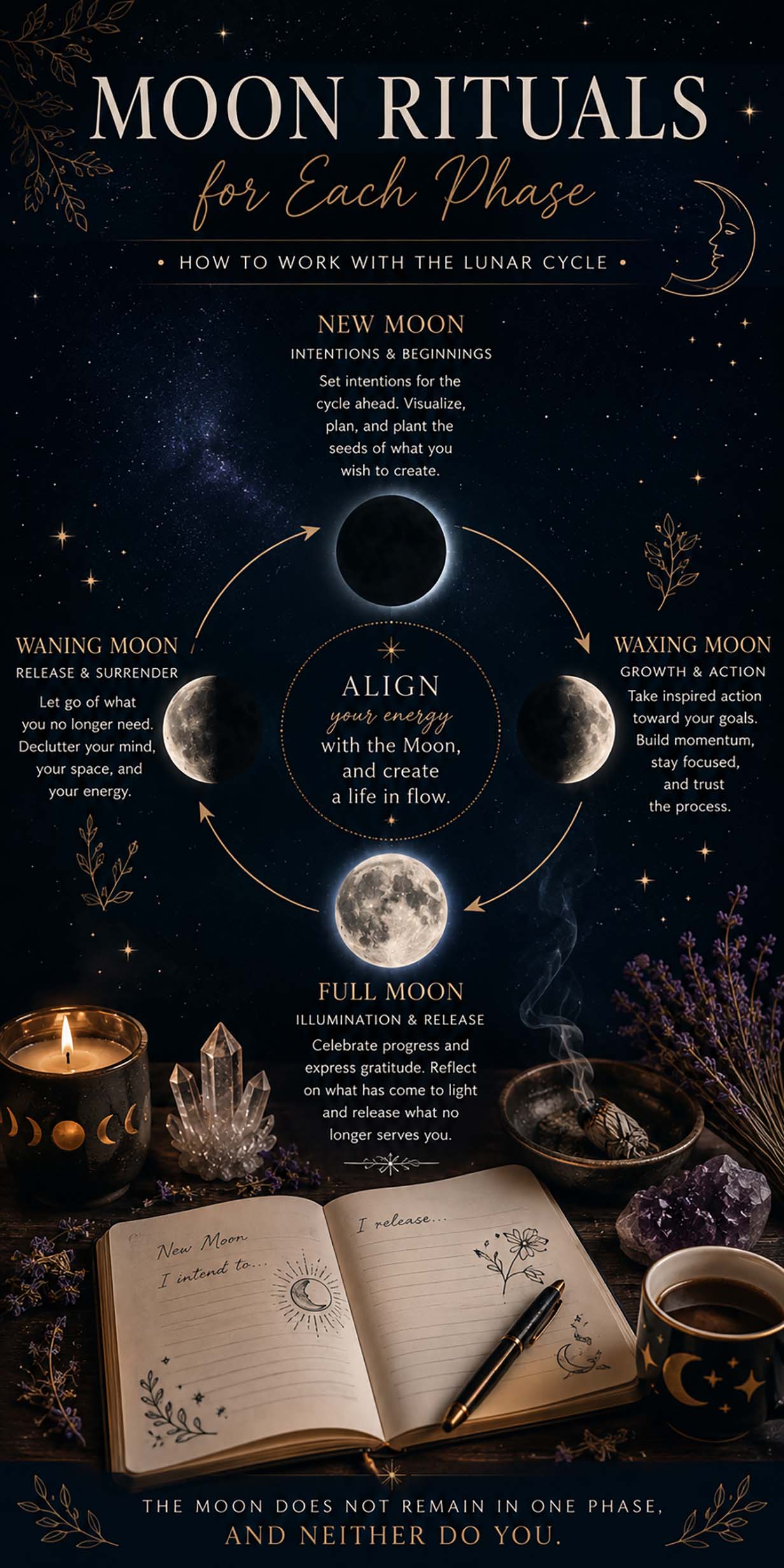
The Moon has always been one of the most powerful symbols of change. Night after night, it moves from darkness into light and then gradually disappears again, creating a natural rhythm that has influenced spiritual traditions, calendars, agriculture, mythology, and personal rituals for centuries. Today, many people use the lunar cycle as a simple way to structure reflection, intention setting, emotional awareness, and personal growth. You do not need to believe that the Moon directly controls your life in order to find value in this practice. The changing phases can simply become meaningful checkpoints that encourage you to stop, look at where you are, and decide what needs to happen next.
A complete lunar cycle lasts around twenty-nine and a half days. During that time, the Moon moves through several visible stages, but most modern Moon rituals focus on four main phases: the New Moon, the Waxing Moon, the Full Moon, and the Waning Moon. Each phase represents a different part of a larger cycle. The New Moon is associated with beginnings and intentions, the Waxing Moon with growth and action, the Full Moon with illumination and culmination, and the Waning Moon with release and completion. Together, these phases create a useful rhythm: begin, build, understand, release, and then begin again.
The beauty of a Moon ritual is that it does not have to be complicated. You do not need an elaborate altar or a collection of spiritual tools. A ritual may be as simple as lighting a candle, sitting quietly for a few minutes, writing in a journal, pulling a tarot card, or making a conscious decision about something you want to change. What turns an ordinary activity into a ritual is intention. You are deliberately creating a moment in which you step away from everyday distractions and pay closer attention to yourself.
Before beginning any Moon ritual, it can help to create a small transition between ordinary life and your reflective time. Put your phone away, lower the lights, make a cup of tea, light a candle, or sit beside a window. Take several slow breaths and notice how you feel physically, emotionally, and mentally. There is no need to immediately fix anything. The first purpose of the ritual is simply to become aware of what is already present.
The New Moon marks the beginning of the lunar cycle. At this point, the Moon is positioned between the Earth and the Sun, which means that its illuminated side is largely hidden from our view. Symbolically, this darkness is often treated as an empty space before something new begins. The New Moon is therefore traditionally associated with new intentions, new projects, fresh decisions, and the possibility of changing direction.
A useful New Moon ritual begins with a simple question: what do I want to begin? This sounds straightforward, but it can reveal more than expected. Many people move from one responsibility to another without stopping to consider whether the direction they are moving in still suits them. The New Moon offers an opportunity to look at areas such as relationships, work, money, creativity, home, wellbeing, confidence, or spiritual development and decide where your attention is needed most.
Rather than creating a long list of vague wishes, it is usually more useful to choose one to five intentions that feel realistic and personally meaningful. For example, instead of writing, "I want to be more confident," you might write, "I want to become more comfortable expressing what I need instead of automatically staying silent." Instead of saying, "I want more money," you could focus on building a more conscious relationship with spending, saving, earning, or valuing your work. A good intention describes a direction rather than demanding a specific outcome.
Once an intention has been chosen, it helps to imagine what it would actually look like in everyday life. If you became more confident, what would you do differently? If your financial situation improved, which habits would have changed? If you wanted a healthier relationship, how would your communication look? This kind of visualization makes an intention more concrete because it shifts attention away from fantasy and toward behaviour.
The final part of a New Moon ritual should involve choosing one practical action. Every intention needs a bridge between reflection and reality. The action might be sending an email, making an appointment, starting a savings plan, beginning a course, organising a workspace, writing the first page of a project, or having a conversation you have been avoiding. The action does not need to be dramatic. Its purpose is simply to create movement.
After the New Moon, the Moon begins to grow brighter each night. This is the Waxing Moon, the period between the New Moon and the Full Moon. Symbolically, it represents development, effort, movement, commitment, and growth. If the New Moon asks what you want, the Waxing Moon asks what you are prepared to do about it.
This phase is useful for reviewing the intentions you made at the beginning of the cycle and checking whether they still matter. Sometimes a goal that felt important several days earlier already seems less relevant. That is not necessarily failure. It can simply mean that reflection has clarified what you actually want. If an intention still feels important, the Waxing Moon is the time to turn it into smaller practical actions.
For example, if your New Moon intention was to become more creative, the next step might be scheduling time to create several times during the week, completing one unfinished project, finding a dedicated workspace, or sharing your work with someone. If your intention was to improve your career, your actions might involve updating your CV, learning a new skill, applying for opportunities, or speaking with someone in your industry.
The Waxing Moon is also a useful time to pay attention to resistance. Once an idea becomes real, fear often appears. You may procrastinate, doubt yourself, compare yourself to other people, or become impatient because progress is slower than expected. Instead of treating these reactions as evidence that the goal is wrong, it can be useful to investigate them. Ask yourself what you are actually afraid of. Perhaps you fear criticism. Perhaps success would require more responsibility. Perhaps the goal is connected to an expectation that no longer belongs to you. Sometimes resistance reveals exactly where growth needs to happen.
As the lunar cycle continues, the Moon eventually becomes fully illuminated. The Full Moon is one of the most visually striking phases and has long been associated with culmination, revelation, intensity, and completion. In a personal ritual, the Full Moon can be treated as a moment of illumination. The important question is not simply whether your intentions have manifested, but what you can now see more clearly.
The Full Moon is a good time to review what has happened since the beginning of the cycle. Look back at your New Moon intentions and ask what has changed. What progress have you made? What have you learned? What surprised you? What did not work? What feels different now? Sometimes the answer will be positive. You may have taken an important step, resolved a problem, or received an opportunity. At other times, the most valuable realization may be that something you wanted is no longer right for you.
A Full Moon ritual should include celebration as well as reflection. People are often quick to notice unfinished goals but slow to recognize their own progress. Take time to acknowledge what you have handled well, even if the achievement seems small. Perhaps you set a boundary, completed a difficult task, had an honest conversation, or simply remained consistent with something that normally disappears after a few days.
This phase is also associated with emotional clarity. Feelings that were difficult to identify earlier in the month may become more obvious. You may recognize frustration, disappointment, excitement, gratitude, or resentment that has been building in the background. Journaling during the Full Moon can help bring these feelings into clearer focus. Useful questions include: what has become clearer since the New Moon, what am I proud of, what truth have I been avoiding, what deserves gratitude, and what needs to change?
The Full Moon can also be used as a point of adjustment. Your original intention does not need to remain unchanged simply because you wrote it several weeks earlier. You may continue it, modify it, simplify it, or let it go. Personal growth sometimes means changing your mind rather than forcing yourself to complete a goal that no longer fits.
After the Full Moon, the visible light begins to decrease. This is the Waning Moon. Where the Waxing Moon is associated with building, the Waning Moon is associated with reducing, clearing, simplifying, and releasing. It is a useful phase for asking what no longer needs to continue into the next cycle.
Release is often misunderstood as giving up, but the two are not the same. Something may simply have completed its purpose. A belief that once protected you may now be limiting you. A goal may belong to an older version of yourself. A relationship may have changed. A habit may have stopped serving you. An obligation may exist only because you are afraid of disappointing someone. The Waning Moon creates a symbolic opportunity to recognize these things and decide what you are ready to carry less of.
A simple Waning Moon ritual can begin by writing the sentence, "I am ready to release..." and completing it as many times as necessary. You might write about resentment, unrealistic expectations, comparison, guilt, fear, unnecessary commitments, old habits, unfinished goals, or the need to control every possible outcome. Once the list is complete, choose the item that feels most important and ask what holding onto it has been costing you.
Some people like to make this release symbolic by writing the issue on a separate piece of paper and tearing it up or safely burning it. The physical action is not supposed to magically remove the problem. Its purpose is to mark a decision. It represents the moment when you acknowledge that you no longer want to feed the same pattern in the same way.
The Waning Moon can also be used for practical clearing. Decluttering a drawer, deleting unused files, cancelling unnecessary subscriptions, clearing old emails, donating clothes, or reorganising a workspace can all become part of the ritual. Physical space and mental space are not the same thing, but small acts of clearing can help reinforce the feeling that a cycle is ending and that something new will soon have room to begin.
As the Moon becomes darker, the lunar cycle approaches the Dark Moon, the final period before the next New Moon. This is a phase that is often overlooked because people are usually more interested in manifestation, action, or dramatic Full Moon rituals. Yet rest is an important part of any cycle. Not every phase needs to be used for doing more.
The Dark Moon can simply be a time to slow down. Sleep more if you need to. Spend time alone. Walk. Read. Journal without searching for a solution. Allow things to settle. Sometimes insight appears only after we stop forcing ourselves to produce an answer. The emptiness between cycles is not wasted time. It creates space for the next beginning.
One of the most useful ways to make lunar practice meaningful over time is to keep a Moon journal. Record the date, Moon phase, your mood, your main intention, important events, tarot cards you may have drawn, actions you took, emotional shifts, lessons, and anything you decided to release. After several months, look back through the entries. Patterns often become much easier to recognise over longer periods.
You may notice that the same themes keep returning. Perhaps money appears repeatedly. Perhaps relationships, confidence, belonging, creativity, work, boundaries, or self-worth continue to surface. These repeating subjects can tell you far more about your life than a single ritual ever could. The value of lunar practice is often not found in one dramatic experience but in the accumulation of many small moments of self-observation.
For people who follow astrology, the zodiac sign in which a New Moon or Full Moon occurs can add another symbolic layer. An Aries Moon may bring attention to courage, identity, or independence, while Taurus may focus more on values, stability, money, and security. Gemini is associated with communication and learning, Cancer with home and emotional belonging, Leo with creativity and confidence, Virgo with habits and organisation, Libra with relationships and balance, Scorpio with transformation and emotional depth, Sagittarius with meaning and exploration, Capricorn with ambition and responsibility, Aquarius with individuality and community, and Pisces with intuition, imagination, and surrender.
These associations can be combined with the Moon phase itself. A New Moon in Taurus, for example, may inspire intentions concerning stability, resources, or self-worth, while a Full Moon in Taurus may encourage reflection on what has become clear or completed in those same areas. Astrology works best here as a reflective framework rather than a rigid system that has to explain every event.
Tarot can also be incorporated naturally into lunar practice. A single card is often enough. During the New Moon, you might ask what energy wants to emerge. During the Waxing Moon, ask what action will support growth. During the Full Moon, ask what is being illuminated. During the Waning Moon, ask what you are ready to release. The purpose does not have to be prediction. Tarot can simply offer another symbolic language through which to explore what you are already experiencing.
Crystals are sometimes used in the same way. Clear quartz may represent clarity and intention, amethyst reflection and intuition, rose quartz compassion and relationships, citrine confidence and abundance, black tourmaline grounding and boundaries, moonstone cycles and emotional awareness, and labradorite transformation. None of these objects are necessary. They are simply tools that some people find meaningful when creating a ritual atmosphere.
The most important thing is to keep the practice sustainable. It is easy to turn Moon rituals into another complicated task involving candles, crystals, elaborate altars, special music, specific timing, and long lists of rules. If the ritual becomes stressful, it defeats its purpose. A simple routine is often more useful. At the New Moon, write one intention. During the Waxing Moon, take one meaningful action. At the Full Moon, acknowledge one lesson and one achievement. During the Waning Moon, release one thing. That alone creates a complete monthly cycle of reflection.
It is equally important not to worry if you miss a phase. Nothing is ruined. The Moon continues to move whether or not you perform a ritual. If you miss the New Moon, set your intention during the Waxing Moon. If you forget the Full Moon, reflect the following evening. If an entire cycle passes without any practice at all, begin again with the next one. A ritual should support your life, not create another source of guilt.
Ultimately, working with the Moon is less about controlling the future and more about developing a regular relationship with change. Every month, the same basic questions return. What do I want to begin? What am I willing to work toward? What has become clear? What am I ready to release? The questions may remain the same, but the person answering them continues to change.
That is perhaps the most valuable lesson of the lunar cycle. The Moon never remains in one phase. Darkness becomes light, light becomes darkness, endings create space for beginnings, and nothing stays exactly as it is. Our own lives move in similar patterns. There are times to begin, times to push forward, times to celebrate, times to reconsider, and times to let go.
The next time you notice the Moon in the sky, use it as a reminder to check in with yourself. Ask where you are in your own cycle. Perhaps something is just beginning. Perhaps something needs more attention. Perhaps a truth is becoming impossible to ignore. Or perhaps you are simply ready to put something down.
Then, when the next New Moon arrives, you begin again.
A complete lunar cycle lasts around twenty-nine and a half days. During that time, the Moon moves through several visible stages, but most modern Moon rituals focus on four main phases: the New Moon, the Waxing Moon, the Full Moon, and the Waning Moon. Each phase represents a different part of a larger cycle. The New Moon is associated with beginnings and intentions, the Waxing Moon with growth and action, the Full Moon with illumination and culmination, and the Waning Moon with release and completion. Together, these phases create a useful rhythm: begin, build, understand, release, and then begin again.
The beauty of a Moon ritual is that it does not have to be complicated. You do not need an elaborate altar or a collection of spiritual tools. A ritual may be as simple as lighting a candle, sitting quietly for a few minutes, writing in a journal, pulling a tarot card, or making a conscious decision about something you want to change. What turns an ordinary activity into a ritual is intention. You are deliberately creating a moment in which you step away from everyday distractions and pay closer attention to yourself.
Before beginning any Moon ritual, it can help to create a small transition between ordinary life and your reflective time. Put your phone away, lower the lights, make a cup of tea, light a candle, or sit beside a window. Take several slow breaths and notice how you feel physically, emotionally, and mentally. There is no need to immediately fix anything. The first purpose of the ritual is simply to become aware of what is already present.
The New Moon marks the beginning of the lunar cycle. At this point, the Moon is positioned between the Earth and the Sun, which means that its illuminated side is largely hidden from our view. Symbolically, this darkness is often treated as an empty space before something new begins. The New Moon is therefore traditionally associated with new intentions, new projects, fresh decisions, and the possibility of changing direction.
A useful New Moon ritual begins with a simple question: what do I want to begin? This sounds straightforward, but it can reveal more than expected. Many people move from one responsibility to another without stopping to consider whether the direction they are moving in still suits them. The New Moon offers an opportunity to look at areas such as relationships, work, money, creativity, home, wellbeing, confidence, or spiritual development and decide where your attention is needed most.
Rather than creating a long list of vague wishes, it is usually more useful to choose one to five intentions that feel realistic and personally meaningful. For example, instead of writing, "I want to be more confident," you might write, "I want to become more comfortable expressing what I need instead of automatically staying silent." Instead of saying, "I want more money," you could focus on building a more conscious relationship with spending, saving, earning, or valuing your work. A good intention describes a direction rather than demanding a specific outcome.
Once an intention has been chosen, it helps to imagine what it would actually look like in everyday life. If you became more confident, what would you do differently? If your financial situation improved, which habits would have changed? If you wanted a healthier relationship, how would your communication look? This kind of visualization makes an intention more concrete because it shifts attention away from fantasy and toward behaviour.
The final part of a New Moon ritual should involve choosing one practical action. Every intention needs a bridge between reflection and reality. The action might be sending an email, making an appointment, starting a savings plan, beginning a course, organising a workspace, writing the first page of a project, or having a conversation you have been avoiding. The action does not need to be dramatic. Its purpose is simply to create movement.
After the New Moon, the Moon begins to grow brighter each night. This is the Waxing Moon, the period between the New Moon and the Full Moon. Symbolically, it represents development, effort, movement, commitment, and growth. If the New Moon asks what you want, the Waxing Moon asks what you are prepared to do about it.
This phase is useful for reviewing the intentions you made at the beginning of the cycle and checking whether they still matter. Sometimes a goal that felt important several days earlier already seems less relevant. That is not necessarily failure. It can simply mean that reflection has clarified what you actually want. If an intention still feels important, the Waxing Moon is the time to turn it into smaller practical actions.
For example, if your New Moon intention was to become more creative, the next step might be scheduling time to create several times during the week, completing one unfinished project, finding a dedicated workspace, or sharing your work with someone. If your intention was to improve your career, your actions might involve updating your CV, learning a new skill, applying for opportunities, or speaking with someone in your industry.
The Waxing Moon is also a useful time to pay attention to resistance. Once an idea becomes real, fear often appears. You may procrastinate, doubt yourself, compare yourself to other people, or become impatient because progress is slower than expected. Instead of treating these reactions as evidence that the goal is wrong, it can be useful to investigate them. Ask yourself what you are actually afraid of. Perhaps you fear criticism. Perhaps success would require more responsibility. Perhaps the goal is connected to an expectation that no longer belongs to you. Sometimes resistance reveals exactly where growth needs to happen.
As the lunar cycle continues, the Moon eventually becomes fully illuminated. The Full Moon is one of the most visually striking phases and has long been associated with culmination, revelation, intensity, and completion. In a personal ritual, the Full Moon can be treated as a moment of illumination. The important question is not simply whether your intentions have manifested, but what you can now see more clearly.
The Full Moon is a good time to review what has happened since the beginning of the cycle. Look back at your New Moon intentions and ask what has changed. What progress have you made? What have you learned? What surprised you? What did not work? What feels different now? Sometimes the answer will be positive. You may have taken an important step, resolved a problem, or received an opportunity. At other times, the most valuable realization may be that something you wanted is no longer right for you.
A Full Moon ritual should include celebration as well as reflection. People are often quick to notice unfinished goals but slow to recognize their own progress. Take time to acknowledge what you have handled well, even if the achievement seems small. Perhaps you set a boundary, completed a difficult task, had an honest conversation, or simply remained consistent with something that normally disappears after a few days.
This phase is also associated with emotional clarity. Feelings that were difficult to identify earlier in the month may become more obvious. You may recognize frustration, disappointment, excitement, gratitude, or resentment that has been building in the background. Journaling during the Full Moon can help bring these feelings into clearer focus. Useful questions include: what has become clearer since the New Moon, what am I proud of, what truth have I been avoiding, what deserves gratitude, and what needs to change?
The Full Moon can also be used as a point of adjustment. Your original intention does not need to remain unchanged simply because you wrote it several weeks earlier. You may continue it, modify it, simplify it, or let it go. Personal growth sometimes means changing your mind rather than forcing yourself to complete a goal that no longer fits.
After the Full Moon, the visible light begins to decrease. This is the Waning Moon. Where the Waxing Moon is associated with building, the Waning Moon is associated with reducing, clearing, simplifying, and releasing. It is a useful phase for asking what no longer needs to continue into the next cycle.
Release is often misunderstood as giving up, but the two are not the same. Something may simply have completed its purpose. A belief that once protected you may now be limiting you. A goal may belong to an older version of yourself. A relationship may have changed. A habit may have stopped serving you. An obligation may exist only because you are afraid of disappointing someone. The Waning Moon creates a symbolic opportunity to recognize these things and decide what you are ready to carry less of.
A simple Waning Moon ritual can begin by writing the sentence, "I am ready to release..." and completing it as many times as necessary. You might write about resentment, unrealistic expectations, comparison, guilt, fear, unnecessary commitments, old habits, unfinished goals, or the need to control every possible outcome. Once the list is complete, choose the item that feels most important and ask what holding onto it has been costing you.
Some people like to make this release symbolic by writing the issue on a separate piece of paper and tearing it up or safely burning it. The physical action is not supposed to magically remove the problem. Its purpose is to mark a decision. It represents the moment when you acknowledge that you no longer want to feed the same pattern in the same way.
The Waning Moon can also be used for practical clearing. Decluttering a drawer, deleting unused files, cancelling unnecessary subscriptions, clearing old emails, donating clothes, or reorganising a workspace can all become part of the ritual. Physical space and mental space are not the same thing, but small acts of clearing can help reinforce the feeling that a cycle is ending and that something new will soon have room to begin.
As the Moon becomes darker, the lunar cycle approaches the Dark Moon, the final period before the next New Moon. This is a phase that is often overlooked because people are usually more interested in manifestation, action, or dramatic Full Moon rituals. Yet rest is an important part of any cycle. Not every phase needs to be used for doing more.
The Dark Moon can simply be a time to slow down. Sleep more if you need to. Spend time alone. Walk. Read. Journal without searching for a solution. Allow things to settle. Sometimes insight appears only after we stop forcing ourselves to produce an answer. The emptiness between cycles is not wasted time. It creates space for the next beginning.
One of the most useful ways to make lunar practice meaningful over time is to keep a Moon journal. Record the date, Moon phase, your mood, your main intention, important events, tarot cards you may have drawn, actions you took, emotional shifts, lessons, and anything you decided to release. After several months, look back through the entries. Patterns often become much easier to recognise over longer periods.
You may notice that the same themes keep returning. Perhaps money appears repeatedly. Perhaps relationships, confidence, belonging, creativity, work, boundaries, or self-worth continue to surface. These repeating subjects can tell you far more about your life than a single ritual ever could. The value of lunar practice is often not found in one dramatic experience but in the accumulation of many small moments of self-observation.
For people who follow astrology, the zodiac sign in which a New Moon or Full Moon occurs can add another symbolic layer. An Aries Moon may bring attention to courage, identity, or independence, while Taurus may focus more on values, stability, money, and security. Gemini is associated with communication and learning, Cancer with home and emotional belonging, Leo with creativity and confidence, Virgo with habits and organisation, Libra with relationships and balance, Scorpio with transformation and emotional depth, Sagittarius with meaning and exploration, Capricorn with ambition and responsibility, Aquarius with individuality and community, and Pisces with intuition, imagination, and surrender.
These associations can be combined with the Moon phase itself. A New Moon in Taurus, for example, may inspire intentions concerning stability, resources, or self-worth, while a Full Moon in Taurus may encourage reflection on what has become clear or completed in those same areas. Astrology works best here as a reflective framework rather than a rigid system that has to explain every event.
Tarot can also be incorporated naturally into lunar practice. A single card is often enough. During the New Moon, you might ask what energy wants to emerge. During the Waxing Moon, ask what action will support growth. During the Full Moon, ask what is being illuminated. During the Waning Moon, ask what you are ready to release. The purpose does not have to be prediction. Tarot can simply offer another symbolic language through which to explore what you are already experiencing.
Crystals are sometimes used in the same way. Clear quartz may represent clarity and intention, amethyst reflection and intuition, rose quartz compassion and relationships, citrine confidence and abundance, black tourmaline grounding and boundaries, moonstone cycles and emotional awareness, and labradorite transformation. None of these objects are necessary. They are simply tools that some people find meaningful when creating a ritual atmosphere.
The most important thing is to keep the practice sustainable. It is easy to turn Moon rituals into another complicated task involving candles, crystals, elaborate altars, special music, specific timing, and long lists of rules. If the ritual becomes stressful, it defeats its purpose. A simple routine is often more useful. At the New Moon, write one intention. During the Waxing Moon, take one meaningful action. At the Full Moon, acknowledge one lesson and one achievement. During the Waning Moon, release one thing. That alone creates a complete monthly cycle of reflection.
It is equally important not to worry if you miss a phase. Nothing is ruined. The Moon continues to move whether or not you perform a ritual. If you miss the New Moon, set your intention during the Waxing Moon. If you forget the Full Moon, reflect the following evening. If an entire cycle passes without any practice at all, begin again with the next one. A ritual should support your life, not create another source of guilt.
Ultimately, working with the Moon is less about controlling the future and more about developing a regular relationship with change. Every month, the same basic questions return. What do I want to begin? What am I willing to work toward? What has become clear? What am I ready to release? The questions may remain the same, but the person answering them continues to change.
That is perhaps the most valuable lesson of the lunar cycle. The Moon never remains in one phase. Darkness becomes light, light becomes darkness, endings create space for beginnings, and nothing stays exactly as it is. Our own lives move in similar patterns. There are times to begin, times to push forward, times to celebrate, times to reconsider, and times to let go.
The next time you notice the Moon in the sky, use it as a reminder to check in with yourself. Ask where you are in your own cycle. Perhaps something is just beginning. Perhaps something needs more attention. Perhaps a truth is becoming impossible to ignore. Or perhaps you are simply ready to put something down.
Then, when the next New Moon arrives, you begin again.




Comments
Comments appear after approval.
Log in to comment