Community
Meaning
The Sacred Tree of the Sephiroth – Meaning, Symbolism, and Spiritual Insight
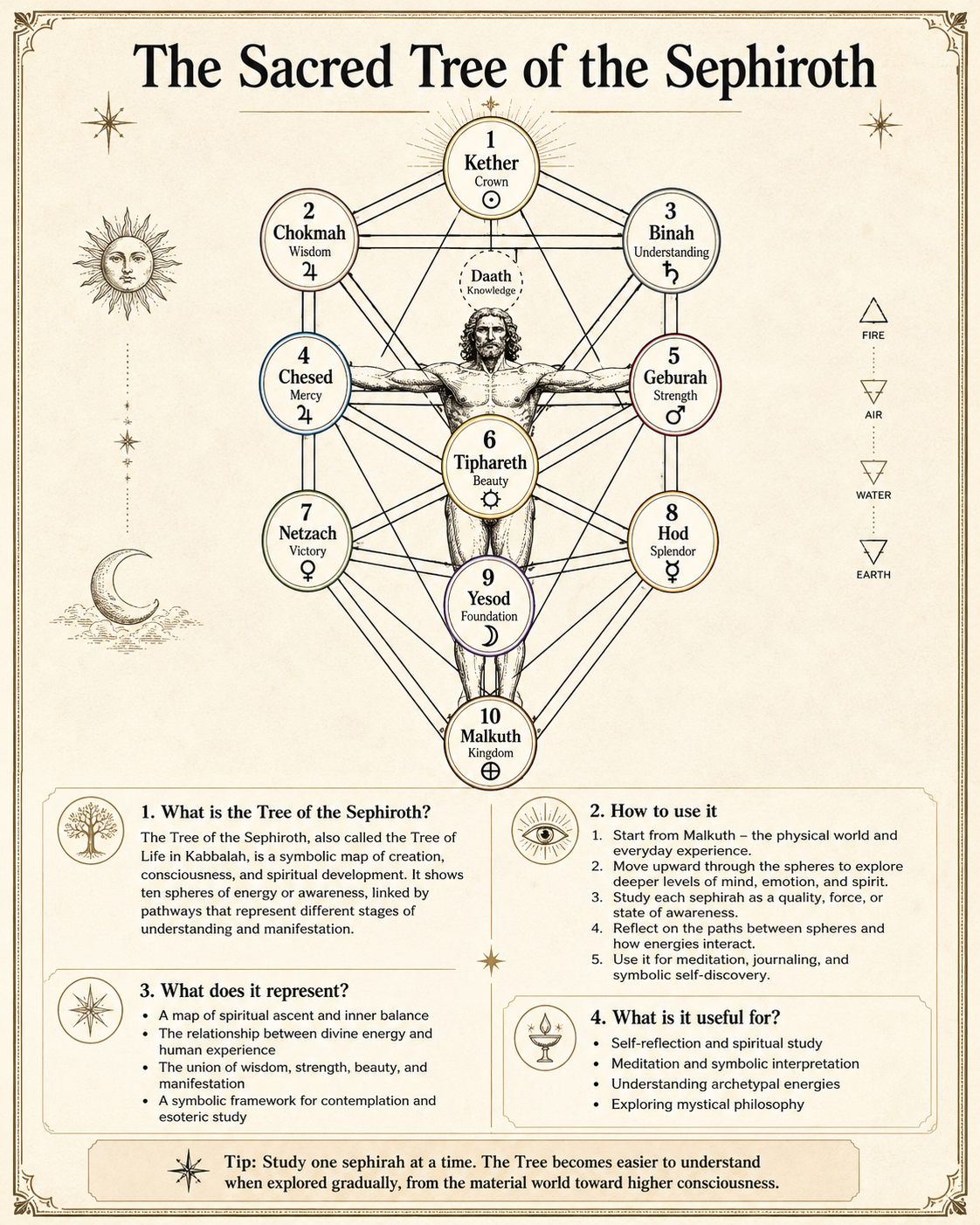
The Sacred Tree of the Sephiroth, often called the Tree of Life in Kabbalistic teaching, is one of the most well-known and visually powerful diagrams in mystical symbolism. At first glance, it may appear to be simply a system of circles connected by lines, but in reality it represents an entire spiritual map — a structure through which creation, divine energy, human consciousness, and inner transformation can be understood.
In traditional Kabbalah, the Tree is made up of ten spheres, or Sephiroth, each expressing a different attribute or aspect of divine manifestation. These are not merely abstract concepts. They are often understood as living principles that shape both the universe and the human soul. The highest sphere, Kether, represents the Crown — the pure source, divine will, and the beginning of all emanation. At the lowest point is Malkuth, the Kingdom, representing the physical world, earthly life, and manifestation. Between these two extremes lies the full journey from spirit into matter, and from human experience back toward spiritual understanding.
Each Sephirah carries its own symbolic meaning. Chokmah is often linked to wisdom, creative force, and primal energy, while Binah is associated with understanding, structure, and form. Chesed expresses mercy, expansion, and generosity, whereas Geburah represents strength, discipline, and judgment. At the center stands Tiphereth, the sphere of beauty, balance, harmony, and spiritual heart. Lower on the Tree, Netzach relates to passion, desire, and endurance, while Hod reflects intellect, logic, language, and analysis. Yesod is the foundation, often associated with the subconscious, dreams, and the channel through which energies are organized before becoming fully expressed in Malkuth, the material plane.
One reason this symbol remains so fascinating is that it can be explored on many different levels. Some study it as a philosophical model of the universe. Others see it as a psychological map of human nature. In esoteric and mystical traditions, it can also be used as a framework for meditation, self-development, and inner contemplation. The Tree shows not only separate points of power, but also the pathways between them. These connections remind us that life is never static — everything flows, interacts, and transforms.
The image is also deeply symbolic because it brings together opposites. Mercy and severity, expansion and restraint, intuition and intellect, spirit and matter — all are present within the Tree. Rather than rejecting one side in favor of the other, the Tree of the Sephiroth teaches balance. It suggests that true wisdom comes not from living at one extreme, but from understanding how apparently opposite forces work together in a greater whole.
For spiritual readers, this diagram can be used as a contemplative tool. You might choose one Sephirah and meditate on its meaning in your own life. For example, if you are seeking emotional balance, you may reflect on Tiphereth. If you feel the need for discipline and clarity, Geburah may offer a useful focus. If you are trying to build stronger foundations in your life, Yesod and Malkuth may become especially meaningful. In this way, the Tree becomes more than a diagram — it becomes a mirror for self-inquiry.
The Sacred Tree of the Sephiroth is also frequently connected with astrology, sacred geometry, Tarot, alchemy, and other symbolic systems. Because of this, many seekers use it as a central key for understanding broader mystical traditions. Its structure offers a way to organize spiritual knowledge and explore how different symbolic systems relate to one another.
What makes this image especially compelling for a blog or spiritual article is its depth. It is not just visually striking; it invites thought, reflection, and repeated study. Each time a person returns to it, new meanings can emerge depending on where they are in life and what they are trying to understand. Some may approach it as sacred philosophy, others as esoteric psychology, and others simply as a beautiful symbolic map of the relationship between the divine and the human.
In the end, the Tree of the Sephiroth remains enduring because it speaks to a timeless human desire: the wish to understand where we come from, how life is structured, and how we can move toward greater awareness. Whether used for mystical study, meditation, or symbolic exploration, it offers a profound and layered vision of spiritual reality.
In traditional Kabbalah, the Tree is made up of ten spheres, or Sephiroth, each expressing a different attribute or aspect of divine manifestation. These are not merely abstract concepts. They are often understood as living principles that shape both the universe and the human soul. The highest sphere, Kether, represents the Crown — the pure source, divine will, and the beginning of all emanation. At the lowest point is Malkuth, the Kingdom, representing the physical world, earthly life, and manifestation. Between these two extremes lies the full journey from spirit into matter, and from human experience back toward spiritual understanding.
Each Sephirah carries its own symbolic meaning. Chokmah is often linked to wisdom, creative force, and primal energy, while Binah is associated with understanding, structure, and form. Chesed expresses mercy, expansion, and generosity, whereas Geburah represents strength, discipline, and judgment. At the center stands Tiphereth, the sphere of beauty, balance, harmony, and spiritual heart. Lower on the Tree, Netzach relates to passion, desire, and endurance, while Hod reflects intellect, logic, language, and analysis. Yesod is the foundation, often associated with the subconscious, dreams, and the channel through which energies are organized before becoming fully expressed in Malkuth, the material plane.
One reason this symbol remains so fascinating is that it can be explored on many different levels. Some study it as a philosophical model of the universe. Others see it as a psychological map of human nature. In esoteric and mystical traditions, it can also be used as a framework for meditation, self-development, and inner contemplation. The Tree shows not only separate points of power, but also the pathways between them. These connections remind us that life is never static — everything flows, interacts, and transforms.
The image is also deeply symbolic because it brings together opposites. Mercy and severity, expansion and restraint, intuition and intellect, spirit and matter — all are present within the Tree. Rather than rejecting one side in favor of the other, the Tree of the Sephiroth teaches balance. It suggests that true wisdom comes not from living at one extreme, but from understanding how apparently opposite forces work together in a greater whole.
For spiritual readers, this diagram can be used as a contemplative tool. You might choose one Sephirah and meditate on its meaning in your own life. For example, if you are seeking emotional balance, you may reflect on Tiphereth. If you feel the need for discipline and clarity, Geburah may offer a useful focus. If you are trying to build stronger foundations in your life, Yesod and Malkuth may become especially meaningful. In this way, the Tree becomes more than a diagram — it becomes a mirror for self-inquiry.
The Sacred Tree of the Sephiroth is also frequently connected with astrology, sacred geometry, Tarot, alchemy, and other symbolic systems. Because of this, many seekers use it as a central key for understanding broader mystical traditions. Its structure offers a way to organize spiritual knowledge and explore how different symbolic systems relate to one another.
What makes this image especially compelling for a blog or spiritual article is its depth. It is not just visually striking; it invites thought, reflection, and repeated study. Each time a person returns to it, new meanings can emerge depending on where they are in life and what they are trying to understand. Some may approach it as sacred philosophy, others as esoteric psychology, and others simply as a beautiful symbolic map of the relationship between the divine and the human.
In the end, the Tree of the Sephiroth remains enduring because it speaks to a timeless human desire: the wish to understand where we come from, how life is structured, and how we can move toward greater awareness. Whether used for mystical study, meditation, or symbolic exploration, it offers a profound and layered vision of spiritual reality.




Comments
Comments appear after approval.
Log in to comment