
Ace of Pentacles Meanings for Money Career Health and Relationships
This article teaches how to read the supplied Ace of Pentacles card in a single-card context across money, career, health and relationships. It anchors interpretation in the card's Rider‑Waite‑Smith imagery and in the provided upright and reversed definitions. You will learn practical techniques for asking questions, distinguishing advice from outcome, reading persons and challenges, avoiding common mistakes, and giving clear, grounded meaning during a one-card session.
Cards explored in this article
 Ace of Pentacles
Why study the Ace of Pentacles in a single-card context
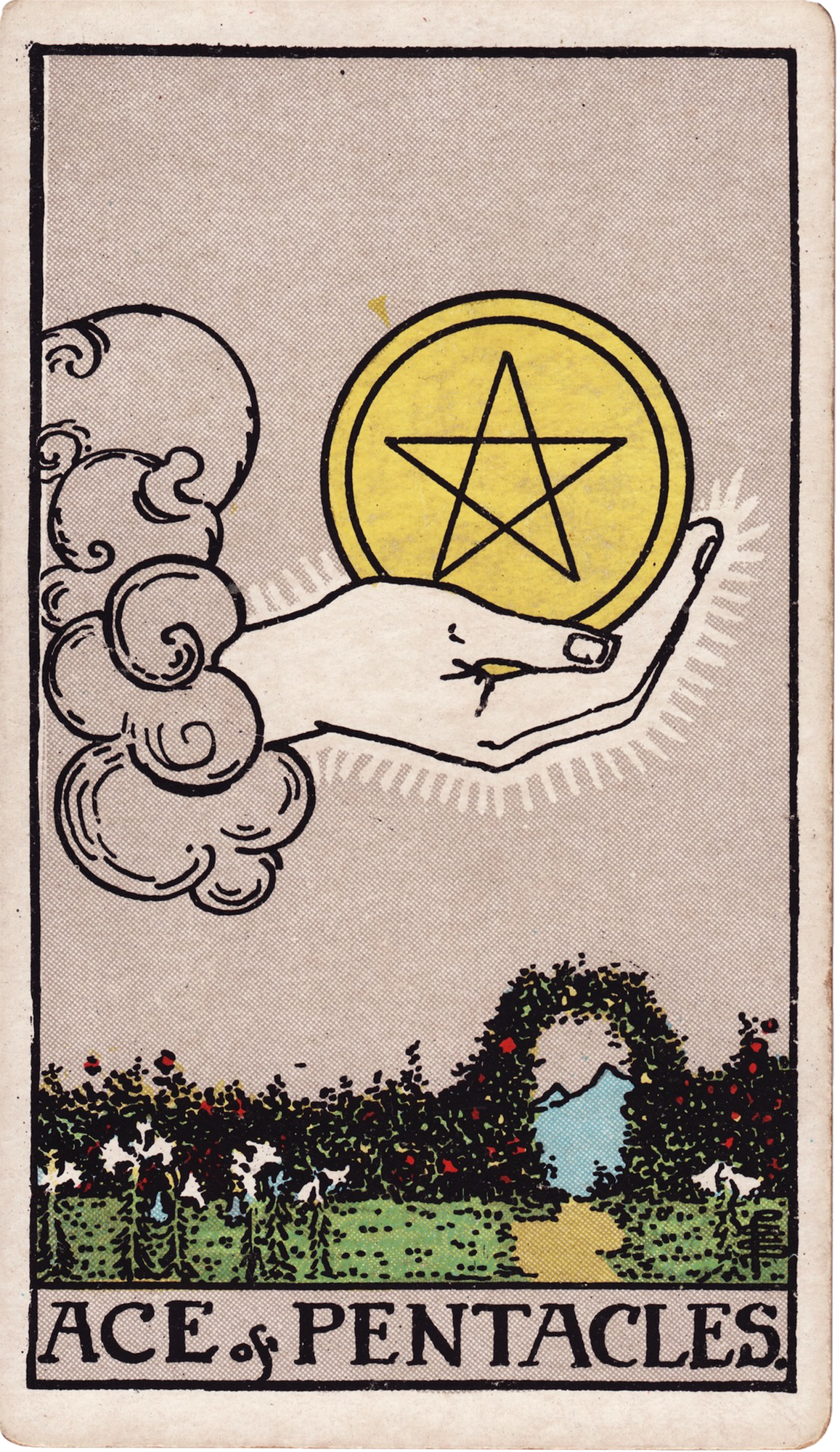
One-card readings are a compact, focused way to get clarity. When that single card is the Ace of Pentacles, you are encountering a concentrated symbol of material potential. The supplied upright and reversed texts for the Ace of Pentacles should be your primary anchors: Upright, Ace of Pentacles highlights a tangible opportunity, resource or beginning that can become valuable through practical care and consistent action. The card is practical: it asks for a response that fits the present stage rather than an abstract ideal. Consider where this pattern is already visible and what action would strengthen its constructive side. In many spreads, the upright card shows that the situation can be handled through the skills associated with Pentacles: work, money, health, routine, resources, craft, the body and long-term material stability. It can still contain effort or discomfort, but it usually makes the core task easier to name. Use the surrounding cards to see whether this energy is beginning, developing, reaching pressure, or moving toward resolution. Reversed, Ace of Pentacles draws attention toward missed opportunity, poor planning, scarcity thinking or wanting results without establishing a workable foundation. The reversal may show too much of the card's usual energy, too little of it, or a situation where the lesson is understood intellectually but not yet lived consistently. It can also indicate that the issue is occurring internally and is not obvious to other people. Rather than treating the reversed card as the opposite of the upright meaning, examine where the process has become stuck. Ask what needs to be simplified, acknowledged, practiced, released, or communicated before the healthier expression of Pentacles can return. This article uses those supplied descriptions and the card's imagery (hand from a cloud holding a pentacle; a planted garden; a stone archway leading toward mountains) to build readings for money, career, health and relationships. It is written for learners: the interpretations are techniques and possibilities, not certainties.
Key Rider‑Waite‑Smith imagery and what each element signals
The Ace of Pentacles in the Rider‑Waite‑Smith tradition is rich with visual cues that translate into reading language. Use these visual elements to ground interpretations literally and metaphorically. - The hand emerging from a cloud: This motif suggests an opportunity that appears from outside ordinary expectation — a gift, a seed, or a fresh offer. It is not purely mystical; the hand indicates an external resource or tangible offer that a querent can take into their own hands. - The pentacle (coin): The pentacle symbolizes material value, resources and the laws of exchange. It points to money, physical tools, contracts, payments, or any solid resource that carries measurable value. - The planted garden and flowering border: These represent cultivation and the need for continued care. A seed (or an offer) will only produce returns if tended to — through routine, practice and prudent attention. - The archway and path toward mountains: The arch is both an entrance and a promise: an invitation to a longer journey of stability. Mountains in the distance indicate long-term goals or the maturity the seed could reach if maintained. When you read the supplied Ace of Pentacles, translate these images into concrete questions: Who or what is offering the pentacle? Is there a garden to tend — do routines or systems need building? Is this an entry point to something larger?
How to think about upright versus reversed in practice
Begin with the supplied definitions as your map. The upright Ace of Pentacles points to tangible opportunity and a practical beginning. In a one-card reading, that usually means 'there is something concrete that can be developed.' The reversed Ace of Pentacles asks: where is the foundation weak? What practical step is missing or being postponed? Avoid framing reversed automatically as 'bad.' The supplied reversed text explicitly advises against treating it as merely the opposite. Instead, read the reversal as 'stalled process' or 'internal resistance.' For instance, upright can say: 'an offer arrives; consider how to transform it by practical action.' Reversed can say: 'there was a missed or mismanaged opportunity, or you are not yet living an idea in practical terms.' Technique: open with neutral language. For upright, ask 'What practical step can make this opportunity real?' For reversed, ask 'What foundation needs repair or what is blocking consistent practice?' Keep your focus on actions and systems rather than destiny.
Money and financial readings with the supplied Ace of Pentacles
Upright — Practical signals and phrasing: When the supplied Ace of Pentacles is upright in a money question, read it as a concrete financial opportunity or a seed of material stabilization. Use the imagery: a coin offered by a hand suggests an incoming resource — a small inheritance, a job bonus, a freelance contract, a seed fund or a practical idea that can be monetized. The garden imagery asks: what habits will allow this income to grow? Translate into actionable phrasing for the querent: 'You have a concrete chance to increase stability; set a simple budget, open a savings account for this money, or commit a percentage to reinvest in the idea.' Reversed — Common meanings and nuance: Reversed, the supplied Ace of Pentacles can indicate missed opportunity, poor planning or expecting results without the systems to support them. Practically: a late invoice, negotiating too quickly, or an idea that is underpriced. The reversed card can also be internal: the querent may be holding a scarcity narrative that sabotages follow-through. Ask clarifying questions: 'Did you take the steps to claim the offer? Are there conditions you overlooked? What small, consistent practice is being avoided?' Examples of reader language: Upright: 'A tangible financial opening is here; treat it as a seed that needs a simple plan.' Reversed: 'There’s potential, but the next practical steps weren’t taken or have been blocked — identify one thing you can do this week to test the offer.' Timing and scale: Aces are beginnings, so expect early-stage money events — first payments, initial contracts, pilot revenue rather than full-scale business profits.
Career and work interpretations
Upright — Opportunity to build: For career questions, the supplied Ace of Pentacles upright often points to a concrete job opportunity, a project with funding, a training that yields practical skill, or a role that increases material stability. Use the archway imagery: this is an entry point that could lead to long-term advancement. Recommended advice: evaluate the offer's terms, consider the routine you will need to establish, and plan modest early wins to build credibility. Reversed — Stalled offers and poor fit: Reversed may indicate that an opportunity was missed, the role lacks infrastructure, or the querent is trying to jump to results without the necessary groundwork. It might show up as declining to apply for a promising role because of fear, or starting a business without a basic cash-flow plan. The reversal could also signal that what looks like a good opportunity is actually a trap: check contracts, expectations and realistic deliverables. Practical prompts for a reading: Upright: 'What system will help you sustain this role?' Ask the querent to identify three daily or weekly routines that will support success. Reversed: 'Which foundational skill or administrative task is missing?' Ask them to list what paperwork, mentorship, or training is necessary to stabilize the situation. Career exit or entrance? An upright Ace commonly suggests entrance. A reversed Ace often flags the need to stabilize before exiting or to repair foundations before accepting new work.
Health and body-focused readings
Upright — Tangible health beginnings: The Ace of Pentacles upright points to concrete, practical beginnings for bodily wellbeing. This might be beginning a sustainable exercise routine, starting a nutrition plan, seeing a practitioner who offers a clear regimen, or obtaining a diagnostic test that leads to actionable steps. Read visually: the garden and planting remind you that health improvements are cultivated through consistent, small actions. Reversed — Inconsistency and neglected foundations: Reversed, the card indicates a missed opportunity for health or poor planning — starting diets that are unsustainable, skipping follow-up appointments, or believing that quick fixes will replace consistent care. It may indicate internal resistance: the querent knows what to do but is not making it habitual. Advice language to use: Upright: 'Begin with a small, repeatable habit: a 10‑minute daily walk, a routine sleep schedule, or an appointment with a provider.' Reversed: 'Identify one neglected baseline (sleep, hydration, medication adherence) and make it manageable to sustain. Ask: what is the smallest habit you can commit to for four weeks?' Boundaries and testing: In health readings, always advise consulting professionals. The Ace of Pentacles signals concrete action, but not medical diagnosis. Use the card to encourage measureable, repeatable steps and to avoid miracle cures.
Relationships and love contexts
Upright — Practical beginnings in partnership: When the supplied Ace of Pentacles appears upright for relationships, it suggests a grounded, material, or practical new beginning. This may be a new partnership that offers stability, a conversation about shared finances, moving in together, or starting a practical project that strengthens the relationship (e.g., co‑owning something, opening a joint account, or planning a home). The hand offering the pentacle can be read as a generous, tangible gesture of commitment. Reversed — Missed foundations or misaligned expectations: Reversed, the card might indicate that one partner wants a quick expression of stability without the ongoing work, or that practicalities (money, chores, long-term planning) have been ignored. It can also reveal that the querent is projecting scarcity or overvaluing security to the point of missing healthier relational dynamics. Use the reversal to ask: what routine or practical conversation has been postponed? Reading suggestions: Upright: encourage concrete conversations — budgets, next steps, timelines. Reversed: recommend clarifying expectations and repairing small infrastructure: who pays what, who does chores, how to plan shared time. The Ace of Pentacles rarely speaks to passion alone; it speaks to matters that build daily life together.
Advice, challenge, person and outcome readings with the Ace of Pentacles
Advice reading: Treat the card as a 'what to do next' card. Upright: adopt a practical routine, claim the opportunity, treat the next step as a testable experiment. Reversed: simplify, slow down, consolidate foundations before expanding, and identify one clear habit to repair. Challenge reading: Upright as challenge can mean 'don’t ignore the mundane work required.' The image of the garden calls for patience. Reversed as challenge signals missed follow‑through, unclear contracts, or scarcity thinking that blocks action. Person reading: The Ace of Pentacles as a person usually describes someone practical, resource-oriented, or in a position to offer tangible help — an employer, investor, landlord or a friend who helps materially. Upright this person is reliable and constructive. Reversed this person might be inconsistent, overly focused on money, or unable to commit to supporting the foundation they claim to offer. Outcome reading: Upright outcome indicates the emergence of material stability if the querent applies effort. Think small wins leading to larger gains. Reversed outcome asks you to consider whether the outcome will be stalled unless foundations are repaired. Technique: Always translate these roles into concrete behaviors. If Ace of Pentacles represents a person, describe their likely actions: 'They are likely to offer practical help or a concrete resource. Expect an offer or a proposal rather than abstract promises.' Avoid personality judgments and focus on behavior related to material support and routine.
Practical one-card method and question framing
Step-by-step method for a single-card Ace of Pentacles reading: 1) Clarify the question: Make it concrete. Replace ‘Will I be happy?’ with ‘What practical next step will increase my financial stability?’ 2) Observe the supplied card imagery and the supplied definitions: Remind yourself of the upright and reversed texts and the RWS visuals (hand, pentacle, garden, arch). Anchor your reading in these signs. 3) Determine the orientation: upright or reversed. Use the supplied upright/reversed text as your starting interpretation. 4) Translate images into actions: If you see a hand offering a coin, ask who is offering and what steps you must take to accept. If you see the garden, ask what routine will keep the seed alive. 5) Ask clarifying follow-up questions aloud or to the querent: 'What is one simple habit you can commit to this week?' 'Who is the resource offering to you and what do they require in return?' 6) Give concrete, measurable advice: Suggest one immediate step plus one planning step (e.g., 'Apply to this job today; schedule a meeting to clarify responsibilities within 7 days. Open a dedicated savings account for any income from this source.'). 7) Close with contingencies: Explain what will indicate progress (e.g., a signed contract, regular payments, steady health metrics) and what will indicate the need to re-evaluate (missed deadlines, inconsistent follow-through). Use this method to keep readings grounded and useful rather than vague.
Common mistakes and how to avoid them
Mistake 1: Turning imagery into mysticism. The hand and coin are practical symbols. Avoid making the card an omen; focus on who, what, and which actions. Avoidance: Ask 'Who is offering this resource?' and 'What specific step must I take to accept it?' Mistake 2: Treating reversed as just 'bad luck.' The supplied reversed definition helps: reversed usually points to process issues, not cosmic punishment. Avoidance: Use reversal to map where systems are incomplete. Ask for the smallest practical repair. Mistake 3: Overgeneralizing from a single card. Aces are beginnings and early signs; they rarely predict final results on their own. Avoidance: Frame outcomes as contingent on action. Give short-term, testable predictions and threshold conditions for success. Mistake 4: Ignoring the body and routine side of Pentacles. People tend to read Pentacles as only money, but the suit includes health, routine and craft. Avoidance: When reading for any area, always consider 'what daily routine supports this?' Mistake 5: Failing to quantify advice. 'Be practical' is not enough. Avoidance: Provide specific next steps: a meeting, a number to save, a daily habit, a timeline.
Example readings and scripts
Example 1 — Money (upright): Querent asks about freelance income. Card: Ace of Pentacles upright. Script: 'This is a tangible opening: an offer or first paid contract is likely or available. Treat it as a seed — price it clearly, invoice immediately, and set aside 20% into a dedicated account to reinvest. This is a test: if you get one steady client, aim to repeat that model three times.' Why this works: The hand offering the pentacle equals an incoming resource; the garden suggests reinvestment and care. Example 2 — Career (reversed): Querent asks whether to accept a promotion. Card: Ace of Pentacles reversed. Script: 'There is material potential, but something foundational is missing. Clarify responsibilities, hours, and supports. Ask for a written job description and trial period. If these practical details are vague, you risk stepping into a role that looks promising but has no structure.' Why this works: Reversal flags missing foundation or poor planning. The advice is to repair the administrative groundwork. Example 3 — Relationship and health combined (upright): Querent starting a partnership and asking about moving in together. Card: Ace of Pentacles upright. Script: 'This is a grounded beginning. Practical steps: create a simple budget, list shared and individual expenses, and set one shared household rule to test for two months. Also, make space for self-care routines so the relationship’s daily life can continue to be sustainable.' Why this works: The card supports practical cohabitation steps and routines. These scripts model how to convert imagery and upright/reversed nuance into clear, testable client actions.
Conclusion and next steps for learners
The supplied Ace of Pentacles is a workhorse card for grounded beginnings across financial, career, health and relationship areas. Use the provided upright and reversed texts as your anchor and translate the Rider‑Waite‑Smith imagery into practical questions: Who offers the pentacle? What garden do you need to tend? What archway is this opening into? Keep readings action-oriented: Aces ask for testing, tending and repetition. Resist the temptation to make the card an oracle of fate; instead, treat it as a prompt for small, measurable experiments that can build into long-term stability. Next steps for practice: perform three single-card readings with the supplied Ace of Pentacles. For each reading, pick a different focus (money, health, relationship), choose a precise question, follow the one-card method in this article, and record outcomes for four weeks. Compare the predictions to the evidence and refine how you translate imagery into step-by-step advice.
Practice questions
• What concrete resource or offer in my life feels like the hand offering the pentacle?
• Which small routine or habit could I begin this week that aligns with the garden imagery?
• If the Ace of Pentacles is reversed for me, where am I expecting results without putting in consistent practice?
• Who in my network could act as the personified pentacle-offerer (practical, resource-oriented), and what would I need to ask them concretely?
• What measurable sign will tell me this beginning is growing versus stalled (e.g., regular payments, consistent workouts, a signed agreement)?
• When I feel scarcity about material matters, what one internal belief can I test and reframe to support a healthier foundation?
Comments
Sign in to comment.
Continue learning
Harnessing the Power of The Magician and Ace of Wands: Igniting Creativity and Manifestation in Tarot Readings
The combination of The Magician and the Ace of Wands in tarot readings offers a potent blend of creative energy and manifestation power. This article delves into the ways these car...
Unlocking Emotional Resilience with Strength and The Star in Tarot Combinations
This article delves into the Tarot card combination of Strength and The Star, revealing how their interplay highlights pathways to emotional resilience. Anchored in the Rider-Waite...
Unlocking Emotional Healing with Temperance and The Star in Tarot Combinations
This article delves into the powerful Tarot combination of Temperance and The Star, focusing on how these cards interact to promote emotional healing. By examining their upright an...
Unlocking the Creative Synergy of The Magician The Empress and Ace of Wands in Tarot Combinations
This article delves into the dynamic interplay of The Magician, The Empress, and Ace of Wands when they appear together in tarot readings. It explores how these cards collectively...
Unlocking Emotional Intelligence with The Queen of Cups and The King of Cups in Tarot Combinations
This article explores the Tarot combination of The Queen of Cups and The King of Cups, focusing on how they unlock emotional intelligence in readings. By analyzing their upright an...
Unlocking Emotional and Intellectual Balance with The Queen of Swords and The Queen of Cups
This article delves into the dynamic interplay between the Queen of Swords and the Queen of Cups in tarot readings, focusing on their combined symbolism to unlock a balanced approa...
Unlocking the Many Dimensions of The Star Card in Spiritual and Emotional Growth
The Star card in Tarot serves as a beacon of hope, authenticity, and renewal, offering rich symbolism that adapts dynamically to different reading contexts. This article unpacks th...
Exploring the Versatile Meanings of The Star Card in Personal Growth and Spiritual Renewal
The Star card in the Tarot deck serves as a powerful symbol of hope, renewal, and authenticity. This article explores its rich and versatile meanings across different life contexts...
Exploring Emotional Balance with The Queen of Cups and The King of Pentacles in Tarot Card Combinations
This article explores the intricate interplay between The Queen of Cups and The King of Pentacles in tarot readings, focusing on emotional balance within personal and practical con...
Understanding the Emperor Card in Leadership Personal Authority and Life Decisions
The Emperor card, a powerful symbol of leadership, structure, and authority, speaks distinctly to personal and external dynamics in life decisions. This article explores how The Em...