
Reading Burnout and Rebirth with 9 of Wands 10 of Wands and Death
This article teaches a step-by-step approach to reading the 9 of Wands, 10 of Wands, and Death as a combined message about exhaustion, responsibility, and necessary endings. Anchored in Rider–Waite–Smith imagery, it explains how each card modifies the others in family and caregiving situations, career stress, and intimate relationships. You will learn how to avoid one-card thinking, read upright and reversed dynamics where they matter, construct precise spread positions, and offer grounded, actionable advice for clients facing burnout and transition.
Read the cards together
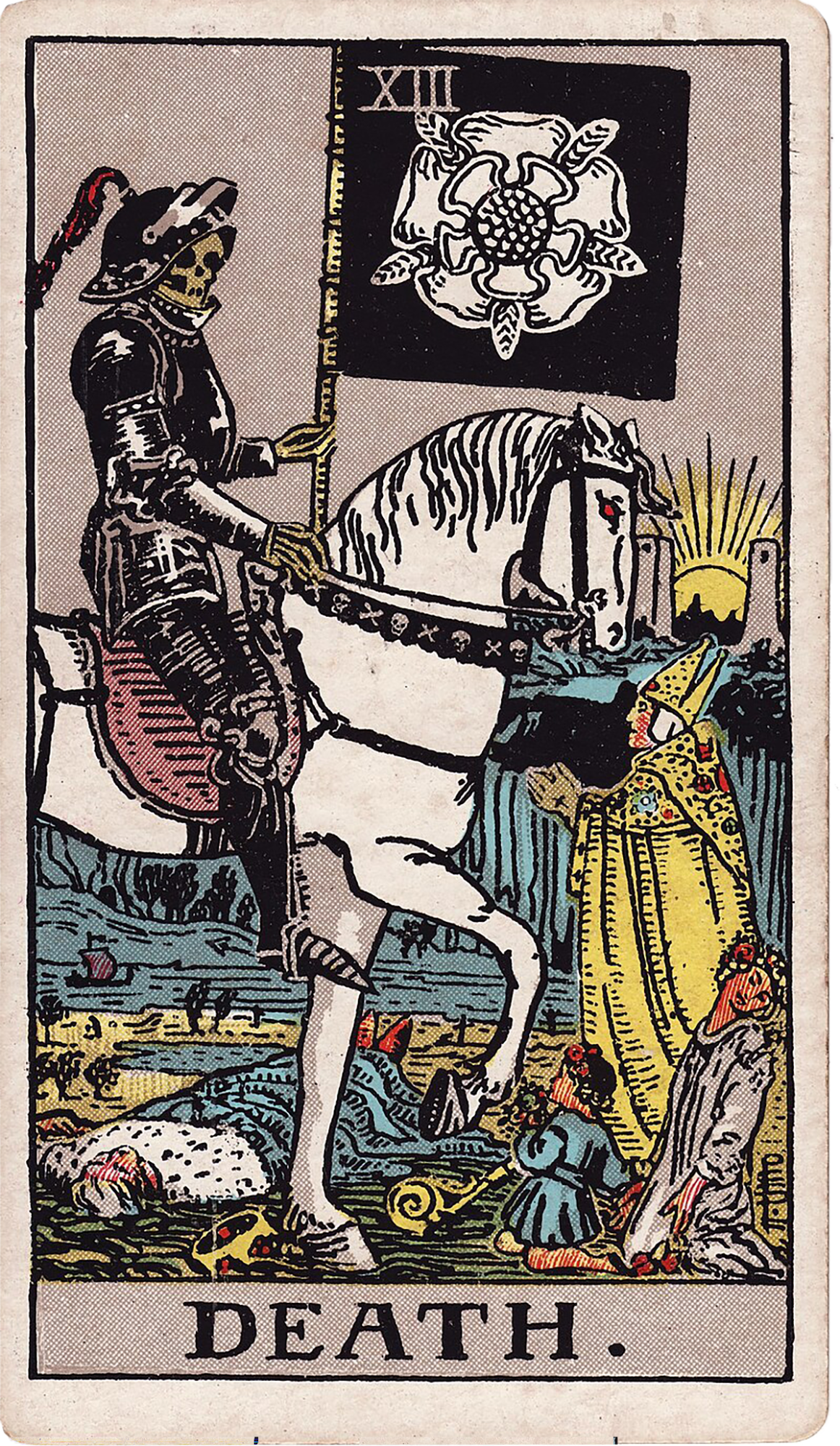 Death
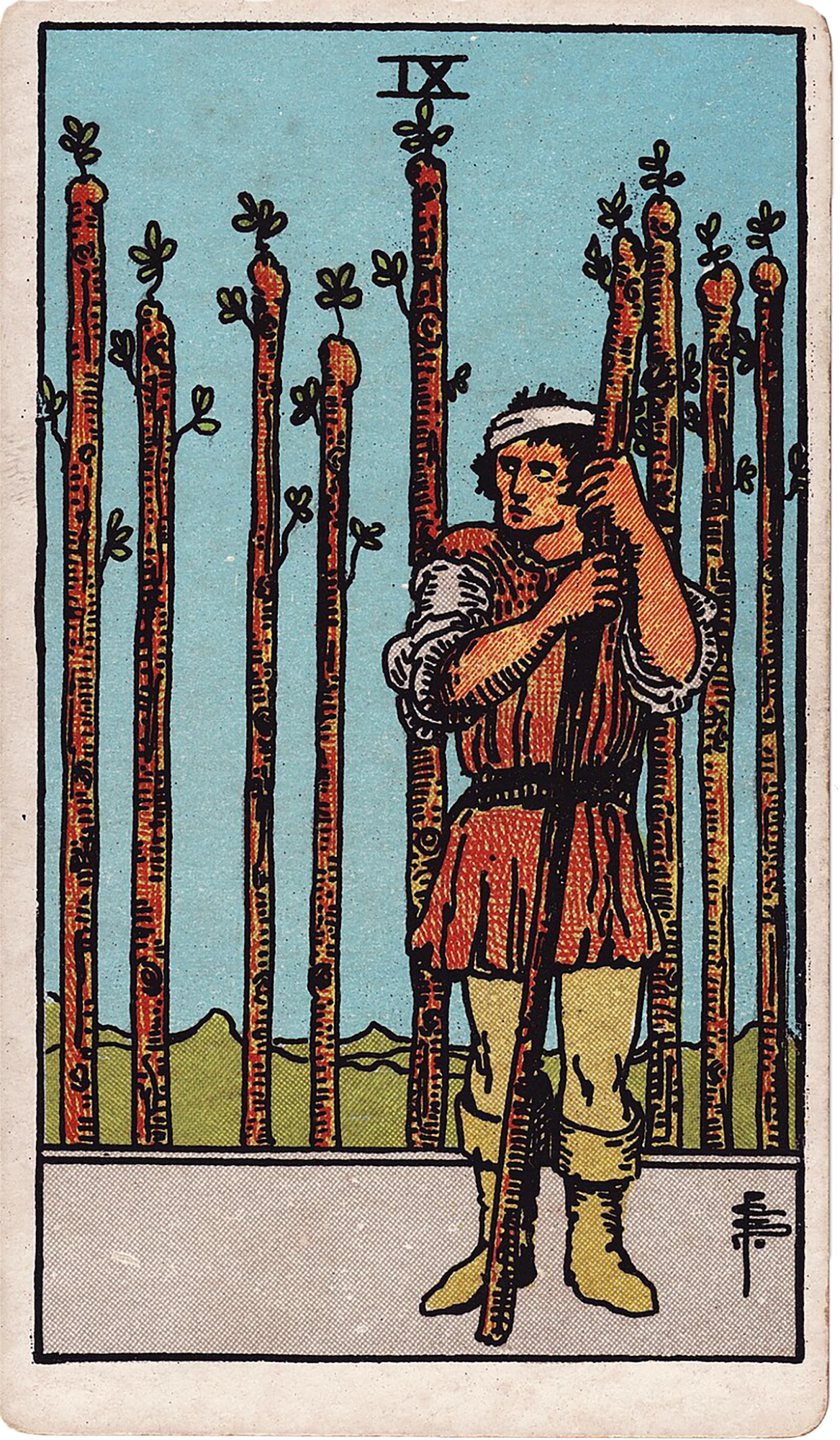 9 of Wands
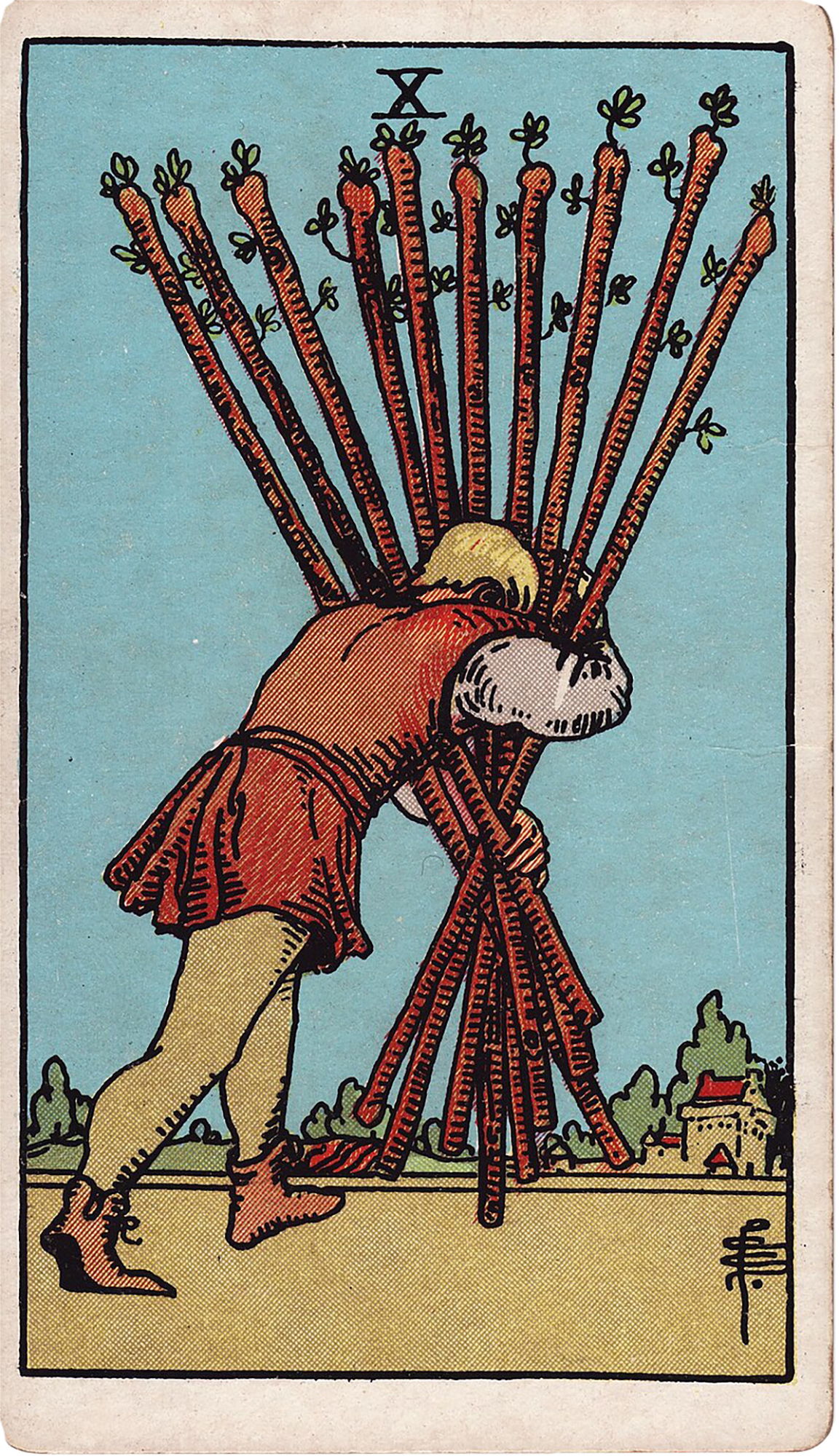 10 of Wands
Why this combination matters
When the 9 of Wands, 10 of Wands, and Death appear together the reading gravitates around a tight cluster of experience: effort worn thin, roles and duties that have become heavy, and the need for a genuine ending or transformation. The Rider–Waite–Smith 9 of Wands shows a wounded, watchful figure holding a single wand and positioned before a row of eight staves. It is an image of guarded resilience: someone who has already been tested and is prepared to defend what remains. The 10 of Wands shows a man straining beneath a large bundle of wands, bent forward under weight and moving toward a distant destination. It is the picture of responsibility aggregated to torque: completion might be near, but the cost is visible. Death presents a skeletal figure, often carrying a banner with a white rose, riding or standing in a landscape where a river and a rising sun appear—clear RWS symbols of unavoidable endings that lead to new ground. Together these three cards map a process rather than a single event: accumulation of effort and protection (9), a tipping point of burden (10), and a structural necessity to release or transform (Death).
Core interpretive logic: flow and function
Read this combination as a narrative arc: the 9 of Wands names the stance and muscle memory (vigilance, protectiveness); the 10 of Wands describes the present consequence of that stance when duties compound (overload, martyrdom, literal burden); Death indicates the structural medicine—an ending, boundary, or radical reconfiguration—required to restore balance. Interpretive priority comes from context: if the question is about a family caregiver, the 9 describes the caregiver's protective stance, the 10 maps the accumulated duties, and Death signals what must be relinquished or renegotiated. If the question concerns career, the 9 may be the employee's persistence, the 10 their unsustainable role, and Death the necessary exit, redefinition, or delegation. Always ask: which of these three images most directly answers the querent's question? Use that card to lead the conversation and allow the other two cards to supply cause and method.
Avoiding one-card-at-a-time reading
A common mistake is to treat each card as a separate sentence rather than parts of one paragraph. Instead of listing three bullet-point meanings, craft sentences that combine imagery: 'Because the person pictured in the 9 of Wands has been guarding this family role, responsibilities piled into the 10 of Wands, and now Death appears to tell them that a real ending or reconfiguration is necessary.' Use syntax that connects card-to-card with verbs—'because,' 'so,' 'therefore,' 'but'—to preserve causal and temporal relationships. Pay attention to how the images relate physically in RWS art: the 9 of Wands' guarded posture suggests a tension that generates the 10's load; Death's procession implies motion away from the current scene rather than a static punishment. When reversals appear, fold them into the narrative as modifiers (e.g., reversed 9 of Wands = exhaustion disguised as vigilance) rather than as separate judgments.
Upright and reversed dynamics where it matters
Use upright/reversed positions sparingly and only when they add precision. Upright 9 of Wands = endurance and practical caution; reversed 9 of Wands emphasizes burnout, hypervigilance, or giving up too close to resolution. Upright 10 of Wands = clear overload that can be organized, delegated, or lightened with practical steps; reversed 10 of Wands may show collapse, refusal to delegate, or finally letting go of duties. Upright Death calls for an allowed ending and conscious transformation; reversed Death highlights clinging to old roles, stalled endings, or inner resistance to necessary change. Example combinations: if 9 is upright, 10 is upright, Death is upright—this often reads as: persistent protection accumulated into a heavy load, and an authentic ending is available that will permit rebirth if the querent chooses it. If 9 is reversed, 10 upright, Death reversed—you may be looking at someone who is exhausted and has become defensive in unhelpful ways, carrying responsibilities they cannot release because they resist acknowledging the need for an ending. Resist deterministic readings: reversals describe energy flow and blockage, not irreversible doom.
Practical spread options for this trio
Use simple, focused positions to illuminate roles and action steps. Three useful spreads: - Role/Burden/Action: Place the 9 of Wands in the Role position (who is protecting or defending?), the 10 of Wands in Burden (what is weighing on that role?), and Death as Action (what ending or transformation is needed?). This spread forces a pragmatic translation of imagery into next steps. - Past/Present/Future with emphasis: 9 of Wands as Past (what established the pattern?), 10 of Wands as Present (what is currently unsustainable?), Death as Future (what is the necessary transformation or endpoint?). This helps with timing and shows whether the querent is moving toward or away from change. - Who/What/How for family questions: 9 of Wands = Who is taking responsibility? 10 of Wands = What duties have accrued? Death = How to restructure the family system (boundaries, delegation, institutional support). Use clarifying cards (if you wish) to detail 'how' but remember the instruction to anchor to these three images first. In every spread, ask follow-up questions aloud or to the querent: 'Which part of the 9 of Wands image feels like you? Where do you feel the load from the 10 of Wands? What in the Death image feels like relief or fearful loss?' This grounds symbolic reading in embodied experience.
Interpreting in family contexts
Because the user requested family-focused combinations, pay attention to roles that family systems encode: caregiver, mediator, financial provider, emotional gatekeeper. The 9 of Wands often signifies a family member who has assumed a defensive posture—this person may be the protector of family norms, the one who insists on 'keeping everyone safe' after past crises. The 10 of Wands shows what happens when that protection becomes unpaid labor: household tasks, coordination for an ill parent, emotional caretaking of children or siblings, or being the person who absorbs everyone's expectations. Death confronts the system with a demand: certain roles or duties must end, be formally transferred, or be reframed if the family is to survive sustainably. Readings might show these dynamics concretely. For example, in an eldercare scenario the 9 of Wands could be the adult child who has historically handled appointments and safety; the 10 of Wands reveals the mounting logistics and emotional burden; Death may signal the need for institutional care, delegation to other family members, or a redefinition of what 'care' looks like—accepting paid support or setting firmer boundaries around tasks the caregiving member will no longer do. Translate Death not as 'abandonment' but as structural realignment: a role ending creates space for new arrangements. Emphasize consent and negotiation: the cards may recommend steps (hire help; set clear visiting policies; create a rotating schedule) rather than unilateral withdrawal.
Relationships and intimacy readings
In intimate relationship contexts these three cards commonly reveal patterns where one partner shields and bears consequences, often to their own depletion. Read the 9 of Wands as the protective partner who has been vigilant—watchful for problems, fighting for the relationship's survival, or suppressing needs to avoid conflict. The 10 of Wands shows how those suppressed needs and additional responsibilities have turned into a load—household labor imbalance, emotional labor, or caretaking that is no longer reciprocal. Death interrupts with the demand for an ending: either an old contract of roles must be renegotiated, a part of the relationship's structure must change, or if change is resisted an ending may become inevitable. This combination is a call to honest negotiation: list what each partner is actually doing and who is willing to change. The Death card can be read constructively—ending old unspoken rules, introducing new boundaries, or beginning couples therapy to rearchitect the partnership.
Career and vocation readings
Apply the imagery to workload, role identity, and career transitions. The 9 of Wands speaks to persistence, to someone holding the line on a project or job. The 10 of Wands displays accumulation—responsibilities, side duties, or managerial tasks that were never in the job description. Death asks whether the job itself, the definition of success, or the current role must end to allow for healthier work life. Use concrete questions: Can anything be delegated? Is there an official job description that can be renegotiated? Is a role change, sabbatical, or exit required? If a client fears leaving because they identify with being the 'one who gets it done' (9 of Wands identity), point out how that identity is now causing the 10 of Wands burden. Death can be read as permission to let go of that identity and reconstruct a vocational self that is sustainable.
Example readings and verbatim phrasing
Practice language that connects imagery to action. Examples: - Family caregiver querent: 'I see you in the 9 of Wands—worn but determined, keeping watch. That vigilance led to the 10 of Wands where many tasks piled on your shoulders. Death here is not catastrophe; it is the instruction to make a real change—either delegate some responsibilities, bring in paid help, or redefine what you will reasonably do going forward.' - Relationship querent: 'The 9 of Wands shows you're protecting the relationship by staying alert; the 10 of Wands reveals you've absorbed emotional and household labor until you are exhausted. Death asks what contract has to end—does the assumption “I’ll always manage this” need to stop? This is your permission to request change and set firm boundaries.' - Career querent: 'You have persistence (9), but persistence has become overload (10). Death says the job or this version of your role is finishing: either you restructure, delegate, or prepare to leave. The image asks you to choose a next proportionate step rather than waiting for total collapse.' Use clarifying follow-ups: 'If you allow one practical ending—what is it? Who will notice? What is the smallest delegable task you can hand off this week?' Concrete exercises turn symbolic counsel into measurable behavior.
Common mistakes and how to correct them
Mistake: treating Death as a threat. Correction: when paired with the 9 and 10 of Wands, Death is often permission and practical medicine. Tell querents what endings can realistically look like. Mistake: ignoring images. Correction: reference the RWS art—how the 9's bandage, the 10's bent posture, and Death's white rose and rising sun speak to ongoing life beyond the ending. Mistake: reading each card in isolation. Correction: weave verbs between card meanings and prioritize context (family, career, relationship). Mistake: overemphasizing timing. Correction: this combination is about process; endings can be immediate or gradual. Focus on the 'how' rather than declaring an exact date. Mistake: moralizing. Correction: avoid saying the querent 'should' stop caring. Instead, offer options that preserve dignity and reallocate resources so care can continue sustainably. Emphasize negotiation, concrete tasks, and self-care.
Techniques for deepening the reading
Several techniques help you refine meaning: - Imagery interrogation: Ask the querent to describe which elements of each card catch their attention. Does the querent notice the bandage on the 9 of Wands, the direction of the 10 of Wands' steps, or the white rose and sunrise in Death? Their answers highlight personal resonance and lead to more specific counsel. - Sensory anchoring: Have the querent name bodily sensations they experience when they imagine each card. A clenched jaw with the 9 suggests ongoing vigilance; a heavy chest with the 10 confirms literal burden; relief at the sight of Death may indicate readiness for change. - Layered questions: Move from descriptive to prescriptive: 'What are you protecting?' 'What will happen if you stop protecting it?' 'Who benefits from your protection?' 'What can be redistributed?' - Action mapping: Translate symbolic endings into 1-week, 1-month, and 3-month actions (delegate task X this week; schedule family meeting in one month; explore alternative care or job role in three months). This turns Death from metaphor into a timeline for restructuring.
Ethics and sensitivity in family and care readings
When family dynamics and caregiving are involved, the stakes are practical and emotional. Be careful not to pressure querents into abrupt decisions if they face legal responsibilities or medical realities. Use these cards to encourage planning and negotiation, not unilateral withdrawal. If Death indicates an ending that would affect vulnerable people, emphasize gradual transition plans, formal agreements, and outside support (legal, medical, social). Respect cultural values about family duty while exploring ways the querent can preserve their health. Encourage professional resources when necessary: social workers, eldercare coordinators, HR, or mental health professionals. Tarot provides clarity and strategy, but it is not a substitute for domain-specific advice.
Summing up the lesson
9 of Wands + 10 of Wands + Death form a compact curriculum on how protective behaviors and accumulated duties become unsustainable, and how an authentic ending or restructuring is the practical remedy. Read them as a story: vigilance leads to load, load requires transformation. Anchor your language in the RWS imagery, prioritize context (family, relationship, career), avoid one-card atomization, and offer concrete, measurable next steps. Use the cards to create permission for change while also mapping how that change can be accomplished ethically and practically.
Practice questions
• When you look at the 9 of Wands image, which detail feels most like your own experience and why?
• What specific duties do you carry now that could be named in the 10 of Wands?
• If Death represents a necessary ending in your life, what is the smallest, least disruptive step you could take toward that ending this week?
• Who in your family would notice if you shifted or released one responsibility, and how might you involve them in the transition?
• What story do you tell yourself about being the 'protector' and how might that identity change if you chose to delegate?
• How can you measure whether an action taken after this reading reduced your burden—what observable indicator will you track?
Comments
Sign in to comment.
Continue learning
Interpreting the Dance of Justice and The Devil: Balancing Morality and Temptation in Tarot Readings
The combination of Justice and The Devil in tarot presents a profound exploration of morality, temptation, and personal accountability. This article unpacks how these cards influen...
Harnessing the Power of The Magician and Ace of Wands: Igniting Creativity and Manifestation in Tarot Readings
The combination of The Magician and the Ace of Wands in tarot readings offers a potent blend of creative energy and manifestation power. This article delves into the ways these car...
Understanding the Synergy Between The Empress and The Emperor in Tarot Card Combinations
This article delves into the intricate synergy between The Empress and The Emperor cards in Tarot, focusing on how their combined energies modify and enrich readings across various...
Decoding Transformation and Renewal with Death and The Star in Tarot Combinations
This article delves into the card combination of Death and The Star, two powerful Major Arcana cards from the Rider-Waite-Smith deck. It explores how their imagery and meanings int...
Balancing Ambition and Compassion with The Emperor and Queen of Cups in Tarot Combinations
This article delves into the nuanced Tarot card combination of The Emperor and Queen of Cups, emphasizing how their energies complement and challenge each other. By analyzing their...
Finding Emotional Healing and Renewal with The Star and The Moon Tarot Combination
This article examines the rich interplay between The Star and The Moon tarot cards when they appear together in a reading. Using the traditional Rider-Waite-Smith symbolism and the...
Unlocking Emotional Wisdom with The High Priestess and The Queen of Cups in Tarot Combinations
This article delves into the card combination of The High Priestess and The Queen of Cups, emphasizing their shared themes of intuition, emotional depth, and receptivity. By examin...
Unlocking Emotional Resilience with Strength and The Star in Tarot Combinations
This article delves into the Tarot card combination of Strength and The Star, revealing how their interplay highlights pathways to emotional resilience. Anchored in the Rider-Waite...
Unveiling Emotional Strength with Strength and The Queen of Cups in Tarot Combinations
This article delves into the dynamic Tarot combination of Strength and The Queen of Cups, emphasizing how these cards together illuminate emotional strength, compassionate boundari...
Unlocking Emotional Transformation with Death and The Moon Tarot Combination
This article explores the rich and complex interaction between the Death and The Moon tarot cards within the Rider-Waite-Smith tradition, focusing on their combined potential to un...