
Reading Mixed Signals with The Moon Page of Cups and 2 of Swords
This article teaches how to read the three-card combination The Moon + Page of Cups + 2 of Swords. The Moon sets an atmospheric theme of uncertainty, imagination, and the unconscious; Page of Cups brings an initiatory emotional message, curiosity, or creative impression; 2 of Swords introduces a mental stalemate, withheld decision, or the sense that necessary information is incomplete. Together these cards commonly appear when someone is receiving an emotional signal they’re unsure how to trust or when an intuitive impression collides with a stalled intellect. You will learn to: read each card in its Rider-Waite-Smith imagery, see how the Major Arcana (The Moon) frames the situation while a Court Card (Page of Cups) offers an entry-level emotional response and a Minor (2 of Swords) reveals the mental mechanics, and combine them into clear, practiceable narratives for relationships, careers, and emotional work. The lesson includes upright and reversed possibilities, step-by-step reading technique, sample interpretations, common mistakes to avoid, and reflective exercises designed for learners who want to move beyond one-card-at-a-time simplifications.
Read the cards together
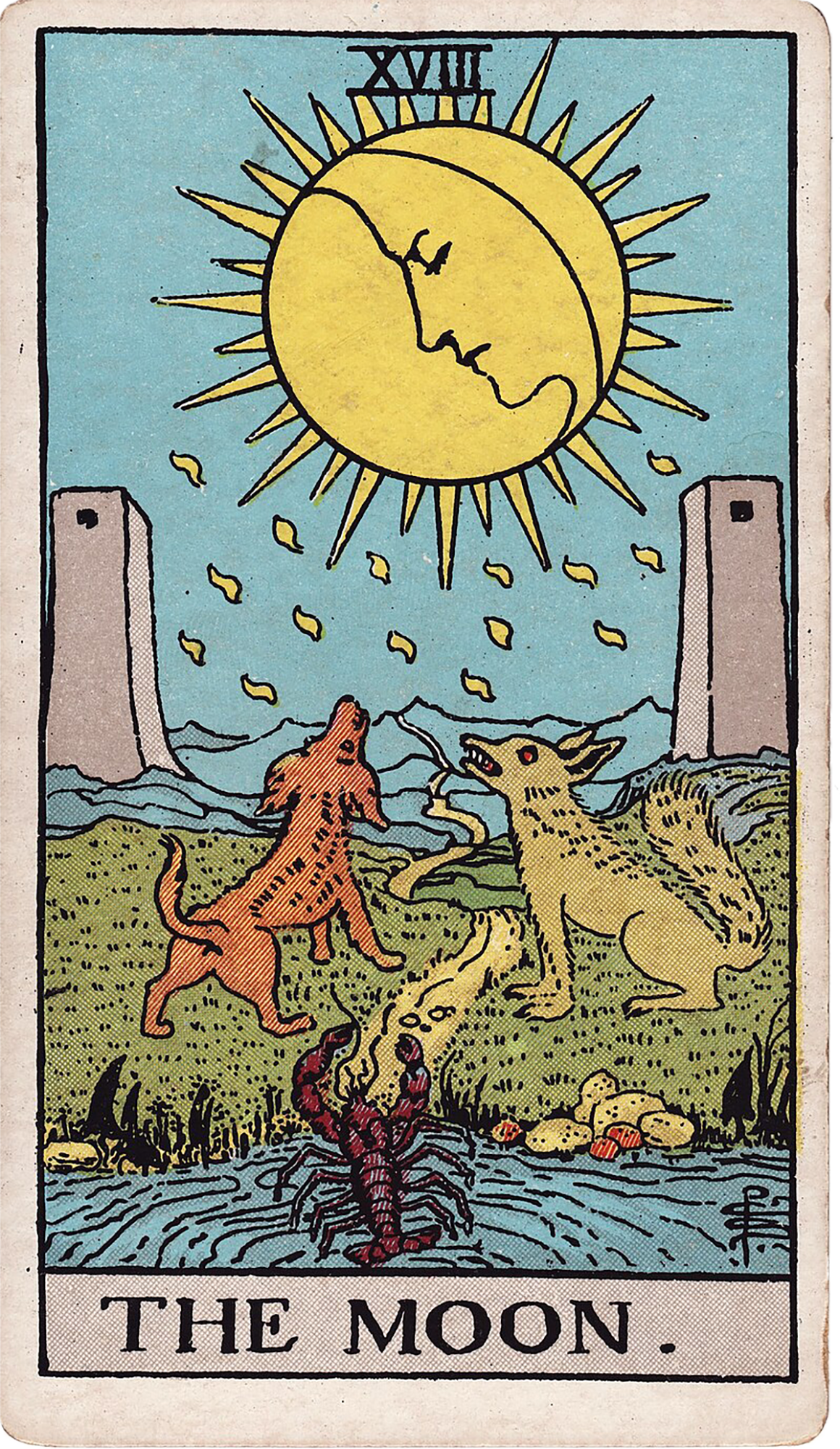 The Moon
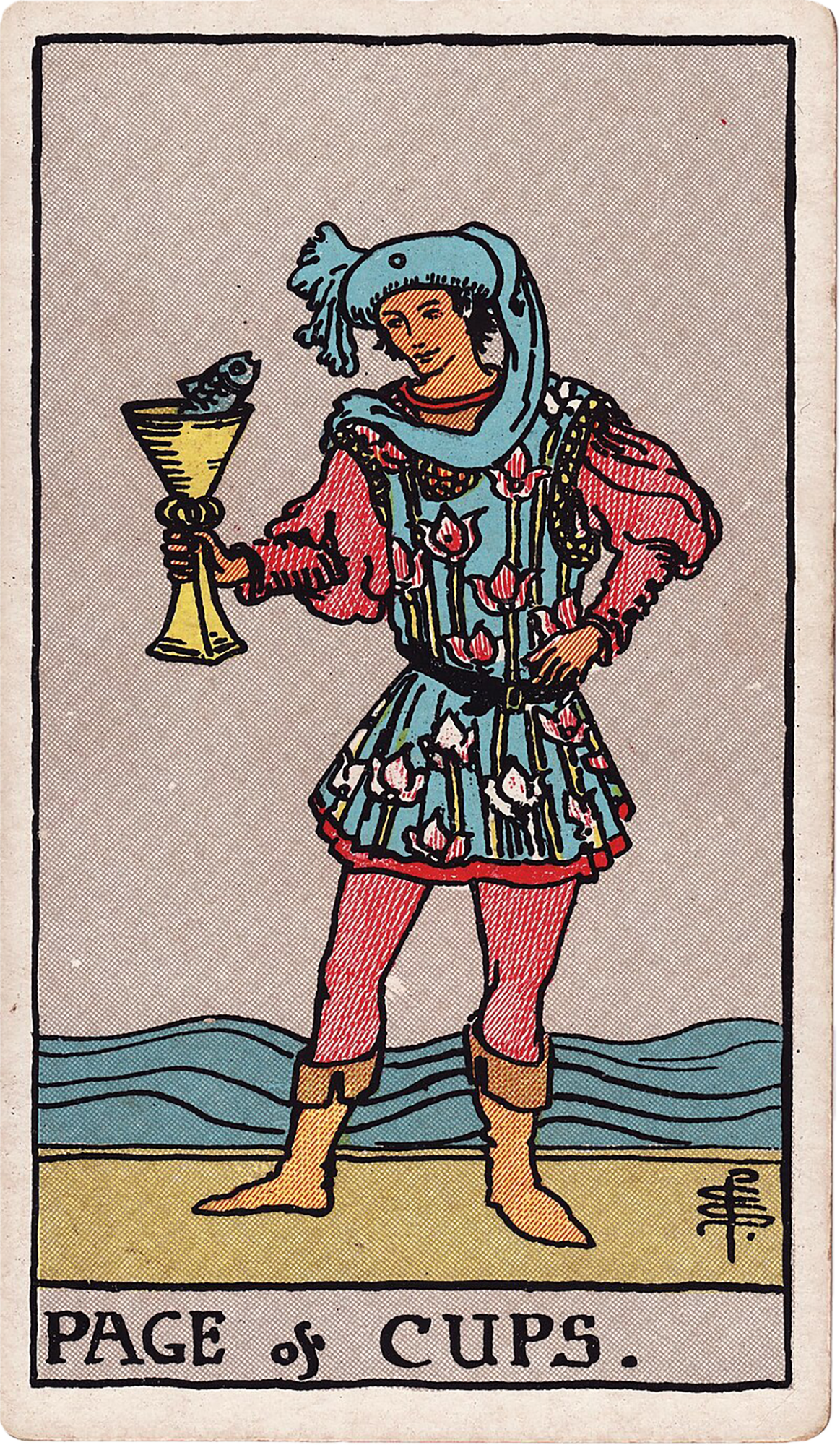 Page of Cups
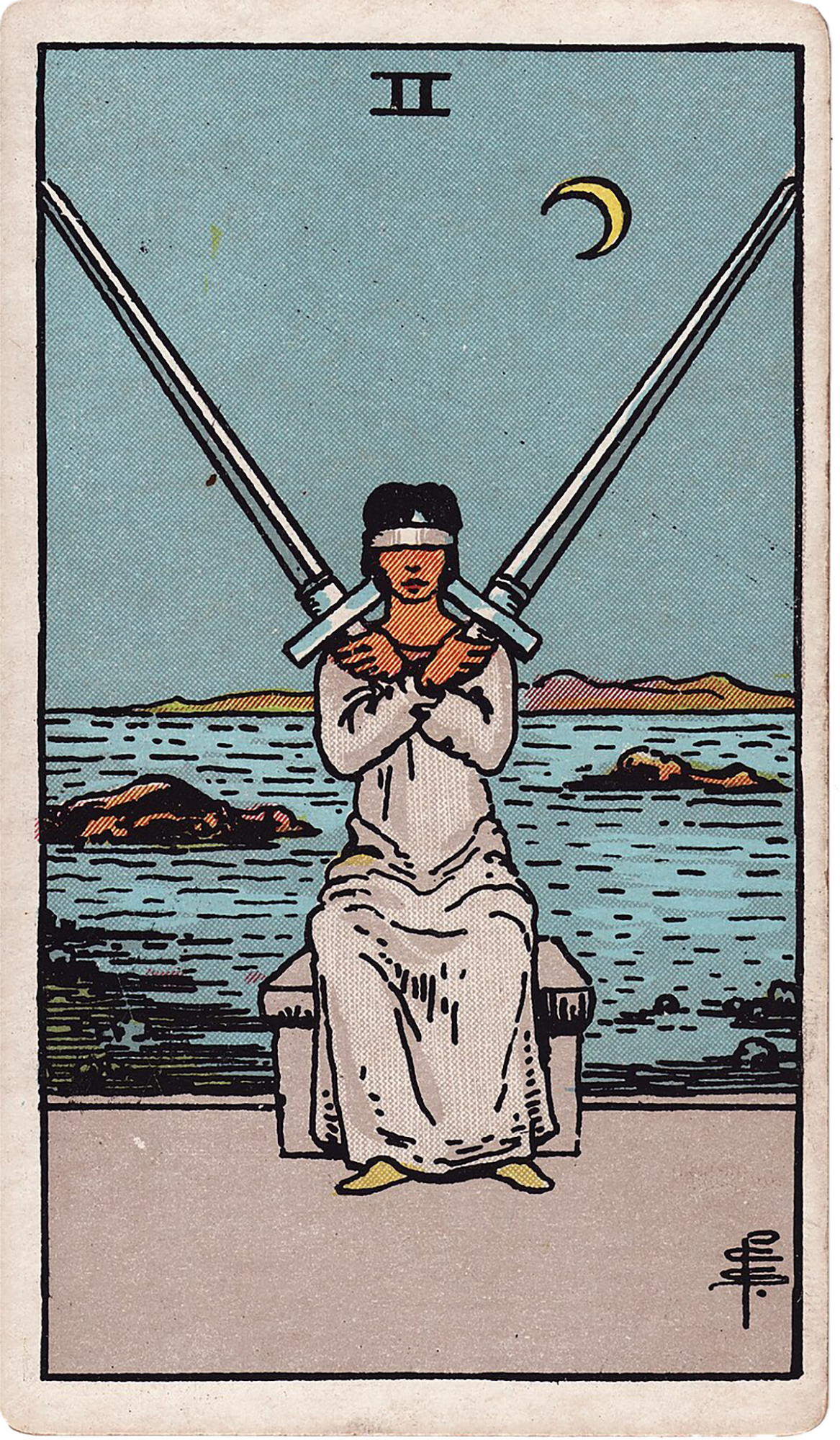 2 of Swords
Why this trio matters
The Moon, Page of Cups, and 2 of Swords form a compact drama: The Moon supplies an atmosphere (uncertainty, dream imagery, submerged material), the Page of Cups supplies a human-scale emotional signal (a message, impression, or new feeling), and the 2 of Swords describes how the mind is responding (blocking, balancing, or refusing to decide). Reading them together teaches students how Major, Court, and Minor cards cooperate. Because the three cards come from different levels of tarot structure, they allow you to practice three essential skills at once: interpreting archetypal background (Major Arcana), reading character and process (Court Card), and tracking immediate cognitive dynamics (Suit of Swords). This combination most often surfaces when somebody is trying to know whether an emotional communication is real or reliable. The Moon says "trust your senses but beware projection," the Page says "a fresh emotional signal is present," and the 2 of Swords says "you are keeping the mind in suspension." That formula can show up in a romantic text that feels like a sign but is ambiguous, a tentative creative idea with shaky feedback, or an internal prompt that the querent refuses to act on because they do not feel ready. The task for the reader is to describe these layers, show how they modify each other, and offer practical next steps.
Reading each card visually and symbolically
Before combining cards, ground yourself in what the Rider-Waite-Smith imagery is doing on each card. Use the supplied images as anchors. The Moon: In the standard imagery you see a full moon flanked by towers, a dog and a wolf baying or howling at the moon, and a crustacean (a crayfish) emerging from a pool onto a winding path toward the distant towers. The moon’s face often appears watchful and the reflected light feels cool and partial. Symbolically this card describes the unconscious, imagination, dreams, projection, the animal and tame sides of the psyche, and a path that is visible but uncertain. Practically, The Moon asks: which part of this issue lives in imagination, projection, or fear? Where is light partial rather than full? Page of Cups: The Page appears youthful, tender, and open. He holds a cup and is surprised or amused to find a little fish peeking out. His clothing and posture are delicate; the image suggests receptivity, early emotional communication, the beginning of creative feeling, or a message that arrives gently and unexpectedly. Symbolically this card indicates an initial emotional impression, a proposal that is not yet mature, curiosity, and an invitation to respond with openness rather than over-control. 2 of Swords: The Rider-Waite imagery shows a seated figure blindfolded, holding two crossed swords, often on a stone bench with water visible behind them and a moon in the sky. This card captures stalemate, blocked decision, willful ignorance, and a paradox: the mind is balancing things by not choosing. The blindfold indicates missing data or refusing to see; the crossed swords represent opposition that is being held in tension rather than resolved. When you describe these images to a querent, point to concrete parts of the cards: the crayfish emerging from The Moon’s water as a sign of something surfacing from the unconscious; the fish in the Page’s cup as an oddly literal emotional message arriving from a surprising place; the blindfold in the 2 of Swords as evidence that the querent is not fully looking at the situation. Teaching students to reference visible motifs keeps readings grounded and reduces projection.
How the cards modify one another
Combinations are about interaction. Here are the principal ways these three cards modify and refine each other. 1) The Moon frames and filters the Page of Cups message. If the Page brings an emotional communication or impression, The Moon asks whether that message is filtered through fear, projection, or wishful thinking. The Page’s little fish may be literally coming from the watery unconscious that The Moon oversees. So instead of reading the Page as a straightforward message, the reader asks: is this message reliable, or is it a symbolic dream-image? The Moon can both deepen the Page (making it more intuitive and meaningful) and distort it (turning it into a projection). 2) The Page humanizes The Moon’s abstraction. The Moon can be nebulous and scary; the Page provides a concrete person or event that anchors the experience—a text, a note, a tentative apology, a creative intuition. If The Moon says "something unresolved is influencing perception," the Page says "here is the specific piece of emotional data you can work with." That dynamic is useful pedagogically: Major Arcana create context, Court Cards provide actors. 3) The 2 of Swords describes the mind’s response to the Page and The Moon. If the Page brings an impression and The Moon makes its status unclear, the 2 of Swords often emerges as the querent’s strategy: to avoid deciding, to blindfold oneself, or to maintain a balance by not choosing. Importantly, the 2 of Swords can be either a temporary protective manoeuvre (buying time until more evidence arrives) or a problematic avoidance (refusing to integrate necessary reality checks). 4) Directional flow: read as a timeline, The Moon → Page of Cups → 2 of Swords can describe an unconscious image surfacing, the arrival of an emotional message based on that image, and then the querent choosing not to act. Read in a different spread position order, the combination could show that a withheld decision (2 of Swords) causes someone to send a tentative message (Page), which then feeds back into the dreamlike anxieties of The Moon. Practice reading flow both as narrative and as reciprocal influence. 5) Emotional vs mental polarity: Cups and Swords are different energies. Page of Cups is feeling and receptivity; 2 of Swords is thought and refusal. The Moon sits above these as the unconscious mediator. When the combination appears, the tension is usually between felt knowing and mental refusal, with The Moon complicating both by making the boundary between inner and outer fuzzy.
Relationship context examples and interpretations
This combination is common in relationship readings, especially when reports of "mixed signals" come in. Scenario A — A text that feels flirtatious but ambiguous (upright Page of Cups, upright 2 of Swords, upright The Moon): The Page is the flirtatious or caring message; The Moon warns you that the tone could be shaped by projection—maybe you want to read more into the text than the sender intended. The 2 of Swords says you are keeping your mind and heart on pause: you haven’t replied or you reply cautiously. Practical counsel: ask clarifying questions rather than assume. Point to the imagery: "The fish in the cup is unexpected—what did you feel when you read it? The blindfold suggests you are keeping options closed until you know more." Scenario B — Someone returns after a breakup with odd gestures but no commitment (The Moon reversed, Page of Cups upright, 2 of Swords reversed possible): If The Moon is reversed (confusion clearing) and the Page is offering a tentative emotional olive branch, the reversed 2 of Swords could indicate the stalemate is breaking. The reversal pattern suggests movement: emotional contact is genuine enough to prompt a decision, and the fog is lifting. Use caution: ask for evidence; confirm what has changed concretely rather than rely on ephemeral signs. Scenario C — Internal ambiguity about whether to trust early feelings (The Moon upright, Page of Cups reversed, 2 of Swords upright): The Page reversed suggests emotional immaturity or misread signals—perhaps the "message" is more fantasy than fact. The Moon amplifies doubt and projection. The 2 of Swords says you’re keeping your thought processes closed off. Work: journal to separate fact from fantasy; invite a calm conversation to gather data; practice noticing which part of the response is longing vs observable behavior. In all relationship contexts, avoid pronouncing "they’re lying" or "it’s true" decisively. Instead, describe how the cards show modes of perception and response: what was received (Page), what filters perception (The Moon), and how the querent is coping mentally (2 of Swords). Offer practical next steps that fit the stage: clarifying questions, small tests of consistency, or a decision deadline if the stalemate is harming wellbeing.
Career and project contexts
Taken into work-life situations, this combination often appears around ambiguous feedback, creative inspiration that is not yet marketable, or workplace gossip that leaves you unsure. Example — A tentative new idea pitched to your manager (Page of Cups upright, The Moon upright, 2 of Swords upright): The Page indicates a creative spark or a tentative emotional plea for support. The Moon warns that feedback may be ambiguous or emotionally charged—people’s reactions could be shaped by fear or projection. The 2 of Swords shows you are holding off on pushing forward because you lack clear information or fear the consequences. Practical moves: gather concrete criteria to evaluate the idea; ask for a pilot or small test that turns feeling into data; set a temporal boundary for the decision to avoid indefinite suspension. Example — Rumors about restructuring (The Moon upright, Page of Cups reversed, 2 of Swords reversed): The Moon describes murky information circulating; the Page reversed suggests immature communication—leaks, half-formed messages, or emotionally reactive posts. The reversed 2 of Swords suggests the stalemate is breaking and a forced choice may arrive. Advice: prioritize verified sources, avoid acting on rumor, and prepare contingency plans for both outcomes. In career readings emphasize systems: convert Page-level feeling into a measurable experiment; use The Moon’s signal to watch for bias in how people present information; treat the 2 of Swords as a sign to either create structure or push for a deadline so the stalemate resolves productively.
Emotional and practical life contexts
Emotionally, this combination teaches about inner signals that feel real but are poorly grounded. Inner work: The Moon is a call to dream and to notice what is arising unconsciously. The Page is a messenger from that inner world—a spontaneous emotion, a sudden sympathy, or an ear-catching intuition. The 2 of Swords shows resistance: the querent might be afraid to feel fully or afraid to think about consequences. Practical therapy-oriented interventions include naming the feeling (Page), mapping where it might come from (The Moon), and making a safe decision to either sit with the feeling for a set period or choose a small, accountable action that removes the stalemate. Household or family decisions: When complicated family dynamics create "mixed signals"—someone offers a tentative apology or a small gift (Page) while past patterns of avoidance continue (Moon) and you cannot decide (2 of Swords)—the reading suggests creating protocols: ask for a clear behavioral change to count as progress; use neutral third-parties to verify change; make your own decision boundary if you are not seeing enough evidence. In practical contexts the cards are less about romantic ambiguity and more about how to convert murky feeling into clear action steps.
Upright and reversed permutations that are most instructive
With three cards there are many permutations. Focus on the most pedagogically useful patterns. Both Pages and 2 of Swords upright with The Moon upright: classic "mixed signals". Emotional approachability is present but being filtered by doubt and avoided decision. Recommended reading style: emphasize careful testing, clarification questions, and timelines. Page upright, The Moon reversed, 2 of Swords upright: the fog around perception is clearing but the querent still holds off on deciding. Interpret as an improving situation where inner signals are becoming clearer; recommend data-gathering and modest responses. Page reversed, The Moon upright, 2 of Swords upright: the emotional signal is immature or distorted and the querent is refusing to decide—be cautious about acting on this communication; suggest grounding, fact-checking, or emotional regulation before responding. 2 of Swords reversed with Page upright and The Moon upright: the stalemate is breaking, for better or worse. A decision will be made but may be forced by unclear information; watch for impulsive choices once the blindfold comes off. The Moon reversed changes the tone: reversed often indicates partial clarity, internalized processing, or denial of intuition. If The Moon reverses in this trio, ask whether the querent is finally seeing a pattern or whether they are ignoring an inner alarm. The Page reversed highlights immaturity or escapism; the 2 reversed highlights movement away from stalemate. In each case, emphasize process: which element is moving and how quickly? Teach learners to avoid absolute judgments based solely on reversals. Reversed cards signal nuance: delay, internalization, distortion, or emerging clarity. Use neighboring cards to determine whether a reversal is corrective or problematic.
Practical reading method step by step
Follow a repeatable routine when you encounter this combination. 1) Observe imagery aloud: name the Moon’s towers, dog/wolf, crayfish, the Page’s fish in the cup, the 2 of Swords blindfold and crossed blades. This anchors the reading in what’s actually visible and helps the querent see the story. 2) Identify levels: say which card is the background (The Moon — major theme), which card is the actor or messenger (Page of Cups), and which card is the cognitive response or technique (2 of Swords). Frame them: "The Moon is the atmosphere; the Page is the message; the 2 of Swords is how your mind is handling it." 3) Ask clarifying questions to locate external vs internal: "Did this message come from someone else (a text, a call) or as an inner impression? Who is being represented by the Page?" Use concrete prompts to collect facts. 4) Test the Page: is this a mature, reliable offer or a tentative one? Evaluate content, tone, consistency, and whether it aligns with evidence. Refer to The Moon: "Is there a reason you might be reading into this? What fears or wishes could color it?" Use the 2 of Swords to point out avoidance: "Are you waiting for a perfect answer before you respond?" 5) Offer practical next steps tuned to the stage: information-gathering, a clarifying question to the other person, a small test action, a deadline for deciding, or an inner practice like journaling or a dream record. 6) Decide on a likely outcome range rather than a single prediction. For example: "If you gather evidence and set a two-week test, you may find the message is consistent; if you wait indefinitely, the 2 of Swords suggests you will remain stuck." Teaching students to give conditional forecasts helps the querent retain agency. 7) Record the reading and follow up. The Moon-card situations often change slowly; encourage the querent to treat the reading as a working hypothesis and to return with outcomes.
Common mistakes and how to avoid them
Mistake 1 — Treating The Moon as simply "liar" or "deception": The Moon is nuance; it signifies imagination, dreams, and partial light as much as outright deception. Avoid moralizing language; describe process. Mistake 2 — Reading the Page as automatically reliable simply because it is a Court Card: Pages are beginnings—tentative and changeable. Ask whether the Page’s message has had time to prove itself. Mistake 3 — Ignoring the blindfold in the 2 of Swords: many readers miss that the 2 of Swords is often a deliberate strategy rather than accidental ignorance. Help querents see whether they are choosing to wait. Mistake 4 — One-card-at-a-time literalism: Don’t deliver three disconnected mini-readings. Show synthesis: who is sending the message, how perception is being altered, and how the querent’s mind is coping. Mistake 5 — Overconfidence about reversals: Reversed cards are ambiguous. Ask follow-up questions to determine whether reversal indicates internalization, delay, or correction. Mistake 6 — Failing to offer concrete next steps: The combination easily becomes talk-heavy. Ground the querent with practical actions: ask a clarifying question, set a small test, establish a deadline for decision, or do a dream record for three nights. Teaching students to check these pitfalls improves accuracy and ethics.
Sample readings and scripts you can practice
Practice helps internalize the method. Here are two short sample readings you can adapt. Sample 1 — Relationship: "I got a late-night message from an ex that read like they miss me. What do the cards say?" (The Moon upright, Page of Cups upright, 2 of Swords upright) Scripted reading: "Look at The Moon—there’s a moonlit path and a crayfish coming out of the water. That tells me something from the past is surfacing and may be shaped by dream and desire. The Page of Cups is literally someone offering a small, soft message: an emotional text that is curious rather than committed. The 2 of Swords shows you are keeping your options suspended; the blindfold suggests you’re not ready to engage without more evidence. Practical step: don’t respond based on longing. Ask one clarifying question and set a two-week boundary to watch for consistent behavior. If the gestures continue and align with concrete changes, you can re-evaluate." Sample 2 — Career: "A colleague hinted at a new role but the details are fuzzy." (The Moon upright, Page of Cups reversed, 2 of Swords reversed) Scripted reading: "The Moon says the situation is clouded; people may be guessing or projecting. The Page reversed suggests immature communication—perhaps a rumor or someone over-selling an idea. The reversed 2 of Swords indicates the stalemate is breaking; a choice or forced re-organization may be imminent. Practical step: ask your manager for clarification in writing and prepare a plan in case the change happens. Don’t act on rumor, but get your resume or project plan current so you can move quickly if needed." Practice these scripts aloud, referencing imagery each time, until narrating the synthesis feels natural.
Practice exercises and next steps for learners
1) Image-to-interpretation drill: Spend five minutes with only one of the three card images. Note every concrete object you see, then write a sentence connecting it to querent behavior. Repeat for all three cards and then write a combined two-paragraph interpretation. 2) Position swaps: Lay the three cards in different order and practice three 1-minute narratives: Moon→Page→2 of Swords, Page→2→Moon, 2→Moon→Page. Notice how narrative emphasis changes. 3) Role-play clarifying questions: With a study partner, ask the querent what evidence they have. Use the Page to identify the message, The Moon to identify projection, and the 2 of Swords to identify withheld decisions. Practice offering two different next-step options: one conservative, one active. 4) Follow-up journaling: When you read this combination for a real client, schedule a follow-up. The Moon’s lessons often play out across time. Note whether your suggested tests produced evidence and how the 2 of Swords resolved (if at all). 5) Dream and active imagination: Use the Page as a prompt for a short active imagination exercise—ask the fish in the cup what it wants and write the response. Use The Moon’s crayfish imagery to notice what arises from the deep; record insights and compare with the rational objections suggested by 2 of Swords. These exercises move students from technique to embodied practice.
Conclusion and teaching takeaways
The Moon + Page of Cups + 2 of Swords is an excellent combination for learners because it forces synthesis across three tarot levels: archetypal atmosphere, human messenger, and cognitive coping. The Moon reminds you to respect imagination and fear without treating them as absolute truth. The Page of Cups gives you what you can work with—a message, an impression, the beginning of an emotional process. The 2 of Swords shows how the mind reacts: protecting, avoiding, or balancing. Always anchor readings to the images: point to the crayfish, the fish in the cup, the blindfold. Ask clarifying questions that translate the cards’ language into testable actions. Avoid one-card-is-everything thinking; instead describe how cards modify one another and offer stage-appropriate steps. The practical art is teaching querents to convert The Moon’s dream material into Page-scale experiments and to decide whether the 2 of Swords is a healthy pause or a behavior that needs to change. With practice you will learn to read this trio with nuance, clarity, and ethical care.
Practice questions
• Looking at the images of The Moon, what specific element (crayfish, towers, dog/wolf) most resonates with your current doubt or hope, and why?
• If the Page of Cups is a person in the situation, what three observable behaviors would prove their sincerity?
• What evidence would you need to remove the blindfold in the 2 of Swords and make a confident decision?
• How might your personal wishes or fears be shaping how you interpret the Page’s message under The Moon’s light?
• When have you used a temporary pause (2 of Swords) productively, and when has it become avoidance?
• If you treat the Page of Cups’ message as a hypothesis, what small test could you run to verify it?
• Does The Moon ask you to trust intuition or to seek clearer facts in this situation? What would each path look like concretely?
• After a week, what signs will indicate that the combination is moving toward clarity rather than deeper confusion?
Comments
Sign in to comment.
Continue learning
Interpreting the Dance of Justice and The Devil: Balancing Morality and Temptation in Tarot Readings
The combination of Justice and The Devil in tarot presents a profound exploration of morality, temptation, and personal accountability. This article unpacks how these cards influen...
Harnessing the Power of The Magician and Ace of Wands: Igniting Creativity and Manifestation in Tarot Readings
The combination of The Magician and the Ace of Wands in tarot readings offers a potent blend of creative energy and manifestation power. This article delves into the ways these car...
Understanding the Synergy Between The Empress and The Emperor in Tarot Card Combinations
This article delves into the intricate synergy between The Empress and The Emperor cards in Tarot, focusing on how their combined energies modify and enrich readings across various...
Decoding Transformation and Renewal with Death and The Star in Tarot Combinations
This article delves into the card combination of Death and The Star, two powerful Major Arcana cards from the Rider-Waite-Smith deck. It explores how their imagery and meanings int...
Balancing Ambition and Compassion with The Emperor and Queen of Cups in Tarot Combinations
This article delves into the nuanced Tarot card combination of The Emperor and Queen of Cups, emphasizing how their energies complement and challenge each other. By analyzing their...
Finding Emotional Healing and Renewal with The Star and The Moon Tarot Combination
This article examines the rich interplay between The Star and The Moon tarot cards when they appear together in a reading. Using the traditional Rider-Waite-Smith symbolism and the...
Unlocking Emotional Wisdom with The High Priestess and The Queen of Cups in Tarot Combinations
This article delves into the card combination of The High Priestess and The Queen of Cups, emphasizing their shared themes of intuition, emotional depth, and receptivity. By examin...
Unlocking Emotional Resilience with Strength and The Star in Tarot Combinations
This article delves into the Tarot card combination of Strength and The Star, revealing how their interplay highlights pathways to emotional resilience. Anchored in the Rider-Waite...
Unveiling Emotional Strength with Strength and The Queen of Cups in Tarot Combinations
This article delves into the dynamic Tarot combination of Strength and The Queen of Cups, emphasizing how these cards together illuminate emotional strength, compassionate boundari...
Unlocking Emotional Transformation with Death and The Moon Tarot Combination
This article explores the rich and complex interaction between the Death and The Moon tarot cards within the Rider-Waite-Smith tradition, focusing on their combined potential to un...