
Reading the Five of Swords in Love Work and Tough Ethical Decisions
This article teaches how to read the 5 of Swords in multiple contexts. Anchored to the supplied card texts—"Upright, 5 of Swords highlights winning at a cost, conflict shaped by ego, or the need to assess whether being right is worth the damage done" and "Reversed, 5 of Swords draws attention toward reconciliation, unresolved resentment, shame after conflict or recognizing the need to change the way battles are fought"—it explains Rider-Waite-Smith imagery, interprets the card in love, work, finance, advice/ethical dilemmas, person and outcome, and spiritual reflection. You will get a clear technique for reading this card in spreads, sample readings, common mistakes, and practical follow-up questions for learners.
Cards explored in this article
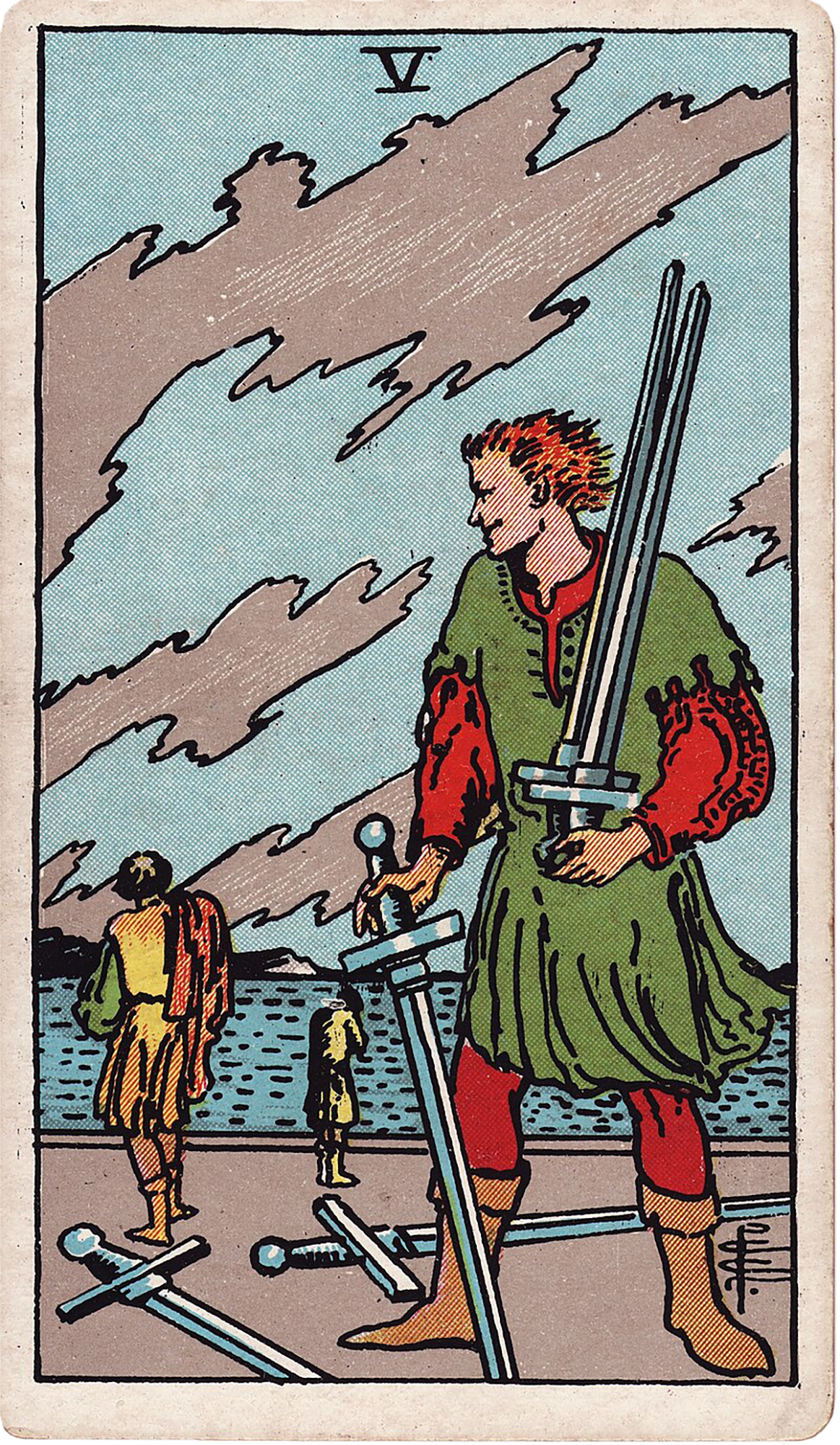 5 of Swords
Introduction and learning aims
This article is a focused single-card lesson on the 5 of Swords. It assumes the reader has the supplied card image visible and will repeatedly anchor interpretation to that imagery and to the exact supplied upright and reversed descriptions. The two supplied texts read: "Upright, 5 of Swords highlights winning at a cost, conflict shaped by ego, or the need to assess whether being right is worth the damage done. The card is practical: it asks for a response that fits the present stage rather than an abstract ideal. Consider where this pattern is already visible and what action would strengthen its constructive side." And: "Reversed, 5 of Swords draws attention toward reconciliation, unresolved resentment, shame after conflict or recognizing the need to change the way battles are fought. The reversal may show too much of the card's usual energy, too little of it, or a situation where the lesson is understood intellectually but not yet lived consistently." Keep these exact formulations at hand; they anchor the card's core messages. Learning aims: 1) Translate the card's core messages into specific contexts (love, work, money, advice/ethical decisions, person/outcome, spiritual reflection). 2) Practice a repeatable technique for reading the card in spreads. 3) Notice common interpretive traps and corrective techniques. 4) Use the card's RWS imagery as a practical interpretive tool.
Quick orientation to upright and reversed meanings
First, treat the supplied upright and reversed descriptions as working definitions for the card. They are deliberately practical. The upright text emphasizes "winning at a cost, conflict shaped by ego," and asks the reader to "assess whether being right is worth the damage done." It links the card to Swords skills: thought, communication, conflict, decision, truth, strategy, and consequences of mental habits. The reversed text flips focus from external victory to internal processing: "reconciliation, unresolved resentment, shame after conflict or recognizing the need to change the way battles are fought." Notice two important interpretive principles present in these descriptions: 1) The 5 of Swords is not primarily about simple success or failure but about the quality and cost of conflicts and mental approaches. 2) Upright and reversed are not clean opposites; reversal often signals a process stuck, excessive expression, or an internalized version of the same lesson. Keep those principles central as you apply the card to contexts.
Symbolism and visual anchors in the Rider-Waite-Smith image
To interpret the card fluently, connect words to image. On the Rider-Waite-Smith 5 of Swords you will see: a man holding three swords and wearing a self-satisfied expression; two figures walking away in the background, their heads down; two swords lying on the ground; a shoreline and wind-torn clouds indicating emotional backdrop and turmoil. Each element gives interpretive leverage. The man with three swords: confidence, triumph, and self-justification — possibly at the expense of others. The two departing figures: loss, retreat, social alienation, or wounded pride among companions. The fallen swords: costs, casualties, or abandoned principles. The shoreline/water in the distance: the emotional context is present but not central; this is a Sword energy card (mental, communicative) with emotional consequences. Notice posture, gaze, and facial expression—these help you judge whether the victory feels hollow or justified. When you read the card, point to specific visual details: Which way are the figures turned? Are the clouds clearing or menacing? Are the fallen swords intact or broken? Use those details to build a story that connects to the querent's situation rather than a generic label.
Interpreting the 5 of Swords in love and relationships
Upright readings in love: Bring the upright text into relational terms: "winning at a cost" or "conflict shaped by ego" often shows a dynamic where one partner has asserted intellectual control, 'won' an argument, or pushed for being right in a way that left the other hurt. The Rider-Waite-Smith man clutching three swords is useful imagery: someone in the relationship may be collecting 'points'—proof of correctness—while the other party walks away. Ask: Did someone claim a moral or intellectual high ground? Is victory prioritized over repair? Practical meanings include: an insistence on unilateral decisions, cutting criticism, or triumph that creates emotional distance. Advice: weigh the long-term cost of 'being right' against repair actions like apology or negotiated compromise. Reversed readings in love: The reversal points to reconciliation efforts, lingering resentment, or shame about past conflicts. It can mean the querent is ready to apologize but unsure how, or that resentment is private and unspoken. Use the reversed card to explore: What needs to be acknowledged? What patterns of argument are being repeated? Techniques: encourage explicit repair language, set small behavioral tests (one forgiving act, one honest boundary), and address power imbalances. Example: Upright — a querent describes always 'winning' arguments by cutting remarks; the card suggests that although they secure the point, their partner is distancing. Reversed — the querent realizes their criticism has caused shame and is asking how to repair; the card encourages small, sincere steps toward reconciliation rather than defensive justification.
Interpreting the 5 of Swords in work and career
Upright in career readings: The 5 of Swords upright can indicate workplace victories that isolate, undermine teamwork, or result from aggressive tactics. The man with three swords can represent a colleague or the querent who takes credit, dominates meetings, or wins budget/control fights at the expense of collaboration. It warns: a tactical win may cause reputational or relational losses later. Practical questions: Is advancement built on undermining others? Have you negotiated in ways that create future obstacles? Advice focuses on strategy recalibration: pursue goals with transparency, document ethical boundaries, and consider mentorship rather than dominance. Reversed in career: The reversal may show a desire for reconciliation with coworkers, regret after a power play, or hidden resentment undermining productivity. It can also mean excessive avoidance of conflict, leading to suppressed issues. In this position, recommend communication repair, accountability steps, or mediated negotiation. Example: Upright — you landed a deal but your style burned a partner; the card asks whether the gain is worth long-term friction. Reversed — lingering resentment is creating passive resistance; the card invites explicit clean-up work: acknowledge harm, renegotiate terms, repair trust.
Interpreting the 5 of Swords for money and financial decisions
When money is the focus, treat the 5 of Swords as a card about cost-benefit ethics rather than a simple yes/no. Upright: financial 'wins' that carry social or ethical cost—short-term gain obtained by aggressive negotiation, predatory deals, or choices that create debt for others (e.g., pushing family finances in one direction). The visual of scattered swords can be read as lost resources or reputational damage. Advice: run a cost-accounting that includes relational and reputational expenses; ask whether the strategy fosters sustainable wealth or isolates future partners. Reversed: financial shame, regret, or the need to reconcile with joint-account partners, family, or business associates. It may also indicate an internal struggle—someone knows they acted poorly around money and must change patterns. Practical steps include transparent accounting, formalized settlements, small reparative transactions, and financial counseling if shame leads to denial. Remember that the card primarily speaks to the decision process—communication and ethics around money—so focus on those elements during the reading.
Advice, challenge, and the card as an ethical decision prompt
This is where the 5 of Swords is often most potent: as a call to evaluate the ethics of a chosen strategy. Use the upright text's phrase "assess whether being right is worth the damage done" as a reading script. For advice positions, translate that script into action steps: 1) Pause and name the win: what exactly are you trying to secure? 2) Map damages: who loses in the process and what is the long-term cost? 3) Consider alternative wins that preserve relationships or values. The RWS man holding swords suggests conscious choice; the departing figures point to foreseeable fallout. For challenge positions, the card often diagnoses the obstacle: a prideful insistence, a reputation for cutting behavior, or an ongoing pattern of argumentative triumph. Tackle the challenge with explicit repair or new tactics: passive-aggressive avoidance rarely solves the underlying logic. When the card appears reversed in an advice/challenge slot, treat it as process-focused prompts: reconciliation steps, naming shame, and practicing new conflict methods (listening skills, compromise experiments, mediated conversation). Use role-play, 'third-way' proposals, or apology scripting as concrete practice.
Reading the 5 of Swords as a person and as an outcome
Person reading: When asked 'who is this person' use visual cues. Upright, the 5 of Swords person is someone who values victory and is willing to accept relational costs to secure it: sharp, competitive, sometimes proud. They may be intellectually quick and blunt in communication. Reversed, the person could be the one who is wounded, regretful, or ready to change—the person who has begun to see the cost of prior tactics. Outcome reading: Upright outcome warns of pyrrhic victory—at the end you may have 'won' but lost support, trust, or inner peace. The image of swords left on the ground suggests what is abandoned: alliances, dignity, or mutual benefit. Reversed outcome offers repair or prolonged stalemate: either resentment subsides through active reconciliation, or resentment festers internally without visible change. When using outcome positions, pair the card with timeframe-sensitive questions: What would victory look like in 3 months? What will relationships look like in 6 months if current tactics continue? The card gives conditional outcomes: change tactics and the reversal becomes possible; insist on ego wins and the upright outcome becomes likely.
Spiritual reflection and inner work with the 5 of Swords
Spiritually, the card is a mirror for an inner mode of 'winning' that disconnects from compassion. Upright invites you to examine mental habits: are you engaged in debates to shore up identity? Are you cultivating arguments as armor? The RWS shoreline suggests emotions are present but offshore—intellect is managing relations while feelings are neglected. Reversed asks for integration: acknowledge shame, practice forgiveness (toward self and others), and learn new conflict rituals. Specific spiritual practices: journaling to trace recurring argumentative themes; compassion practices aimed at softening the inner critic; ritual acts that symbolize laying down swords (literal or symbolic) and committing to new behavior. Remember the supplied reversed text's emphasis: "examine where the process has become stuck"—the spiritual work is not just moralizing but pragmatic: what small consistent practices will change how you fight?
Practical reading method step-by-step
Use this repeatable technique whenever the 5 of Swords appears. 1) Anchor to the supplied meaning: read the exact upright or reversed wording out loud for clarity. 2) Observe image details: who holds swords, who walks away, emotional backdrop. Narrate a one-sentence scene using those details. 3) Place the card in context: which position is it in? (love, career, money, advice, challenge, person, outcome, spiritual). 4) Translate the scene to context-specific risks and options. For example, in career ask: Who is the man with the swords likely to be in my workplace? 5) Ask clarifying questions to the querent: What victory are you defending? Who will you alienate if you pursue this path? 6) Use polarity thinking: What would it look like to accept the win and repair? What would it look like to forgo the win and preserve relationships? 7) Offer concrete next steps—repair scripts, negotiation tactics, holding boundaries, or practice exercises for shame and apology. 8) Close with a prognosis: short-term consequence if current behavior continues; short-term consequence if different tactic is tried. This method balances mental analysis and ethical imagination, reflecting the card's orientation toward strategy and consequence.
Sample readings and worked examples
Example 1 — Love upright: Querent reports frequent petty competitions with partner. The 5 of Swords upright appears in relationship position. Image reading: the man with three swords suggests one partner keeps tally. Interpretation: victory at a cost is happening. Advice: practice 'scoreless' conversations for one week; the querent will suggest checking in after arguments without assigning blame. Expected outcome: reduced distance and fewer 'walk-aways'. Example 2 — Career reversed: The querent recently undercut a colleague and feels guilty. The 5 of Swords reversed appears in the advice slot. Image reading: the departing figures in the background are now internalized. Interpretation: the reversal highlights shame and the need to change fight patterns. Advice: schedule a mediated apology or transparent corrective action and track behavior changes publicly. Example 3 — Ethical choice for business upright: Company must decide whether to accept a profitable contract that requires cutting a supplier. The 5 of Swords upright in the decision slot suggests the profit is achievable but will cost relationships and reputation. Interpretation: short-term gain but reputation casualties. Advice: propose an alternative plan that shares benefit with the supplier or renegotiates terms so the win is not purely extractive. Each example uses the supplied upright/reversed text as interpretive spine and ties specific actionable steps to the imagery.
Common mistakes and how to avoid them
Mistake 1 — Reading the card as simply 'defeat' or 'aggression': The 5 of Swords is subtler; it is about the quality of victory and the thought patterns behind conflict. Avoid one-word labels. Mistake 2 — Treating reversed as always 'good': The reversed card often signals stuck processes or internalized harm, not automatic reconciliation. Ask follow-up questions. Mistake 3 — Ignoring imagery details: The man's posture, the direction of the departing figures, and the landscape matter. Use them to refine whether victory feels justified or hollow. Mistake 4 — Neglecting context: The same card in a reconciliation spread versus a power spread has different implications. Always re-anchor to the position prompt. Mistake 5 — Moralizing the querent: The card points to patterns, not permanent character. Offer strategies rather than judgment. To avoid these traps, use the step-by-step method above and always return to the supplied card texts as the interpretive baseline.
Practice exercises for learners
Exercise 1 — Image storytelling: Spend five minutes describing the RWS image in detail, then write three different one-sentence interpretations for love, career, and ethics. Exercise 2 — Reversal mapping: Draw the card twice in different sessions. In one reading treat it upright and list five immediate action steps; in the second treat it reversed and list five reconciliation steps. Compare differences. Exercise 3 — Role-play repair: With a partner, simulate a workplace dispute where one person reads the 5 of Swords upright behavior and the other practices apology and repair using language drawn from the reversed card description. Exercise 4 — Clarifying questions drill: Create a list of ten follow-up questions (Who benefits most? Who withdraws? What is the emotional cost? What steps would repair this?) and practice asking them in sample readings. These exercises train the learner to move from label-based reading to contextual, image-anchored interpretation.
Closing guidance and ethical stance for readers
The 5 of Swords teaches a hard practical lesson: intellectual agility and tactical wins are useful only insofar as they serve living relationships and long-term values. As a reader, your job is to surface that trade-off for querents and to help them envision concrete alternatives. Anchor each interpretation to the supplied upright and reversed texts, cite image details to support your claim, and always translate observations into at least one ethical and one pragmatic next step. This keeps readings useful, non-judgmental, and action-oriented—the very qualities the 5 of Swords asks us to cultivate when facing conflict.
Practice questions
• When was the last time I prioritized being right over repairing a relationship? What was the cost?
• If I imagine laying down a sword from the RWS image, which argument or position would I give up first?
• In my current work situation, who benefits from my victories and who pays the price?
• What small, consistent practice could change how I fight—listening exercises, apology scripting, or mediated conversations?
• Is there a private resentment I have not named that might be shaping my decisions?
Comments
Sign in to comment.
Continue learning
Mastering Decision Making with the Five Card Cross Tarot Spread
The Five Card Cross Tarot Spread is a powerful tool for deepening decision-making skills by examining the present situation, past influences, future possibilities, challenges, and...
Enhancing Clarity in Complex Choices with the Five Card Cross Tarot Spread
The Five Card Cross Tarot Spread is a practical tool designed to clarify complex choices by breaking down the decision into manageable parts. This article explores each position in...
Using the Five Card Cross Spread to Resolve Complex Life Decisions with Confidence
The Five Card Cross Spread offers a structured, insightful method for exploring complex life decisions. Using cards such as The Fool, The Chariot, Strength, Justice, and The Hanged...
Making Confident Life Choices Using the Five Card Decision Tarot Spread
This article provides a detailed guide to the Five Card Decision Tarot Spread, a practical tool designed to help learners navigate important life decisions with confidence and clar...
Using the Five Card Decision Spread to Navigate Complex Career Choices
The Five Card Decision Spread is an effective Tarot layout designed to help navigate complex career choices by providing clear perspectives on the current situation, two possible o...
Exploring The High Priestess in Career Relationships and Personal Growth
The High Priestess card in the tarot deck invites readers to explore intuition, hidden knowledge, and inner wisdom across various life contexts. This article examines how The High...
The Fool in Life Transitions and New Beginnings
The Fool card embodies the spirit of beginnings, curiosity, and the leap of faith required during life transitions. This article explores The Fool’s meanings across various reading...
Understanding The Chariot Card in Personal Ambition and Overcoming Obstacles
The Chariot card represents the power of focused will, disciplined action, and choosing a clear direction amid competing impulses. Upright, it encourages decisive steps forward usi...
Understanding The Hermit in Self Discovery and Spiritual Enlightenment
The Hermit card in the Rider-Waite-Smith deck embodies themes of introspection, solitude, and spiritual wisdom. This article examines how The Hermit's upright and reversed position...
Exploring The Hierophant in Modern Spiritual Practices and Personal Development
The Hierophant tarot card symbolizes structured wisdom, tradition, and the pursuit of knowledge through established systems. This article explores how The Hierophant’s upright and...