
Uncovering the Origins and Enduring Mysteries of the Moon Card in Tarot Tradition
The Moon card in tarot embodies themes of intuition, uncertainty, and the subconscious, drawing from a deep historical tradition that spans family and cultural symbolism. This article explores the origins of the Moon card, its traditional symbolism especially as depicted in Rider-Waite-Smith imagery, common interpretative challenges, and practical approaches for readers. We consider both the upright and reversed meanings of the card, emphasizing how to engage with its lessons in family and personal contexts while avoiding common pitfalls.
Cards explored in this article
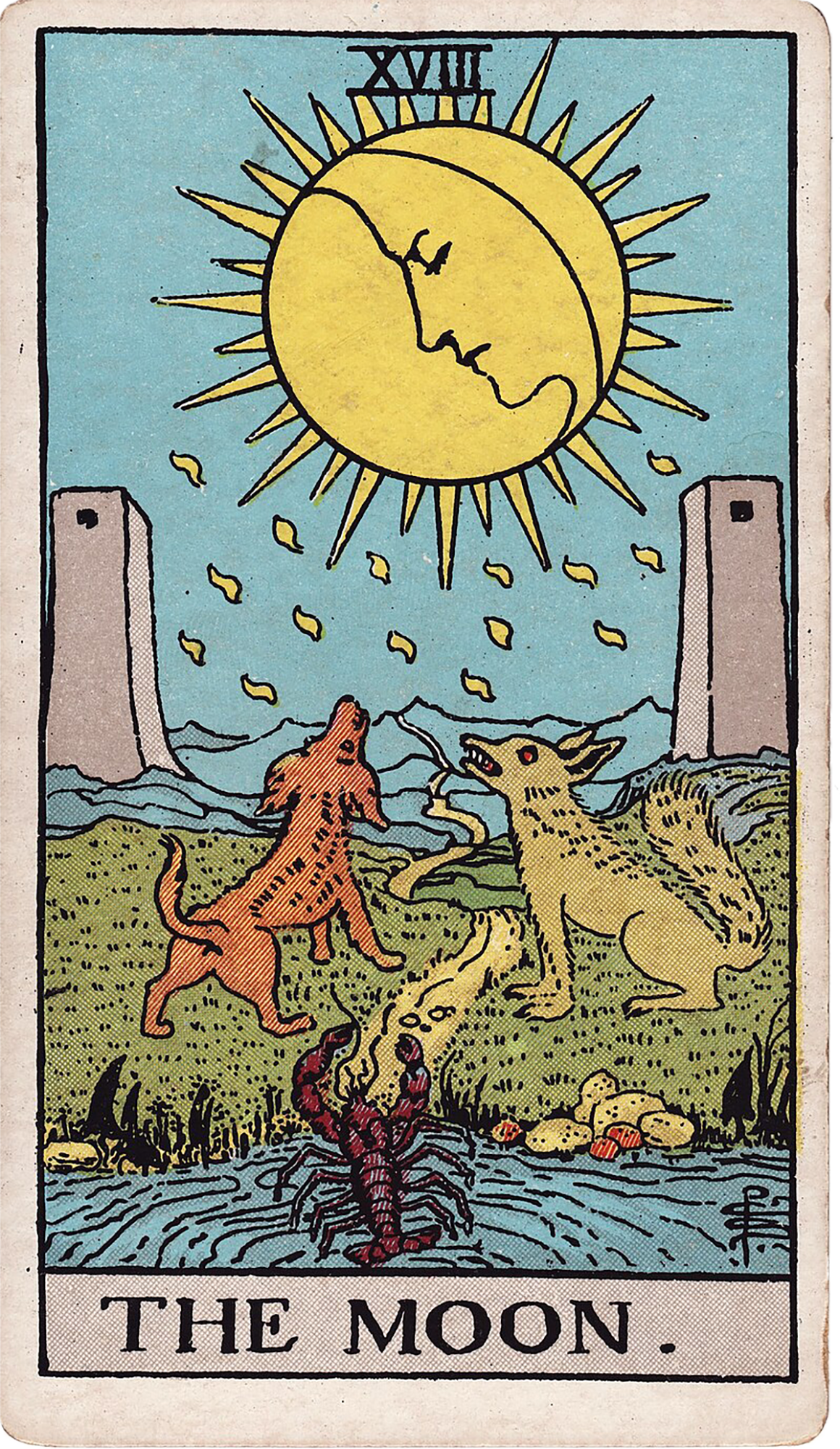 The Moon
Introduction to the Moon Card and Its Place in Tarot Tradition
The Moon card, often numbered XVIII in the Major Arcana, represents a complex intersection of intuition, dreams, and the unknown. Its imagery, as seen in traditional decks like Rider-Waite-Smith, captures a nocturnal scene with a luminous moon, a wolf and dog howling, a winding path, and a crayfish emerging from a pool. Each element conveys layers of meaning related to mystery, fear, and the subconscious mind. Historically, the Moon card arises from a blend of astrological, mythological, and folkloric traditions. It reflects humanity’s longstanding fascination with the moon’s influence on tides, emotions, and the cycles of life. As a symbol, the moon is tied to family histories and traditions of storytelling, dreams, and the transmission of intuitive knowledge. This connection roots the card deeply within cultural and familial contexts where intuition and caution must be balanced. In tarot readings, the Moon calls attention to the unseen and the uncertain. It challenges readers and querents alike to navigate ambiguity while honoring inner wisdom. This article will explore how to approach the Moon card with respect for its historical context and symbolic richness, providing practical techniques to integrate its lessons into readings.
Historical Origins and Symbolic Foundations of the Moon Card
The Moon card’s origin can be traced back to early European tarot decks where lunar symbolism was prevalent. The moon’s fluctuating phases made it a natural emblem for change, cycles, and emotional rhythm. Early divinatory traditions often linked the moon with feminine energy, secrets, and the unconscious realm. The Rider-Waite-Smith deck, designed in the early 20th century, crystallized the Moon’s imagery into a coherent tableau. The moon itself, with a human face, hovers between two towers, symbolizing the boundary between the conscious and unconscious. The dog and wolf represent the tamed and wild aspects of the mind, often interpreted as the tension between societal conditioning and primal instinct. The crayfish emerging from the water suggests the beginning of a journey from the depths of the subconscious toward conscious awareness. These symbols collectively underscore themes of uncertainty, illusion, and the necessity of careful navigation through unclear terrain. The Moon card encourages readers to honor dreams and intuition but also to seek clarity by examining projections against reality. This duality is crucial to understanding the card’s role in family and personal traditions, where myths, fears, and wisdom intermingle.
Interpreting the Upright Moon Card in Practical Readings
When the Moon card appears upright in a reading, it emphasizes the presence of uncertainty and the need for careful, deliberate action. The card suggests that the situation is not straightforward but that a clearer understanding is emerging. The imagery of the winding path illuminated by the moonlight encourages the querent to move forward slowly, trusting intuition but verifying impressions. In family or personal contexts, this can mean recognizing inherited patterns or emotional legacies that influence current circumstances. The card invites the reader to ask: Where would a direct response, clearer boundary, or deeper honesty help move the situation forward? It signals a time to work with what is present rather than waiting for complete clarity. A common practical method is to focus on the card’s elements during interpretation: the moon as intuition, the dog and wolf as internal conflict, and the pathway as gradual progress. Readers benefit from encouraging querents to journal dreams, track emotional reactions, or explore subconscious influences without becoming overwhelmed by fear or confusion. Avoiding common mistakes is important here. One such error is reading the Moon as purely negative or predicting inevitable chaos. Instead, recognize the card’s constructive quality as a prompt for careful navigation and self-awareness. This balanced approach helps readers and querents alike engage the Moon card as a guide rather than a warning.
Understanding the Reversed Moon Card and Its Nuances
When the Moon card appears reversed, its meanings shift but remain connected to the theme of inner experience. The reversal often points to confusion beginning to clear or the denial of intuition. It can highlight hidden fears, deception, or becoming trapped in imagined scenarios. However, the reversed Moon is not inherently negative; it can indicate a phase where the querent is starting to recognize old patterns but has not fully transformed them. In family and tradition contexts, the reversed Moon may signal that inherited emotional legacies are becoming more private and psychological. It can mark a turning point where illusions or misunderstandings are confronted but require ongoing attention. A useful interpretative question when the card is reversed is: Where is this energy becoming difficult to access, distorted, or delayed? This shifts the focus from fear of disaster to practical examination of where intuition or clarity is blocked. Readers should look to neighboring cards in a spread for evidence of resistance, recovery, or imbalance. Practically, reversed Moon readings benefit from encouraging querents to practice mindfulness, seek honest feedback, and avoid self-deception. The card invites a gentle correction rather than harsh judgment, serving as a reminder that internal work takes time and patience.
Common Questions and Challenges When Reading the Moon Card
Learners often face several questions when working with the Moon card, especially regarding its ambiguous nature: 1. How do I differentiate between intuition and fear when interpreting the Moon? This requires careful attention to context and the querent’s emotional state. The card encourages trusting dreams and gut feelings but also verifying them. The imagery of the wolf and dog suggests the interplay of instinct and learned behavior; recognizing this helps distinguish true intuition from projection. 2. Is the Moon card always about confusion or deception? No. While the Moon can signal these themes, it primarily highlights the presence of unseen factors and the need for caution. It is a card about the journey through uncertainty rather than a verdict of failure. 3. How can I use the Moon card to understand family traditions or emotional inheritance? The Moon’s connection to subconscious and ancestral patterns makes it a powerful tool to explore family dynamics, secret histories, or emotional legacies that shape behavior. Readers should encourage querents to reflect on recurring family themes or stories that influence their current situation. 4. What are common mistakes in reading the Moon card? Overemphasizing fear or predicting inevitable deception without context is a frequent pitfall. Another is ignoring the card’s constructive potential to guide rather than paralyze. Readers benefit from balancing respect for the card’s mystery with practical advice for forward movement.
Techniques for Engaging the Moon Card in Personal and Family Readings
To work effectively with the Moon card, readers can apply several techniques: - Visualization: Encourage querents to visualize the path illuminated by the moonlight in the card, imagining themselves stepping carefully forward. This supports integration of uncertainty with intentional action. - Dream journaling: Since the Moon relates strongly to dreams, keeping a journal can reveal subconscious patterns that inform the reading. - Symbolic exploration: Discuss the specific imagery of the Moon card — the two towers, animals, and water — to deepen understanding of internal conflicts and boundaries. - Question framing: Use questions prompted by the card, such as where clarity is needed or what unconscious fears may be present, to guide reflection. - Contextual reading: Always interpret the Moon in relation to surrounding cards and the querent’s story to avoid isolated or alarmist conclusions. Applying these techniques helps readers transform the Moon card from a source of confusion into a tool for insight, particularly in family-related inquiries where legacy and intuition intertwine.
Conclusion on the Enduring Significance of the Moon Card
The Moon card remains one of the most evocative and multilayered symbols in tarot tradition. Its origins in ancient lunar mythology, combined with Rider-Waite-Smith’s rich imagery, provide a foundation that honors the complexities of intuition, fear, and the subconscious. For learners and seasoned readers alike, the Moon card challenges us to embrace uncertainty with courage and curiosity. It teaches that ambiguity is not a barrier but a landscape that demands respect and careful navigation. Whether exploring family traditions, personal growth, or emotional legacies, the Moon invites a balanced approach that honors both shadow and light. By grounding interpretation in the card’s traditional symbolism and practical reading strategies, readers can unlock its enduring mysteries and offer meaningful guidance. The Moon is not just a card of confusion or illusion but a map for the inner journey toward greater awareness and honesty.
Practice questions
• How can I distinguish between fear and intuition when interpreting the Moon card in a reading?
• In what ways might family history and emotional legacies influence the meanings of the Moon card for a querent?
• What practical steps can I suggest to a querent when the Moon card appears upright versus reversed?
• How does the symbolism of the dog, wolf, and crayfish in the Moon card help clarify its message?
• How can I avoid common interpretative mistakes when working with ambiguous cards like the Moon?
Comments
Sign in to comment.
Continue learning
Exploring The High Priestess in Career Relationships and Personal Growth
The High Priestess card in the tarot deck invites readers to explore intuition, hidden knowledge, and inner wisdom across various life contexts. This article examines how The High...
Using the Career Five Card Spread to Identify Growth Opportunities and Challenges
This article explores the Career Five Card Spread, a practical tarot method designed to spotlight growth opportunities, strengths, and obstacles within a career context. By analyzi...
Advanced Techniques for Combining The Moon and The Star to Enhance Intuition in Tarot Readings
This article explores advanced techniques to combine the symbolism and energy of The Moon and The Star Tarot cards to enhance intuition during Tarot readings. Drawing from traditio...
Finding Emotional Healing and Renewal with The Star and The Moon Tarot Combination
This article examines the rich interplay between The Star and The Moon tarot cards when they appear together in a reading. Using the traditional Rider-Waite-Smith symbolism and the...
Unlocking Emotional Wisdom with The High Priestess and The Queen of Cups in Tarot Combinations
This article delves into the card combination of The High Priestess and The Queen of Cups, emphasizing their shared themes of intuition, emotional depth, and receptivity. By examin...
Exploring Emotional Growth with The Moon and The Queen of Cups in Tarot Combinations
This article explores the deep emotional and intuitive themes arising when The Moon and The Queen of Cups appear together in Tarot spreads. By examining their upright and reversed...
Balancing Ambition and Intuition with The Emperor and The High Priestess in Tarot Combinations
This article delves into the card combination of The Emperor and The High Priestess, highlighting their complementary energies of structure and intuition. It explores how these car...
Unlocking Emotional Growth with The Moon and The Hanged Man in Tarot Combinations
This article delves into the Tarot combination of The Moon and The Hanged Man, highlighting how their interplay unlocks emotional growth. By analyzing their upright and reversed me...
Understanding the Many Facets of The Moon in Emotional and Intuitive Tarot Readings
The Moon card in the Tarot deck embodies themes of intuition, uncertainty, dreams, and emotional complexity. This article offers a comprehensive exploration of The Moon’s upright a...
Unlocking Advanced Intuition Techniques Using The High Priestess The Moon and The Hermit
This article examines advanced intuition development in tarot reading by focusing on The High Priestess, The Moon, and The Hermit cards. It offers practical techniques for beginner...