
Community
Runes
The Ancient Power of Runes and the Spiritual Journey Through Trance and Inner Awakening
Throughout human history, symbols have served as bridges between the visible world and the mysteries of human consciousness. Long before modern psychology began investigating the relationship between attention, perception, and inner experience, ancient societies developed symbolic languages through which they expressed their understanding of life, nature, destiny, and the sacred. Among the most fascinating of these symbolic traditions are the runes, the characters of early Germanic writing systems that gradually acquired profound associations with wisdom, mystery, spiritual power, and the forces believed to shape existence. Although their original purpose included practical writing and communication, runes also appeared in religious, commemorative, and magical contexts, becoming an important part of the cultural imagination of Northern Europe.
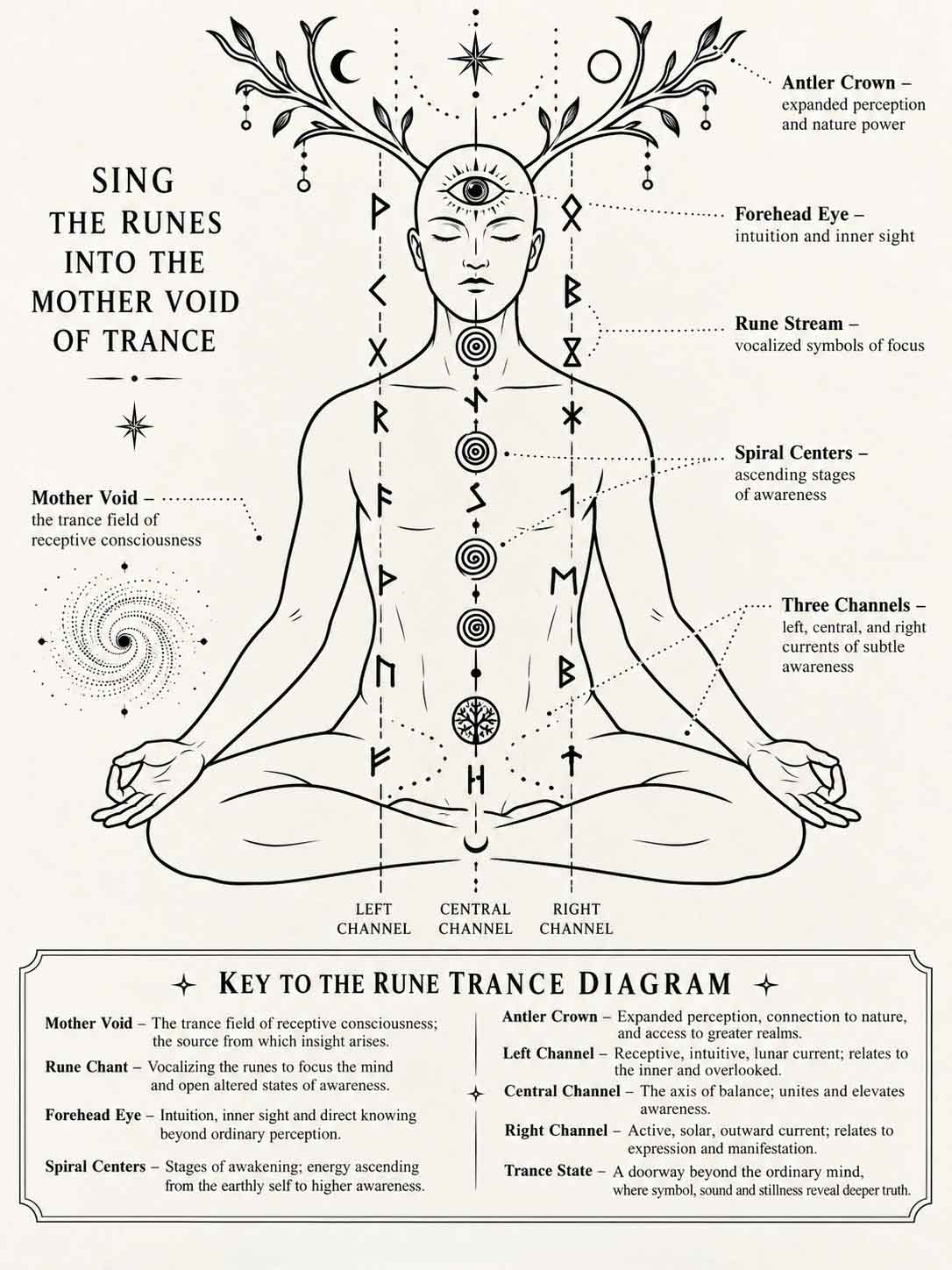
The relationship between runes and spiritual experience continues to inspire modern interpretations that combine ancient symbols with meditation, visualization, and contemplative practices. One particularly intriguing representation depicts a meditating human figure surrounded by runic characters, spiral energy centers, and three vertical channels extending through the body. Above the head rises a branching crown resembling antlers or the limbs of a sacred tree, while a symbolic eye occupies the center of the forehead. Alongside the figure appears the mysterious instruction, "Sing the Runes into the Mother Void of Trance." This image presents a symbolic journey from ordinary awareness toward deeper states of consciousness, bringing together elements of Northern European mythology, modern esoteric spirituality, and ideas drawn from yogic meditation.
To appreciate the meaning of such an image, it is important to distinguish between the historical use of runes and the contemporary spiritual interpretations attached to them. Runes were used by Germanic-speaking peoples for many centuries, beginning during the early centuries of the Common Era. The Elder Futhark, one of the earliest widely recognized runic alphabets, consisted of twenty-four characters, each representing a sound and traditionally associated with a name. Later writing systems, including the Younger Futhark and medieval runic alphabets, developed as languages and cultural circumstances changed. These writing systems were used for inscriptions on stone, wood, metal, personal objects, and memorial monuments. Their historical importance lies in both their linguistic function and the cultural traditions in which they appeared.
The spiritual reputation of runes is closely connected with Norse mythology, particularly the figure of Odin, the god associated with wisdom, poetry, magic, and the pursuit of hidden knowledge. In the Old Norse poem Hávamál, Odin describes hanging upon a tree for nine nights, wounded by a spear and dedicated to himself, before gaining knowledge of the runes. This extraordinary image became one of the most influential symbols of sacrifice and spiritual discovery within the mythology of the North. Wisdom, in this narrative, is not presented as something obtained without effort. It emerges through endurance, confrontation with uncertainty, and a willingness to move beyond familiar limitations.
The tree associated with Odin's mythological experience is commonly understood in connection with Yggdrasil, the great cosmic tree of Norse tradition. Yggdrasil links different realms of existence and symbolizes a universe whose diverse regions remain connected through a greater structure. Its roots and branches extend beyond the ordinary boundaries of human life, making it a powerful representation of relationship, continuity, and the interconnected nature of existence. In contemporary spiritual artwork, branches or antlers rising from a meditator's head can evoke this cosmic symbolism. They suggest awareness extending beyond narrow personal concerns toward a wider relationship with nature and the mysteries of existence.
The antler crown shown above the meditating figure carries several possible symbolic meanings. Antlers are associated with animals such as deer and elk, whose natural cycles of growth and renewal have inspired symbolic interpretations across different cultures. Because antlers are shed and regrown, they can represent transformation, regeneration, and the recurring rhythms of life. Their branching structure also resembles the limbs of a tree, creating a visual connection between animal existence and the plant world. Within a modern meditation diagram, these associations can be used to symbolize an expanding field of awareness, as though the individual's perception were extending outward into a larger living environment.
However, the antler crown should not be understood as an established feature of historical Viking meditation. Its appearance in contemporary esoteric art reflects a creative interpretation rather than a clearly documented ancient practice. The symbolism remains meaningful as an artistic expression, but the distinction between historical tradition and modern spiritual imagination is essential. Ancient Norse mythology offers rich imagery involving sacred trees, animals, divine wisdom, and transformation, while modern practitioners often combine these elements into new forms of personal spiritual expression.
The eye positioned at the center of the forehead introduces another important dimension of the illustration. Often described as the Third Eye, this symbol is more directly associated with South Asian spiritual traditions than with historically documented Norse religious practice. Within yogic and tantric symbolism, the region between the eyebrows is frequently connected with Ajna, a center associated with insight, attention, and awareness. In modern esoteric interpretations, the Third Eye has become a universal symbol of intuition and the ability to perceive beyond habitual patterns of thought.
The symbolic eye does not imply the existence of an additional physical organ capable of supernatural vision. Rather, it represents a different way of understanding perception. Human beings do not experience reality only through sensory information. Every perception is influenced by memory, expectation, interpretation, and emotional response. The mind continually creates meaning from what the senses provide, often without consciously examining the assumptions behind those interpretations. The Third Eye can therefore be understood as a symbol of reflective awareness, the ability to recognize how perception is shaped and to observe experience with greater clarity.
This idea becomes particularly relevant during meditation. When attention is no longer directed exclusively toward external events, subtle aspects of inner experience may become more noticeable. Thoughts that usually pass unnoticed can be observed more clearly. Emotional reactions may become easier to recognize before they develop into automatic responses. The individual begins to notice the difference between experiencing a thought and being completely identified with it. This form of awareness does not require belief in supernatural perception. It reflects the practical possibility of developing a more attentive relationship with the mind.
The spiral symbols arranged vertically through the body add another layer of meaning. Spirals appear throughout nature, from the structure of certain shells and plants to the movement of weather systems and galaxies. Their repeated appearance in art and spiritual symbolism reflects the human tendency to recognize movement, continuity, and transformation within curved and expanding forms. Unlike a straight line, which suggests movement from one fixed point to another, a spiral conveys the possibility of returning toward familiar positions while experiencing a gradual change in perspective.
In the meditation diagram, the spirals resemble a sequence of energetic centers extending from the lower body toward the head. Their arrangement evokes the chakra system found in Indian yogic traditions, although the exact number and placement of these spiral forms do not necessarily correspond to a specific historical chakra model. Within the modern symbolic interpretation, each spiral may represent a particular stage of awareness or an aspect of personal development. The lower centers can be associated with stability, instinct, and embodied existence, while those closer to the heart, throat, and head can symbolize emotional understanding, expression, insight, and contemplation.
The significance of this vertical arrangement lies in the idea that spiritual development involves the whole person. Awareness does not exist in isolation from physical sensation, emotional experience, relationships, or the ordinary conditions of life. A person may seek intellectual insight while remaining disconnected from bodily needs, just as another may become absorbed in physical activity without examining deeper patterns of thought. By arranging symbolic centers along the body, the diagram presents spiritual development as an integrated process in which different dimensions of experience are brought into greater harmony.
The image also distinguishes three vertical channels running through the meditating figure. They are identified as the left, central, and right channels, creating a structure that resembles certain interpretations of the yogic subtle body. In Indian yoga traditions, three important channels are known as Ida, Pingala, and Sushumna. Ida is often associated with lunar and receptive qualities, Pingala with solar and active qualities, and Sushumna with the central path of spiritual ascent. These channels belong to traditional subtle-body philosophy and should not be confused with anatomically verified structures of the nervous system.
Within a contemporary rune meditation diagram, the three channels can be interpreted symbolically as different orientations of human awareness. The left channel represents the receptive dimension of experience, including intuition, reflection, emotional understanding, and the capacity to listen inwardly. The right channel represents active expression, decision-making, intention, and engagement with the external world. The central channel symbolizes the possibility of integrating these qualities without allowing either to dominate completely.
The relationship between receptivity and action is a familiar challenge in everyday life. Some individuals spend so much time analyzing their feelings and memories that decisive action becomes difficult. Others remain constantly active, moving from one responsibility to another without creating space for reflection. Both tendencies can become unbalanced when taken to extremes. The symbolism of the three channels offers a way of contemplating this relationship. Receptivity without action may become passivity, while action without awareness may become impulsiveness. Balance involves recognizing when to observe, when to respond, and when to remain still.
The runes distributed along these channels introduce the relationship between symbolic language and focused attention. In their original historical context, runes were letters belonging to specific writing systems. Their names and associations also gave them a broader cultural significance, and medieval rune poems preserve traditional descriptions of various characters. Modern esoteric interpretations frequently extend these associations by assigning psychological, spiritual, or energetic meanings to individual runes. Such interpretations can provide a framework for personal reflection, although they should not automatically be presented as ancient teachings passed down unchanged from the Viking Age.
Fehu, for example, is traditionally associated through its name with cattle and movable wealth. In modern symbolic interpretation, it is often connected with abundance, resources, and the responsibilities that accompany prosperity. Uruz takes its name from the aurochs, an extinct wild bovine animal, and is frequently interpreted as a symbol of strength, endurance, and vitality. Raidho is associated with riding or a journey, making it a natural metaphor for movement, direction, and the unfolding path of life. Isa means ice and can be contemplated as a symbol of stillness, restriction, or the importance of waiting before acting.
Other runes provide equally rich material for reflection. Ansuz, whose traditional name is associated with a deity, is often interpreted in modern practices through themes of communication, inspiration, and wisdom. Gebo, associated with a gift, can symbolize exchange, generosity, and reciprocity. Jera is connected with the year or seasonal cycle and is frequently understood as representing gradual development and the consequences of actions over time. These meanings should be approached with historical care because interpretations differ between rune poems, linguistic reconstructions, and contemporary occult systems. The artistic rune-like signs in the diagram also cannot all be identified with certainty from their appearance alone.
The practice of chanting runic sounds is commonly associated with the Old Norse term Galdr. Historical Scandinavian sources describe magical songs, incantations, and verbal formulas, although the precise methods and purposes of these practices varied. Modern rune chanting often involves repeating the sound or name of a selected rune while maintaining focused attention. The practice may also incorporate breathing, visualization, posture, and contemplation of the rune's symbolic meaning. Not every contemporary Galdr technique can be demonstrated to have existed in ancient Scandinavia, but the connection between sacred sound and focused intention has an authentic place within the broader history of ritual and religious expression.
Sound possesses a distinctive relationship with human experience because it is encountered both physically and psychologically. When a person chants, the body participates through breathing, vocal movement, and the sensation of vibration. At the same time, the mind becomes occupied with a repeating pattern that can provide a stable point of attention. A rhythmically repeated sound may gradually reduce distraction by giving awareness something simple and consistent to follow. The experience depends on many factors, including the individual's expectations, emotional state, environment, and familiarity with the practice.
Within the symbolism of the illustration, chanting is represented as a movement of sound through the body and toward the mysterious space described as the Mother Void of Trance. The phrase possesses an evocative quality, suggesting a return to a receptive state from which insight and new understanding may emerge. The expression should not be mistaken for a standardized ancient Norse doctrine. Rather, it appears to function as a poetic description of an inner experience in which ordinary mental activity becomes quieter and attention moves toward a more open condition.
The idea of a primordial void also has interesting parallels with Northern European mythology. In the Norse creation tradition preserved in medieval sources, Ginnungagap is the great gap associated with the primordial conditions from which the cosmos emerges. It belongs to a mythological account involving the relationship between different primordial regions and the development of the world. Although the Mother Void of Trance may invite comparison with Ginnungagap, the two expressions should not be treated as historically identical concepts. The resemblance is primarily symbolic, connecting the image of emptiness with the possibility of creation or transformation.
The word void can initially suggest absence, darkness, or a complete lack of meaning. In contemplative language, however, emptiness is sometimes interpreted differently. It may represent a space no longer filled by habitual thoughts, assumptions, and expectations. When the mind becomes less occupied with maintaining a constant interpretation of experience, previously unnoticed impressions may become more accessible. Silence can reveal the extent to which mental activity normally shapes perception, while stillness can provide an opportunity to observe feelings without immediately acting upon them.
The Mother Void can therefore be understood as a metaphor for receptive awareness rather than a literal location or supernatural realm. It represents the possibility of allowing the mind to become quiet enough for observation to take precedence over constant reaction. This does not require eliminating thoughts or attempting to force consciousness into an unusual condition. In fact, excessive effort to produce a particular meditative experience can create additional tension. A gentler approach involves allowing attention to settle naturally while recognizing that thoughts and sensations may continue to arise.
The term trance is equally important to understand. Across religious, cultural, and psychological contexts, trance refers to a broad range of states involving changes in attention, absorption, and the ordinary organization of awareness. Some experiences may involve strong concentration upon a particular sound, image, or activity, while others may include a reduced sense of distraction from the surrounding environment. Trance is not necessarily a loss of consciousness, nor does it automatically imply contact with supernatural beings or hidden dimensions of reality.
In modern contemplative practice, repetitive chanting and visualization may encourage absorption by narrowing attention toward a particular experience. The symbolism of the runes can become a focus through which the individual temporarily sets aside unrelated concerns. The process resembles other forms of meditation that use mantras, repeated phrases, prayer, or rhythmic movement. Nevertheless, trance experiences vary considerably, and there is no reliable basis for claiming that particular runes produce specific supernatural effects or activate measurable energy centers within the body.
The position of the meditating figure reinforces the importance of stillness and intentional attention. Sitting cross-legged with the hands resting upon the knees creates an image of physical stability and mental receptivity. The symmetry of the posture suggests balance, while the upright alignment of the body provides a central axis around which the other symbols are arranged. In practical meditation, however, the exact posture is less important than physical comfort, alertness, and the ability to breathe naturally. A person may meditate while seated in a chair or another comfortable position without adopting the precise posture shown in the artwork.
The relationship between the body and attention is especially relevant when contemplating the spiral centers. Although the diagram uses the language of energy, these symbols can also be understood as visual representations of different dimensions of subjective experience. The lower part of the body draws attention toward grounding and physical presence. The abdomen may be associated with the experience of vitality and emotional sensation. The chest can become a focus for compassion and the awareness of relationships. The throat may symbolize expression, while the head represents perception and reflective understanding. These associations are interpretive rather than established physiological facts.
By following the symbolic arrangement from the base of the body toward the head, the observer encounters a visual narrative of transformation. The movement begins with embodied existence and gradually approaches the imagery of insight, cosmic branches, and expanded consciousness. Yet the journey need not be understood as a rejection of the physical world. The meditating figure remains seated upon the earth, suggesting that the search for deeper awareness can remain connected with ordinary human life. The most meaningful transformation may not be an extraordinary experience during meditation, but a change in how a person responds to the world afterward.
The nature symbolism of the antler crown becomes particularly significant in this context. Human beings have always existed within larger ecological systems, depending upon the rhythms of seasons, landscapes, plants, and animals. Modern life can sometimes create an impression of separation from these relationships, especially when attention is dominated by artificial environments and continual mental demands. The branches rising above the figure can be contemplated as a reminder of belonging to a world that extends far beyond personal concerns. They symbolize expansion without requiring the abandonment of earthly identity.
The celestial elements surrounding the crown, including the moon, circular forms, and star-like symbols, extend this interpretation toward the wider universe. The moon has long been associated with recurring cycles and the passage of time, while stars have served as guides for navigation and symbols of distant mystery. Within the artwork, such images create an atmosphere of cosmic connection. They suggest a relationship between the inner world of contemplation and the vast environment within which human existence unfolds. Their arrangement is an artistic expression rather than a documented ancient Norse cosmological system.
The central spiral and the branching crown together create an interesting contrast between inward and outward movement. The spiral draws attention toward a center, suggesting concentration, introspection, and the exploration of inner experience. The branches extend outward, suggesting connection, openness, and an awareness of wider relationships. These two movements can be understood as complementary rather than contradictory. A person who develops greater self-awareness may become better able to recognize the needs and experiences of others, while contact with the wider world may encourage a more realistic understanding of the self.
The symbolism of rune chanting also raises the question of intention. In many modern spiritual practices, selecting a symbol provides a way of organizing attention around a particular quality or question. Someone reflecting on Raidho might contemplate the direction of their life, while the symbolism of Isa could become a reminder to pause before making an important decision. Gebo might encourage reflection on generosity and mutual responsibility. Such practices need not be understood as attempts to manipulate supernatural forces. They can function as structured exercises in attention, imagination, and personal reflection.
There is an important difference between allowing a symbol to inspire contemplation and believing that the symbol possesses independently verified powers over external events. Runes have authentic historical and cultural significance, but modern claims about guaranteed healing, physical energy activation, or supernatural results are not established by scientific evidence. The value of a symbolic practice may instead lie in the meanings individuals explore through it, the attention they bring to their experience, and the decisions that emerge from thoughtful reflection.
Meditation itself is best approached without pressure to produce dramatic altered states. A person exploring contemplative attention can begin by sitting comfortably, relaxing unnecessary muscular tension, and allowing breathing to continue naturally. A selected word, sound, or symbol may serve as a point of focus. When thoughts arise, attention can return gently to the chosen focus without frustration. There is no need to force breath retention, hyperventilation, sensory deprivation, or prolonged trance. The aim of a simple practice can be greater steadiness and awareness rather than the pursuit of extraordinary experiences.
As attention becomes more settled, the symbolism of the Mother Void may take on a personal meaning. It can represent the moments when the mind is no longer constantly occupied with evaluating the past or anticipating the future. These moments do not require complete silence, and they do not need to be prolonged to become meaningful. Sometimes a brief period of quiet awareness is enough to reveal how much mental energy is normally consumed by repetitive concerns. The symbolic act of returning to the void can therefore be interpreted as returning to a more open relationship with the present moment.
The three channels can also serve as a practical reminder of the need for balance after meditation. Receptive awareness may support careful listening, emotional understanding, and patience. Active awareness may support responsibility, creativity, and decisive action. The central path represents an effort to integrate both qualities rather than becoming trapped in one extreme. This interpretation allows the diagram to function as a reflective map of everyday behavior without requiring belief that invisible currents move through specific physical nerves.
The relationship between ancient symbolism and contemporary spirituality requires a thoughtful approach. Norse runes, Indian chakra concepts, the Third Eye, modern energy-channel imagery, and antler symbolism arise from different cultural and historical backgrounds. Bringing them together can produce compelling artwork and meaningful personal interpretations, but such combinations should be recognized as modern forms of spiritual synthesis. Presenting them as a single unchanged system practiced by ancient Vikings would obscure the distinct histories and traditions from which the symbols originate.
This distinction does not diminish the artistic or contemplative value of the diagram. Human cultures have always developed new interpretations of inherited symbols, and spiritual imagery often changes as ideas move between communities and historical periods. What matters is maintaining clarity about the difference between historical evidence, traditional religious teachings, and contemporary imaginative interpretation. Respect for the original traditions can coexist with creative exploration, provided the boundaries between them remain visible.
The rune trance illustration can ultimately be read as a symbolic portrait of the human search for awareness. The runes represent language, memory, and meaning. The spirals represent movement through different dimensions of experience. The three channels suggest the relationship between receptivity, action, and balance. The forehead eye symbolizes reflection and insight, while the antler crown evokes connection with nature and the wider universe. The Mother Void represents the possibility of inner spaciousness, and the seated figure embodies the stillness through which these ideas are contemplated.
Viewed together, these elements form a narrative of movement from distraction toward attention, from fragmentation toward integration, and from automatic reactions toward a more deliberate relationship with experience. The artwork does not need to be interpreted as a literal map of invisible anatomy to communicate this message. Its power lies in the way familiar human questions are expressed through an unusual combination of symbols. How can the mind become quieter without losing its capacity to think? How can a person remain grounded while exploring unfamiliar perspectives? What is the relationship between individual identity and the wider world? Can ancient images encourage new forms of understanding without being mistaken for scientific proof?
These questions are not limited to any single spiritual tradition. They belong to a much wider human effort to understand consciousness and the meaning of existence. The practice of observing thoughts, contemplating symbols, and creating space for reflection can offer opportunities for self-understanding regardless of whether a person follows a particular religious or esoteric system. Symbols become useful when they encourage inquiry rather than replace it, and spiritual language becomes meaningful when it deepens awareness rather than discourages critical thinking.
The phrase "Sing the Runes into the Mother Void of Trance" captures the poetic essence of this journey. It invites the imagination to consider sound as an expression of intention, silence as a space of possibility, and the human body as the meeting place of thought, sensation, and awareness. The movement from sound into silence reflects a familiar rhythm of contemplative experience. Words are spoken and eventually fade. Thoughts arise and pass. Attention shifts between activity and stillness. Beneath these changes remains the continuing possibility of becoming aware of experience itself.
The deeper message of the diagram is therefore not that a particular arrangement of runes can unlock hidden powers or guarantee access to supernatural realms. It is that symbols, sounds, and contemplative attention can provide a meaningful language for exploring the inner life. The ancient history of runic writing offers one source of inspiration, while the modern symbolic arrangement creates a new framework through which questions of balance, identity, nature, and consciousness can be considered.
The journey toward inner awakening is rarely a simple progression from ignorance to certainty. It often involves discovering how much of experience is shaped by assumptions, recognizing patterns that have remained unnoticed, and developing the patience to examine them without immediate judgment. Moments of insight may be followed by uncertainty, and periods of stillness may alternate with the ordinary demands of daily life. Such changes do not necessarily represent failure. They are part of the broader process through which understanding develops.
In the end, the meditating figure surrounded by runes stands as an image of the individual seeking a deeper relationship with existence. The branches above the head reach toward the unknown, while the seated body remains grounded in the present. The spirals suggest transformation, the runes invite contemplation, and the central channel symbolizes the search for balance. The Mother Void represents the open space in which thought can settle and awareness can become more receptive.
The lasting significance of this symbolic journey may be found not in escaping ordinary life but in returning to it with greater clarity. A quieter mind may listen more carefully. A more reflective person may act with greater intention. A deeper appreciation of symbolic traditions may encourage curiosity about history, nature, and the many ways human beings have understood consciousness. The ancient runes remind us of humanity's enduring effort to give meaning to the unknown, while the meditative figure suggests that some of the most important questions begin with the simple act of becoming aware.
Beyond the mystery of the symbols and the fascination of trance lies a quieter possibility. Awareness does not always need to be pursued through extraordinary experiences. Sometimes it becomes more accessible when the constant movement of thought is allowed to settle, when the body is treated with patience, and when attention returns to the present without resistance. The runes, the spirals, the sacred branches, and the symbolic eye ultimately point toward this central theme. The journey of inner awakening is a continuing exploration of what it means to experience life consciously, to recognize the limits of one's understanding, and to remain open to the deeper possibilities of awareness.
The relationship between runes and spiritual experience continues to inspire modern interpretations that combine ancient symbols with meditation, visualization, and contemplative practices. One particularly intriguing representation depicts a meditating human figure surrounded by runic characters, spiral energy centers, and three vertical channels extending through the body. Above the head rises a branching crown resembling antlers or the limbs of a sacred tree, while a symbolic eye occupies the center of the forehead. Alongside the figure appears the mysterious instruction, "Sing the Runes into the Mother Void of Trance." This image presents a symbolic journey from ordinary awareness toward deeper states of consciousness, bringing together elements of Northern European mythology, modern esoteric spirituality, and ideas drawn from yogic meditation.
To appreciate the meaning of such an image, it is important to distinguish between the historical use of runes and the contemporary spiritual interpretations attached to them. Runes were used by Germanic-speaking peoples for many centuries, beginning during the early centuries of the Common Era. The Elder Futhark, one of the earliest widely recognized runic alphabets, consisted of twenty-four characters, each representing a sound and traditionally associated with a name. Later writing systems, including the Younger Futhark and medieval runic alphabets, developed as languages and cultural circumstances changed. These writing systems were used for inscriptions on stone, wood, metal, personal objects, and memorial monuments. Their historical importance lies in both their linguistic function and the cultural traditions in which they appeared.
The spiritual reputation of runes is closely connected with Norse mythology, particularly the figure of Odin, the god associated with wisdom, poetry, magic, and the pursuit of hidden knowledge. In the Old Norse poem Hávamál, Odin describes hanging upon a tree for nine nights, wounded by a spear and dedicated to himself, before gaining knowledge of the runes. This extraordinary image became one of the most influential symbols of sacrifice and spiritual discovery within the mythology of the North. Wisdom, in this narrative, is not presented as something obtained without effort. It emerges through endurance, confrontation with uncertainty, and a willingness to move beyond familiar limitations.
The tree associated with Odin's mythological experience is commonly understood in connection with Yggdrasil, the great cosmic tree of Norse tradition. Yggdrasil links different realms of existence and symbolizes a universe whose diverse regions remain connected through a greater structure. Its roots and branches extend beyond the ordinary boundaries of human life, making it a powerful representation of relationship, continuity, and the interconnected nature of existence. In contemporary spiritual artwork, branches or antlers rising from a meditator's head can evoke this cosmic symbolism. They suggest awareness extending beyond narrow personal concerns toward a wider relationship with nature and the mysteries of existence.
The antler crown shown above the meditating figure carries several possible symbolic meanings. Antlers are associated with animals such as deer and elk, whose natural cycles of growth and renewal have inspired symbolic interpretations across different cultures. Because antlers are shed and regrown, they can represent transformation, regeneration, and the recurring rhythms of life. Their branching structure also resembles the limbs of a tree, creating a visual connection between animal existence and the plant world. Within a modern meditation diagram, these associations can be used to symbolize an expanding field of awareness, as though the individual's perception were extending outward into a larger living environment.
However, the antler crown should not be understood as an established feature of historical Viking meditation. Its appearance in contemporary esoteric art reflects a creative interpretation rather than a clearly documented ancient practice. The symbolism remains meaningful as an artistic expression, but the distinction between historical tradition and modern spiritual imagination is essential. Ancient Norse mythology offers rich imagery involving sacred trees, animals, divine wisdom, and transformation, while modern practitioners often combine these elements into new forms of personal spiritual expression.
The eye positioned at the center of the forehead introduces another important dimension of the illustration. Often described as the Third Eye, this symbol is more directly associated with South Asian spiritual traditions than with historically documented Norse religious practice. Within yogic and tantric symbolism, the region between the eyebrows is frequently connected with Ajna, a center associated with insight, attention, and awareness. In modern esoteric interpretations, the Third Eye has become a universal symbol of intuition and the ability to perceive beyond habitual patterns of thought.
The symbolic eye does not imply the existence of an additional physical organ capable of supernatural vision. Rather, it represents a different way of understanding perception. Human beings do not experience reality only through sensory information. Every perception is influenced by memory, expectation, interpretation, and emotional response. The mind continually creates meaning from what the senses provide, often without consciously examining the assumptions behind those interpretations. The Third Eye can therefore be understood as a symbol of reflective awareness, the ability to recognize how perception is shaped and to observe experience with greater clarity.
This idea becomes particularly relevant during meditation. When attention is no longer directed exclusively toward external events, subtle aspects of inner experience may become more noticeable. Thoughts that usually pass unnoticed can be observed more clearly. Emotional reactions may become easier to recognize before they develop into automatic responses. The individual begins to notice the difference between experiencing a thought and being completely identified with it. This form of awareness does not require belief in supernatural perception. It reflects the practical possibility of developing a more attentive relationship with the mind.
The spiral symbols arranged vertically through the body add another layer of meaning. Spirals appear throughout nature, from the structure of certain shells and plants to the movement of weather systems and galaxies. Their repeated appearance in art and spiritual symbolism reflects the human tendency to recognize movement, continuity, and transformation within curved and expanding forms. Unlike a straight line, which suggests movement from one fixed point to another, a spiral conveys the possibility of returning toward familiar positions while experiencing a gradual change in perspective.
In the meditation diagram, the spirals resemble a sequence of energetic centers extending from the lower body toward the head. Their arrangement evokes the chakra system found in Indian yogic traditions, although the exact number and placement of these spiral forms do not necessarily correspond to a specific historical chakra model. Within the modern symbolic interpretation, each spiral may represent a particular stage of awareness or an aspect of personal development. The lower centers can be associated with stability, instinct, and embodied existence, while those closer to the heart, throat, and head can symbolize emotional understanding, expression, insight, and contemplation.
The significance of this vertical arrangement lies in the idea that spiritual development involves the whole person. Awareness does not exist in isolation from physical sensation, emotional experience, relationships, or the ordinary conditions of life. A person may seek intellectual insight while remaining disconnected from bodily needs, just as another may become absorbed in physical activity without examining deeper patterns of thought. By arranging symbolic centers along the body, the diagram presents spiritual development as an integrated process in which different dimensions of experience are brought into greater harmony.
The image also distinguishes three vertical channels running through the meditating figure. They are identified as the left, central, and right channels, creating a structure that resembles certain interpretations of the yogic subtle body. In Indian yoga traditions, three important channels are known as Ida, Pingala, and Sushumna. Ida is often associated with lunar and receptive qualities, Pingala with solar and active qualities, and Sushumna with the central path of spiritual ascent. These channels belong to traditional subtle-body philosophy and should not be confused with anatomically verified structures of the nervous system.
Within a contemporary rune meditation diagram, the three channels can be interpreted symbolically as different orientations of human awareness. The left channel represents the receptive dimension of experience, including intuition, reflection, emotional understanding, and the capacity to listen inwardly. The right channel represents active expression, decision-making, intention, and engagement with the external world. The central channel symbolizes the possibility of integrating these qualities without allowing either to dominate completely.
The relationship between receptivity and action is a familiar challenge in everyday life. Some individuals spend so much time analyzing their feelings and memories that decisive action becomes difficult. Others remain constantly active, moving from one responsibility to another without creating space for reflection. Both tendencies can become unbalanced when taken to extremes. The symbolism of the three channels offers a way of contemplating this relationship. Receptivity without action may become passivity, while action without awareness may become impulsiveness. Balance involves recognizing when to observe, when to respond, and when to remain still.
The runes distributed along these channels introduce the relationship between symbolic language and focused attention. In their original historical context, runes were letters belonging to specific writing systems. Their names and associations also gave them a broader cultural significance, and medieval rune poems preserve traditional descriptions of various characters. Modern esoteric interpretations frequently extend these associations by assigning psychological, spiritual, or energetic meanings to individual runes. Such interpretations can provide a framework for personal reflection, although they should not automatically be presented as ancient teachings passed down unchanged from the Viking Age.
Fehu, for example, is traditionally associated through its name with cattle and movable wealth. In modern symbolic interpretation, it is often connected with abundance, resources, and the responsibilities that accompany prosperity. Uruz takes its name from the aurochs, an extinct wild bovine animal, and is frequently interpreted as a symbol of strength, endurance, and vitality. Raidho is associated with riding or a journey, making it a natural metaphor for movement, direction, and the unfolding path of life. Isa means ice and can be contemplated as a symbol of stillness, restriction, or the importance of waiting before acting.
Other runes provide equally rich material for reflection. Ansuz, whose traditional name is associated with a deity, is often interpreted in modern practices through themes of communication, inspiration, and wisdom. Gebo, associated with a gift, can symbolize exchange, generosity, and reciprocity. Jera is connected with the year or seasonal cycle and is frequently understood as representing gradual development and the consequences of actions over time. These meanings should be approached with historical care because interpretations differ between rune poems, linguistic reconstructions, and contemporary occult systems. The artistic rune-like signs in the diagram also cannot all be identified with certainty from their appearance alone.
The practice of chanting runic sounds is commonly associated with the Old Norse term Galdr. Historical Scandinavian sources describe magical songs, incantations, and verbal formulas, although the precise methods and purposes of these practices varied. Modern rune chanting often involves repeating the sound or name of a selected rune while maintaining focused attention. The practice may also incorporate breathing, visualization, posture, and contemplation of the rune's symbolic meaning. Not every contemporary Galdr technique can be demonstrated to have existed in ancient Scandinavia, but the connection between sacred sound and focused intention has an authentic place within the broader history of ritual and religious expression.
Sound possesses a distinctive relationship with human experience because it is encountered both physically and psychologically. When a person chants, the body participates through breathing, vocal movement, and the sensation of vibration. At the same time, the mind becomes occupied with a repeating pattern that can provide a stable point of attention. A rhythmically repeated sound may gradually reduce distraction by giving awareness something simple and consistent to follow. The experience depends on many factors, including the individual's expectations, emotional state, environment, and familiarity with the practice.
Within the symbolism of the illustration, chanting is represented as a movement of sound through the body and toward the mysterious space described as the Mother Void of Trance. The phrase possesses an evocative quality, suggesting a return to a receptive state from which insight and new understanding may emerge. The expression should not be mistaken for a standardized ancient Norse doctrine. Rather, it appears to function as a poetic description of an inner experience in which ordinary mental activity becomes quieter and attention moves toward a more open condition.
The idea of a primordial void also has interesting parallels with Northern European mythology. In the Norse creation tradition preserved in medieval sources, Ginnungagap is the great gap associated with the primordial conditions from which the cosmos emerges. It belongs to a mythological account involving the relationship between different primordial regions and the development of the world. Although the Mother Void of Trance may invite comparison with Ginnungagap, the two expressions should not be treated as historically identical concepts. The resemblance is primarily symbolic, connecting the image of emptiness with the possibility of creation or transformation.
The word void can initially suggest absence, darkness, or a complete lack of meaning. In contemplative language, however, emptiness is sometimes interpreted differently. It may represent a space no longer filled by habitual thoughts, assumptions, and expectations. When the mind becomes less occupied with maintaining a constant interpretation of experience, previously unnoticed impressions may become more accessible. Silence can reveal the extent to which mental activity normally shapes perception, while stillness can provide an opportunity to observe feelings without immediately acting upon them.
The Mother Void can therefore be understood as a metaphor for receptive awareness rather than a literal location or supernatural realm. It represents the possibility of allowing the mind to become quiet enough for observation to take precedence over constant reaction. This does not require eliminating thoughts or attempting to force consciousness into an unusual condition. In fact, excessive effort to produce a particular meditative experience can create additional tension. A gentler approach involves allowing attention to settle naturally while recognizing that thoughts and sensations may continue to arise.
The term trance is equally important to understand. Across religious, cultural, and psychological contexts, trance refers to a broad range of states involving changes in attention, absorption, and the ordinary organization of awareness. Some experiences may involve strong concentration upon a particular sound, image, or activity, while others may include a reduced sense of distraction from the surrounding environment. Trance is not necessarily a loss of consciousness, nor does it automatically imply contact with supernatural beings or hidden dimensions of reality.
In modern contemplative practice, repetitive chanting and visualization may encourage absorption by narrowing attention toward a particular experience. The symbolism of the runes can become a focus through which the individual temporarily sets aside unrelated concerns. The process resembles other forms of meditation that use mantras, repeated phrases, prayer, or rhythmic movement. Nevertheless, trance experiences vary considerably, and there is no reliable basis for claiming that particular runes produce specific supernatural effects or activate measurable energy centers within the body.
The position of the meditating figure reinforces the importance of stillness and intentional attention. Sitting cross-legged with the hands resting upon the knees creates an image of physical stability and mental receptivity. The symmetry of the posture suggests balance, while the upright alignment of the body provides a central axis around which the other symbols are arranged. In practical meditation, however, the exact posture is less important than physical comfort, alertness, and the ability to breathe naturally. A person may meditate while seated in a chair or another comfortable position without adopting the precise posture shown in the artwork.
The relationship between the body and attention is especially relevant when contemplating the spiral centers. Although the diagram uses the language of energy, these symbols can also be understood as visual representations of different dimensions of subjective experience. The lower part of the body draws attention toward grounding and physical presence. The abdomen may be associated with the experience of vitality and emotional sensation. The chest can become a focus for compassion and the awareness of relationships. The throat may symbolize expression, while the head represents perception and reflective understanding. These associations are interpretive rather than established physiological facts.
By following the symbolic arrangement from the base of the body toward the head, the observer encounters a visual narrative of transformation. The movement begins with embodied existence and gradually approaches the imagery of insight, cosmic branches, and expanded consciousness. Yet the journey need not be understood as a rejection of the physical world. The meditating figure remains seated upon the earth, suggesting that the search for deeper awareness can remain connected with ordinary human life. The most meaningful transformation may not be an extraordinary experience during meditation, but a change in how a person responds to the world afterward.
The nature symbolism of the antler crown becomes particularly significant in this context. Human beings have always existed within larger ecological systems, depending upon the rhythms of seasons, landscapes, plants, and animals. Modern life can sometimes create an impression of separation from these relationships, especially when attention is dominated by artificial environments and continual mental demands. The branches rising above the figure can be contemplated as a reminder of belonging to a world that extends far beyond personal concerns. They symbolize expansion without requiring the abandonment of earthly identity.
The celestial elements surrounding the crown, including the moon, circular forms, and star-like symbols, extend this interpretation toward the wider universe. The moon has long been associated with recurring cycles and the passage of time, while stars have served as guides for navigation and symbols of distant mystery. Within the artwork, such images create an atmosphere of cosmic connection. They suggest a relationship between the inner world of contemplation and the vast environment within which human existence unfolds. Their arrangement is an artistic expression rather than a documented ancient Norse cosmological system.
The central spiral and the branching crown together create an interesting contrast between inward and outward movement. The spiral draws attention toward a center, suggesting concentration, introspection, and the exploration of inner experience. The branches extend outward, suggesting connection, openness, and an awareness of wider relationships. These two movements can be understood as complementary rather than contradictory. A person who develops greater self-awareness may become better able to recognize the needs and experiences of others, while contact with the wider world may encourage a more realistic understanding of the self.
The symbolism of rune chanting also raises the question of intention. In many modern spiritual practices, selecting a symbol provides a way of organizing attention around a particular quality or question. Someone reflecting on Raidho might contemplate the direction of their life, while the symbolism of Isa could become a reminder to pause before making an important decision. Gebo might encourage reflection on generosity and mutual responsibility. Such practices need not be understood as attempts to manipulate supernatural forces. They can function as structured exercises in attention, imagination, and personal reflection.
There is an important difference between allowing a symbol to inspire contemplation and believing that the symbol possesses independently verified powers over external events. Runes have authentic historical and cultural significance, but modern claims about guaranteed healing, physical energy activation, or supernatural results are not established by scientific evidence. The value of a symbolic practice may instead lie in the meanings individuals explore through it, the attention they bring to their experience, and the decisions that emerge from thoughtful reflection.
Meditation itself is best approached without pressure to produce dramatic altered states. A person exploring contemplative attention can begin by sitting comfortably, relaxing unnecessary muscular tension, and allowing breathing to continue naturally. A selected word, sound, or symbol may serve as a point of focus. When thoughts arise, attention can return gently to the chosen focus without frustration. There is no need to force breath retention, hyperventilation, sensory deprivation, or prolonged trance. The aim of a simple practice can be greater steadiness and awareness rather than the pursuit of extraordinary experiences.
As attention becomes more settled, the symbolism of the Mother Void may take on a personal meaning. It can represent the moments when the mind is no longer constantly occupied with evaluating the past or anticipating the future. These moments do not require complete silence, and they do not need to be prolonged to become meaningful. Sometimes a brief period of quiet awareness is enough to reveal how much mental energy is normally consumed by repetitive concerns. The symbolic act of returning to the void can therefore be interpreted as returning to a more open relationship with the present moment.
The three channels can also serve as a practical reminder of the need for balance after meditation. Receptive awareness may support careful listening, emotional understanding, and patience. Active awareness may support responsibility, creativity, and decisive action. The central path represents an effort to integrate both qualities rather than becoming trapped in one extreme. This interpretation allows the diagram to function as a reflective map of everyday behavior without requiring belief that invisible currents move through specific physical nerves.
The relationship between ancient symbolism and contemporary spirituality requires a thoughtful approach. Norse runes, Indian chakra concepts, the Third Eye, modern energy-channel imagery, and antler symbolism arise from different cultural and historical backgrounds. Bringing them together can produce compelling artwork and meaningful personal interpretations, but such combinations should be recognized as modern forms of spiritual synthesis. Presenting them as a single unchanged system practiced by ancient Vikings would obscure the distinct histories and traditions from which the symbols originate.
This distinction does not diminish the artistic or contemplative value of the diagram. Human cultures have always developed new interpretations of inherited symbols, and spiritual imagery often changes as ideas move between communities and historical periods. What matters is maintaining clarity about the difference between historical evidence, traditional religious teachings, and contemporary imaginative interpretation. Respect for the original traditions can coexist with creative exploration, provided the boundaries between them remain visible.
The rune trance illustration can ultimately be read as a symbolic portrait of the human search for awareness. The runes represent language, memory, and meaning. The spirals represent movement through different dimensions of experience. The three channels suggest the relationship between receptivity, action, and balance. The forehead eye symbolizes reflection and insight, while the antler crown evokes connection with nature and the wider universe. The Mother Void represents the possibility of inner spaciousness, and the seated figure embodies the stillness through which these ideas are contemplated.
Viewed together, these elements form a narrative of movement from distraction toward attention, from fragmentation toward integration, and from automatic reactions toward a more deliberate relationship with experience. The artwork does not need to be interpreted as a literal map of invisible anatomy to communicate this message. Its power lies in the way familiar human questions are expressed through an unusual combination of symbols. How can the mind become quieter without losing its capacity to think? How can a person remain grounded while exploring unfamiliar perspectives? What is the relationship between individual identity and the wider world? Can ancient images encourage new forms of understanding without being mistaken for scientific proof?
These questions are not limited to any single spiritual tradition. They belong to a much wider human effort to understand consciousness and the meaning of existence. The practice of observing thoughts, contemplating symbols, and creating space for reflection can offer opportunities for self-understanding regardless of whether a person follows a particular religious or esoteric system. Symbols become useful when they encourage inquiry rather than replace it, and spiritual language becomes meaningful when it deepens awareness rather than discourages critical thinking.
The phrase "Sing the Runes into the Mother Void of Trance" captures the poetic essence of this journey. It invites the imagination to consider sound as an expression of intention, silence as a space of possibility, and the human body as the meeting place of thought, sensation, and awareness. The movement from sound into silence reflects a familiar rhythm of contemplative experience. Words are spoken and eventually fade. Thoughts arise and pass. Attention shifts between activity and stillness. Beneath these changes remains the continuing possibility of becoming aware of experience itself.
The deeper message of the diagram is therefore not that a particular arrangement of runes can unlock hidden powers or guarantee access to supernatural realms. It is that symbols, sounds, and contemplative attention can provide a meaningful language for exploring the inner life. The ancient history of runic writing offers one source of inspiration, while the modern symbolic arrangement creates a new framework through which questions of balance, identity, nature, and consciousness can be considered.
The journey toward inner awakening is rarely a simple progression from ignorance to certainty. It often involves discovering how much of experience is shaped by assumptions, recognizing patterns that have remained unnoticed, and developing the patience to examine them without immediate judgment. Moments of insight may be followed by uncertainty, and periods of stillness may alternate with the ordinary demands of daily life. Such changes do not necessarily represent failure. They are part of the broader process through which understanding develops.
In the end, the meditating figure surrounded by runes stands as an image of the individual seeking a deeper relationship with existence. The branches above the head reach toward the unknown, while the seated body remains grounded in the present. The spirals suggest transformation, the runes invite contemplation, and the central channel symbolizes the search for balance. The Mother Void represents the open space in which thought can settle and awareness can become more receptive.
The lasting significance of this symbolic journey may be found not in escaping ordinary life but in returning to it with greater clarity. A quieter mind may listen more carefully. A more reflective person may act with greater intention. A deeper appreciation of symbolic traditions may encourage curiosity about history, nature, and the many ways human beings have understood consciousness. The ancient runes remind us of humanity's enduring effort to give meaning to the unknown, while the meditative figure suggests that some of the most important questions begin with the simple act of becoming aware.
Beyond the mystery of the symbols and the fascination of trance lies a quieter possibility. Awareness does not always need to be pursued through extraordinary experiences. Sometimes it becomes more accessible when the constant movement of thought is allowed to settle, when the body is treated with patience, and when attention returns to the present without resistance. The runes, the spirals, the sacred branches, and the symbolic eye ultimately point toward this central theme. The journey of inner awakening is a continuing exploration of what it means to experience life consciously, to recognize the limits of one's understanding, and to remain open to the deeper possibilities of awareness.






Comments
Comments appear after approval.
Log in to comment