
Community
Sahaja Yoga
The Chakras in the Sahasrara and the Journey Toward Higher Consciousness

Throughout human history, people have searched for ways to understand the deeper nature of consciousness and the mysterious relationship between the physical body and inner experience. Ancient spiritual traditions developed different explanations for this connection, often describing the human being as more than a collection of physical organs and biological processes. Among these traditions, the chakra system became one of the most recognizable symbolic representations of spiritual development, offering a way to contemplate the qualities that shape human awareness, emotions, thoughts, and behavior.
The Sahasrara holds a particularly important place within this understanding. Known as the crown chakra, it is traditionally associated with the highest state of spiritual awareness and the possibility of experiencing a profound sense of unity. The Sanskrit word Sahasrara is commonly translated as the thousand-petaled lotus, a symbol representing the unfolding of consciousness beyond its ordinary limitations. While the lower chakras are associated with different qualities of human life, the Sahasrara is understood as the point where these qualities become integrated into a greater whole.
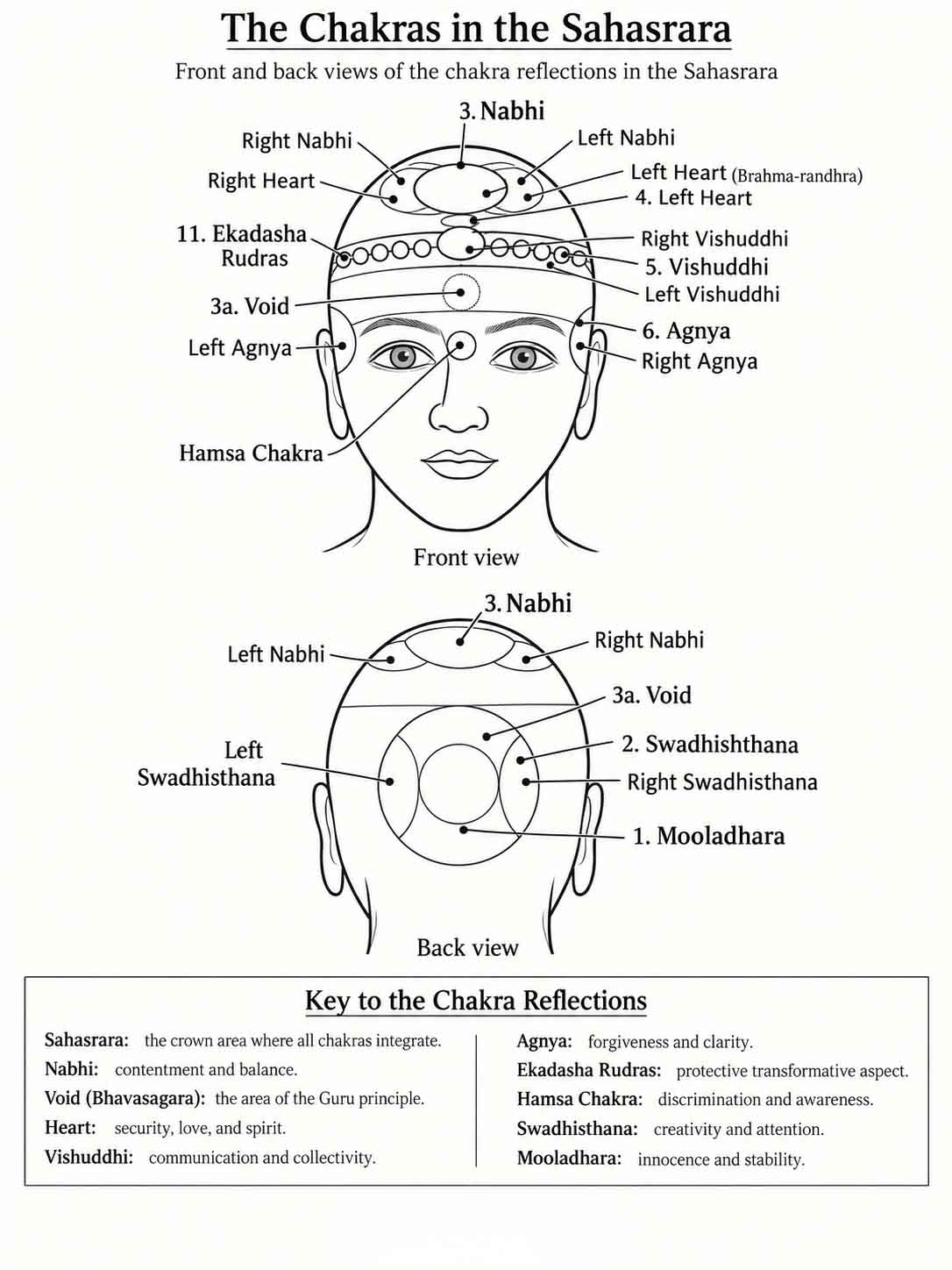
Within the teachings of Sahaja Yoga, this relationship is expressed through an intriguing representation of the subtle system. The chakras that are normally depicted along the spine are also shown as having symbolic reflections within the Sahasrara. These reflections appear across different regions of the head, forming a spiritual map that illustrates the interconnected nature of human qualities and the process of inner transformation. The diagram is not intended as a conventional anatomical illustration of the brain. Instead, it presents a spiritual interpretation of how the subtle centers are believed to come together in the experience of higher consciousness.
To understand the meaning of this representation, it is helpful to consider the traditional idea of Kundalini. In yogic philosophy, Kundalini is described as a dormant spiritual energy resting near the base of the spine. Its awakening is associated with a gradual movement through the subtle energy centers, ultimately reaching the Sahasrara at the crown of the head. In Sahaja Yoga, this awakening is closely connected with Self-realization, an experience through which an individual is believed to develop a more direct awareness of the inner spiritual Self. The journey is described not simply as an ascent through different centers but as a process in which the qualities represented by those centers become increasingly balanced and integrated.
At the foundation of this symbolic journey lies the Mooladhara chakra, traditionally associated with innocence, purity, wisdom, and stability. Innocence in this context does not mean ignorance or an inability to recognize the difficulties of life. It represents a natural quality of awareness that exists before experience becomes dominated by excessive fear, judgment, and calculation. The Mooladhara reflection in the Sahasrara diagram serves as a reminder that spiritual maturity does not necessarily require abandoning simplicity. A person may gain knowledge, overcome difficulties, and develop a deeper understanding of the world while still preserving sincerity, humility, and a sense of inner stability.
Closely connected with the foundations of human development is the Swadhisthana chakra, which represents creativity, inspiration, and the capacity for focused attention. Its reflections are illustrated in the back of the head, with distinctions between the left, right, and central aspects. Creativity is often understood as the ability to produce something original, yet its deeper significance extends beyond artistic expression. It can also appear in the way a person approaches difficulties, discovers new perspectives, and responds to changing circumstances. In contemplative traditions, genuine inspiration is sometimes associated with moments when the mind becomes less occupied with repetitive thinking. Instead of trying to control every idea, the individual allows attention to become more open and receptive.
The Nabhi chakra introduces another essential dimension of inner development through its association with contentment, satisfaction, and balance. Human beings naturally pursue security, achievement, relationships, and material well-being, but these pursuits do not always produce lasting fulfillment. When satisfaction depends entirely on external circumstances, the mind can become trapped in a continuous search for something more. The spiritual quality represented by Nabhi suggests that genuine contentment involves developing an inner relationship with life that is not constantly disturbed by changing conditions. This does not require the rejection of ambition or worldly responsibility. Rather, it reflects the possibility of acting with purpose while remaining free from the belief that peace can only be found after every desire has been fulfilled.
Surrounding the Nabhi in the traditional subtle-system model is the Void, also known as Bhavasagara. Its symbolic significance is connected with the Guru principle, which represents wisdom, guidance, discipline, and the development of inner authority. Throughout life, individuals often depend on external sources for direction. Teachers, traditions, family expectations, and social values can all influence the way a person understands the world. Yet genuine maturity also requires the ability to examine these influences and develop personal discernment. The Guru principle points toward a form of inner guidance grounded in responsibility, honesty, and an increasingly clear understanding of one's actions. Within this interpretation, wisdom is not merely the accumulation of information but the ability to recognize what is meaningful and act accordingly.
The Heart chakra brings attention to qualities that are central to human relationships and emotional life. Associated with compassion, security, love, and the Spirit, it represents a dimension of awareness that cannot be reduced to intellectual understanding alone. Love can take many forms, ranging from attachment and personal affection to a more expansive sense of compassion. Spiritual traditions often distinguish between these experiences, suggesting that deeper love becomes possible when the individual is less dominated by fear, possession, and the constant need for approval. The Heart reflections within the Sahasrara symbolize the importance of emotional security and the recognition of an inner identity that remains deeper than passing feelings or external circumstances.
As awareness develops, communication becomes another essential expression of inner balance. The Vishuddhi chakra is traditionally associated with communication, self-respect, relationships, and collective consciousness. Its reflections appear across the upper forehead region of the Sahasrara diagram, emphasizing the significance of interaction with others. Communication is not limited to speaking clearly or expressing opinions. It also includes the ability to listen, to recognize the experiences of other people, and to participate in relationships without losing one's individuality. A person may possess considerable knowledge and still struggle to communicate with kindness or understanding. Vishuddhi symbolizes the possibility of developing a more balanced relationship between personal expression and awareness of the wider human community.
The Agnya chakra, commonly associated with the forehead and the space between the eyebrows, introduces the qualities of forgiveness, clarity, and freedom from excessive mental identification. Much of ordinary experience is shaped by thoughts about the past and expectations concerning the future. The mind revisits conversations, evaluates decisions, imagines difficulties, and creates narratives about personal identity. Although thinking is essential to daily life, the continuous movement of thought can also become a source of inner tension. Within Sahaja Yoga, Agnya is particularly connected with forgiveness, which is understood as a way of releasing unnecessary mental burdens. Forgiveness does not require denying injustice or abandoning personal boundaries. Its deeper meaning lies in the possibility of no longer allowing resentment to dominate one's inner experience.
Another significant center represented in the diagram is the Hamsa chakra, which is associated with discrimination and discernment. Spiritual awareness does not mean accepting every impression, emotion, or belief without examination. On the contrary, the capacity to distinguish between helpful and harmful influences becomes increasingly important as a person develops greater sensitivity to experience. Discernment allows an individual to recognize the difference between genuine understanding and superficial attraction, between intuition and impulsiveness, and between compassion and the absence of healthy boundaries. In this sense, the Hamsa chakra symbolizes an essential quality of wisdom that supports spiritual development without requiring the abandonment of critical thinking.
The Ekadasha Rudras add a further dimension to this symbolic system. Traditionally associated with eleven aspects of Rudra, they carry meanings connected with protection, correction, and transformation within Sahaja Yoga teachings. Their representation across the forehead suggests that spiritual development also involves confronting the patterns that prevent greater clarity. Human beings naturally develop habits of thought and behavior, some of which become deeply rooted over time. Transformation may therefore require more than the pursuit of peaceful experiences. It can involve recognizing pride, fear, resentment, or self-deception and gradually developing a more truthful relationship with oneself. The symbolism of the Ekadasha Rudras reflects the understanding that spiritual balance includes both compassion and responsibility.
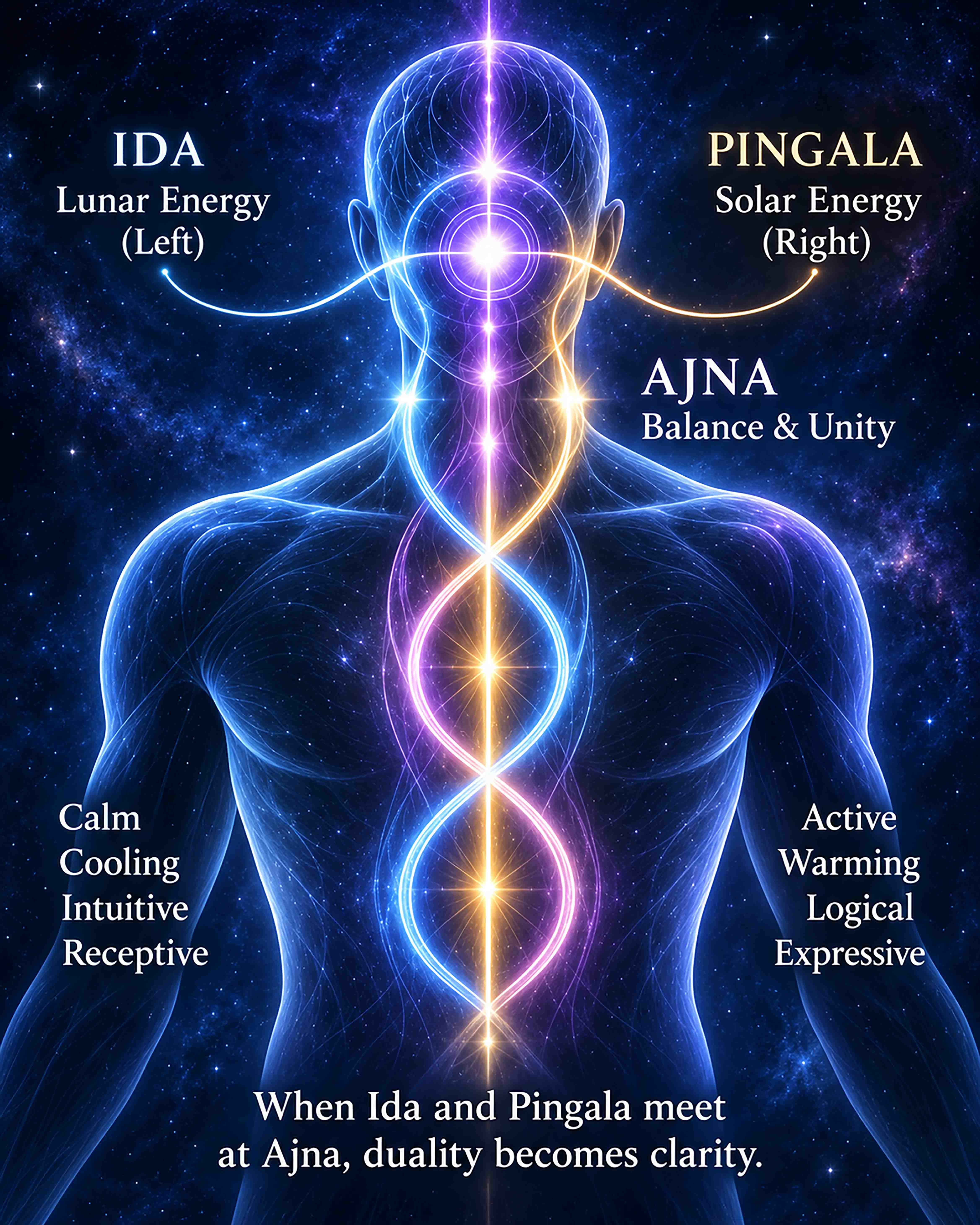
The distinctions between the left, right, and central aspects of the chakras are closely related to another important feature of the traditional subtle system. Sahaja Yoga describes three principal channels known as Ida Nadi, Pingala Nadi, and Sushumna Nadi. The left channel is associated with emotional life, desire, memory, and the influence of the past. The right channel is connected with physical and mental activity, planning, and the tendency to direct attention toward future achievements. The central channel represents the path of spiritual ascent and balance. These channels are not scientifically established anatomical structures but form part of the spiritual language through which the tradition explains different aspects of human experience.
The relationship between these channels offers an interesting perspective on the difficulties of modern life. Some individuals become absorbed in memories, emotional reactions, and concerns about what has already happened. Others remain continually occupied with planning, productivity, and the pressure to achieve future results. Both tendencies can make it difficult to experience the present moment without distraction. The central path symbolically represents a state in which neither emotional attachment nor excessive mental activity completely dominates awareness. Rather than rejecting thought or emotion, the individual learns to observe both with greater steadiness.
This understanding leads naturally toward the practice of meditation. In Sahaja Yoga, meditation is closely associated with the experience of thoughtless awareness, a state in which consciousness remains present without being constantly occupied by mental commentary. The expression does not imply a loss of intelligence or an inability to think. Instead, it describes a quality of attention that is no longer entirely absorbed in the continuous movement of thoughts. An individual may remain alert, conscious, and receptive while experiencing moments of unusual mental quietness.
Meditation can begin with something as simple as sitting comfortably and observing the present moment. The body gradually settles, breathing continues naturally, and attention becomes less concerned with controlling every internal experience. Thoughts may arise, but they do not necessarily require immediate reaction. Emotions may be noticed without becoming the entire focus of awareness. Over time, this practice can encourage a different relationship with the mind, one in which observation becomes possible without constant judgment. Such experiences can be explored independently of whether a person accepts the traditional spiritual explanations of chakras and Kundalini.
It is important to recognize that the Sahasrara diagram belongs to a symbolic and spiritual framework. The locations and energetic reflections illustrated in the head are not established structures recognized by modern neuroscience. Scientific research has investigated various effects of meditation on attention, stress, and psychological well-being, but this does not establish the physical existence of the chakra system described in yogic traditions. Appreciating the philosophical meaning of these teachings does not require confusing spiritual interpretations with medical facts.
What makes the Sahasrara particularly meaningful within Sahaja Yoga is the idea that higher awareness is not separate from the qualities expressed in ordinary life. Compassion cannot be completely separated from discernment, just as creativity cannot flourish without attention and inner balance. Forgiveness, self-respect, contentment, and responsibility all contribute to the broader experience of personal development. The reflections of the chakras within the Sahasrara symbolize this interconnection, presenting consciousness as something that becomes more integrated as different dimensions of experience are brought into harmony.
The thousand-petaled lotus offers a fitting image for this process. A lotus unfolds gradually, revealing its petals without forcing them open. In much the same way, spiritual development can be understood as a gradual deepening of awareness rather than a single dramatic achievement. There may be moments of insight followed by periods of uncertainty, experiences of peace followed by encounters with familiar difficulties. None of these necessarily invalidates the journey. Growth can involve learning to meet changing experiences with increasing clarity, patience, and understanding.
Ultimately, the teachings surrounding the Chakras in the Sahasrara invite reflection on the possibility of a more complete relationship with oneself and the world. The diagram brings together the symbolic qualities of innocence, creativity, satisfaction, wisdom, love, communication, forgiveness, and transformation within a single representation of the crown chakra. Rather than depicting spiritual awakening as an escape from human experience, it suggests that greater consciousness may involve a deeper integration of the qualities already present within life.
The search for higher awareness may begin with meditation, philosophical inquiry, or simple moments of sincere self-observation. Yet its meaning is ultimately reflected in how a person lives, how they treat others, how they respond to difficulties, and how honestly they understand their own thoughts and actions. The Sahasrara stands as a spiritual symbol of unity, reminding us that inner development is not necessarily about becoming something entirely different, but about discovering a more balanced, conscious, and compassionate way of being.
The Sahasrara holds a particularly important place within this understanding. Known as the crown chakra, it is traditionally associated with the highest state of spiritual awareness and the possibility of experiencing a profound sense of unity. The Sanskrit word Sahasrara is commonly translated as the thousand-petaled lotus, a symbol representing the unfolding of consciousness beyond its ordinary limitations. While the lower chakras are associated with different qualities of human life, the Sahasrara is understood as the point where these qualities become integrated into a greater whole.
Within the teachings of Sahaja Yoga, this relationship is expressed through an intriguing representation of the subtle system. The chakras that are normally depicted along the spine are also shown as having symbolic reflections within the Sahasrara. These reflections appear across different regions of the head, forming a spiritual map that illustrates the interconnected nature of human qualities and the process of inner transformation. The diagram is not intended as a conventional anatomical illustration of the brain. Instead, it presents a spiritual interpretation of how the subtle centers are believed to come together in the experience of higher consciousness.
To understand the meaning of this representation, it is helpful to consider the traditional idea of Kundalini. In yogic philosophy, Kundalini is described as a dormant spiritual energy resting near the base of the spine. Its awakening is associated with a gradual movement through the subtle energy centers, ultimately reaching the Sahasrara at the crown of the head. In Sahaja Yoga, this awakening is closely connected with Self-realization, an experience through which an individual is believed to develop a more direct awareness of the inner spiritual Self. The journey is described not simply as an ascent through different centers but as a process in which the qualities represented by those centers become increasingly balanced and integrated.
At the foundation of this symbolic journey lies the Mooladhara chakra, traditionally associated with innocence, purity, wisdom, and stability. Innocence in this context does not mean ignorance or an inability to recognize the difficulties of life. It represents a natural quality of awareness that exists before experience becomes dominated by excessive fear, judgment, and calculation. The Mooladhara reflection in the Sahasrara diagram serves as a reminder that spiritual maturity does not necessarily require abandoning simplicity. A person may gain knowledge, overcome difficulties, and develop a deeper understanding of the world while still preserving sincerity, humility, and a sense of inner stability.
Closely connected with the foundations of human development is the Swadhisthana chakra, which represents creativity, inspiration, and the capacity for focused attention. Its reflections are illustrated in the back of the head, with distinctions between the left, right, and central aspects. Creativity is often understood as the ability to produce something original, yet its deeper significance extends beyond artistic expression. It can also appear in the way a person approaches difficulties, discovers new perspectives, and responds to changing circumstances. In contemplative traditions, genuine inspiration is sometimes associated with moments when the mind becomes less occupied with repetitive thinking. Instead of trying to control every idea, the individual allows attention to become more open and receptive.
The Nabhi chakra introduces another essential dimension of inner development through its association with contentment, satisfaction, and balance. Human beings naturally pursue security, achievement, relationships, and material well-being, but these pursuits do not always produce lasting fulfillment. When satisfaction depends entirely on external circumstances, the mind can become trapped in a continuous search for something more. The spiritual quality represented by Nabhi suggests that genuine contentment involves developing an inner relationship with life that is not constantly disturbed by changing conditions. This does not require the rejection of ambition or worldly responsibility. Rather, it reflects the possibility of acting with purpose while remaining free from the belief that peace can only be found after every desire has been fulfilled.
Surrounding the Nabhi in the traditional subtle-system model is the Void, also known as Bhavasagara. Its symbolic significance is connected with the Guru principle, which represents wisdom, guidance, discipline, and the development of inner authority. Throughout life, individuals often depend on external sources for direction. Teachers, traditions, family expectations, and social values can all influence the way a person understands the world. Yet genuine maturity also requires the ability to examine these influences and develop personal discernment. The Guru principle points toward a form of inner guidance grounded in responsibility, honesty, and an increasingly clear understanding of one's actions. Within this interpretation, wisdom is not merely the accumulation of information but the ability to recognize what is meaningful and act accordingly.
The Heart chakra brings attention to qualities that are central to human relationships and emotional life. Associated with compassion, security, love, and the Spirit, it represents a dimension of awareness that cannot be reduced to intellectual understanding alone. Love can take many forms, ranging from attachment and personal affection to a more expansive sense of compassion. Spiritual traditions often distinguish between these experiences, suggesting that deeper love becomes possible when the individual is less dominated by fear, possession, and the constant need for approval. The Heart reflections within the Sahasrara symbolize the importance of emotional security and the recognition of an inner identity that remains deeper than passing feelings or external circumstances.
As awareness develops, communication becomes another essential expression of inner balance. The Vishuddhi chakra is traditionally associated with communication, self-respect, relationships, and collective consciousness. Its reflections appear across the upper forehead region of the Sahasrara diagram, emphasizing the significance of interaction with others. Communication is not limited to speaking clearly or expressing opinions. It also includes the ability to listen, to recognize the experiences of other people, and to participate in relationships without losing one's individuality. A person may possess considerable knowledge and still struggle to communicate with kindness or understanding. Vishuddhi symbolizes the possibility of developing a more balanced relationship between personal expression and awareness of the wider human community.
The Agnya chakra, commonly associated with the forehead and the space between the eyebrows, introduces the qualities of forgiveness, clarity, and freedom from excessive mental identification. Much of ordinary experience is shaped by thoughts about the past and expectations concerning the future. The mind revisits conversations, evaluates decisions, imagines difficulties, and creates narratives about personal identity. Although thinking is essential to daily life, the continuous movement of thought can also become a source of inner tension. Within Sahaja Yoga, Agnya is particularly connected with forgiveness, which is understood as a way of releasing unnecessary mental burdens. Forgiveness does not require denying injustice or abandoning personal boundaries. Its deeper meaning lies in the possibility of no longer allowing resentment to dominate one's inner experience.
Another significant center represented in the diagram is the Hamsa chakra, which is associated with discrimination and discernment. Spiritual awareness does not mean accepting every impression, emotion, or belief without examination. On the contrary, the capacity to distinguish between helpful and harmful influences becomes increasingly important as a person develops greater sensitivity to experience. Discernment allows an individual to recognize the difference between genuine understanding and superficial attraction, between intuition and impulsiveness, and between compassion and the absence of healthy boundaries. In this sense, the Hamsa chakra symbolizes an essential quality of wisdom that supports spiritual development without requiring the abandonment of critical thinking.
The Ekadasha Rudras add a further dimension to this symbolic system. Traditionally associated with eleven aspects of Rudra, they carry meanings connected with protection, correction, and transformation within Sahaja Yoga teachings. Their representation across the forehead suggests that spiritual development also involves confronting the patterns that prevent greater clarity. Human beings naturally develop habits of thought and behavior, some of which become deeply rooted over time. Transformation may therefore require more than the pursuit of peaceful experiences. It can involve recognizing pride, fear, resentment, or self-deception and gradually developing a more truthful relationship with oneself. The symbolism of the Ekadasha Rudras reflects the understanding that spiritual balance includes both compassion and responsibility.
The distinctions between the left, right, and central aspects of the chakras are closely related to another important feature of the traditional subtle system. Sahaja Yoga describes three principal channels known as Ida Nadi, Pingala Nadi, and Sushumna Nadi. The left channel is associated with emotional life, desire, memory, and the influence of the past. The right channel is connected with physical and mental activity, planning, and the tendency to direct attention toward future achievements. The central channel represents the path of spiritual ascent and balance. These channels are not scientifically established anatomical structures but form part of the spiritual language through which the tradition explains different aspects of human experience.
The relationship between these channels offers an interesting perspective on the difficulties of modern life. Some individuals become absorbed in memories, emotional reactions, and concerns about what has already happened. Others remain continually occupied with planning, productivity, and the pressure to achieve future results. Both tendencies can make it difficult to experience the present moment without distraction. The central path symbolically represents a state in which neither emotional attachment nor excessive mental activity completely dominates awareness. Rather than rejecting thought or emotion, the individual learns to observe both with greater steadiness.
This understanding leads naturally toward the practice of meditation. In Sahaja Yoga, meditation is closely associated with the experience of thoughtless awareness, a state in which consciousness remains present without being constantly occupied by mental commentary. The expression does not imply a loss of intelligence or an inability to think. Instead, it describes a quality of attention that is no longer entirely absorbed in the continuous movement of thoughts. An individual may remain alert, conscious, and receptive while experiencing moments of unusual mental quietness.
Meditation can begin with something as simple as sitting comfortably and observing the present moment. The body gradually settles, breathing continues naturally, and attention becomes less concerned with controlling every internal experience. Thoughts may arise, but they do not necessarily require immediate reaction. Emotions may be noticed without becoming the entire focus of awareness. Over time, this practice can encourage a different relationship with the mind, one in which observation becomes possible without constant judgment. Such experiences can be explored independently of whether a person accepts the traditional spiritual explanations of chakras and Kundalini.
It is important to recognize that the Sahasrara diagram belongs to a symbolic and spiritual framework. The locations and energetic reflections illustrated in the head are not established structures recognized by modern neuroscience. Scientific research has investigated various effects of meditation on attention, stress, and psychological well-being, but this does not establish the physical existence of the chakra system described in yogic traditions. Appreciating the philosophical meaning of these teachings does not require confusing spiritual interpretations with medical facts.
What makes the Sahasrara particularly meaningful within Sahaja Yoga is the idea that higher awareness is not separate from the qualities expressed in ordinary life. Compassion cannot be completely separated from discernment, just as creativity cannot flourish without attention and inner balance. Forgiveness, self-respect, contentment, and responsibility all contribute to the broader experience of personal development. The reflections of the chakras within the Sahasrara symbolize this interconnection, presenting consciousness as something that becomes more integrated as different dimensions of experience are brought into harmony.
The thousand-petaled lotus offers a fitting image for this process. A lotus unfolds gradually, revealing its petals without forcing them open. In much the same way, spiritual development can be understood as a gradual deepening of awareness rather than a single dramatic achievement. There may be moments of insight followed by periods of uncertainty, experiences of peace followed by encounters with familiar difficulties. None of these necessarily invalidates the journey. Growth can involve learning to meet changing experiences with increasing clarity, patience, and understanding.
Ultimately, the teachings surrounding the Chakras in the Sahasrara invite reflection on the possibility of a more complete relationship with oneself and the world. The diagram brings together the symbolic qualities of innocence, creativity, satisfaction, wisdom, love, communication, forgiveness, and transformation within a single representation of the crown chakra. Rather than depicting spiritual awakening as an escape from human experience, it suggests that greater consciousness may involve a deeper integration of the qualities already present within life.
The search for higher awareness may begin with meditation, philosophical inquiry, or simple moments of sincere self-observation. Yet its meaning is ultimately reflected in how a person lives, how they treat others, how they respond to difficulties, and how honestly they understand their own thoughts and actions. The Sahasrara stands as a spiritual symbol of unity, reminding us that inner development is not necessarily about becoming something entirely different, but about discovering a more balanced, conscious, and compassionate way of being.










Comments
Comments appear after approval.
Log in to comment