
Community
Kashmir Shaivism
The Three Divine Goddesses of Trika and the Ancient Path to Higher Consciousness

# The Three Divine Goddesses of Trika and the Ancient Path to Higher Consciousness
Throughout the long history of spiritual exploration, human beings have searched for an understanding of consciousness that reaches beyond the ordinary experiences of thought, emotion, and physical existence. Ancient philosophical traditions of India developed remarkably detailed systems to describe the relationship between the individual and the universe, often expressing their ideas through sacred symbols, divine figures, and carefully structured representations of reality. Among these traditions, Trika philosophy occupies a distinctive place because of its profound understanding of consciousness as the fundamental nature of existence.
Closely associated with Kashmir Shaivism, Trika is a nondual tantric tradition that developed an intricate spiritual philosophy centered on Shiva, Shakti, and the recognition of the true Self. The word Trika refers to a triad, reflecting the importance of threefold relationships throughout its teachings. These relationships are not simply classifications of separate spiritual powers. They are ways of understanding how one indivisible reality can appear in different forms while remaining fundamentally whole. The three divine goddesses known as Para, Parapara, and Apara express this principle through sacred imagery, representing different aspects of divine consciousness and its manifestation.
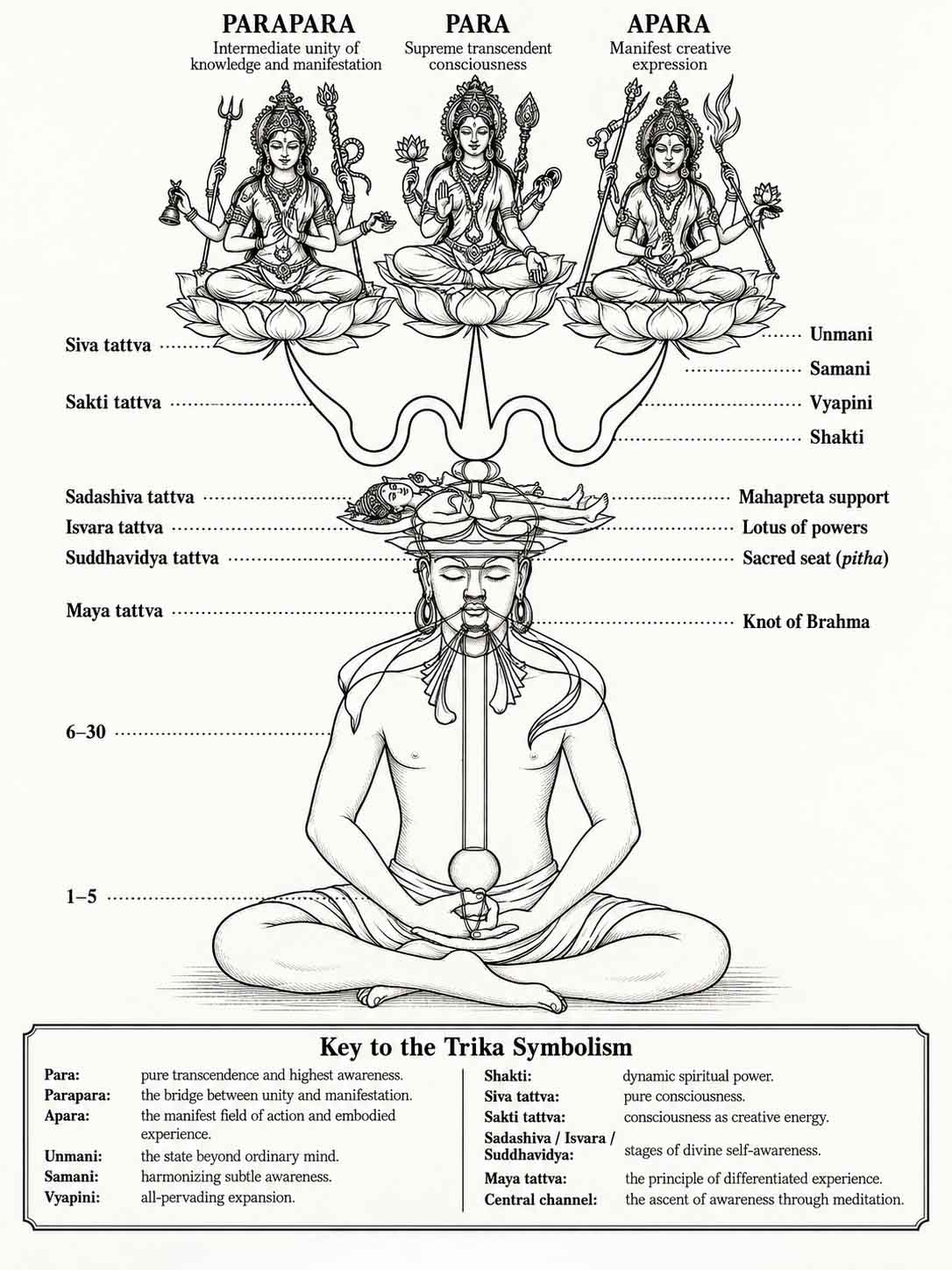
The traditional symbolism of these three goddesses is often represented through a sacred trident rising above the figure of a meditating practitioner. Each goddess occupies a different position upon the three branches of the trident, while the structure beneath them connects the divine realm with the embodied human experience. Surrounding the central image are references to different stages of consciousness, the thirty-six tattvas, and subtle spiritual principles that appear in tantric philosophy. At first glance, such a diagram may seem like a complicated map of invisible energies. Its deeper purpose, however, is to express a fundamental question that has occupied spiritual thinkers for centuries. How can the limitless nature of consciousness appear as the limited experience of an individual human being?
To understand this question, it is necessary to begin with the relationship between Shiva and Shakti. Within nondual Kashmir Shaivism, Shiva represents the luminous nature of pure consciousness, while Shakti represents its inherent power of awareness, freedom, and manifestation. These principles are not regarded as two entirely separate entities. They describe inseparable aspects of the same reality. Consciousness is not understood as an inactive observer standing apart from existence, nor is creative power considered independent of awareness. Instead, reality is described as consciousness possessing the intrinsic freedom to reveal itself in countless forms. The universe, from this perspective, is not fundamentally disconnected from its source. It is an expression of the same consciousness that makes experience possible.
The goddess Para represents the supreme aspect of this divine reality. Her name is associated with that which is highest, transcendent, and beyond ordinary conceptual distinction. In the symbolic arrangement of the Trika goddesses, Para occupies the central position, expressing the supreme unity from which the different manifestations of consciousness are understood to arise. She represents a condition in which the distinction between the observer and the observed has not yet become the defining structure of experience. There is no fundamental separation between awareness and what awareness reveals. Instead, there is the indivisible fullness of consciousness, complete within itself.
This understanding differs considerably from the ordinary way people experience the world. Everyday perception is organized around distinctions. There is an individual who observes, an object being observed, and an apparent distance between the two. Personal identity is constructed through memories, relationships, physical sensations, and interpretations of experience. Para symbolizes a dimension of reality that precedes these divisions. She represents the possibility that consciousness is more fundamental than the particular experiences appearing within it. The spiritual significance of Para therefore lies not in escaping the world but in recognizing a deeper unity that is believed to remain present beneath the appearance of separation.
Parapara represents an intermediate aspect of divine consciousness, traditionally situated between the supreme and the more fully differentiated forms of manifestation. The name itself suggests a relationship between the higher and the lower, or between transcendence and expression. Within the symbolic framework of Trika, Parapara can be contemplated as the dimension in which unity and differentiation coexist. Consciousness begins to express its potential for distinction while remaining inseparable from its essential nature.
This intermediate principle has considerable philosophical significance because it challenges the assumption that reality must be either completely unified or completely divided. Human awareness frequently moves between these apparent opposites. There are moments when experience feels fragmented into separate problems, responsibilities, and identities, while at other times life may appear interconnected and meaningful. Parapara symbolizes a relationship between unity and manifestation, suggesting that difference does not necessarily destroy the underlying wholeness of existence. The world may contain countless distinct forms without those forms being absolutely separate from the consciousness through which they are known.
The third goddess, Apara, represents the more fully manifest dimension of divine energy. Her symbolism is associated with differentiation, activity, and the field of embodied experience. Through Apara, the spiritual philosophy of Trika acknowledges the importance of the world that human beings encounter through their senses and actions. Physical existence is not simply dismissed as meaningless or entirely opposed to spiritual reality. Instead, it is understood as an expression of consciousness appearing through limitation, diversity, and particular forms.
Apara is therefore important to the relationship between spirituality and everyday life. The manifest world contains movement, relationships, individual decisions, suffering, creativity, responsibility, and change. These experiences are often treated as obstacles to spiritual understanding, particularly when spiritual life is imagined as withdrawal from ordinary existence. Nondual Trika philosophy offers a different perspective. If the universe is an expression of Shiva's freedom through Shakti, then the experiences of daily life are not fundamentally outside the field of spiritual inquiry. The challenge is not necessarily to reject manifestation but to recognize its deeper nature.
Together, Para, Parapara, and Apara form a sacred triad expressing different dimensions of one divine power. Their relationship is illustrated by the three branches of Shiva's trident, known as the Trishula. In Hindu iconography, the trident possesses numerous symbolic meanings, and its interpretation varies across traditions. Within Trika, the three-pronged form provides a natural representation of the three goddesses and their interconnected powers. Their placement upon lotus seats further emphasizes the relationship between divine manifestation and spiritual purity, while the trident unites them within a single visual structure.
The lotus is one of the most enduring symbols in Indian spiritual art. Emerging from water and opening toward the light, it is frequently associated with purity, awakening, and the unfolding of awareness. Its presence beneath the three goddesses suggests that spiritual consciousness may reveal itself through different degrees of expression without losing its essential nature. The lotus also serves as a sacred seat, or pitha, a symbolic place in which divine power is established. In tantric traditions, such seats may be understood through ritual, visualization, sacred geography, or the internal landscape of spiritual practice. Their precise meanings depend on the particular lineage and ritual context.
Beneath the divine figures, the diagram presents another significant symbol through the reclining form associated with Mahapreta. The Sanskrit term may be translated as the great corpse or great departed being, although its meaning in tantric iconography is highly specialized and should not be reduced to an ordinary image of death. In some Shakta and Shaiva symbolic arrangements, a reclining or apparently lifeless divine form serves as the foundation beneath the active power of the goddess. This imagery expresses the relationship between consciousness and its creative energy. Without Shakti, consciousness can be symbolically portrayed as inactive, while Shakti represents the dynamic power through which manifestation becomes possible.
The Mahapreta imagery also invites reflection on the relationship between stillness and movement. A state of complete stillness may appear opposite to the continuous activity of the world, yet the tantric understanding of Shiva and Shakti suggests that these dimensions are inseparable. Movement arises within a reality that is not itself exhausted by movement. Thoughts appear and disappear, emotions develop and change, and physical forms emerge and dissolve, while the philosophical principle of consciousness is described as the underlying condition through which all these transformations are experienced. The reclining figure becomes a visual reminder of the mysterious relationship between the unchanging and the changing.
The sacred arrangement surrounding the meditating figure also includes references to the thirty-six tattvas, one of the most important philosophical structures within Kashmir Shaivism. The word tattva can be understood as a principle, reality, or fundamental constituent of existence. The thirty-six tattvas describe a progressive structure of manifestation, beginning with the highest principles of consciousness and continuing through the conditions that make individual experience and the material world possible. They are not intended as thirty-six physical organs or measurable locations within the human body. Rather, they form a philosophical explanation of how apparently limited existence can emerge from unlimited consciousness.
The highest five tattvas are known as the pure principles. These are Shiva, Shakti, Sadashiva, Ishvara, and Shuddhavidya. Shiva tattva represents pure consciousness in its most fundamental sense, while Shakti tattva represents the intrinsic freedom and self-awareness of that consciousness. The distinction between them is conceptual rather than an absolute separation. Shiva is traditionally associated with the luminous presence of awareness, and Shakti with the capacity of awareness to recognize and express itself. Together, they establish the foundation of the entire system.
Sadashiva tattva introduces a subtle emphasis upon the experience of identity in which consciousness remains predominant while the possibility of manifestation begins to appear. It is often explained through the expression of awareness in which the sense of I remains dominant over the emerging recognition of this. The universe is not yet experienced as something fundamentally separate from consciousness. Instead, manifestation exists as a potential or emerging expression within the greater fullness of awareness.
Ishvara tattva represents a further development in this relationship. Here, the aspect of manifestation becomes more prominent, while the essential unity of consciousness remains recognized. The object of awareness becomes clearer, yet it is not understood as something completely disconnected from the subject. In philosophical explanations of these levels, the relationship between I and this is used to illustrate the changing emphasis between consciousness and its expression. These expressions are not intended as literal spoken thoughts but as conceptual tools for describing subtle distinctions within the experience of reality.
Shuddhavidya, also known as Sadvidya, represents a state in which the subjective and objective aspects of awareness are held in balance. The distinction between the knower and the known can be recognized without becoming an experience of absolute separation. This principle completes the five pure tattvas and marks an important transition in the philosophical description of manifestation. The universe is now understood as capable of appearing through distinctions while still belonging to the same fundamental consciousness.
The next major principle is Maya, which has a particular meaning within nondual Kashmir Shaivism. Although Maya is sometimes popularly translated as illusion, this translation can be misleading when applied without further explanation. Within the Trika understanding, Maya is closely associated with the power through which unlimited consciousness appears as limited and differentiated experience. It is not necessarily the claim that the world simply does not exist. Rather, Maya describes the condition in which the underlying unity of reality becomes concealed by the appearance of separate identities and objects.
This limitation develops through five principles traditionally called the Kanchukas, or coverings. They describe how unlimited capacities are experienced in restricted forms. Kala represents limited agency, through which the individual experiences the ability to perform only certain actions rather than possessing unrestricted creative power. Vidya represents limited knowledge, the condition in which awareness is confined to particular information and perspectives. Raga represents desire or the experience of incompleteness, through which an individual seeks fulfillment in particular objects or circumstances. Kala, in its distinct Sanskrit sense referring to time, represents temporal limitation, while Niyati expresses restriction through order, circumstance, and causality.
These five limitations offer a striking philosophical description of ordinary human experience. Every individual acts within particular circumstances, possesses incomplete knowledge, experiences desires, lives through time, and encounters conditions that cannot always be controlled. The Trika system interprets these limitations as expressions of a deeper process through which universal consciousness appears in individualized form. The individual is not understood as absolutely separate from the infinite but as experiencing reality through a contracted perspective.
Beyond these principles, the remaining tattvas describe the structure of individual existence and the world of experience. Purusha represents the individual conscious experiencer, while Prakriti is associated with the fundamental nature through which psychological and material differentiation develops. Other tattvas include Buddhi, the faculty of understanding and discrimination; Ahamkara, the principle associated with the formation of individual identity; and Manas, the organizing activity of the mind. The system continues through the capacities of perception and action, subtle sensory qualities, and the five gross elements traditionally described as space, air, fire, water, and earth.
The thirty-six tattvas therefore form a comprehensive philosophical movement from the highest understanding of consciousness to the ordinary material world. The first five pure tattvas are followed by the principles of limitation and the structures of individualized experience, eventually reaching the gross elements. In diagrams that arrange these principles around a human figure, the placement is symbolic rather than anatomical. The numerical groupings shown in different illustrations should not automatically be interpreted as standard bodily locations, and the traditional ordering of the tattvas must be distinguished from the artistic arrangement used to represent them.
Another important feature of the diagram is the presence of subtle stages identified as Shakti, Vyapini, Samani, and Unmani. These names occur in tantric discussions of increasingly subtle dimensions of awareness, particularly in teachings concerned with mantra, sound, and the movement beyond ordinary mental activity. Their meanings can vary according to the text and tradition in which they appear, but they generally belong to a symbolic understanding of consciousness becoming progressively less restricted by ordinary distinctions.
Shakti, in this context, expresses dynamic spiritual power, the capacity of consciousness to manifest, sustain, and transform experience. Vyapini is associated with pervasiveness and expansion beyond ordinary limits. Its symbolism suggests an awareness that is no longer understood exclusively through the boundaries of individual bodily identity. Samani is connected with a highly subtle condition of awareness, sometimes described through the language of undifferentiated or harmonizing cognition. Unmani, also expressed as Unmana, represents a condition beyond the ordinary operations of the mind, a state in which conceptual distinctions no longer determine the fundamental character of awareness.
The idea of Unmani is particularly significant because it challenges the assumption that consciousness must always be identified with thought. Ordinary experience often gives the impression that the continuous movement of the mind constitutes the entirety of personal awareness. Yet contemplative traditions have long explored the possibility that thoughts may appear within awareness without completely defining it. Unmani expresses a spiritual ideal beyond conventional mental construction. It should not be confused with unconsciousness, physical incapacity, or the suppression of healthy mental functioning. Rather, it belongs to a philosophical and contemplative language concerned with what awareness may be when it is no longer dominated by conceptual identification.
The diagram also includes the Brahma Granthi, one of the symbolic knots discussed in certain yogic and tantric systems. The term Granthi refers to a knot or binding, and such knots are traditionally associated with obstacles to the free movement of spiritual awareness. Different yogic traditions describe these knots in different ways, and their positions should not be mistaken for scientifically identified anatomical structures. Symbolically, the concept concerns the difficulty of moving beyond established patterns of attachment and identification. Human beings become accustomed to particular understandings of themselves, and these understandings can become so familiar that alternatives seem impossible. The image of a knot captures the experience of awareness being restricted by deeply established conditioning.
At the center of the entire illustration sits the meditating practitioner, whose calm posture provides a visual contrast to the elaborate divine symbolism above. The body is presented as a place where the spiritual principles of the tradition may be contemplated and experienced. A vertical axis connects the lower region of the body with the head and the transcendent symbolism beyond it. This central alignment evokes the importance of the subtle channel frequently called Sushumna in yogic traditions, although the exact relationship between such diagrams and the various systems of subtle anatomy depends on the sources being studied.
The meditating figure is not simply an observer looking upward toward a divine reality located somewhere else. Within the nondual understanding of Trika, the deepest nature of the individual is already inseparable from the consciousness represented by Shiva. Spiritual realization is therefore not fundamentally the creation of a new identity. It is the recognition of a truth believed to have been obscured by limited perception. This principle is closely associated with Pratyabhijna, the philosophy of recognition developed within Kashmir Shaivism.
Pratyabhijna proposes that liberation involves recognizing one's essential identity with the universal consciousness of Shiva. The Sanskrit term conveys the idea of recognizing something that was already known at a deeper level but had become obscured. In ordinary life, people often define themselves through their achievements, failures, physical appearance, emotional history, and social relationships. These aspects of identity are meaningful, but they are also subject to change. The philosophy of recognition asks whether the awareness through which these changing experiences are known may possess a more fundamental nature than any particular experience.
The development of this philosophy is associated with important thinkers such as Utpaladeva and Abhinavagupta, whose works contributed significantly to the intellectual and spiritual traditions of medieval Kashmir. Their explanations of consciousness, manifestation, recognition, and liberation developed an influential body of thought that continues to be studied today. Abhinavagupta's Tantraloka, in particular, is among the major works associated with the integration of tantric ritual, philosophy, and contemplative practice within the Trika tradition.
Meditation plays an important role in the practical exploration of these ideas, although the tradition contains a wider range of practices than meditation alone. Tantric spiritual disciplines may include mantra, visualization, ritual worship, philosophical reflection, and approaches to direct awareness. These methods are traditionally understood within particular teaching contexts, and not every technique is suitable for casual experimentation without guidance. Nevertheless, the underlying philosophical questions can be explored through simple, non-forceful contemplation.
A person sitting quietly may begin by becoming aware of the body resting in the present moment. Sensations arise, sounds appear in the surrounding environment, and thoughts move through the mind. Normally, attention becomes absorbed in the contents of these experiences, moving rapidly from one object to another. But it is also possible to notice the fact of awareness itself. Thoughts are known because they appear in awareness. Emotions are experienced because they are present to consciousness. Even uncertainty and distraction become recognizable through the same basic capacity to know experience.
From a Trika perspective, this simple observation can open the way toward a deeper philosophical reflection. If the contents of experience continually change, what is the nature of the awareness through which those changes are recognized? The question is not intended merely as an intellectual puzzle. Within the tradition, it becomes part of a movement toward direct recognition, where the practitioner gradually examines the assumptions through which personal identity and the world are ordinarily understood.
The relationship between spiritual practice and everyday life is essential to this process. Higher consciousness is sometimes imagined as a distant state accessible only through extraordinary experiences. Yet the philosophy of Trika suggests that ordinary life itself can become a field of recognition. Every perception, action, relationship, and moment of attention belongs to the wider reality being explored. The purpose of spiritual understanding is not necessarily to abandon the world but to recognize the consciousness that, according to the tradition, is present throughout its manifestation.
This perspective also changes the meaning of inner transformation. Transformation is not simply the replacement of unpleasant emotions with pleasant ones, nor does it require maintaining a permanent state of calm. Human experience includes uncertainty, conflict, desire, disappointment, and change. A deeper relationship with awareness may involve learning to recognize these experiences without reducing one's entire identity to them. The individual continues to think, act, feel, and participate in the world, but these activities can be approached with greater clarity and less automatic identification.
The three goddesses provide a symbolic expression of this relationship between unity and diversity. Para represents the supreme and undivided nature of consciousness. Parapara represents the relationship between transcendence and differentiation. Apara represents consciousness expressed through the manifest world. These are not simply three distant divine personalities separated from human experience. Within the philosophical framework of Trika, they reveal different aspects of the same reality that the practitioner seeks to recognize.
The descending symbolism of the trident and the ascending symbolism of the meditating figure can therefore be understood as complementary movements. One illustrates how the unlimited appears through increasingly differentiated forms, while the other represents the spiritual movement toward recognition of the underlying unity. Manifestation and liberation are not necessarily journeys between two unrelated realities. They can be interpreted as different perspectives on the relationship between consciousness and its expressions.
The entire diagram becomes a visual representation of a profound philosophical idea. What appears as an individual human being, limited by time, knowledge, desire, and circumstance, is understood within Trika as an expression of a reality that is not itself limited in the same way. The thirty-six tattvas describe the development of differentiated existence, the three goddesses represent the principal dimensions of divine manifestation, and the subtle stages above the head express the movement beyond ordinary mental distinctions. The lotus, sacred seat, reclining support, and central axis unite these ideas within a single contemplative image.
It is important, however, to distinguish the traditional spiritual meaning of these symbols from scientific explanations of the body and mind. The tattvas, subtle channels, divine energies, and stages of transcendence are not established anatomical or neurological structures. They belong to a religious and philosophical tradition that uses symbolic language to explore consciousness and existence. Understanding their cultural and historical significance does not require presenting them as scientifically demonstrated mechanisms.
The continuing appeal of Trika philosophy lies partly in its refusal to treat the world and consciousness as fundamentally opposed. Rather than imagining spirituality as the rejection of everything human, the tradition invites reflection on the possibility that awareness and manifestation belong to a deeper unity. The diversity of existence is not simply an error to be removed but an expression whose underlying nature may be recognized through insight.
In this sense, the meditating figure beneath the three goddesses represents every individual who has questioned the boundaries of ordinary experience. The journey begins within a world of separate forms, personal identities, changing circumstances, and countless thoughts. It continues through the exploration of awareness, the recognition of limitation, and the possibility of perceiving experience from a wider perspective. The divine figures above do not merely symbolize a distant destination. They express the philosophical understanding that the highest reality is inseparable from the consciousness through which the journey itself is known.
The ancient symbolism of Para, Parapara, and Apara offers a way of contemplating existence that is both intricate and remarkably unified. The universe, the individual, the movement of thought, and the stillness of awareness are presented as dimensions of one profound mystery. The spiritual goal is not simply to accumulate more knowledge about invisible worlds but to investigate the nature of the awareness through which all knowledge and experience become possible.
Ultimately, Trika philosophy invites the individual to reconsider the meaning of separation. The mind divides experience into inner and outer, sacred and ordinary, self and world, yet the nondual vision proposes that these distinctions do not exhaust the nature of reality. Beneath the changing forms of existence, it describes an indivisible consciousness whose freedom is expressed through the very diversity of life.
The journey toward higher consciousness is therefore not only a movement beyond limitation. It is also a journey toward recognizing the deeper nature of what is already present. Through the symbolic unity of Shiva and Shakti, the three goddesses, and the unfolding principles of existence, Trika offers a vision in which awareness is both the foundation of the universe and the deepest mystery of the individual Self. The ultimate significance of the path lies in the possibility that what appears separate may, at its most fundamental level, never have been divided.
Throughout the long history of spiritual exploration, human beings have searched for an understanding of consciousness that reaches beyond the ordinary experiences of thought, emotion, and physical existence. Ancient philosophical traditions of India developed remarkably detailed systems to describe the relationship between the individual and the universe, often expressing their ideas through sacred symbols, divine figures, and carefully structured representations of reality. Among these traditions, Trika philosophy occupies a distinctive place because of its profound understanding of consciousness as the fundamental nature of existence.
Closely associated with Kashmir Shaivism, Trika is a nondual tantric tradition that developed an intricate spiritual philosophy centered on Shiva, Shakti, and the recognition of the true Self. The word Trika refers to a triad, reflecting the importance of threefold relationships throughout its teachings. These relationships are not simply classifications of separate spiritual powers. They are ways of understanding how one indivisible reality can appear in different forms while remaining fundamentally whole. The three divine goddesses known as Para, Parapara, and Apara express this principle through sacred imagery, representing different aspects of divine consciousness and its manifestation.
The traditional symbolism of these three goddesses is often represented through a sacred trident rising above the figure of a meditating practitioner. Each goddess occupies a different position upon the three branches of the trident, while the structure beneath them connects the divine realm with the embodied human experience. Surrounding the central image are references to different stages of consciousness, the thirty-six tattvas, and subtle spiritual principles that appear in tantric philosophy. At first glance, such a diagram may seem like a complicated map of invisible energies. Its deeper purpose, however, is to express a fundamental question that has occupied spiritual thinkers for centuries. How can the limitless nature of consciousness appear as the limited experience of an individual human being?
To understand this question, it is necessary to begin with the relationship between Shiva and Shakti. Within nondual Kashmir Shaivism, Shiva represents the luminous nature of pure consciousness, while Shakti represents its inherent power of awareness, freedom, and manifestation. These principles are not regarded as two entirely separate entities. They describe inseparable aspects of the same reality. Consciousness is not understood as an inactive observer standing apart from existence, nor is creative power considered independent of awareness. Instead, reality is described as consciousness possessing the intrinsic freedom to reveal itself in countless forms. The universe, from this perspective, is not fundamentally disconnected from its source. It is an expression of the same consciousness that makes experience possible.
The goddess Para represents the supreme aspect of this divine reality. Her name is associated with that which is highest, transcendent, and beyond ordinary conceptual distinction. In the symbolic arrangement of the Trika goddesses, Para occupies the central position, expressing the supreme unity from which the different manifestations of consciousness are understood to arise. She represents a condition in which the distinction between the observer and the observed has not yet become the defining structure of experience. There is no fundamental separation between awareness and what awareness reveals. Instead, there is the indivisible fullness of consciousness, complete within itself.
This understanding differs considerably from the ordinary way people experience the world. Everyday perception is organized around distinctions. There is an individual who observes, an object being observed, and an apparent distance between the two. Personal identity is constructed through memories, relationships, physical sensations, and interpretations of experience. Para symbolizes a dimension of reality that precedes these divisions. She represents the possibility that consciousness is more fundamental than the particular experiences appearing within it. The spiritual significance of Para therefore lies not in escaping the world but in recognizing a deeper unity that is believed to remain present beneath the appearance of separation.
Parapara represents an intermediate aspect of divine consciousness, traditionally situated between the supreme and the more fully differentiated forms of manifestation. The name itself suggests a relationship between the higher and the lower, or between transcendence and expression. Within the symbolic framework of Trika, Parapara can be contemplated as the dimension in which unity and differentiation coexist. Consciousness begins to express its potential for distinction while remaining inseparable from its essential nature.
This intermediate principle has considerable philosophical significance because it challenges the assumption that reality must be either completely unified or completely divided. Human awareness frequently moves between these apparent opposites. There are moments when experience feels fragmented into separate problems, responsibilities, and identities, while at other times life may appear interconnected and meaningful. Parapara symbolizes a relationship between unity and manifestation, suggesting that difference does not necessarily destroy the underlying wholeness of existence. The world may contain countless distinct forms without those forms being absolutely separate from the consciousness through which they are known.
The third goddess, Apara, represents the more fully manifest dimension of divine energy. Her symbolism is associated with differentiation, activity, and the field of embodied experience. Through Apara, the spiritual philosophy of Trika acknowledges the importance of the world that human beings encounter through their senses and actions. Physical existence is not simply dismissed as meaningless or entirely opposed to spiritual reality. Instead, it is understood as an expression of consciousness appearing through limitation, diversity, and particular forms.
Apara is therefore important to the relationship between spirituality and everyday life. The manifest world contains movement, relationships, individual decisions, suffering, creativity, responsibility, and change. These experiences are often treated as obstacles to spiritual understanding, particularly when spiritual life is imagined as withdrawal from ordinary existence. Nondual Trika philosophy offers a different perspective. If the universe is an expression of Shiva's freedom through Shakti, then the experiences of daily life are not fundamentally outside the field of spiritual inquiry. The challenge is not necessarily to reject manifestation but to recognize its deeper nature.
Together, Para, Parapara, and Apara form a sacred triad expressing different dimensions of one divine power. Their relationship is illustrated by the three branches of Shiva's trident, known as the Trishula. In Hindu iconography, the trident possesses numerous symbolic meanings, and its interpretation varies across traditions. Within Trika, the three-pronged form provides a natural representation of the three goddesses and their interconnected powers. Their placement upon lotus seats further emphasizes the relationship between divine manifestation and spiritual purity, while the trident unites them within a single visual structure.
The lotus is one of the most enduring symbols in Indian spiritual art. Emerging from water and opening toward the light, it is frequently associated with purity, awakening, and the unfolding of awareness. Its presence beneath the three goddesses suggests that spiritual consciousness may reveal itself through different degrees of expression without losing its essential nature. The lotus also serves as a sacred seat, or pitha, a symbolic place in which divine power is established. In tantric traditions, such seats may be understood through ritual, visualization, sacred geography, or the internal landscape of spiritual practice. Their precise meanings depend on the particular lineage and ritual context.
Beneath the divine figures, the diagram presents another significant symbol through the reclining form associated with Mahapreta. The Sanskrit term may be translated as the great corpse or great departed being, although its meaning in tantric iconography is highly specialized and should not be reduced to an ordinary image of death. In some Shakta and Shaiva symbolic arrangements, a reclining or apparently lifeless divine form serves as the foundation beneath the active power of the goddess. This imagery expresses the relationship between consciousness and its creative energy. Without Shakti, consciousness can be symbolically portrayed as inactive, while Shakti represents the dynamic power through which manifestation becomes possible.
The Mahapreta imagery also invites reflection on the relationship between stillness and movement. A state of complete stillness may appear opposite to the continuous activity of the world, yet the tantric understanding of Shiva and Shakti suggests that these dimensions are inseparable. Movement arises within a reality that is not itself exhausted by movement. Thoughts appear and disappear, emotions develop and change, and physical forms emerge and dissolve, while the philosophical principle of consciousness is described as the underlying condition through which all these transformations are experienced. The reclining figure becomes a visual reminder of the mysterious relationship between the unchanging and the changing.
The sacred arrangement surrounding the meditating figure also includes references to the thirty-six tattvas, one of the most important philosophical structures within Kashmir Shaivism. The word tattva can be understood as a principle, reality, or fundamental constituent of existence. The thirty-six tattvas describe a progressive structure of manifestation, beginning with the highest principles of consciousness and continuing through the conditions that make individual experience and the material world possible. They are not intended as thirty-six physical organs or measurable locations within the human body. Rather, they form a philosophical explanation of how apparently limited existence can emerge from unlimited consciousness.
The highest five tattvas are known as the pure principles. These are Shiva, Shakti, Sadashiva, Ishvara, and Shuddhavidya. Shiva tattva represents pure consciousness in its most fundamental sense, while Shakti tattva represents the intrinsic freedom and self-awareness of that consciousness. The distinction between them is conceptual rather than an absolute separation. Shiva is traditionally associated with the luminous presence of awareness, and Shakti with the capacity of awareness to recognize and express itself. Together, they establish the foundation of the entire system.
Sadashiva tattva introduces a subtle emphasis upon the experience of identity in which consciousness remains predominant while the possibility of manifestation begins to appear. It is often explained through the expression of awareness in which the sense of I remains dominant over the emerging recognition of this. The universe is not yet experienced as something fundamentally separate from consciousness. Instead, manifestation exists as a potential or emerging expression within the greater fullness of awareness.
Ishvara tattva represents a further development in this relationship. Here, the aspect of manifestation becomes more prominent, while the essential unity of consciousness remains recognized. The object of awareness becomes clearer, yet it is not understood as something completely disconnected from the subject. In philosophical explanations of these levels, the relationship between I and this is used to illustrate the changing emphasis between consciousness and its expression. These expressions are not intended as literal spoken thoughts but as conceptual tools for describing subtle distinctions within the experience of reality.
Shuddhavidya, also known as Sadvidya, represents a state in which the subjective and objective aspects of awareness are held in balance. The distinction between the knower and the known can be recognized without becoming an experience of absolute separation. This principle completes the five pure tattvas and marks an important transition in the philosophical description of manifestation. The universe is now understood as capable of appearing through distinctions while still belonging to the same fundamental consciousness.
The next major principle is Maya, which has a particular meaning within nondual Kashmir Shaivism. Although Maya is sometimes popularly translated as illusion, this translation can be misleading when applied without further explanation. Within the Trika understanding, Maya is closely associated with the power through which unlimited consciousness appears as limited and differentiated experience. It is not necessarily the claim that the world simply does not exist. Rather, Maya describes the condition in which the underlying unity of reality becomes concealed by the appearance of separate identities and objects.
This limitation develops through five principles traditionally called the Kanchukas, or coverings. They describe how unlimited capacities are experienced in restricted forms. Kala represents limited agency, through which the individual experiences the ability to perform only certain actions rather than possessing unrestricted creative power. Vidya represents limited knowledge, the condition in which awareness is confined to particular information and perspectives. Raga represents desire or the experience of incompleteness, through which an individual seeks fulfillment in particular objects or circumstances. Kala, in its distinct Sanskrit sense referring to time, represents temporal limitation, while Niyati expresses restriction through order, circumstance, and causality.
These five limitations offer a striking philosophical description of ordinary human experience. Every individual acts within particular circumstances, possesses incomplete knowledge, experiences desires, lives through time, and encounters conditions that cannot always be controlled. The Trika system interprets these limitations as expressions of a deeper process through which universal consciousness appears in individualized form. The individual is not understood as absolutely separate from the infinite but as experiencing reality through a contracted perspective.
Beyond these principles, the remaining tattvas describe the structure of individual existence and the world of experience. Purusha represents the individual conscious experiencer, while Prakriti is associated with the fundamental nature through which psychological and material differentiation develops. Other tattvas include Buddhi, the faculty of understanding and discrimination; Ahamkara, the principle associated with the formation of individual identity; and Manas, the organizing activity of the mind. The system continues through the capacities of perception and action, subtle sensory qualities, and the five gross elements traditionally described as space, air, fire, water, and earth.
The thirty-six tattvas therefore form a comprehensive philosophical movement from the highest understanding of consciousness to the ordinary material world. The first five pure tattvas are followed by the principles of limitation and the structures of individualized experience, eventually reaching the gross elements. In diagrams that arrange these principles around a human figure, the placement is symbolic rather than anatomical. The numerical groupings shown in different illustrations should not automatically be interpreted as standard bodily locations, and the traditional ordering of the tattvas must be distinguished from the artistic arrangement used to represent them.
Another important feature of the diagram is the presence of subtle stages identified as Shakti, Vyapini, Samani, and Unmani. These names occur in tantric discussions of increasingly subtle dimensions of awareness, particularly in teachings concerned with mantra, sound, and the movement beyond ordinary mental activity. Their meanings can vary according to the text and tradition in which they appear, but they generally belong to a symbolic understanding of consciousness becoming progressively less restricted by ordinary distinctions.
Shakti, in this context, expresses dynamic spiritual power, the capacity of consciousness to manifest, sustain, and transform experience. Vyapini is associated with pervasiveness and expansion beyond ordinary limits. Its symbolism suggests an awareness that is no longer understood exclusively through the boundaries of individual bodily identity. Samani is connected with a highly subtle condition of awareness, sometimes described through the language of undifferentiated or harmonizing cognition. Unmani, also expressed as Unmana, represents a condition beyond the ordinary operations of the mind, a state in which conceptual distinctions no longer determine the fundamental character of awareness.
The idea of Unmani is particularly significant because it challenges the assumption that consciousness must always be identified with thought. Ordinary experience often gives the impression that the continuous movement of the mind constitutes the entirety of personal awareness. Yet contemplative traditions have long explored the possibility that thoughts may appear within awareness without completely defining it. Unmani expresses a spiritual ideal beyond conventional mental construction. It should not be confused with unconsciousness, physical incapacity, or the suppression of healthy mental functioning. Rather, it belongs to a philosophical and contemplative language concerned with what awareness may be when it is no longer dominated by conceptual identification.
The diagram also includes the Brahma Granthi, one of the symbolic knots discussed in certain yogic and tantric systems. The term Granthi refers to a knot or binding, and such knots are traditionally associated with obstacles to the free movement of spiritual awareness. Different yogic traditions describe these knots in different ways, and their positions should not be mistaken for scientifically identified anatomical structures. Symbolically, the concept concerns the difficulty of moving beyond established patterns of attachment and identification. Human beings become accustomed to particular understandings of themselves, and these understandings can become so familiar that alternatives seem impossible. The image of a knot captures the experience of awareness being restricted by deeply established conditioning.
At the center of the entire illustration sits the meditating practitioner, whose calm posture provides a visual contrast to the elaborate divine symbolism above. The body is presented as a place where the spiritual principles of the tradition may be contemplated and experienced. A vertical axis connects the lower region of the body with the head and the transcendent symbolism beyond it. This central alignment evokes the importance of the subtle channel frequently called Sushumna in yogic traditions, although the exact relationship between such diagrams and the various systems of subtle anatomy depends on the sources being studied.
The meditating figure is not simply an observer looking upward toward a divine reality located somewhere else. Within the nondual understanding of Trika, the deepest nature of the individual is already inseparable from the consciousness represented by Shiva. Spiritual realization is therefore not fundamentally the creation of a new identity. It is the recognition of a truth believed to have been obscured by limited perception. This principle is closely associated with Pratyabhijna, the philosophy of recognition developed within Kashmir Shaivism.
Pratyabhijna proposes that liberation involves recognizing one's essential identity with the universal consciousness of Shiva. The Sanskrit term conveys the idea of recognizing something that was already known at a deeper level but had become obscured. In ordinary life, people often define themselves through their achievements, failures, physical appearance, emotional history, and social relationships. These aspects of identity are meaningful, but they are also subject to change. The philosophy of recognition asks whether the awareness through which these changing experiences are known may possess a more fundamental nature than any particular experience.
The development of this philosophy is associated with important thinkers such as Utpaladeva and Abhinavagupta, whose works contributed significantly to the intellectual and spiritual traditions of medieval Kashmir. Their explanations of consciousness, manifestation, recognition, and liberation developed an influential body of thought that continues to be studied today. Abhinavagupta's Tantraloka, in particular, is among the major works associated with the integration of tantric ritual, philosophy, and contemplative practice within the Trika tradition.
Meditation plays an important role in the practical exploration of these ideas, although the tradition contains a wider range of practices than meditation alone. Tantric spiritual disciplines may include mantra, visualization, ritual worship, philosophical reflection, and approaches to direct awareness. These methods are traditionally understood within particular teaching contexts, and not every technique is suitable for casual experimentation without guidance. Nevertheless, the underlying philosophical questions can be explored through simple, non-forceful contemplation.
A person sitting quietly may begin by becoming aware of the body resting in the present moment. Sensations arise, sounds appear in the surrounding environment, and thoughts move through the mind. Normally, attention becomes absorbed in the contents of these experiences, moving rapidly from one object to another. But it is also possible to notice the fact of awareness itself. Thoughts are known because they appear in awareness. Emotions are experienced because they are present to consciousness. Even uncertainty and distraction become recognizable through the same basic capacity to know experience.
From a Trika perspective, this simple observation can open the way toward a deeper philosophical reflection. If the contents of experience continually change, what is the nature of the awareness through which those changes are recognized? The question is not intended merely as an intellectual puzzle. Within the tradition, it becomes part of a movement toward direct recognition, where the practitioner gradually examines the assumptions through which personal identity and the world are ordinarily understood.
The relationship between spiritual practice and everyday life is essential to this process. Higher consciousness is sometimes imagined as a distant state accessible only through extraordinary experiences. Yet the philosophy of Trika suggests that ordinary life itself can become a field of recognition. Every perception, action, relationship, and moment of attention belongs to the wider reality being explored. The purpose of spiritual understanding is not necessarily to abandon the world but to recognize the consciousness that, according to the tradition, is present throughout its manifestation.
This perspective also changes the meaning of inner transformation. Transformation is not simply the replacement of unpleasant emotions with pleasant ones, nor does it require maintaining a permanent state of calm. Human experience includes uncertainty, conflict, desire, disappointment, and change. A deeper relationship with awareness may involve learning to recognize these experiences without reducing one's entire identity to them. The individual continues to think, act, feel, and participate in the world, but these activities can be approached with greater clarity and less automatic identification.
The three goddesses provide a symbolic expression of this relationship between unity and diversity. Para represents the supreme and undivided nature of consciousness. Parapara represents the relationship between transcendence and differentiation. Apara represents consciousness expressed through the manifest world. These are not simply three distant divine personalities separated from human experience. Within the philosophical framework of Trika, they reveal different aspects of the same reality that the practitioner seeks to recognize.
The descending symbolism of the trident and the ascending symbolism of the meditating figure can therefore be understood as complementary movements. One illustrates how the unlimited appears through increasingly differentiated forms, while the other represents the spiritual movement toward recognition of the underlying unity. Manifestation and liberation are not necessarily journeys between two unrelated realities. They can be interpreted as different perspectives on the relationship between consciousness and its expressions.
The entire diagram becomes a visual representation of a profound philosophical idea. What appears as an individual human being, limited by time, knowledge, desire, and circumstance, is understood within Trika as an expression of a reality that is not itself limited in the same way. The thirty-six tattvas describe the development of differentiated existence, the three goddesses represent the principal dimensions of divine manifestation, and the subtle stages above the head express the movement beyond ordinary mental distinctions. The lotus, sacred seat, reclining support, and central axis unite these ideas within a single contemplative image.
It is important, however, to distinguish the traditional spiritual meaning of these symbols from scientific explanations of the body and mind. The tattvas, subtle channels, divine energies, and stages of transcendence are not established anatomical or neurological structures. They belong to a religious and philosophical tradition that uses symbolic language to explore consciousness and existence. Understanding their cultural and historical significance does not require presenting them as scientifically demonstrated mechanisms.
The continuing appeal of Trika philosophy lies partly in its refusal to treat the world and consciousness as fundamentally opposed. Rather than imagining spirituality as the rejection of everything human, the tradition invites reflection on the possibility that awareness and manifestation belong to a deeper unity. The diversity of existence is not simply an error to be removed but an expression whose underlying nature may be recognized through insight.
In this sense, the meditating figure beneath the three goddesses represents every individual who has questioned the boundaries of ordinary experience. The journey begins within a world of separate forms, personal identities, changing circumstances, and countless thoughts. It continues through the exploration of awareness, the recognition of limitation, and the possibility of perceiving experience from a wider perspective. The divine figures above do not merely symbolize a distant destination. They express the philosophical understanding that the highest reality is inseparable from the consciousness through which the journey itself is known.
The ancient symbolism of Para, Parapara, and Apara offers a way of contemplating existence that is both intricate and remarkably unified. The universe, the individual, the movement of thought, and the stillness of awareness are presented as dimensions of one profound mystery. The spiritual goal is not simply to accumulate more knowledge about invisible worlds but to investigate the nature of the awareness through which all knowledge and experience become possible.
Ultimately, Trika philosophy invites the individual to reconsider the meaning of separation. The mind divides experience into inner and outer, sacred and ordinary, self and world, yet the nondual vision proposes that these distinctions do not exhaust the nature of reality. Beneath the changing forms of existence, it describes an indivisible consciousness whose freedom is expressed through the very diversity of life.
The journey toward higher consciousness is therefore not only a movement beyond limitation. It is also a journey toward recognizing the deeper nature of what is already present. Through the symbolic unity of Shiva and Shakti, the three goddesses, and the unfolding principles of existence, Trika offers a vision in which awareness is both the foundation of the universe and the deepest mystery of the individual Self. The ultimate significance of the path lies in the possibility that what appears separate may, at its most fundamental level, never have been divided.




Comments
Comments appear after approval.
Log in to comment