
Community
The Five Koshas
The Five Koshas and the Ancient Journey Through the Layers of Human Consciousness

Throughout the history of human civilization, people have attempted to understand the mysterious relationship between the physical body, the mind, and the deeper nature of consciousness. Although the human body can be observed, measured, and studied through the methods of science, the subjective experience of being alive raises questions that extend beyond physical description alone. What is the nature of the Self? Are human beings defined entirely by their physical form, memories, emotions, and thoughts? Is there a dimension of awareness that remains deeper than the constantly changing experiences of everyday life? Ancient Indian philosophy approached these questions through remarkably sophisticated systems of reflection, meditation, and spiritual inquiry, developing teachings that continue to influence the understanding of human existence today.
Among these teachings, the concept of the Five Koshas offers a particularly rich way of contemplating the different dimensions of human experience. Originating in the philosophical tradition of the Taittiriya Upanishad, the Kosha model describes five sheaths through which the individual Self appears to be experienced. The Sanskrit word Kosha means a sheath, covering, or layer, suggesting something that surrounds or conceals a deeper reality. Rather than describing five physically separate structures within the human body, this philosophical model explores the relationships between physical existence, vital activity, mental experience, intellectual understanding, and the subtle condition of bliss. Together, these sheaths form a symbolic explanation of the complexity of human identity and the spiritual journey toward recognizing what Vedanta understands as the true Self.
The Five Koshas are traditionally named Annamaya Kosha, Pranamaya Kosha, Manomaya Kosha, Vijnanamaya Kosha, and Anandamaya Kosha. They are generally contemplated in a progression from the outermost physical sheath toward the innermost sheath of bliss. Each represents a different dimension through which a person experiences life, and each appears to contribute to the familiar sense of individual identity. Yet the central teaching of Vedantic self-inquiry suggests that none of these sheaths, considered individually, completely defines the ultimate nature of the Self. They belong to the field of experience, while Atman, the true Self, is understood as the fundamental awareness that cannot be reduced to any passing experience.
To appreciate the depth of this teaching, it is important to understand the philosophical environment from which it emerged. The Upanishads form an important part of the ancient Indian spiritual and philosophical heritage, exploring questions concerning consciousness, existence, ultimate reality, and liberation. Rather than concentrating exclusively on external rituals, many Upanishadic teachings direct attention toward the nature of the individual and the possibility of discovering a deeper identity beyond ordinary appearances. The Taittiriya Upanishad, particularly the section known as the Brahmananda Valli, develops an influential sequence of increasingly subtle understandings of the Self through the fivefold model that later came to be widely described as the Pancha Kosha system.
The journey begins with Annamaya Kosha, the physical sheath, whose name is derived from the Sanskrit word Anna, meaning food. This designation reflects a simple but profound observation about embodied existence. The physical body is sustained by nourishment, formed through biological development, and dependent upon the continual exchange of matter and energy with the environment. Everything that contributes to its growth, maintenance, and eventual decline belongs to the natural processes of the material world. The body is not isolated from nature but continuously participates in it through nourishment, respiration, movement, and change.
Annamaya Kosha includes the visible and tangible dimensions of physical existence, such as bones, muscles, organs, tissues, and bodily structures. It is the sheath through which a person occupies space, interacts with the environment, and experiences the conditions of physical life. From birth onward, the body undergoes constant transformation. Its size, strength, appearance, and capabilities change over time, and even the most familiar aspects of physical identity remain subject to aging and circumstance. The significance of Annamaya Kosha is therefore not simply that the body exists, but that the body represents a changing aspect of individual experience.
Within the spiritual interpretation of the Koshas, care for the physical body is an important foundation for contemplative life. Proper nourishment, adequate rest, appropriate movement, and attention to physical well-being support the ordinary conditions in which meditation and reflection take place. The teaching does not require the rejection of the body or the belief that physical existence is inherently inferior. Instead, it encourages recognition of the body's importance without reducing the entirety of personal identity to it. A person may experience illness, physical discomfort, or changes in appearance while continuing to possess an inner life that cannot be fully described by those conditions alone.
This observation leads toward the second sheath, Pranamaya Kosha, the dimension associated with Prana, traditionally understood as vital life-force. In yogic philosophy, Prana is a subtle principle through which life and activity are expressed. It is closely associated with breathing, vitality, and the movement of life within the body, although it should not be understood as identical to oxygen, electricity, or another scientifically established physiological substance. Pranamaya Kosha represents the traditional yogic understanding of the dynamic processes through which embodied existence is sustained.
Breathing provides one of the most accessible ways to contemplate this sheath because it occupies a distinctive position between automatic bodily activity and conscious attention. Most of the time, breathing continues without deliberate effort. Yet it can also become an object of awareness, and its rhythm may change with emotional states, physical activity, and environmental conditions. When a person becomes anxious, breathing may become rapid or irregular. During periods of rest, it often becomes quieter and more settled. These ordinary observations help explain why the breath became an important symbol and practical focus within many systems of yoga and meditation.
The deeper significance of Pranamaya Kosha lies in the relationship between the living body and the experience of vitality. Human beings are not experienced merely as static collections of physical structures. Life is encountered through movement, sensation, activity, and the continual processes that sustain bodily existence. The traditional concept of Prana provides a language for contemplating this dynamic quality. Within the classical yogic framework, Prana is also described through different functions and subtle channels, although these concepts belong to spiritual physiology rather than scientifically verified anatomical structures.
Meditation practices involving breath awareness can offer a practical way of examining the relationship between attention and bodily experience. Sitting comfortably and noticing the natural movement of breathing may reveal sensations that ordinarily pass unnoticed. The body moves slightly with each inhalation and exhalation, while attention becomes more aware of the present moment. There is no need to force the breath, create discomfort, or attempt to produce an extraordinary energetic experience. The contemplative value lies in developing greater sensitivity to what is already occurring.
Beyond the physical and vital dimensions of existence, the third sheath introduces the complex world of thought and emotion. Manomaya Kosha, commonly translated as the mental sheath, is associated with the activity of Manas, the mind that processes sensory impressions, emotions, desires, and ordinary patterns of thinking. This sheath represents a dimension of experience that strongly influences the way individuals understand themselves and the world around them. While the physical body provides the conditions for sensory contact, the mind continually interprets those sensations, organizes impressions, and responds to what is perceived.
The ordinary mind rarely remains completely still. Thoughts arise in response to external events, memories return without deliberate invitation, and expectations shape the interpretation of future possibilities. A simple conversation may continue internally long after it has ended, while an uncertain situation may produce numerous imagined outcomes. Emotions influence these processes, affecting what receives attention and how events are understood. Manomaya Kosha therefore concerns more than deliberate intellectual thinking. It represents the broad field of mental and emotional experience through which ordinary personal life is constructed.
One of the most important insights associated with contemplative examination of the mind is the recognition that thoughts and emotions are constantly changing. A person may feel confident in one moment and uncertain in the next. An event that once seemed overwhelming may eventually lose much of its emotional intensity. Beliefs can develop, memories can fade, and interpretations can change as new information becomes available. Yet individuals often identify themselves so completely with these mental experiences that a temporary state begins to feel like a permanent description of who they are.
The concept of Manomaya Kosha encourages a different perspective. Instead of assuming that every thought must be accepted as a complete representation of reality, the individual can begin to recognize thought as an activity occurring within experience. Anger can be noticed without becoming the whole of personal identity. Anxiety can be acknowledged without automatically treating every fearful prediction as certain. Happiness can be appreciated without requiring it to remain permanently unchanged. This capacity to observe mental activity creates the possibility of a more balanced relationship with emotional life.
Such reflection does not imply that emotions are meaningless or should be suppressed. Feelings provide important information about personal needs, relationships, values, and circumstances. However, the ability to experience emotions without being completely controlled by them can contribute to greater understanding. In meditation, this may involve allowing thoughts and feelings to arise while gently returning attention to a stable point of observation. Over time, the practice can support a distinction between having a mental experience and assuming that the experience defines the entire Self.
The fourth sheath, Vijnanamaya Kosha, introduces the dimension of understanding, discernment, and reflective intelligence. Its name is associated with Vijnana, a form of differentiated knowledge or insight, and it is commonly described as the wisdom or intellectual sheath. In the broader philosophical interpretation, Vijnanamaya Kosha is related to the capacity to evaluate experience, distinguish between alternatives, make judgments, and develop a coherent understanding of reality. Whereas Manomaya Kosha concerns the movement of mental impressions and ordinary reactions, Vijnanamaya Kosha represents the discriminative faculty through which those experiences can be examined.
This distinction becomes clearer when considering how human beings respond to difficult situations. An unexpected event may initially produce fear, frustration, or disappointment. These reactions belong to the immediate field of mental and emotional experience. Yet a person may also examine the situation, consider different interpretations, identify the consequences of possible actions, and decide how to respond. This capacity for reflection introduces a dimension of awareness that is not entirely governed by the first emotional impulse.
Vijnanamaya Kosha is therefore closely associated with discernment, a quality of particular importance in Indian spiritual philosophy. Discernment involves recognizing differences that may initially be obscured by emotional reactions, personal desires, or established assumptions. It allows the individual to distinguish between temporary satisfaction and lasting meaning, between useful information and misleading impressions, and between habitual thinking and more carefully considered understanding. In spiritual self-inquiry, discernment also becomes the means through which a person begins to question the assumption that the Self is identical with the body, senses, thoughts, or intellectual processes.
However, the intellectual sheath introduces another subtle challenge. The capacity to understand and analyze experience is extremely valuable, but knowledge can also become part of personal identity. Individuals may become attached to their beliefs, achievements, intellectual abilities, or sense of being correct. Even a sophisticated philosophical understanding can remain limited if it exists only as an idea that the mind possesses. The teaching of the Koshas suggests that intellectual insight, although more subtle than ordinary emotional reaction, is still an aspect of experience rather than the ultimate nature of the Self.
This recognition helps explain why spiritual traditions often distinguish between knowing something conceptually and realizing it through direct understanding. A person may be able to describe the philosophical meaning of awareness while remaining deeply identified with passing thoughts and emotions. Reading about stillness does not necessarily produce a still mind, just as understanding the definition of compassion does not automatically make every action compassionate. The movement from Manomaya to Vijnanamaya represents an important development in reflective understanding, but the broader contemplative journey continues beyond intellectual knowledge alone.
The fifth and most subtle sheath in the traditional progression is Anandamaya Kosha, commonly translated as the bliss sheath. The Sanskrit word Ananda refers to bliss, joy, or profound fulfillment, while Anandamaya expresses a condition characterized by or consisting of bliss. Within Vedantic interpretation, this sheath is associated with a subtle dimension of happiness or peaceful absorption that differs from ordinary pleasure derived from external circumstances. Its significance becomes clearer when considering the difference between temporary enjoyment and a more profound sense of inner contentment.
Much of ordinary happiness is connected with particular objects, events, and achievements. A desired outcome produces excitement, a pleasant experience creates satisfaction, and the fulfillment of a personal goal may bring a temporary sense of completion. These experiences are natural aspects of human life, but they remain subject to change. What produces happiness today may no longer have the same effect tomorrow. External circumstances continually shift, and the mind often returns to searching for another source of satisfaction.
Anandamaya Kosha represents a subtler dimension of this relationship with happiness. In the contemplative framework, bliss is not understood merely as excitement or the absence of immediate difficulty. It points toward an experience of profound ease, peacefulness, or inward fulfillment in which ordinary mental agitation becomes less prominent. Such states may be discussed in relation to deep relaxation, contemplative absorption, or traditional interpretations of deep sleep. However, the precise philosophical meaning of Anandamaya depends upon the Vedantic school and its interpretation of the Upanishadic teaching.
The distinction between Anandamaya Kosha and the ultimate Self is especially important within Advaita Vedanta. Although the bliss sheath is considered the subtlest of the five coverings, it is not generally identified with the final reality of Atman in the classical five-sheath method of self-inquiry. Blissful experience can still be described as a condition that appears and disappears, while the Self is understood as that which is not limited to any changing condition. This distinction prevents spiritual development from becoming merely the pursuit of pleasant states during meditation.
The human desire for happiness is understandable, and periods of peace may have genuine personal value. Yet if a person becomes attached to reproducing a particular contemplative experience, the search for bliss may become another form of dissatisfaction. The mind begins comparing present experiences with remembered ones, hoping to recover a state that has already passed. The teaching of Anandamaya Kosha encourages a more subtle understanding in which even deeply peaceful states can be contemplated without being mistaken for the entirety of one's identity.
At this point, the philosophical purpose of the Five Koshas becomes increasingly clear. The model is not simply a description of five different components that must be strengthened or activated. It provides a structured process of inquiry into the layers through which human beings ordinarily understand themselves. The physical body is experienced, but it changes. Vital activity is experienced, but it fluctuates. Thoughts and emotions arise, yet none remains permanently fixed. Intellectual understanding develops and changes, while states of happiness and peaceful absorption also appear under particular conditions. Each sheath contributes something significant to human life, but each remains within the field of changing experience.
Vedantic self-inquiry asks whether the ultimate Self can be fully identified with any of these changing dimensions. In Advaita Vedanta, the answer is explored through the recognition of Atman, the innermost Self, which is understood not as another object hidden inside the body but as the fundamental reality of awareness. The relationship between Atman and Brahman, the ultimate reality described in the Upanishads, forms one of the central themes of Advaita philosophy. The deepest realization is traditionally expressed through the understanding that the essential Self is not ultimately separate from Brahman.
This teaching is subtle because ordinary language naturally encourages the imagination to picture the Self as something located within physical space. When the Koshas are drawn as nested layers surrounding a meditating figure, it may seem that the ultimate Self must occupy a small point at the center. Such imagery can be helpful as a symbolic guide, but it should not be interpreted literally. Atman is not described in Advaita as a tiny physical structure hidden inside the organs or brain. The inward journey represents a movement of discernment and understanding rather than a physical movement through measurable layers of tissue.
The metaphor of removing coverings can help clarify this distinction. Imagine looking at an object through several layers of transparent material. Each layer influences the appearance of what is seen, yet removing one layer does not create the object beneath it. The object was already present. In a similar way, the Vedantic method of examining the Koshas seeks to distinguish the essential nature of the Self from the changing dimensions through which it appears to be identified. Spiritual inquiry is therefore understood as recognition rather than the production of an entirely new reality.
This process is closely related to the traditional method of negation often expressed through the Sanskrit phrase Neti Neti, meaning not this, not this. The method involves examining what can be experienced and recognizing that the ultimate Self cannot be reduced to any particular object of experience. The body can be observed, sensations can be noticed, thoughts can be recognized, and even the sense of personal identity can become an object of reflection. The philosophical inquiry then turns toward the nature of the awareness through which these experiences are known.
Such questions do not necessarily produce immediate answers, nor are they intended to encourage a rejection of ordinary life. The body remains important, emotions continue to have meaning, and intellectual understanding remains essential for practical decision-making. The purpose is not to deny the reality of experience but to examine the assumptions through which personal identity is formed. From this perspective, the Five Koshas provide a language for recognizing the complexity of being human while contemplating a deeper foundation of awareness.
Meditation offers one possible approach to exploring these relationships through direct experience. A person may begin by sitting comfortably and becoming aware of physical sensations, noticing the points where the body makes contact with the chair or floor. This simple attention reflects the dimension associated with Annamaya Kosha. As attention settles, the natural rhythm of breathing may become more noticeable, inviting reflection on the vital dimension represented by Pranamaya Kosha.
Thoughts and emotions may then become the focus of observation. The mind may revisit past events, construct expectations, or respond to sensations with judgments and interpretations. Recognizing these movements without immediately following every thought provides a practical illustration of Manomaya Kosha. The capacity to understand what is occurring, to distinguish observation from reaction, and to respond with discernment reflects qualities associated with Vijnanamaya Kosha. If a sense of quiet contentment arises, it may invite contemplation of the bliss dimension represented by Anandamaya Kosha.
This progression should not be treated as a rigid meditation technique in which every person must experience the sheaths in an identical order. The Koshas belong to a philosophical framework, and the relationship between that framework and contemporary meditation exercises is interpretive. There is no requirement to visualize invisible layers, manipulate subtle energies, or force the mind into unfamiliar states. Gentle attention, patience, and curiosity are sufficient for a basic reflective practice.
The relevance of the Five Koshas extends beyond formal meditation because the model encourages recognition of how different dimensions of experience influence daily life. Physical exhaustion may affect emotional resilience, while prolonged mental stress can influence the experience of bodily comfort. Emotional reactions may interfere with judgment, and thoughtful reflection may change the way difficult situations are interpreted. Moments of contentment can arise when external demands temporarily recede, revealing how strongly habitual thinking influences the ordinary experience of satisfaction.
These relationships are familiar in everyday life, even without adopting the traditional spiritual interpretation. Human well-being involves physical, emotional, psychological, and social dimensions that cannot always be understood independently. The Kosha model offers a symbolic framework for contemplating this interconnectedness, although it should not be confused with modern scientific models of physiology or psychology. Prana, the subtle sheaths, and Atman are concepts belonging to Indian philosophical and spiritual traditions, not scientifically established anatomical structures or measurable forms of biological energy.
An important feature of the teaching is that the movement toward self-understanding does not require treating any particular sheath as an enemy. The body is not something to despise because it changes. The mind is not inherently harmful because it produces thoughts. Discernment does not become meaningless because intellectual knowledge has limitations, and peaceful experiences do not lose their value because they are temporary. Each dimension contributes to the richness of human existence, while spiritual inquiry examines whether the whole of identity can be contained within any one of them.
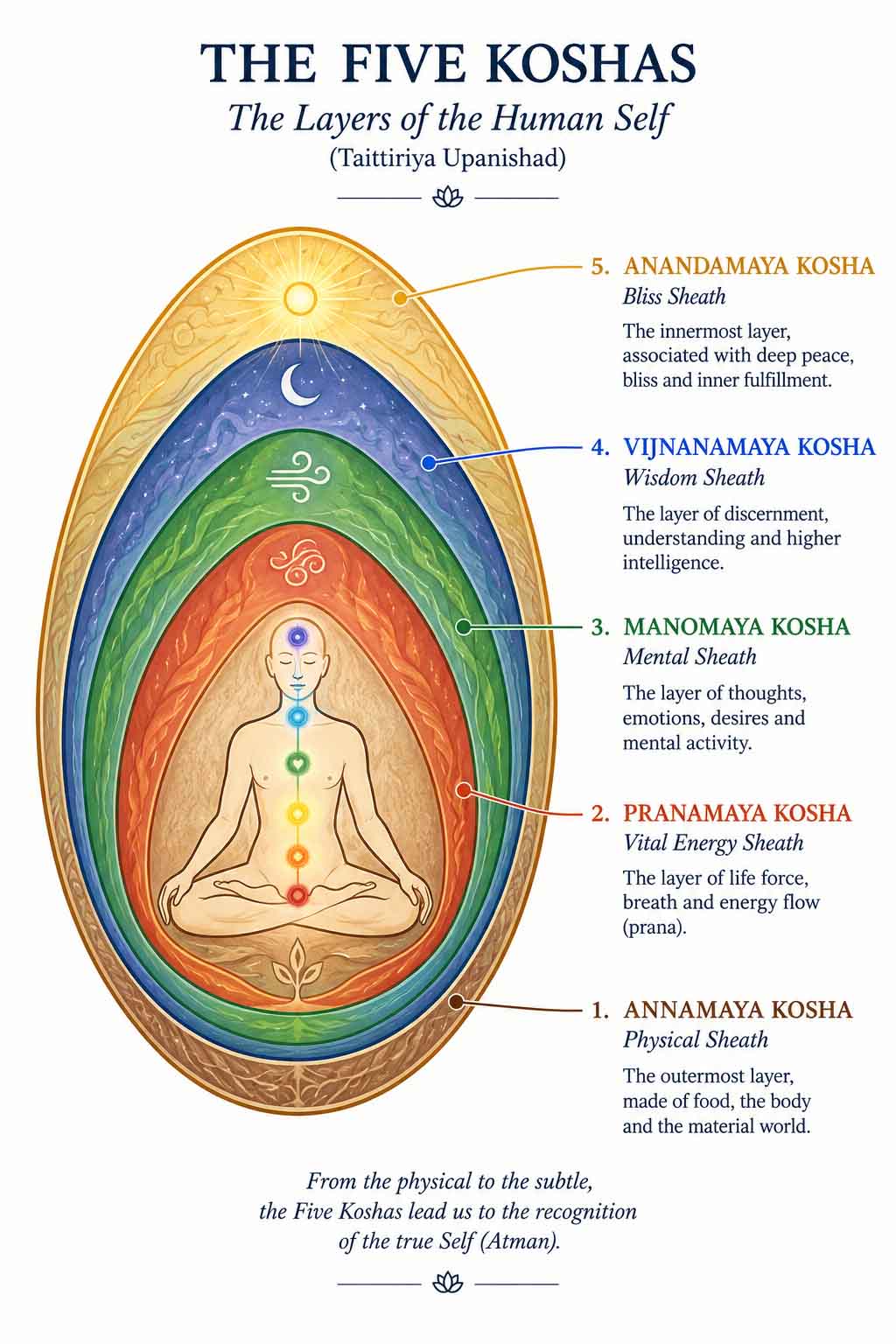
The visual representation of the Five Koshas as nested forms provides a memorable way of expressing this relationship. The layers create an impression of increasing subtlety, while the meditating figure offers a human reference point for the philosophical journey. Decorative elements such as stars, flowing patterns, light, and natural forms may be used to express qualities of thought, vitality, wisdom, and bliss. These artistic details can enrich the contemplative meaning of the diagram, although their precise arrangement is not itself an ancient anatomical map.
Traditionally, the progression begins with Annamaya as the outermost sheath, continues inward through Pranamaya, Manomaya, and Vijnanamaya, and reaches Anandamaya as the innermost sheath. Even this innermost covering is transcended in the Advaita interpretation through recognition of the Self beyond all five. The image of moving inward should therefore be understood as a philosophical movement from identification with relatively tangible experiences toward increasingly subtle inquiry, rather than a journey into a literal hidden chamber within the body.
The teaching also encourages a careful distinction between information and understanding. A person may study the Sanskrit names, memorize the order of the sheaths, and explain their traditional meanings without necessarily changing their relationship with experience. Intellectual familiarity provides an important foundation, but the philosophical purpose of the model extends toward direct examination of personal assumptions. When difficulties arise, the individual may begin to notice whether distress is connected with bodily discomfort, emotional interpretation, attachment to a particular belief, or the expectation that happiness must depend on external conditions.
Such observation does not guarantee that problems will disappear. Physical illness requires appropriate medical care, difficult emotions may require interpersonal support or professional assistance, and practical challenges often demand concrete action. The Kosha framework should not be used to replace these forms of care. Its value lies in providing a contemplative perspective through which a person may develop greater awareness of the different dimensions involved in experience.
There is also a relationship between the Five Koshas and the broader ethical concerns of spiritual life. Awareness of the physical body can encourage responsibility for health and the conditions that sustain life. Attention to mental experience can support greater sensitivity toward emotional reactions. Discernment can encourage honesty, patience, and thoughtful decision-making, while the contemplation of deeper contentment may reduce the tendency to seek constant validation through external achievements. Although these ethical applications are not identical to the original philosophical descriptions, they offer meaningful ways of reflecting on the teaching within contemporary life.
The deeper significance of the Five Koshas may ultimately be found in the questions they raise rather than in the certainty of any single explanation. What remains of personal identity when physical appearance changes? How do thoughts influence the feeling of being a particular person? Can awareness recognize an emotion without becoming completely defined by it? Is intellectual understanding sufficient for self-knowledge? What is the difference between temporary happiness and the deeper peace described in spiritual philosophy? These questions encourage a form of inquiry that can continue throughout life.
The Kosha model is especially compelling because it does not begin with an abstract concept entirely removed from ordinary experience. It begins with the physical body, the most immediately recognizable dimension of human existence. From there, it moves through the experience of vitality, the changing activity of the mind, the faculty of discernment, and the subtle condition of bliss. Every stage provides an opportunity to examine something familiar more carefully. The journey gradually shifts from asking what a person possesses or experiences toward asking what it means to be the one who is aware of those experiences.
This shift lies at the heart of the Vedantic understanding of self-inquiry. Ordinary identity is often constructed through statements such as I am my body, I am my thoughts, I am my achievements, or I am the emotions that I feel. Such statements can contain practical truths, but they may also narrow the way a person understands existence. The philosophical method of examining the Koshas invites the recognition that these descriptions do not necessarily exhaust the meaning of the Self.
The image of five sheaths surrounding a meditating individual captures this movement with remarkable simplicity. Each covering represents a dimension that contributes to experience, while the inward orientation of the composition suggests a search for something more fundamental than changing appearances. The visual journey is not an instruction to abandon physical life but an invitation to understand it within a broader philosophical perspective. The body, breath, mind, wisdom, and bliss are presented as interconnected expressions of embodied experience, while the question of ultimate awareness remains at the center of contemplative inquiry.
In the end, the Five Koshas offer a profound symbolic framework for understanding the layered character of human existence. Annamaya Kosha reminds us of our physical relationship with nature and the conditions that sustain the body. Pranamaya Kosha expresses the traditional yogic understanding of vitality and living activity. Manomaya Kosha reveals the constantly changing world of thought and emotion. Vijnanamaya Kosha points toward discernment and the capacity for deeper understanding, while Anandamaya Kosha introduces the subtle experience of bliss and inner contentment.
Yet the central message of Advaita Vedanta continues beyond these five dimensions. The ultimate Self is not presented as another temporary experience to be acquired, nor as a particular emotional condition that must be maintained. It is understood as the foundational reality that the process of self-inquiry seeks to recognize. The Five Koshas become meaningful because they illuminate the distinction between the changing contents of experience and the deeper question of awareness itself.
The journey through the sheaths is therefore not simply a movement from the physical world toward a distant spiritual destination. It is a journey toward a more careful understanding of what it means to exist, perceive, think, feel, and know. Through contemplation, meditation, and philosophical reflection, the individual is invited to examine the layers of identity that ordinarily seem unquestionable.
Perhaps the enduring power of this ancient teaching lies in its capacity to remind us that no single aspect of life contains the whole meaning of who we are. The body changes, thoughts move, emotions rise and fall, knowledge develops, and moments of happiness appear and disappear. Yet the search for understanding continues through every stage of experience. Within the spiritual vision of Vedanta, the deepest purpose of that search is not to create a more perfect identity but to recognize the fundamental nature of the Self that has never been limited to any one of its changing expressions.
The Five Koshas stand as a timeless invitation to look beyond the surface of experience, to approach the different dimensions of human life with greater awareness, and to explore the possibility that true self-understanding begins when we question the boundaries of everything we have assumed ourselves to be.
Among these teachings, the concept of the Five Koshas offers a particularly rich way of contemplating the different dimensions of human experience. Originating in the philosophical tradition of the Taittiriya Upanishad, the Kosha model describes five sheaths through which the individual Self appears to be experienced. The Sanskrit word Kosha means a sheath, covering, or layer, suggesting something that surrounds or conceals a deeper reality. Rather than describing five physically separate structures within the human body, this philosophical model explores the relationships between physical existence, vital activity, mental experience, intellectual understanding, and the subtle condition of bliss. Together, these sheaths form a symbolic explanation of the complexity of human identity and the spiritual journey toward recognizing what Vedanta understands as the true Self.
The Five Koshas are traditionally named Annamaya Kosha, Pranamaya Kosha, Manomaya Kosha, Vijnanamaya Kosha, and Anandamaya Kosha. They are generally contemplated in a progression from the outermost physical sheath toward the innermost sheath of bliss. Each represents a different dimension through which a person experiences life, and each appears to contribute to the familiar sense of individual identity. Yet the central teaching of Vedantic self-inquiry suggests that none of these sheaths, considered individually, completely defines the ultimate nature of the Self. They belong to the field of experience, while Atman, the true Self, is understood as the fundamental awareness that cannot be reduced to any passing experience.
To appreciate the depth of this teaching, it is important to understand the philosophical environment from which it emerged. The Upanishads form an important part of the ancient Indian spiritual and philosophical heritage, exploring questions concerning consciousness, existence, ultimate reality, and liberation. Rather than concentrating exclusively on external rituals, many Upanishadic teachings direct attention toward the nature of the individual and the possibility of discovering a deeper identity beyond ordinary appearances. The Taittiriya Upanishad, particularly the section known as the Brahmananda Valli, develops an influential sequence of increasingly subtle understandings of the Self through the fivefold model that later came to be widely described as the Pancha Kosha system.
The journey begins with Annamaya Kosha, the physical sheath, whose name is derived from the Sanskrit word Anna, meaning food. This designation reflects a simple but profound observation about embodied existence. The physical body is sustained by nourishment, formed through biological development, and dependent upon the continual exchange of matter and energy with the environment. Everything that contributes to its growth, maintenance, and eventual decline belongs to the natural processes of the material world. The body is not isolated from nature but continuously participates in it through nourishment, respiration, movement, and change.
Annamaya Kosha includes the visible and tangible dimensions of physical existence, such as bones, muscles, organs, tissues, and bodily structures. It is the sheath through which a person occupies space, interacts with the environment, and experiences the conditions of physical life. From birth onward, the body undergoes constant transformation. Its size, strength, appearance, and capabilities change over time, and even the most familiar aspects of physical identity remain subject to aging and circumstance. The significance of Annamaya Kosha is therefore not simply that the body exists, but that the body represents a changing aspect of individual experience.
Within the spiritual interpretation of the Koshas, care for the physical body is an important foundation for contemplative life. Proper nourishment, adequate rest, appropriate movement, and attention to physical well-being support the ordinary conditions in which meditation and reflection take place. The teaching does not require the rejection of the body or the belief that physical existence is inherently inferior. Instead, it encourages recognition of the body's importance without reducing the entirety of personal identity to it. A person may experience illness, physical discomfort, or changes in appearance while continuing to possess an inner life that cannot be fully described by those conditions alone.
This observation leads toward the second sheath, Pranamaya Kosha, the dimension associated with Prana, traditionally understood as vital life-force. In yogic philosophy, Prana is a subtle principle through which life and activity are expressed. It is closely associated with breathing, vitality, and the movement of life within the body, although it should not be understood as identical to oxygen, electricity, or another scientifically established physiological substance. Pranamaya Kosha represents the traditional yogic understanding of the dynamic processes through which embodied existence is sustained.
Breathing provides one of the most accessible ways to contemplate this sheath because it occupies a distinctive position between automatic bodily activity and conscious attention. Most of the time, breathing continues without deliberate effort. Yet it can also become an object of awareness, and its rhythm may change with emotional states, physical activity, and environmental conditions. When a person becomes anxious, breathing may become rapid or irregular. During periods of rest, it often becomes quieter and more settled. These ordinary observations help explain why the breath became an important symbol and practical focus within many systems of yoga and meditation.
The deeper significance of Pranamaya Kosha lies in the relationship between the living body and the experience of vitality. Human beings are not experienced merely as static collections of physical structures. Life is encountered through movement, sensation, activity, and the continual processes that sustain bodily existence. The traditional concept of Prana provides a language for contemplating this dynamic quality. Within the classical yogic framework, Prana is also described through different functions and subtle channels, although these concepts belong to spiritual physiology rather than scientifically verified anatomical structures.
Meditation practices involving breath awareness can offer a practical way of examining the relationship between attention and bodily experience. Sitting comfortably and noticing the natural movement of breathing may reveal sensations that ordinarily pass unnoticed. The body moves slightly with each inhalation and exhalation, while attention becomes more aware of the present moment. There is no need to force the breath, create discomfort, or attempt to produce an extraordinary energetic experience. The contemplative value lies in developing greater sensitivity to what is already occurring.
Beyond the physical and vital dimensions of existence, the third sheath introduces the complex world of thought and emotion. Manomaya Kosha, commonly translated as the mental sheath, is associated with the activity of Manas, the mind that processes sensory impressions, emotions, desires, and ordinary patterns of thinking. This sheath represents a dimension of experience that strongly influences the way individuals understand themselves and the world around them. While the physical body provides the conditions for sensory contact, the mind continually interprets those sensations, organizes impressions, and responds to what is perceived.
The ordinary mind rarely remains completely still. Thoughts arise in response to external events, memories return without deliberate invitation, and expectations shape the interpretation of future possibilities. A simple conversation may continue internally long after it has ended, while an uncertain situation may produce numerous imagined outcomes. Emotions influence these processes, affecting what receives attention and how events are understood. Manomaya Kosha therefore concerns more than deliberate intellectual thinking. It represents the broad field of mental and emotional experience through which ordinary personal life is constructed.
One of the most important insights associated with contemplative examination of the mind is the recognition that thoughts and emotions are constantly changing. A person may feel confident in one moment and uncertain in the next. An event that once seemed overwhelming may eventually lose much of its emotional intensity. Beliefs can develop, memories can fade, and interpretations can change as new information becomes available. Yet individuals often identify themselves so completely with these mental experiences that a temporary state begins to feel like a permanent description of who they are.
The concept of Manomaya Kosha encourages a different perspective. Instead of assuming that every thought must be accepted as a complete representation of reality, the individual can begin to recognize thought as an activity occurring within experience. Anger can be noticed without becoming the whole of personal identity. Anxiety can be acknowledged without automatically treating every fearful prediction as certain. Happiness can be appreciated without requiring it to remain permanently unchanged. This capacity to observe mental activity creates the possibility of a more balanced relationship with emotional life.
Such reflection does not imply that emotions are meaningless or should be suppressed. Feelings provide important information about personal needs, relationships, values, and circumstances. However, the ability to experience emotions without being completely controlled by them can contribute to greater understanding. In meditation, this may involve allowing thoughts and feelings to arise while gently returning attention to a stable point of observation. Over time, the practice can support a distinction between having a mental experience and assuming that the experience defines the entire Self.
The fourth sheath, Vijnanamaya Kosha, introduces the dimension of understanding, discernment, and reflective intelligence. Its name is associated with Vijnana, a form of differentiated knowledge or insight, and it is commonly described as the wisdom or intellectual sheath. In the broader philosophical interpretation, Vijnanamaya Kosha is related to the capacity to evaluate experience, distinguish between alternatives, make judgments, and develop a coherent understanding of reality. Whereas Manomaya Kosha concerns the movement of mental impressions and ordinary reactions, Vijnanamaya Kosha represents the discriminative faculty through which those experiences can be examined.
This distinction becomes clearer when considering how human beings respond to difficult situations. An unexpected event may initially produce fear, frustration, or disappointment. These reactions belong to the immediate field of mental and emotional experience. Yet a person may also examine the situation, consider different interpretations, identify the consequences of possible actions, and decide how to respond. This capacity for reflection introduces a dimension of awareness that is not entirely governed by the first emotional impulse.
Vijnanamaya Kosha is therefore closely associated with discernment, a quality of particular importance in Indian spiritual philosophy. Discernment involves recognizing differences that may initially be obscured by emotional reactions, personal desires, or established assumptions. It allows the individual to distinguish between temporary satisfaction and lasting meaning, between useful information and misleading impressions, and between habitual thinking and more carefully considered understanding. In spiritual self-inquiry, discernment also becomes the means through which a person begins to question the assumption that the Self is identical with the body, senses, thoughts, or intellectual processes.
However, the intellectual sheath introduces another subtle challenge. The capacity to understand and analyze experience is extremely valuable, but knowledge can also become part of personal identity. Individuals may become attached to their beliefs, achievements, intellectual abilities, or sense of being correct. Even a sophisticated philosophical understanding can remain limited if it exists only as an idea that the mind possesses. The teaching of the Koshas suggests that intellectual insight, although more subtle than ordinary emotional reaction, is still an aspect of experience rather than the ultimate nature of the Self.
This recognition helps explain why spiritual traditions often distinguish between knowing something conceptually and realizing it through direct understanding. A person may be able to describe the philosophical meaning of awareness while remaining deeply identified with passing thoughts and emotions. Reading about stillness does not necessarily produce a still mind, just as understanding the definition of compassion does not automatically make every action compassionate. The movement from Manomaya to Vijnanamaya represents an important development in reflective understanding, but the broader contemplative journey continues beyond intellectual knowledge alone.
The fifth and most subtle sheath in the traditional progression is Anandamaya Kosha, commonly translated as the bliss sheath. The Sanskrit word Ananda refers to bliss, joy, or profound fulfillment, while Anandamaya expresses a condition characterized by or consisting of bliss. Within Vedantic interpretation, this sheath is associated with a subtle dimension of happiness or peaceful absorption that differs from ordinary pleasure derived from external circumstances. Its significance becomes clearer when considering the difference between temporary enjoyment and a more profound sense of inner contentment.
Much of ordinary happiness is connected with particular objects, events, and achievements. A desired outcome produces excitement, a pleasant experience creates satisfaction, and the fulfillment of a personal goal may bring a temporary sense of completion. These experiences are natural aspects of human life, but they remain subject to change. What produces happiness today may no longer have the same effect tomorrow. External circumstances continually shift, and the mind often returns to searching for another source of satisfaction.
Anandamaya Kosha represents a subtler dimension of this relationship with happiness. In the contemplative framework, bliss is not understood merely as excitement or the absence of immediate difficulty. It points toward an experience of profound ease, peacefulness, or inward fulfillment in which ordinary mental agitation becomes less prominent. Such states may be discussed in relation to deep relaxation, contemplative absorption, or traditional interpretations of deep sleep. However, the precise philosophical meaning of Anandamaya depends upon the Vedantic school and its interpretation of the Upanishadic teaching.
The distinction between Anandamaya Kosha and the ultimate Self is especially important within Advaita Vedanta. Although the bliss sheath is considered the subtlest of the five coverings, it is not generally identified with the final reality of Atman in the classical five-sheath method of self-inquiry. Blissful experience can still be described as a condition that appears and disappears, while the Self is understood as that which is not limited to any changing condition. This distinction prevents spiritual development from becoming merely the pursuit of pleasant states during meditation.
The human desire for happiness is understandable, and periods of peace may have genuine personal value. Yet if a person becomes attached to reproducing a particular contemplative experience, the search for bliss may become another form of dissatisfaction. The mind begins comparing present experiences with remembered ones, hoping to recover a state that has already passed. The teaching of Anandamaya Kosha encourages a more subtle understanding in which even deeply peaceful states can be contemplated without being mistaken for the entirety of one's identity.
At this point, the philosophical purpose of the Five Koshas becomes increasingly clear. The model is not simply a description of five different components that must be strengthened or activated. It provides a structured process of inquiry into the layers through which human beings ordinarily understand themselves. The physical body is experienced, but it changes. Vital activity is experienced, but it fluctuates. Thoughts and emotions arise, yet none remains permanently fixed. Intellectual understanding develops and changes, while states of happiness and peaceful absorption also appear under particular conditions. Each sheath contributes something significant to human life, but each remains within the field of changing experience.
Vedantic self-inquiry asks whether the ultimate Self can be fully identified with any of these changing dimensions. In Advaita Vedanta, the answer is explored through the recognition of Atman, the innermost Self, which is understood not as another object hidden inside the body but as the fundamental reality of awareness. The relationship between Atman and Brahman, the ultimate reality described in the Upanishads, forms one of the central themes of Advaita philosophy. The deepest realization is traditionally expressed through the understanding that the essential Self is not ultimately separate from Brahman.
This teaching is subtle because ordinary language naturally encourages the imagination to picture the Self as something located within physical space. When the Koshas are drawn as nested layers surrounding a meditating figure, it may seem that the ultimate Self must occupy a small point at the center. Such imagery can be helpful as a symbolic guide, but it should not be interpreted literally. Atman is not described in Advaita as a tiny physical structure hidden inside the organs or brain. The inward journey represents a movement of discernment and understanding rather than a physical movement through measurable layers of tissue.
The metaphor of removing coverings can help clarify this distinction. Imagine looking at an object through several layers of transparent material. Each layer influences the appearance of what is seen, yet removing one layer does not create the object beneath it. The object was already present. In a similar way, the Vedantic method of examining the Koshas seeks to distinguish the essential nature of the Self from the changing dimensions through which it appears to be identified. Spiritual inquiry is therefore understood as recognition rather than the production of an entirely new reality.
This process is closely related to the traditional method of negation often expressed through the Sanskrit phrase Neti Neti, meaning not this, not this. The method involves examining what can be experienced and recognizing that the ultimate Self cannot be reduced to any particular object of experience. The body can be observed, sensations can be noticed, thoughts can be recognized, and even the sense of personal identity can become an object of reflection. The philosophical inquiry then turns toward the nature of the awareness through which these experiences are known.
Such questions do not necessarily produce immediate answers, nor are they intended to encourage a rejection of ordinary life. The body remains important, emotions continue to have meaning, and intellectual understanding remains essential for practical decision-making. The purpose is not to deny the reality of experience but to examine the assumptions through which personal identity is formed. From this perspective, the Five Koshas provide a language for recognizing the complexity of being human while contemplating a deeper foundation of awareness.
Meditation offers one possible approach to exploring these relationships through direct experience. A person may begin by sitting comfortably and becoming aware of physical sensations, noticing the points where the body makes contact with the chair or floor. This simple attention reflects the dimension associated with Annamaya Kosha. As attention settles, the natural rhythm of breathing may become more noticeable, inviting reflection on the vital dimension represented by Pranamaya Kosha.
Thoughts and emotions may then become the focus of observation. The mind may revisit past events, construct expectations, or respond to sensations with judgments and interpretations. Recognizing these movements without immediately following every thought provides a practical illustration of Manomaya Kosha. The capacity to understand what is occurring, to distinguish observation from reaction, and to respond with discernment reflects qualities associated with Vijnanamaya Kosha. If a sense of quiet contentment arises, it may invite contemplation of the bliss dimension represented by Anandamaya Kosha.
This progression should not be treated as a rigid meditation technique in which every person must experience the sheaths in an identical order. The Koshas belong to a philosophical framework, and the relationship between that framework and contemporary meditation exercises is interpretive. There is no requirement to visualize invisible layers, manipulate subtle energies, or force the mind into unfamiliar states. Gentle attention, patience, and curiosity are sufficient for a basic reflective practice.
The relevance of the Five Koshas extends beyond formal meditation because the model encourages recognition of how different dimensions of experience influence daily life. Physical exhaustion may affect emotional resilience, while prolonged mental stress can influence the experience of bodily comfort. Emotional reactions may interfere with judgment, and thoughtful reflection may change the way difficult situations are interpreted. Moments of contentment can arise when external demands temporarily recede, revealing how strongly habitual thinking influences the ordinary experience of satisfaction.
These relationships are familiar in everyday life, even without adopting the traditional spiritual interpretation. Human well-being involves physical, emotional, psychological, and social dimensions that cannot always be understood independently. The Kosha model offers a symbolic framework for contemplating this interconnectedness, although it should not be confused with modern scientific models of physiology or psychology. Prana, the subtle sheaths, and Atman are concepts belonging to Indian philosophical and spiritual traditions, not scientifically established anatomical structures or measurable forms of biological energy.
An important feature of the teaching is that the movement toward self-understanding does not require treating any particular sheath as an enemy. The body is not something to despise because it changes. The mind is not inherently harmful because it produces thoughts. Discernment does not become meaningless because intellectual knowledge has limitations, and peaceful experiences do not lose their value because they are temporary. Each dimension contributes to the richness of human existence, while spiritual inquiry examines whether the whole of identity can be contained within any one of them.
The visual representation of the Five Koshas as nested forms provides a memorable way of expressing this relationship. The layers create an impression of increasing subtlety, while the meditating figure offers a human reference point for the philosophical journey. Decorative elements such as stars, flowing patterns, light, and natural forms may be used to express qualities of thought, vitality, wisdom, and bliss. These artistic details can enrich the contemplative meaning of the diagram, although their precise arrangement is not itself an ancient anatomical map.
Traditionally, the progression begins with Annamaya as the outermost sheath, continues inward through Pranamaya, Manomaya, and Vijnanamaya, and reaches Anandamaya as the innermost sheath. Even this innermost covering is transcended in the Advaita interpretation through recognition of the Self beyond all five. The image of moving inward should therefore be understood as a philosophical movement from identification with relatively tangible experiences toward increasingly subtle inquiry, rather than a journey into a literal hidden chamber within the body.
The teaching also encourages a careful distinction between information and understanding. A person may study the Sanskrit names, memorize the order of the sheaths, and explain their traditional meanings without necessarily changing their relationship with experience. Intellectual familiarity provides an important foundation, but the philosophical purpose of the model extends toward direct examination of personal assumptions. When difficulties arise, the individual may begin to notice whether distress is connected with bodily discomfort, emotional interpretation, attachment to a particular belief, or the expectation that happiness must depend on external conditions.
Such observation does not guarantee that problems will disappear. Physical illness requires appropriate medical care, difficult emotions may require interpersonal support or professional assistance, and practical challenges often demand concrete action. The Kosha framework should not be used to replace these forms of care. Its value lies in providing a contemplative perspective through which a person may develop greater awareness of the different dimensions involved in experience.
There is also a relationship between the Five Koshas and the broader ethical concerns of spiritual life. Awareness of the physical body can encourage responsibility for health and the conditions that sustain life. Attention to mental experience can support greater sensitivity toward emotional reactions. Discernment can encourage honesty, patience, and thoughtful decision-making, while the contemplation of deeper contentment may reduce the tendency to seek constant validation through external achievements. Although these ethical applications are not identical to the original philosophical descriptions, they offer meaningful ways of reflecting on the teaching within contemporary life.
The deeper significance of the Five Koshas may ultimately be found in the questions they raise rather than in the certainty of any single explanation. What remains of personal identity when physical appearance changes? How do thoughts influence the feeling of being a particular person? Can awareness recognize an emotion without becoming completely defined by it? Is intellectual understanding sufficient for self-knowledge? What is the difference between temporary happiness and the deeper peace described in spiritual philosophy? These questions encourage a form of inquiry that can continue throughout life.
The Kosha model is especially compelling because it does not begin with an abstract concept entirely removed from ordinary experience. It begins with the physical body, the most immediately recognizable dimension of human existence. From there, it moves through the experience of vitality, the changing activity of the mind, the faculty of discernment, and the subtle condition of bliss. Every stage provides an opportunity to examine something familiar more carefully. The journey gradually shifts from asking what a person possesses or experiences toward asking what it means to be the one who is aware of those experiences.
This shift lies at the heart of the Vedantic understanding of self-inquiry. Ordinary identity is often constructed through statements such as I am my body, I am my thoughts, I am my achievements, or I am the emotions that I feel. Such statements can contain practical truths, but they may also narrow the way a person understands existence. The philosophical method of examining the Koshas invites the recognition that these descriptions do not necessarily exhaust the meaning of the Self.
The image of five sheaths surrounding a meditating individual captures this movement with remarkable simplicity. Each covering represents a dimension that contributes to experience, while the inward orientation of the composition suggests a search for something more fundamental than changing appearances. The visual journey is not an instruction to abandon physical life but an invitation to understand it within a broader philosophical perspective. The body, breath, mind, wisdom, and bliss are presented as interconnected expressions of embodied experience, while the question of ultimate awareness remains at the center of contemplative inquiry.
In the end, the Five Koshas offer a profound symbolic framework for understanding the layered character of human existence. Annamaya Kosha reminds us of our physical relationship with nature and the conditions that sustain the body. Pranamaya Kosha expresses the traditional yogic understanding of vitality and living activity. Manomaya Kosha reveals the constantly changing world of thought and emotion. Vijnanamaya Kosha points toward discernment and the capacity for deeper understanding, while Anandamaya Kosha introduces the subtle experience of bliss and inner contentment.
Yet the central message of Advaita Vedanta continues beyond these five dimensions. The ultimate Self is not presented as another temporary experience to be acquired, nor as a particular emotional condition that must be maintained. It is understood as the foundational reality that the process of self-inquiry seeks to recognize. The Five Koshas become meaningful because they illuminate the distinction between the changing contents of experience and the deeper question of awareness itself.
The journey through the sheaths is therefore not simply a movement from the physical world toward a distant spiritual destination. It is a journey toward a more careful understanding of what it means to exist, perceive, think, feel, and know. Through contemplation, meditation, and philosophical reflection, the individual is invited to examine the layers of identity that ordinarily seem unquestionable.
Perhaps the enduring power of this ancient teaching lies in its capacity to remind us that no single aspect of life contains the whole meaning of who we are. The body changes, thoughts move, emotions rise and fall, knowledge develops, and moments of happiness appear and disappear. Yet the search for understanding continues through every stage of experience. Within the spiritual vision of Vedanta, the deepest purpose of that search is not to create a more perfect identity but to recognize the fundamental nature of the Self that has never been limited to any one of its changing expressions.
The Five Koshas stand as a timeless invitation to look beyond the surface of experience, to approach the different dimensions of human life with greater awareness, and to explore the possibility that true self-understanding begins when we question the boundaries of everything we have assumed ourselves to be.





Comments
Comments appear after approval.
Log in to comment