
The Fool
The Fool is a Major Arcana card concerned with beginnings, openness, trust, curiosity, freedom, a leap into experience. In a reading, it often marks a significant inner lesson or turning point rather than a small passing mood. Its value is not that it predicts one fixed outcome, but that it gives a symbolic framework for asking what kind of choice, attitude, or transition is active now.\n\nAt its clearest, The Fool points toward starting before every detail is known, choosing curiosity over paralysis, and meeting a new chapter with openness. The card becomes most useful when the reader connects that theme to the actual circumstances of the question instead of treating the image as a universal verdict. Context matters: the surrounding cards, the position in the spread, and the question being asked can shift which part of the symbolism deserves the most attention.
Core meaning
The Fool is a Major Arcana card concerned with beginnings, openness, trust, curiosity, freedom, a leap into experience. In a reading, it often marks a significant inner lesson or turning point rather than a small passing mood. Its value is not that it predicts one fixed outcome, but that it gives a symbolic framework for asking what kind of choice, attitude, or transition is active now.\n\nAt its clearest, The Fool points toward starting before every detail is known, choosing curiosity over paralysis, and meeting a new chapter with openness. The card becomes most useful when the reader connects that theme to the actual circumstances of the question instead of treating the image as a universal verdict. Context matters: the surrounding cards, the position in the spread, and the question being asked can shift which part of the symbolism deserves the most attention.
Symbolism & imagery
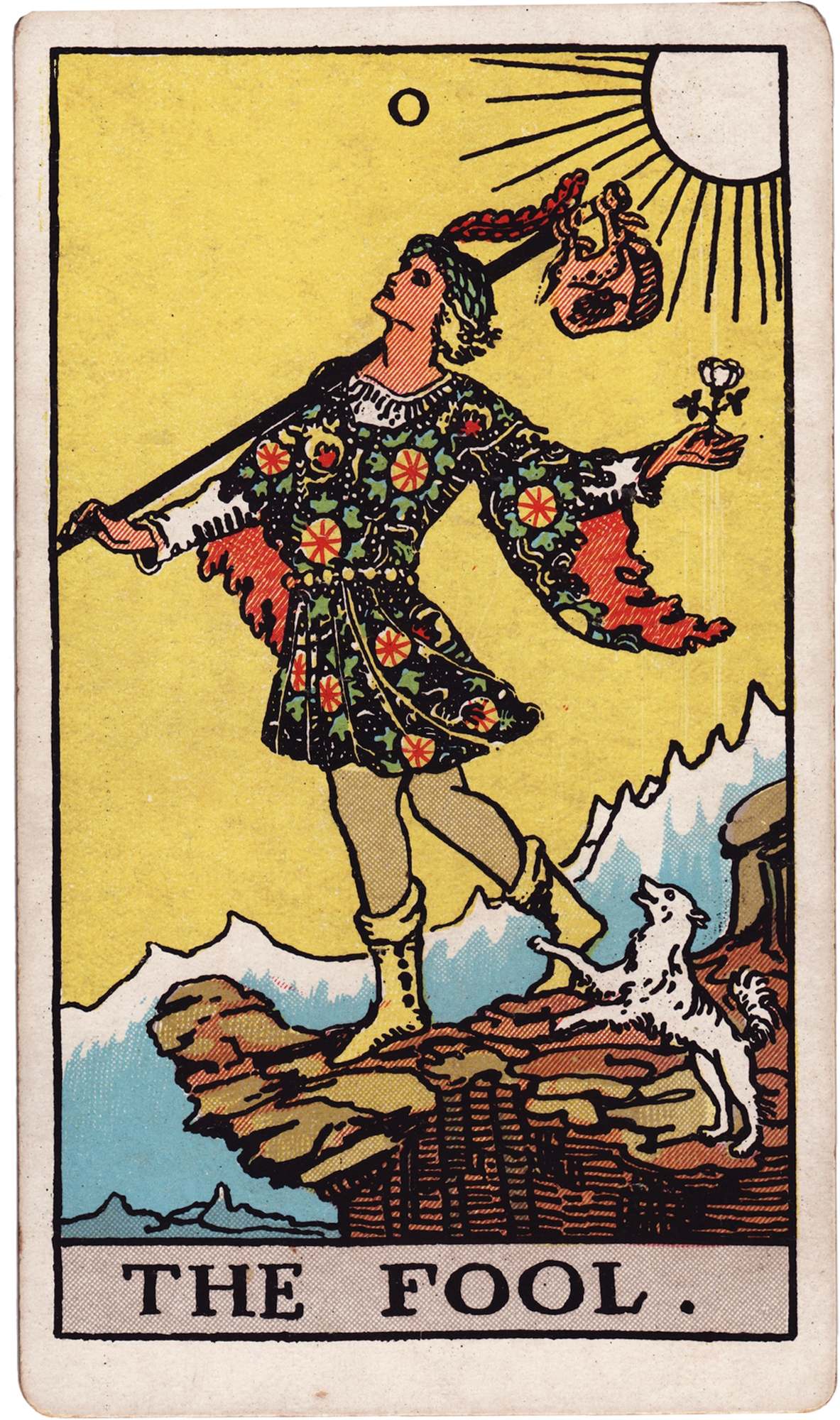
In the Rider–Waite–Smith image, A young traveler stands at a cliff edge with a small bundle, a white rose, and a dog at his heels. The bright sky and distant mountains emphasize possibility, while the precipice reminds the reader that freedom also requires awareness. These details are not decorative extras; they shape how the card is read. The scene creates a visual tension between possibility and consequence, inner attitude and outer circumstance. Looking carefully at posture, direction of movement, landscape, objects, and color can reveal whether the card is emphasizing growth, restraint, conflict, release, or integration.\n\nBecause The Fool belongs to the Major Arcana, its symbolism can be read on more than one level. It may describe an external situation, but it can also describe a developmental task: how a person relates to beginnings, openness, trust, curiosity, freedom, a leap into experience. The card therefore works best as a prompt for reflection and decision-making, not as proof that a specific event must happen.
Upright meaning
Upright, The Fool emphasizes starting before every detail is known, choosing curiosity over paralysis, and meeting a new chapter with openness. This does not mean the situation will automatically become easy. Instead, the card describes the quality that can be used constructively. When this card appears, ask where a direct response, clearer boundary, deeper honesty, or more deliberate choice would move the situation forward.\n\nOn a practical level, the upright card encourages the reader to work with what is available now. It can indicate that the central issue has become visible enough to engage consciously. Rather than waiting for certainty, use the symbolism to identify the next proportionate step and notice which part of the card's lesson is already present in your behavior.
Reversed meaning
Reversed, The Fool often turns attention toward recklessness, avoidance of consequences, naivety, or refusing to begin because uncertainty feels uncomfortable. A reversed card is not automatically 'bad'; it may show that the upright quality is blocked, delayed, internalized, exaggerated, or being expressed without balance. The useful question is not 'what disaster does this mean?' but 'where is this energy becoming distorted or difficult to access?'\n\nIn some readings, reversal can indicate that the issue is becoming more private and psychological. It may also mark a correction: the person is beginning to see an old pattern but has not yet fully changed it. Look to neighboring cards for evidence of whether the reversal describes resistance, recovery, excess, or a temporary pause.
Love & relationships
In love and relationship readings, The Fool brings attention to fresh emotional territory, spontaneity, and the courage to be authentic without forcing commitment too early. The card should be read in relation to the actual stage of the relationship: a new connection, an established partnership, a period of distance, or a decision about what happens next. It can describe one person's stance, the shared dynamic, or the kind of conversation that is now needed.\n\nFor single readers, the card is often more useful as a description of relational readiness and pattern than as a promise that a specific person will appear. Ask what the card suggests about boundaries, expectations, reciprocity, and the emotional behavior that would support a healthier connection.
Career & direction
In career and work readings, The Fool can be understood through a new path, role, study, or project that rewards experimentation and learning by doing. It may describe a project stage, a workplace dynamic, the reader's current approach to responsibility, or the quality needed for the next professional decision. Look for concrete evidence in the situation before treating the card as a forecast.\n\nIf the surrounding cards are supportive, The Fool can show how to make progress with greater clarity. If the spread is tense, the same symbolism may identify the pressure point that needs management, a skill that must be developed, or an assumption that should be reconsidered.
Money & resources
In money and resource readings, The Fool highlights taking a calculated chance while keeping enough practical awareness to avoid careless losses. The card is best used to examine behavior, priorities, risk, and the structure around financial choices rather than to predict a guaranteed gain or loss. Consider budgets, commitments, time horizons, and whether the decision is being driven by evidence or emotion.\n\nWhere the card looks favorable, it still benefits from practical planning. Where it looks challenging, it can be used as an early warning to slow down, verify information, reduce exposure, or change an unsustainable habit.
Spiritual reflection
Spiritually, The Fool can be read as an invitation toward beginner's mind, trust in experience, and releasing the need to control the entire journey. This does not require a particular belief system. The card can function as a contemplative image that helps the reader observe motives, attachments, fears, and values with more honesty.\n\nA useful spiritual reading keeps symbolism connected to lived experience. Rather than asking the card to provide certainty, ask how its lesson could be practiced through attention, integrity, compassion, courage, or a more conscious relationship with ordinary life.
Advice
Advice from The Fool: work with the card's central lesson deliberately rather than dramatically. Name what is actually happening, separate facts from assumptions, and choose the next action that best expresses starting before every detail is known, choosing curiosity over paralysis, and meeting a new chapter with openness. If the situation is complex, reduce the decision to what can be responsibly done now and let later steps be informed by new evidence.
What to watch for
The warning side of The Fool is recklessness, avoidance of consequences, naivety, or refusing to begin because uncertainty feels uncomfortable. Watch for the point where a useful quality becomes excessive, defensive, avoidant, or disconnected from reality. If you notice that pattern, the card is not a sentence; it is a signal to adjust before the pattern becomes more costly.
Questions to reflect on
• Where is the theme of beginnings already visible in this situation?
• What would the constructive expression of The Fool look like in one practical action?
• What part of the shadow meaning—recklessness—needs the most honest attention?
• What changes if I read this card as advice rather than prediction?
• Which surrounding card in the spread changes or sharpens this interpretation most?
Card combinations
With a supportive Major Arcana card, The Fool can show that its lesson is part of a larger period of development rather than an isolated event.
With tense Swords cards, The Fool may need to be read through conflict, assumptions, communication pressure, or difficult decisions.
With strong Cups cards, emotional context and relationship dynamics become more important to how The Fool is expressed.
With Pentacles cards, look for practical consequences, resources, work, health, routine, and long-term sustainability.
With Wands cards, motivation, timing, initiative, ambition, and the amount of available energy can change how quickly the theme of The Fool develops.