
Applying the Ten of Cups to Real Relationship Questions and Family Decisions
This article teaches learners how to apply the 10 of Cups (upright and reversed) as a single-card answer to everyday relationship questions and family decisions. Anchored repeatedly to the card's Rider‑Waite‑Smith imagery—the rainbow of cups, the embracing couple and children, the home and river—the piece explains how to read contextually across love, family logistics, finance-sharing, workplace dynamics, personal roles, outcomes and spiritual growth. You will learn a clear technique for single-card pulls, how to translate image and suit energy into practical actions, common interpretive mistakes to avoid, example readings, and reflection prompts to sharpen your skill.
Cards explored in this article
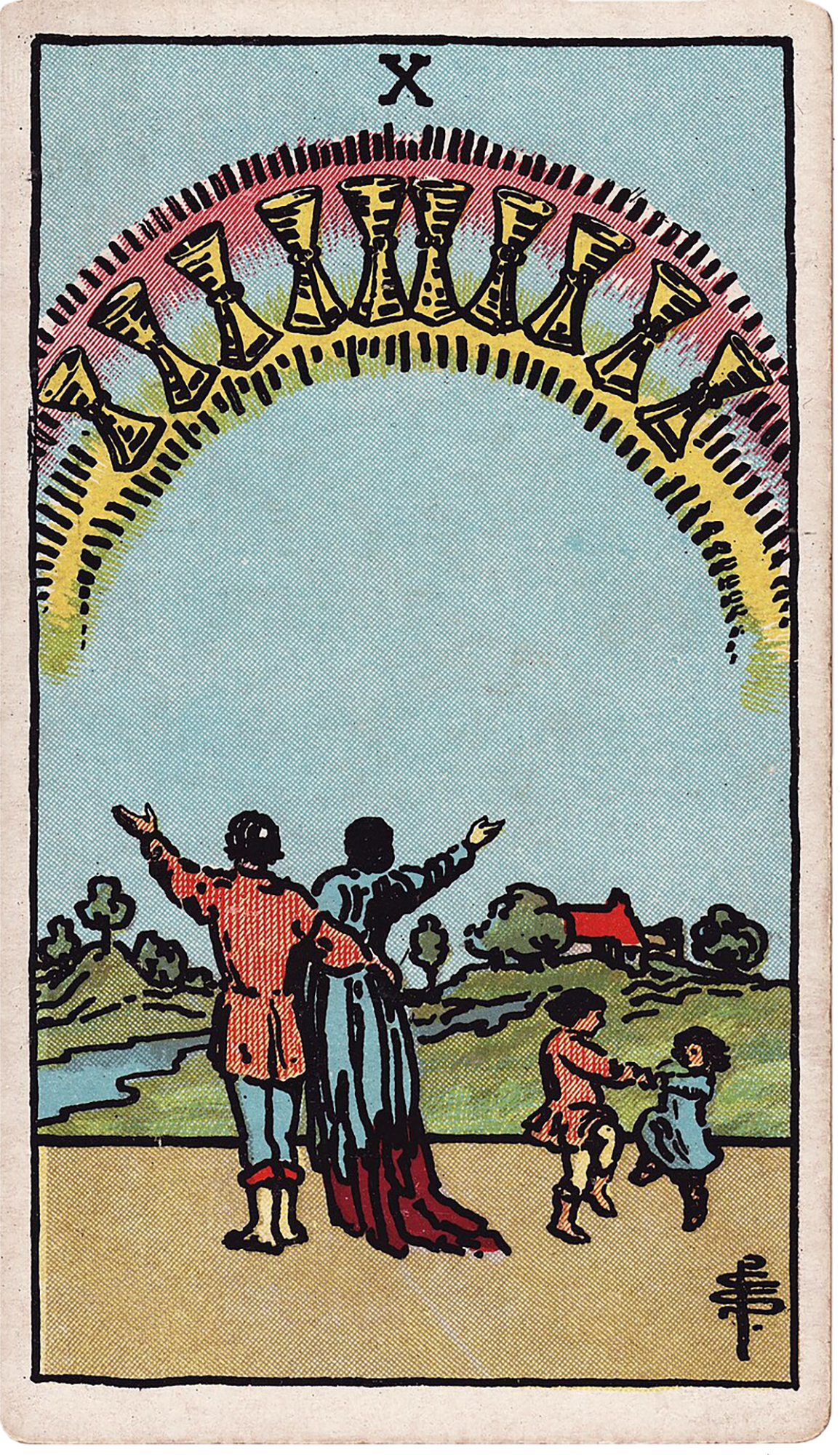 10 of Cups
Introduction: Why a single card can be powerful for family and relationship questions
Single-card readings are often underrated because of their simplicity. For intimate questions about relationships and family decisions, a single clear symbol can focus a querent who is overwhelmed by options or emotions. The 10 of Cups is a particularly rich single-card choice because its imagery (in the Rider‑Waite‑Smith version shown in the public display) compresses a family narrative: a rainbow of ten cups arches over a contented couple with raised arms, two children running and a modest home set in a fertile landscape with a flowing river. That compact scene contains information about what is possible, what is being experienced, and what practical attitude or action will most likely move things toward sustainable belonging. Learn to treat the card as a diagnostic and advisory tool rather than a mystical decree. The job of the reader is to translate the card's visual and symbolic language into usable, ethically held guidance for the querent's real-life choices.
The Rider‑Waite‑Smith imagery to anchor every interpretation
Begin every reading by describing concretely what you see on the 10 of Cups card that the querent can see too. The classic RWS scene matters because its details suggest which life area the card emphasizes and what resources are available. Key visual elements to note: - Rainbow with ten cups: a visible, celebratory arc—symbolizes emotional fulfillment that is both visible and sacred; it's not an accident but a pattern reaching its completion. - Embracing couple with raised arms: partnership, mutual recognition, a shared emotional stance rather than one-sided devotion. - Children running or playing: lineage, future orientation, the spontaneity and resilience of family life. - House in the distance: a stable shelter or shared project—home as outcome or goal. - River and fertile hills/trees: flow, nourishment, continuity and a landscape that supports domestic life. Keep pointing back to these images as you interpret the card in any context. If the querent's question involves housing, the house is not abstract: it speaks about stability and shared responsibility. If the issue is about interpersonal trust, the couple with raised arms can indicate mutual emotional affirmation or a model to aspire to.
Upright and reversed core meanings (use the supplied definitions)
Work from the supplied upright and reversed definitions for the 10 of Cups. Upright, the card highlights shared emotional fulfillment, belonging and the possibility of a stable atmosphere of love and mutual support. It is practical and asks for a response appropriate to the present stage rather than an abstract ideal. Consider where this pattern is already visible and what action would strengthen it. The suit of Cups signals that the situation is primarily about feelings, relationship skills, intuition, receptivity, memory and the processing of emotion. Reversed, the card draws attention toward family tension, unrealistic expectations of perfect harmony, disconnection at home or a gap between public happiness and private reality. The reversal asks you to examine where the process is stuck: what needs simplification, acknowledgement, practice, release or communication before healthier expression can return. The reversed card frequently points to internal issues that are not obvious to others rather than to an external catastrophe. Do not read reversed as merely 'bad'—read it as a map to what practical repairs or changes are required.
Technique: Conducting an effective single-card 10 of Cups reading
Follow a repeatable method so your readings are useful and ethically grounded. 1) Clarify the question: Ask the querent to state the question in one sentence. Encourage specificity: Are we choosing whether to move? Is this about deciding to start a family, or about whether a partner will commit? Single cards are best applied to specific choices or a clear dilemma. 2) Note orientation and first impression: Is the 10 of Cups upright or reversed? Before interpretation, state the orientation and what image first caught your eye—the rainbow, the couple, the children, the house, the river. 3) Translate suit energy: Remember Cups => emotions, relationship skills, receptivity. Ask: How are emotions being handled in this situation? What relationship habits are present? What memories or narratives are shaping the decision? 4) Contextualize the imagery: Tie the visual elements to the querent's situation. If the couple’s arms are raised, is there a need for public affirmation? If the house is small but present, is the goal achievable with modest changes? 5) Decide practical next steps: A single-card reading should conclude with 2–3 concrete actions the querent can take in the next week or month. For the 10 of Cups that often means activities which strengthen routine belonging—clear communication, scheduling a family conversation, modest home preparations, or gratitude practices. 6) Offer caveats and alternatives: If reversed, emphasize repair work, boundary-setting, or professional support if there’s entrenched dysfunction. Always offer follow-up reading options (a three-card spread for dynamics, a timing spread, or a clarifier if needed). 7) Close ethically: Remind the querent the card suggests possibilities, not guarantees. The reading should empower action rather than foster dependency.
Love and partnership: reading the 10 of Cups
Upright interpretation: The imagery of the embracing couple and flowing landscape suggests that the relationship can embody mutual fulfillment. For a question like "Is this relationship viable for long-term commitment?" the 10 of Cups upright says: the emotional foundation is present or within reach. It emphasizes practical, lived compatibility—daily kindnesses, shared goals, and a household rhythm that supports both parties. Actionable advice: consolidate small rituals (shared meals, check-ins), clarify mutual expectations about home life, and celebrate progress in visible ways (symbolic acts that mirror the rainbow of cups). Reversed interpretation: If the 10 of Cups is reversed, ask where the ideal of perfection is causing harm. The couple in public might present as joyful while private disconnection persists. Questions to explore: Are expectations about perfect family life unrealistic? Is one partner suppressing their needs to maintain an appearance? Repair work often includes explicit communication about unmet needs, renegotiating roles, or seeking couple therapy. The card can also indicate that the concept of 'family' needs redefining to include chosen family or community supports rather than insisting on a biological ideal. Example phrasing for clients: - Upright: "This card suggests your relationship has the ingredients for sustained intimacy; focus on routine practices that make emotional safety visible." - Reversed: "This card is asking you to name what's not working beneath the surface rather than trying to pretend everything is fine."
Family decisions and parenting: the card as a practical guide
Upright: The 10 of Cups often arrives when decisions affect the family unit—moving, homeschooling, choosing caregiving arrangements, or expanding the family. The house in the card indicates stability is achievable; the river implies resources will flow if the family’s needs are prioritized. Reading this way means focusing on logistics that create emotional safety: predictable routines, communication plans for children, and equitable distribution of responsibilities among adults. Ask: How will this decision affect daily rhythms? What structures will ensure belonging for each family member? Reversed: In family decisions the reversed 10 of Cups warns against letting an image or social expectation drive choices (e.g., moving to 'the right' neighborhood because others expect it). It may indicate that harmony is used as a cover for unresolved attachment issues or unbalanced labor. Practical steps: inventory emotional workloads, hold a family meeting with clear agendas, and create small experiments before committing to major changes (short-term trial of new school, temporary caregiving schedule). Technique tip: For parenting questions, include children's perspectives where possible (age-appropriate) rather than making unilateral decisions based only on adult ideals of harmony.
Career and team dynamics: reading the emotional ecology
Although the 10 of Cups sits squarely in the realm of the heart, it can describe workplace dynamics—especially when the workplace functions like a family or when the decision affects a team. Upright: The card suggests a work environment where people feel valued and the team's interpersonal bonds support productivity. When asking about a job offer that affects family life, the 10 of Cups upright often means the job's schedule and culture will sustain relationships. For leadership questions, it calls for fostering inclusion, celebrating team successes visibly, and building rituals that affirm belonging (team check-ins, recognition practices). Reversed: If the card appears reversed for a career question, look for illusions of workplace harmony. The reversal can indicate cliques, suppressed conflict, or people performing positivity while resentments pile up. For a querent choosing whether to stay, the card may advise assessing whether the organization is willing to negotiate conditions that support their family life. If not, practical exit planning and boundary enforcement are usually the appropriate steps. Practical reading point: Translate the card’s image of mutual support into specific HR-type actions—documented agreements, regular feedback cycles, and transparent schedules.
Money and shared resources: what the 10 of Cups says about finances
The 10 of Cups is primarily emotional, but in questions about money it indicates the financial choices that will either support or undermine emotional security. Upright: Shared resources used with mutual respect strengthen belonging. The house and river imagery suggest steady income or a sustainable pooling strategy that funds a stable home life. Financial choices aligned with family priorities (simplifying, saving for a shared goal, creating transparent budgets) will reinforce emotional trust. Practical steps: create a shared budget that reflects relational values, schedule regular financial conversations and small joint goals (e.g., emergency fund, home repairs. Reversed: The reversal flags hidden resentments around money—one partner may feel excluded from decisions, or there may be a public-facing image of prosperity that hides instability. Advice: increase transparency, renegotiate expectations and roles around money, and consider mediation if patterns of secrecy or control persist. The reversed card encourages small, consistent acts to rebuild trust (weekly money check-in, agreed limits on discretionary spending until trust is restored). Important nuance: Cups are about values as much as dollars—when money decisions align with relationship values, the financial plan will have emotional resilience.
Advice and concrete actions the card commonly recommends
Whether upright or reversed, the 10 of Cups points toward concrete interpersonal steps rather than purely abstract ideals. Common, pragmatic recommendations tied to the card’s imagery include: - Create visible rituals: family dinners, weekly check-ins, gratitude practices, or a shared calendar. These map to the card’s public, celebratory rainbow. - Name success practices: ask, "What would it look like in two months if we were functioning like the family in the card?" and make a short list. - Test major decisions before committing: use trial periods and small experiments (temporary moves, short caregiving stints). - Communicate expectations: use neutral language to describe how chores, finances, and time will be shared. - Repair gently but consistently if reversed: shorter, frequent conversations; external support (counsellor, mediator) when necessary; focus on one small structural change at a time. These actions keep the reading practical and behaviour-focused in a way the cards encourage.
Challenge and blockage: what the reversed card often reveals
When the 10 of Cups appears reversed as the single card, it functions diagnostically. It rarely points to a single dramatic event; instead it shows habitual obstacles to belonging: - Expectation traps: aiming for a perfect picture of family life and punishing reality for not matching it. - Role overload: one person doing the lion’s share of emotional labour to maintain peace. - Avoidance of honest talk: preferring surface harmony over messy but necessary conversations. - Internal disconnect: a person mentally withdrawn from family life even when physically present. Interpretation strategy: convert the complaint into a micro-action plan. If the blockage is unrealistic expectations, assign the client the task of listing three things they admire about their family that are real and tangible. If the issue is role overload, create a swap test—rotate a responsibility for two weeks to see how labor can be redistributed.
Person reading: who does the 10 of Cups describe?
In single-card person questions the 10 of Cups can represent a person or the role that someone plays in the querent's life rather than precise personality traits. Upright: The person is someone who embodies generosity, emotional availability, and a stabilizing presence. They are likely family‑oriented or invested in long-term partnership and rituals. They might be a partner, parent, or friend who actively creates belonging. Reversed: The person might appear ‘perfect’ publicly but be out of sync with their private behavior. They could be overinvested in keeping appearances or withdrawing emotionally. The reversed 10 of Cups as a person can also signal inner immaturity about relational expectations: a person who expects others to create their happiness rather than participating in its construction. Skillful phrasing: Use hedged language. Instead of, "They are your soulmate," say, "They present as someone who values family and belonging; notice whether their actions match that value in day-to-day life."
Outcome and timing: how the 10 of Cups frames what follows
As an outcome card, the 10 of Cups tends to describe a trajectory rather than a hard deadline. Upright, it indicates that a stable, emotionally fulfilling outcome is possible if present efforts are sustained and practical steps are taken. The house and river imply slow, sustainable growth rather than instant transformation. Reversed as outcome: It warns that the desired outcome will stall unless repair work is done. If you get the reversed 10 of Cups as an outcome, advise the querent to treat the card as both a warning and a guide—it shows the precise area (communication, expectations, distribution of labour) where attention is needed to attain the upright result. Timing methodology: Because the 10 of Cups pictures long-term domestic stability, think in months rather than days. Use the card to recommend a timetable: "Try a two‑month experiment of new routines and reassess."
Spiritual reflection: what the card asks you to cultivate
Spiritually, the 10 of Cups invites practices that foster gratitude, reciprocity and embodied belonging. Upright, it asks: How do you make gratitude visible? How do you honor everyday relational labour? The rainbow suggests a sacred recognition of wholeness and blessing in the ordinary. Reversed, it asks you to examine faith in relational myths—are you attached to an image of perfect family life that blocks acceptance of actual gifts and limitations? Practical spiritual practices connected to the card: - Daily gratitude for small relational moments (one sentence per person). - Ritualized check-ins (a question at dinner like "What made you feel most seen today?"). - Boundary meditation to distinguish performing harmony from authentic presence. These practices help the querent align emotional habits with the card’s healthier expression.
Common mistakes and how to avoid them
Learners regularly fall into a few traps when reading the 10 of Cups. Avoid these errors: - Overidealizing the card: Treating the upright 10 of Cups as a guarantee of effortless bliss. Remedy: Always recommend practical steps to maintain health. - Reading reversal as doom: Interpreting reversed as permanent failure. Remedy: Read reversal as process—identify repair tasks and timelines. - Ignoring image details: Skipping the house, river or children when they are directly relevant. Remedy: Make a checklist of visual cues to mention every time. - Applying the card outside its suit: Trying to make the 10 of Cups speak purely about career advancement without tying it to relationship or values consequences. Remedy: Translate career/money outcomes into their effect on emotional life. - Projecting the querent’s desires: Allowing your own wishful narrative to rearrange the card’s plain meaning. Remedy: Use clarifying questions and summarize the card to the querent for confirmation. Check these pitfalls after every reading to improve accuracy and ethical care.
Two short example single-card readings
Example 1 — Question: "Should we move to the suburbs for better schools?" Card: 10 of Cups upright Interpretation: The card's house and river signal that a stable family life is achievable; however, the card emphasizes fitting the choice to the present stage. Practical reading: Trial the neighborhood with weekend visits, create a checklist of daily needs (commute, routines, financial impact) and have a family meeting to test how the new rhythm would work. The card supports the idea if the move enhances daily belonging and not merely social status. Example 2 — Question: "Is our marriage really okay?" Card: 10 of Cups reversed Interpretation: The reversal highlights a gap between appearances and private reality. Suggest immediate micro-actions: schedule a 30-minute honest conversation with agreed boundaries, identify one household task to redistribute, and commit to a two-week experiment of explicit appreciation for each other's contributions. If attempts fail or patterns are deep-seated, recommend couple counselling. These examples show how the card yields practical steps tied to its imagery rather than vague assurances.
Practical checklists to use during readings
Use short checklists to keep readings grounded. For upright 10 of Cups: - Describe which image spoke most to you (rainbow, couple, children, house, river). - Ask how the querent already shows small rituals of belonging (name one). - Recommend 1–3 concrete actions with a short timeline (week/month). For reversed 10 of Cups: - Identify the gap: expectation, workload, secrecy, or internal withdrawal. - Offer a micro-experiment (2–4 weeks) to test a change. - Advise on supports (therapist, mediator, financial planner) if the issue is entrenched. Use these lists to keep the reading practical and to avoid drifting into abstract spiritualization.
Conclusion: reading the 10 of Cups as a relational roadmap
The 10 of Cups is one of the tarot’s most reassuring images but it is most useful when read as a roadmap rather than an outcome guarantee. By repeatedly anchoring your interpretation in the card’s Rider‑Waite‑Smith imagery—the rainbow, the couple, the children, the house and the river—you can translate symbolic meaning into concrete, ethically sound advice. Upright, the card encourages building visible rituals and practical supports for belonging. Reversed, it points to the precise places where repair, boundary-setting, or realistic expectation management is needed. Use the single-card techniques described here to turn the 10 of Cups into a tool for clearer decisions about love, family, money and work. Finally, always close readings with a short, time-bound action plan and an invitation to follow up so the querent can test the card's guidance in real life.
Practice questions
• Which specific element of the 10 of Cups image (rainbow, couple, children, house, river) feels most relevant to your situation and why?
• If the 10 of Cups appears upright in your reading, what are three small rituals you could implement this week to strengthen belonging?
• If the 10 of Cups appears reversed, what one expectation or story about family harmony might you be holding that could be revised?
• How do your financial decisions support or undermine the emotional goals implied by the 10 of Cups?
• When thinking about a potential move or major family decision, what trial period could you arrange to test how everyday routines would change?
• Who in your life currently plays the role of the 10 of Cups (stabilizer or celebrant)? How does their behavior align with that role?
• What would a two-month experiment look like to test whether your family can move from a reversed to an upright expression of the 10 of Cups?
• What ethical boundaries will you set when sharing a 10 of Cups reading with someone who is vulnerable or in crisis?
Comments
Sign in to comment.
Continue learning
Harnessing the Power of The Magician and Ace of Wands: Igniting Creativity and Manifestation in Tarot Readings
The combination of The Magician and the Ace of Wands in tarot readings offers a potent blend of creative energy and manifestation power. This article delves into the ways these car...
Advanced Techniques for Combining The Moon and The Star to Enhance Intuition in Tarot Readings
This article explores advanced techniques to combine the symbolism and energy of The Moon and The Star Tarot cards to enhance intuition during Tarot readings. Drawing from traditio...
Enhancing Clarity in Complex Choices with the Five Card Cross Tarot Spread
The Five Card Cross Tarot Spread is a practical tool designed to clarify complex choices by breaking down the decision into manageable parts. This article explores each position in...
Tracing the Origins and Evolution of The Fool Card in Tarot History
The Fool card holds a foundational place in tarot tradition, symbolizing beginnings, openness, and the embrace of uncertainty. This article traces its origins from early European d...
Understanding The Hermit Card in Solitude Reflection and Guidance
This article offers an in-depth exploration of The Hermit tarot card as a single-card reading in different contexts such as love, career, money, advice, challenge, person, outcome,...
Unlocking the Creative Flow with The Magician and The Empress in Tarot Combinations
This article delves into the powerful synergy between The Magician and The Empress in Tarot combinations, focusing on how their combined symbolism unlocks creative flow across vari...
Using the Seven Card Horseshoe Spread to Uncover Career Growth and Opportunity
This article presents an in-depth guide to the Seven Card Horseshoe Tarot Spread with a focus on career growth and opportunity. Using the cards The Fool, The Magician, The Empress,...
Understanding the Many Facets of The Moon in Emotional and Intuitive Tarot Readings
The Moon card in the Tarot deck embodies themes of intuition, uncertainty, dreams, and emotional complexity. This article offers a comprehensive exploration of The Moon’s upright a...
Unlocking Advanced Intuition Techniques Using The High Priestess The Moon and The Hermit
This article examines advanced intuition development in tarot reading by focusing on The High Priestess, The Moon, and The Hermit cards. It offers practical techniques for beginner...
Mastering Intuition with The High Priestess The Hermit and The Moon in Tarot Readings
This article delves into mastering intuition through three powerful Tarot cards: The High Priestess, The Hermit, and The Moon. It guides readers from beginner to advanced reading t...