
How to Read the Four of Wands in Love Career Home and Life Milestones
This article is a deep instructional guide to reading the supplied 4 of Wands card across personal contexts. Using the Rider-Waite-Smith visual vocabulary visible on the provided card image and the supplied upright and reversed meanings, we walk through how to interpret the card for love (single and partnered), family and home situations, career and finances, life milestones, spiritual reflection, and as both advice and challenge. The focus is practical: how to extract nuance from a single-card draw, how to test interpretations against the querent's situation, and what to do when the card appears reversed. Examples, reading techniques, and common mistakes are given so learners can practice reliably and develop confident, grounded readings.
Cards explored in this article
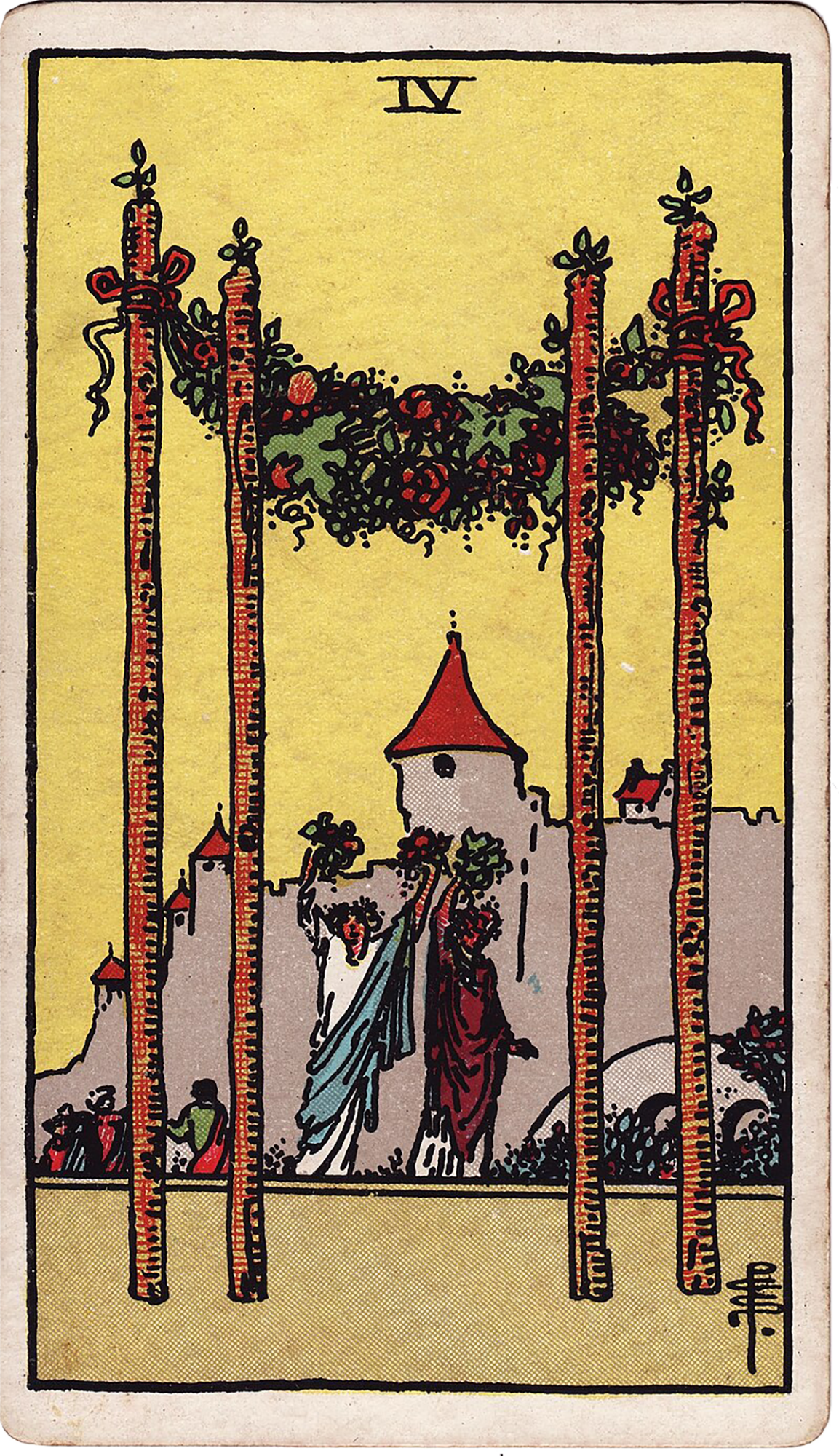 4 of Wands
Introduction — Why study the supplied 4 of Wands as a single-card lesson
A single-card reading can be deceptively rich. The supplied 4 of Wands image carries concentrated symbolic information: a temporary structure formed of four upright wands, a floral garland or festoon between them, and figures celebrating beneath or beyond that structure. The upright definition you were given emphasizes a stable milestone worth acknowledging, communal joy, and a practical request to match action to the present stage. The reversed definition points to instability under appearances, delayed celebration, and internal inconsistency between knowing and living a lesson. Studying this single card in several contexts teaches you how to read visual cues, weigh upright vs reversed nuance, and translate that into specific, testable guidance for querents without inventing drama. This article treats the supplied 4 of Wands as the only card in focus: refer to it continually, anchor your answers in its image and text, and build interpretations around the card's core themes of milestone, community, home, and form.
Rider-Waite-Smith symbolism visible on the supplied 4 of Wands and how it informs meaning
Start with what you can see. In the traditional Rider-Waite-Smith visual language that the supplied card reflects, four wands are planted and connected by a floral garland. Behind the garland there is an architectural backdrop — often a castle or walled house — and figures of celebration appear in the foreground. Each element maps to meanings: the wands are suit-signifiers of energy, initiative, identity and creative direction; the garland and flowers signal ritual, seasonal celebration, fertility, and marking time; the building indicates home, permanence, or community structures that provide boundary and belonging; and the celebrating people represent community recognition, shared joy, and the social confirmation of a milestone. When you read the supplied 4 of Wands, translate those visual cues into questions: Which wands are forming the structure in this situation — are these plans, projects, relationships, or roles? Who is in the 'crowd' that would celebrate this with the querent? What boundary or building is implied — an actual house, a family role, an employer or community institution? The supplied upright text already points you toward a practical, stage-appropriate response and using skill sets associated with Wands: motivation, creativity, ambition and initiative. The visual symbols give you the 'where' and 'how': this is usually local, social, and rooted in a specific context.
Upright supplied meaning expanded: practical celebration and manageable milestones
The supplied upright explanation says: "Upright, 4 of Wands highlights a stable milestone worth acknowledging; joy becomes stronger when it is shared and when a temporary success is allowed to feel real. The card is practical: it asks for a response that fits the present stage rather than an abstract ideal. Consider where this pattern is already visible and what action would strengthen its constructive side." Expand this into a working interpretive approach. Upright 4 of Wands is rarely about fantasy-level success; it asks you to name precisely what was achieved and let the querent feel it. The card likes small public rites: a dinner to mark a promotion, a housewarming, an engagement announcement, a completed creative project, or a familial reconciliation. The 'practical' instruction means the right answer is not "go big" but "acknowledge what exists and solidify it." Ask for evidence: what has been completed? Who would notice? Is there a short ceremony, announcement, or practical consolidation that fits the stage? If the querent resists celebration because they think more work is needed, the upright card reminds them that allowing rest and recognition is itself a productive act.
Reversed supplied meaning expanded: instability, delay, and internal inconsistency
The supplied reversed text reads: "Reversed, 4 of Wands draws attention toward instability beneath appearances, delayed celebration, tension at home or difficulty feeling secure even after progress. The reversal may show too much of the card's usual energy, too little of it, or a situation where the lesson is understood intellectually but not yet lived consistently. It can also indicate that the issue is occurring internally and is not obvious to other people." In practice, reversed 4 of Wands asks you to look under the garland. The structure might be shaky: the home is not safe, the announcement is premature, or a party papered over unresolved conflict. Alternatively, the celebratory energy may be excessive—people are performing joy to hide anxiety—or too scarce: the querent refuses to mark wins and therefore undercuts their own momentum. The reversal is diagnostic more than fatalistic: identify the blockage. Is it communication, logistics, fear of commitment, or an unmet condition that must be satisfied before genuine security is possible? For learners, the reversed card is an invitation to gather facts and propose small, concrete steps to reduce instability rather than offering grand remedies.
Interpreting the supplied 4 of Wands in love — single, partnered, and family of origin
Love readings are where the 4 of Wands shows up very often, because relationships are primary sites for milestones and public recognition. Single querent: The upright supplied card suggests a near-term invitation to join a community or ritual that makes a partnership possibility visible. That could be an event where new people appear, a step toward mutual commitment like agreeing to date exclusively, or simply receiving external validation that the querent's identity is attractive. The practical instruction: encourage the querent to accept invitations and perform social initiative; small acts (answering a message, RSVP-ing) matter. Reversed for a single querent warns against putting too much pressure on a single interaction to prove future security, or feeling insecure despite social successes. Ask: is the querent equating visibility with lasting attachment? Are they staging celebrations without addressing boundaries? Partnered querent: Upright, the supplied 4 of Wands signals an established milestone — moving in together, an engagement, a relationship becoming more public or socially recognized. Emphasize consolidation actions: set up shared routines, divide domestic responsibilities, or hold a small rite to acknowledge the change. Reversed, watch for under-the-surface tensions: one partner may appear committed while secretly uncertain, or family pressure prevents true celebration. The card reversed may mean the couple is rushing a public announcement before private issues are dealt with. Ask targeted questions: what practical steps would make both partners feel safer? Family of origin context: Upright, the supplied card often points to harmonious gatherings, reconciliations, or rituals that restore a sense of belonging. Reversed, it may reveal that surface peace at family events masks unresolved conflict — a performative harmony that leaves members feeling insecure. Use the image of the garland: is the family festooned for show? Or are there missing supports that make the 'arch' symbolic rather than structural?
Family, home, and domestic contexts — household, parenting, and living situations
Because the supplied 4 of Wands visually suggests a domestic structure behind celebration, it is particularly relevant to home life and family dynamics. Household and moving: Upright, this card can mean a literal housewarming, a settled move, or practical progress on a domestic project. The suggested response is to anchor that progress with routine and shared tasks. Reversed, the card can indicate a shaky living arrangement, undisclosed problems in the home (mold, financial strain, incompatible roommates), or premature decisions around buying or renting. Ask for specifics: what visible signs confirm the home is secure, and what small inspections or conversations will reduce risk? Parenting and family roles: Upright, the supplied 4 of Wands can mean a parenting milestone — a child starting school, a successful audition, or a family ritual that strengthens bonds. It invites shared celebration. Reversed, it can point to tension that surfaces at family gatherings (jealousy, boundary violations), or parental expectations that make celebrations feel performative. The task is to see who is excluded from celebration and what small changes would include them.
Career and money: practical consolidation, public recognition, and financial milestones
In workplace and financial readings, the supplied 4 of Wands emphasizes recognition, completion of a project, and the need to solidify gains. Career: Upright, this card can indicate a promotion, a completed project, a successful presentation, or public acknowledgment from colleagues. It favors practical consolidation: negotiate title and responsibilities that match current realities, document accomplishments, and let the team mark the success. Reversed, the card may signal that praise is superficial or premature—imagine a promotion announced without a salary change or a team celebration that hides unresolved workload issues. For learners, the practical question is: what tiny administrative or contractual step would turn the celebration into lasting improvement? Money and finances: Upright, the supplied 4 of Wands can point to a stable financial milestone — debt reduction, a savings goal reached, or a planned purchase that can now be made with confidence. Reversed, it warns against treating a temporary windfall as permanent stability. It can also reveal domestic financial conflicts: one partner wants to celebrate spending while another wants to shore up reserves. The card asks you to draft modest, conservative actions that protect the gain: update budgets, create a contingency plan, formalize agreements.
Life milestones, rites, and ceremonies — when to celebrate and when to prepare
One of the clearest lessons of the supplied 4 of Wands is about the appropriate timing and form of celebration. When upright appears, it signals that a milestone is real enough to name. Teach querents to design ceremonies that match scale and context: a meal with people who witnessed the work, a small ritual to mark transition, or a public acknowledgment that formalizes new status. The card's emphasis on shared joy means the act of celebrating helps institutionalize the milestone. When reversed, the 4 of Wands asks you to delay or reconfigure celebrations until certain conditions are met. This isn't about denying joy indefinitely; it's about removing obstacles that would make celebration hollow. Reversal could mean postponing a wedding until financial or family issues are addressed, reframing a professional celebration after contractual details are secured, or making private repairs before hosting public gatherings. The upside of this cautious approach is that it prevents future regret.
As advice and as challenge — action-oriented steps from the supplied card
Treat the supplied 4 of Wands as both a map and a to-do list. As advice (upright): 1) Name the milestone aloud. 2) Invite or accept a small ceremony or public recognition that is appropriate to the achievement. 3) Perform a practical consolidation step: sign paperwork, split responsibilities, or document the success. 4) Lean on community supports; let other people share the burden of maintaining the gain. As challenge (reversed): 1) Look for instability beneath the visible success: ask for facts. 2) Resist premature announcements until conditions are stabilized. 3) Reduce complexity: simplify the plan, acknowledge what is incomplete, and make a sequential plan. 4) Turn inward and practice consistent behaviors that embody the desired security (paying bills on time, setting household routines) so intellectual understanding becomes lived reality. These action steps convert symbolic readings into practical interventions. Encourage querents to choose one small step from the list and implement it within a week; measure the effect.
Person readings and outcomes using only the supplied 4 of Wands
When the querent asks "who is this person" and only the supplied 4 of Wands appears, interpret through role and energy rather than physical description. Person-as-role (upright): This person is often a community anchor: the one who organizes gatherings, honors milestones, or stabilizes group identity. They may hold a home, be a reliable colleague who celebrates wins, or be the friend who plans housewarmings and weddings. They are practical and visible. Person-as-role (reversed): The person may seem celebratory but be inconsistent; they may overperform happiness to hide insecurity, or be someone who announces intentions they don't follow through on. Alternatively, they could be someone who keeps family issues private, creating the appearance of harmony while withholding support. Outcomes: If the supplied 4 of Wands appears alone for outcome, use the upright/reversed split as a timeline test. Upright suggests a likely short-term consolidation and public acknowledgment; encourage the querent to take one consolidating step and observe whether external recognition follows. Reversed indicates a need for work: either postpone expectation of public confirmation or put in steady, internal practice to create a more durable outcome.
Spiritual reflection and inner work tied to the supplied 4 of Wands
Spiritually, the supplied 4 of Wands invites you to notice rituals that anchor identity. Upright, it asks: what small practice marks your passage from one version of yourself to another? This could be writing a brief reflection, performing a private rite, or publicly naming a change. The key is embodied recognition: living the transition rather than simply thinking about it. Reversed, the card highlights internal dissonance. You may 'know' a truth intellectually but not embody it — for example, feeling you deserve belonging but behaving in ways that push people away. The spiritual work is incremental: develop tiny, repeatable acts that communicate the new identity to your nervous system (consistent bedtime, regular check-ins, offering help without needing to be seen). The supplied 4 of Wands image — a structured, shared space crowned with a garland — becomes a metaphor for building inner architecture through habitual practice.
Practical single-card reading method and exercise using the supplied 4 of Wands
A disciplined method helps learners turn symbolism into reliable guidance. Step 1: Observe the supplied card image carefully. Describe out loud the visible elements: the four wands, the garland, buildings, figures. Note your immediate gut feeling. Step 2: Read the supplied upright and reversed meanings and pick the orientation that matches how the card appeared. If the card looks upright, take the supplied upright text as primary; if reversed, use the supplied reversed text as the starting point. Step 3: Ask context-specific diagnostic questions (pick one context from love, career, home, finance, person, outcome, spiritual). For each question, use three filters: (a) Visual anchor: which part of the image speaks to this question? (b) Function: what practical action would consolidate or repair? (c) Social: who must be involved for the milestone to hold? Step 4: Offer one concrete action and one watch-for sign. Example (career upright): "Action — send a one-page summary of your project accomplishments to your manager by Friday; Sign — an invitation to a team celebration or formal feedback within two weeks." Example (family reversed): "Action — postpone the party and schedule a private mediation with the key family members; Sign — if conversations remain evasive, that signals unresolved issues." Practice exercise: Do ten single-card readings over two weeks. For each reading: note the orientation, context, one actionable step, and one specific sign to observe. After a week, tally how many actions produced measurable change. This trains you to convert symbolic insight into empirical testing.
Examples and sample one-card readings anchored to the supplied 4 of Wands
Example 1 — Single-card love reading, upright: Querent draws the supplied 4 of Wands upright and asks about the romantic future. Interpretation: A social milestone is likely; encourage the querent to accept invitations and allow small public steps (introducing someone to friends) to happen. Action: Attend the upcoming event and intentionally introduce yourself to one person. Outcome sign: you receive a message from someone new within 7 days. Example 2 — Family reading, reversed: Querent is worried about hosting a holiday and draws the supplied 4 of Wands reversed. Interpretation: Surface peace may hide conflict; the card advises postponing a large public gathering until a few private family conversations are held. Action: Call three family members in advance to address expectations. Outcome sign: if calls produce clear agreements, proceed; if calls are evasive, delay. Example 3 — Career reading, upright: Querent wants to know if they will be recognized at work. Interpretation: The supplied 4 of Wands upright suggests acknowledgment is appropriate. Action: Send a concise project summary and propose a short team debrief. Outcome sign: a scheduled debrief or a message of thanks. In each example you see how the supplied 4 of Wands image and text produce concrete, testable guidance rather than vague promises.
Common mistakes and how to avoid them when reading the supplied 4 of Wands
1) Mistake: Over-romanticizing celebration. Fix: Tie the image to a practical consolidation step (document, sign, schedule). 2) Mistake: Treating reversal as purely negative. Fix: Use the reversed card as diagnostic—look for what specifically needs repair and propose small actions. 3) Mistake: Ignoring the social dimension. Fix: Always ask who needs to be included in the celebration or the repair. 4) Mistake: Assuming the card predicts major life change without evidence. Fix: Look for immediate signs and timeframe; recommend short experiments. 5) Mistake: Projecting personal desire onto the querent. Fix: Use questions to distinguish what the querent wants from what the card suggests ("What would you consider an appropriate celebration?"). Avoid these mistakes by anchoring every interpretation to an observable action and an outcome sign — this keeps readings practical and accountable.
Interpretation logic — how to justify a reading from image to advice
Good interpretations move along a clear chain: Image → Core theme → Contextual translation → Practical action → Observable sign. With the supplied 4 of Wands, the image yields themes of milestone, community, home, boundary, and ritual. In a given context you translate those themes: e.g., "milestone" becomes "move-in" in a home reading or "presentation completed" in a career reading. From there you propose pragmatic steps (send the summary, postpone the party, set up routines) and choose signs to measure progress (invitation, scheduled debrief, private conversation). When you can state that chain aloud, your reasoning is transparent to the querent and subject to verification, which is the hallmark of a strong, ethical reading.
Putting it together: guidelines for learners practicing with the supplied 4 of Wands
1) Repeat the single-card method daily for a week using different contexts. 2) Keep a reading log: record image orientation, context, three interpretive notes (visual anchor, practical action, sign) and results after one week. 3) Compare upright and reversed cases to learn the diagnostic differences. 4) Practice asking clarifying questions that shift interpretations from vague to specific (Who, When, What will change?). 5) Reflect on ethical considerations: when the card suggests delaying celebration for safety, prioritize concrete, harm-reduction steps over advice to simply 'wait.' By training with one card and one reliable method, learners sharpen their ability to see nuance in imagery, test interpretations, and offer grounded guidance.
Practice questions
• When you look at the supplied 4 of Wands image, which element—wands, garland, building, or figures—catches your attention first and why?
• If the supplied 4 of Wands appeared upright for a recent achievement, what small ceremony or practical consolidation step would make that achievement feel real?
• If the supplied 4 of Wands appeared reversed for a family event you are planning, what facts could you gather in the next 72 hours to confirm whether the celebration is premature?
• How would you translate the supplied 4 of Wands into a one-week action plan for career recognition that is measurable?
• What habitual behavior in your home life might be preventing the upright expression of the supplied 4 of Wands, and what single practice could begin to shift that pattern?
• When the supplied 4 of Wands appears reversed in a love reading, how can you distinguish between a genuine warning and your own fear of commitment?
• Which people in your community would you involve to make a milestone more stable, and what would you ask them to do?
• What is one small ritual you can perform privately to move from intellectual understanding of a change to embodied acceptance?
Comments
Sign in to comment.
Continue learning
Harnessing the Power of The Magician and Ace of Wands: Igniting Creativity and Manifestation in Tarot Readings
The combination of The Magician and the Ace of Wands in tarot readings offers a potent blend of creative energy and manifestation power. This article delves into the ways these car...
Advanced Techniques for Combining The Moon and The Star to Enhance Intuition in Tarot Readings
This article explores advanced techniques to combine the symbolism and energy of The Moon and The Star Tarot cards to enhance intuition during Tarot readings. Drawing from traditio...
Enhancing Clarity in Complex Choices with the Five Card Cross Tarot Spread
The Five Card Cross Tarot Spread is a practical tool designed to clarify complex choices by breaking down the decision into manageable parts. This article explores each position in...
Tracing the Origins and Evolution of The Fool Card in Tarot History
The Fool card holds a foundational place in tarot tradition, symbolizing beginnings, openness, and the embrace of uncertainty. This article traces its origins from early European d...
Understanding The Hermit Card in Solitude Reflection and Guidance
This article offers an in-depth exploration of The Hermit tarot card as a single-card reading in different contexts such as love, career, money, advice, challenge, person, outcome,...
Unlocking the Creative Flow with The Magician and The Empress in Tarot Combinations
This article delves into the powerful synergy between The Magician and The Empress in Tarot combinations, focusing on how their combined symbolism unlocks creative flow across vari...
Using the Seven Card Horseshoe Spread to Uncover Career Growth and Opportunity
This article presents an in-depth guide to the Seven Card Horseshoe Tarot Spread with a focus on career growth and opportunity. Using the cards The Fool, The Magician, The Empress,...
Understanding the Many Facets of The Moon in Emotional and Intuitive Tarot Readings
The Moon card in the Tarot deck embodies themes of intuition, uncertainty, dreams, and emotional complexity. This article offers a comprehensive exploration of The Moon’s upright a...
Unlocking Advanced Intuition Techniques Using The High Priestess The Moon and The Hermit
This article examines advanced intuition development in tarot reading by focusing on The High Priestess, The Moon, and The Hermit cards. It offers practical techniques for beginner...
Mastering Intuition with The High Priestess The Hermit and The Moon in Tarot Readings
This article delves into mastering intuition through three powerful Tarot cards: The High Priestess, The Hermit, and The Moon. It guides readers from beginner to advanced reading t...