
Interpreting the Five of Wands for Conflict Creativity and Collaboration
This article teaches how to read the 5 of Wands as a single-card lesson in multiple contexts. Using Rider-Waite-Smith symbolism and the supplied upright and reversed card text, it distinguishes productive friction from destructive conflict, outlines interpretation logic, offers step-by-step reading methods, real-world examples, common mistakes, and reflective questions to deepen skill.
Cards explored in this article
 5 of Wands
Introduction: Why the 5 of Wands matters in a single-card lesson
The 5 of Wands is a compact, active image that contains an entire dynamic in its composition: multiple figures, crossed staves, motion, and tension. In a single-card draw the 5 of Wands is unusually useful because it models interaction rather than inner state. The supplied upright and reversed card texts give a practical starting point: Upright, 5 of Wands highlights productive friction, differing agendas and the need to distinguish useful challenge from wasteful struggle. Reversed, 5 of Wands draws attention toward avoided conflict, resentment, conflict fatigue, or competition turning personal and undermining the larger goal. This lesson treats the card as a tool for learners — not as a guarantee — and shows how to translate its visual and traditional cues into specific readings across love, work, money, advice, people, outcomes, and spiritual reflection.
Reading the image: Rider-Waite-Smith symbolism to anchor interpretation
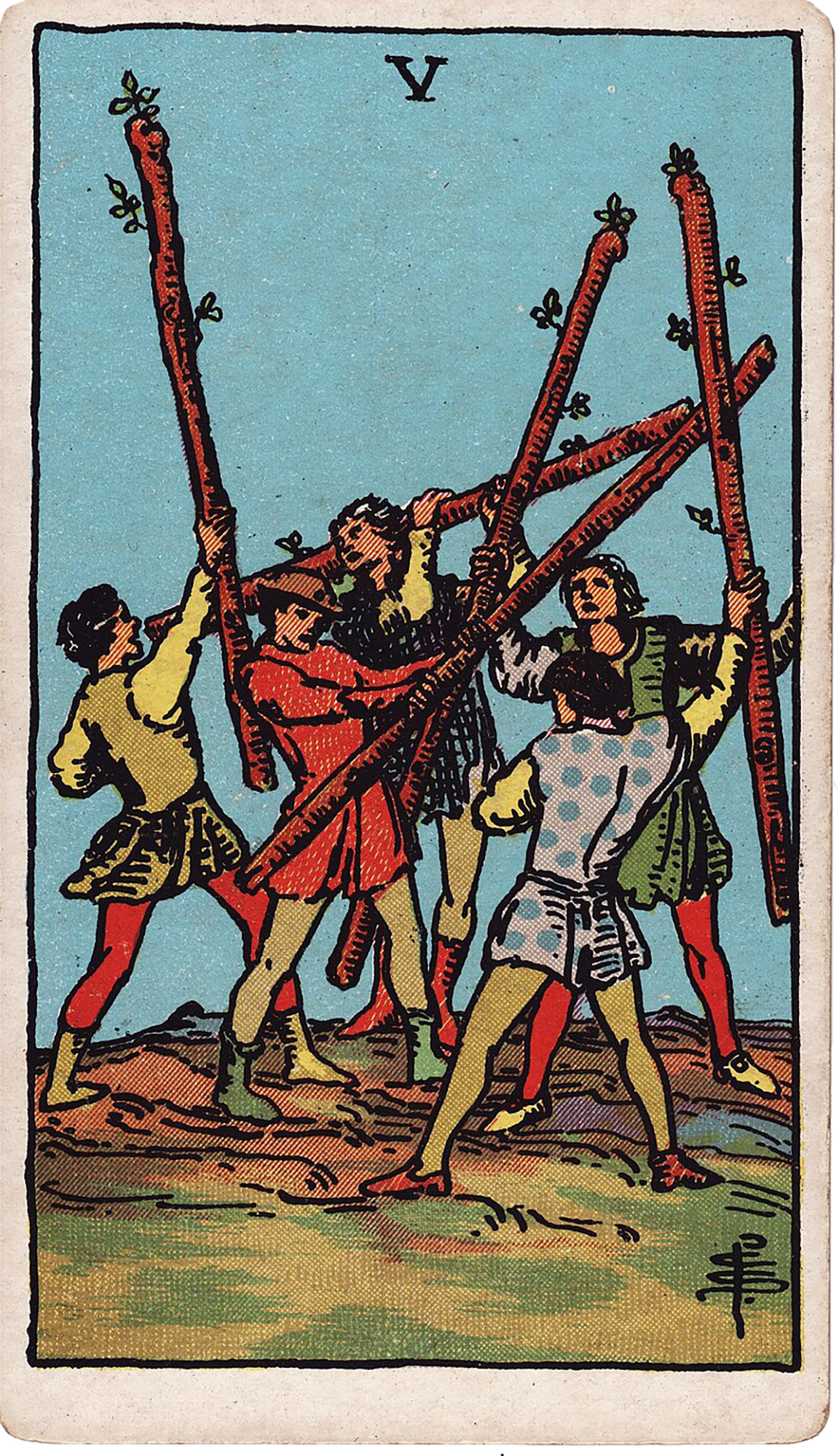
Start by looking closely at the supplied 5 of Wands image. The Rider-Waite-Smith symbolism typically shows five young men in a rough circle, brandishing staves that cross and clash. Their postures vary: competitive, uncoordinated, energetic. The background is usually open — a field — suggesting public or shared ground rather than a private interior. Colors often include reds and earth tones that indicate heat, ambition, and physical energy. Those concrete visual elements guide meaning: multiple actors (not a single opponent), active energy (not passive), focused tools (wands = will, creativity, ambition), and a field of engagement (a shared project or arena). When you read the card, translate visuals into checks: Who are the multiple parties? What are the tools or stakes (what the wands stand for in this situation)? Is the energy raw or channelled? The supplied upright and reversed texts give the polarity: the upright leans toward workable contest and the reversed toward avoidance, internalized conflict, or counterproductive escalation. Always narrate the scene you see before you convert it to advice.
Upright 5 of Wands: deep dive into productive friction
Use the supplied upright description as your anchor: productive friction, differing agendas, and the need to fit your response to the present stage. Practically, the upright 5 of Wands says: there is activity and disagreement, but it can be useful if shaped. In a single-card reading, treat the image as an active diagnosis — the situation needs a response that is practical and situational, not an appeal to an idealized harmony. Key tonal markers to emphasize: motivation and creativity (Wands domain), visible competition or differing opinions, and an opportunity to clarify roles. The card rarely means literal violence; the staves are often clumsy and improvised rather than weapons. Think in terms of brainstorming clashes, overlapping responsibilities, or competing proposals. Ask what small organizational or communicative steps would make the friction generative — forming an agreed framework, defining boundaries, or setting turn-taking rules. Use the image of young people improvising with wands to imagine improvisation and experimentation as useful rather than threatening.
Reversed 5 of Wands: where friction becomes stuck or internalized
The supplied reversed text warns against avoided conflict, resentment, conflict fatigue, or competition turning personal. Reversal is not simply the opposite; in this case it shows distortion in the process. When the 5 of Wands appears reversed in a single-card pull, follow the diagnostic questions: Is the friction happening inside one person (quiet resentment, self-criticism), or has activity turned petty and personal? Is energy blocked — people are tired and no one speaks up — or is the tension amplified into interfering personality conflict? The imagery of the upright card can be reimagined: the staves are tangled, faces are weary, or one figure withdraws. The appropriate responses are different from the upright. The task is to simplify, acknowledge grievances, practice new coordination, release personalizing narratives, or name what’s been avoided so the healthier expression of Wands can return.
Practical single-card method: step-by-step reading process
This is a reproducible technique for learners when you draw the 5 of Wands by itself. 1) Observe: Describe what you see in the supplied image out loud or in writing — number of figures, body language, the environment, colors, and the staves. Anchor interpretation to those concrete details. 2) Anchor to the upright/reversed text provided: If upright, prime for productive friction; if reversed, look for stuck or internalized conflict. 3) Ask a context question: Decide which context you are reading the card for (love, career, money, advice, person, outcome, spiritual reflection). Use a specific question rather than a vague one. 4) Map symbols to the question: Translate each visual element into that life area—who the five actors might represent (teams, departments, family members, competing desires), what the staves are (projects, ideas, resources), and where the field is (shared space, marketplace, social circle). 5) Identify stage and required action: Based on the intensity and posture in the image, decide if this is a beginning skirmish, mid-process friction, escalation, or nearing resolution. Choose one or two focused actions that match — e.g., set boundaries, mediate, reallocate tasks, practice self-reflection. 6) Finish with a concrete next step: Single-card readings benefit from actionable advice. Translate interpretation into 1–3 tangible moves the querent can take in the next 72 hours. This method keeps readings accountable: you move from image to explanation to practical action without inventing extra narrative.
Interpreting the 5 of Wands in relationship and love readings
When you draw the supplied 5 of Wands for a love question, use the image to map interpersonal dynamics. Upright: Expect lively difference — disagreements, competing priorities, or playful rivalry. In new relationships the card can signal flirtatious competition or clashing expectations that are useful to surface. In long-term relationships it may mean recurring arguments about roles. The upright framing invites turning these clashes into growth by clarifying boundaries or scheduling dedicated time for important issues so they don’t become perpetual skirmishes. Reversed: Look for avoidance or simmering resentment. One partner may be withdrawing to avoid conflict, or pent-up irritation is turning small issues into personal attacks. The reversed card can also indicate that the apparent conflict is internal — one person wrestling with multiple desires. Practical interventions: name the avoided topics, create a safe script for difficult conversations, or use small rituals to rebuild trust. Example: If a querent asks whether to move in with a partner and draws the upright 5 of Wands, you might say that practical disagreements (division of chores, finances) will surface and are not a dealbreaker; create clear agreements now. If they draw the reversed 5 of Wands, advise addressing underlying resentments before moving in, and suggest a mediation conversation to move from avoidance to clear rules.
Career and workplace readings: teams, projects, and leadership
In career contexts the supplied 5 of Wands most often points to team dynamics. Upright: Expect differing agendas, overlapping roles, or spirited debate over direction. This can be productive — brainstorming that scrapes and refines ideas. Emphasize process: who takes responsibility for decisions? How are disagreements documented? Use the image of several active people each with a staff to think about allocation of authority and initiative. The card can also encourage a leader to harness competitive energy by setting clear criteria for evaluation and deadlines. Reversed: The trouble is either avoidance (important issues shelved) or escalating interpersonal conflict that distracts from goals. It might indicate conflict fatigue — colleagues are burned out and less able to negotiate. Practical moves include simplifying tasks, clarifying expectations, rotating responsibilities, or third-party facilitation. The reversed 5 of Wands can also provoke the leader to examine whether systems are forcing competition where collaboration would be better. Example: A project manager drawing upright 5 of Wands for a stalled product meeting could interpret it as a signal to schedule a structured ideation session with time limits and decision points. Reversed, the manager might interpret it as a sign to step in and resolve interpersonal disputes before they derail the timeline.
Money and resources: competition, negotiation, and priorities
Applied to finances, the supplied 5 of Wands involves competing priorities over resources. Upright: Expect negotiation, competing claims on money (shared budgets, household spending, bids on a property) and a need to prioritize. The card often advises practical triage — distinguish essential from discretionary spending and create transparent rules for shared finances. The staves can symbolize different expense streams or investment proposals that clash but can be evaluated objectively. Reversed: Look for avoidance of financial conversations, resentment over secret spending, or a chaotic scramble that has become counterproductive. The reversal can also represent internal conflict about spending values. Practical steps: schedule a calm money conversation, create a simple budget that addresses everyone's non-negotiables, or temporarily freeze new commitments until clarity is restored. Example: If someone asks whether to accept multiple competing freelance offers and draws upright 5 of Wands, the card recommends mapping the terms and choosing by clear criteria (rate, timeline, portfolio fit). If reversed, the querent may be overcommitted or avoiding pricing conversations—advise renegotiation or stepping back to re-evaluate priorities.
Advice and action reading: what the 5 of Wands recommends
Use the supplied meanings to craft direct actionable advice. Upright advice: engage and structure the energy. Do not seek harmony at the cost of clarity; instead, make rules that turn conflict into productive testing. For example: set a timed agenda, propose a pilot to test competing ideas, or invite differing voices but assign a final arbiter. The image suggests improvisation, so small experiments and flexible frameworks work well. Reversed advice: simplify and acknowledge. Where energy is stuck, reduce complexity. Explicitly name resentments or avoided topics. Practice saying small, specific things rather than generalized critiques. The instruction is restorative rather than combative — repair process before reintroducing competition. Always finish advice with a single, immediate action: call to schedule a conversation, draft a one-page responsibilities chart, or take one hour to list avoided issues.
Reading the 5 of Wands as a person
When the supplied 5 of Wands describes a person, describe a pattern rather than a fixed personality. Upright person: a spirited, competitive, creative figure who enjoys testing ideas and pushing boundaries. They are often energetic, somewhat theatrical, and skilled at initiating. They may thrive in roles that require quick thinking and debate. The image suggests someone who brings many opinions to the table and can be constructive if given a channel. Reversed person: a person who is conflict-averse, burnt out by repeated disputes, or someone whose competitiveness has become petty. Alternatively, the reversed person might look amiable but harbor internal strife. In readings, clarify whether the querent sees this person as a team member, a partner, or an aspect of themselves. Encourage concrete ways to interact: if upright, invite them into specific challenges; if reversed, create safe boundaries or encourage them to name grievances privately before making demands publicly.
Outcome reading: where the 5 of Wands can lead
As an outcome card the supplied 5 of Wands shows process more than finality. Upright outcome: through productive friction, solutions are refined and roles clarified — the end result is usually improved structure or a better-tested idea, not immediate harmony. Expect a period of testing that yields clearer next steps. Reversed outcome: risk of stalemate, passive-aggressive breakdown, or unresolved competition that hampers progress. If reversed, the likely necessary outcome is a reset: simplification, apology, or reallocation of responsibilities to break the impasse. When you report this outcome to a querent, emphasize actions that can alter the trajectory: encourage them to step into facilitation if upright, or to initiate a reset if reversed. Outcomes with the 5 of Wands are rarely sudden transformations; they are incremental and require continued attention.
Spiritual reflection: inner conflict, vocation, and creative initiation
Spiritually, the supplied 5 of Wands invites a reflective posture about how conflict serves growth. Upright: see conflict as initiatory — a clearing that exposes priorities, tests commitments, and ignites creativity. The imagery of youthful figures wielding staves can symbolize the soul’s apprenticeship: trying different wills against one another to discover authentic desire. The spiritual practice here is disciplined engagement — use ritual, journaling, or embodied practice to test impulses without damage. Reversed: the spiritual work is reconciliation and integration. The conflict may be internal — multiple impulses stalled by shame, fear, or perfectionism. The task is to acknowledge the voices, practice small consistent actions to build trust with your own will, and simplify spiritual tasks to rebuild momentum. Meditation that notices inner debate without identifying with it is useful. In both orientations, resist moralizing conflict; treat it as material to be learned from.
Common mistakes and how to avoid them
Learners often make predictable errors with the 5 of Wands. 1) Treating the card as inherently negative: Because it depicts conflict, readers sometimes assume catastrophe. Avoid this by referencing the supplied upright text which frames friction as potentially productive. 2) Reading reversal as only "good" or "bad": The reversed text shows nuance — avoidance, internalization, or excess. Ask diagnostic questions before concluding. 3) Over-personalizing: The image contains multiple actors; the conflict may be structural, not about personalities. Translate staves into roles or resources before assigning blame. 4) Missing stage of process: The supplied upright meaning asks you to consider whether the energy is beginning, developing, at pressure, or moving toward resolution. Always situate the 5 of Wands temporally. 5) Giving abstract moral advice: Learners sometimes say things like "be more mature" rather than concrete steps. Use the single-card method to produce clear actions (set a meeting, list three priorities, call to clarify roles). 6) Ignoring visual detail: If you skip the image and jump to meaning, readings become generic. The figures’ postures, number, and field matter and will suggest different interventions.
Exercises to build skill and example readings
Exercise 1 — Single-card journal: Once a week pull the supplied 5 of Wands and write three brief entries: 1) What conflict or creative pressure is present this week? 2) One small action to channel it (15–30 minutes). 3) What outcome would indicate productive friction? Exercise 2 — Role mapping: Draw five circles representing the staves and label them with people or priorities in a current situation. Where do overlaps occur? Pick one overlap and propose an agreement to test. Example reading (career, upright): Querent: "Will our team finalize the product scope this month?" Card: upright 5 of Wands. Interpretation: multiple stakeholders are pushing different features; this is refining energy. Action: propose a decision framework and a one-week sprints test. Example reading (love, reversed): Querent: "Is our communication improving?" Card: reversed 5 of Wands. Interpretation: resentment or fatigue remains; small conflicts are being avoided. Action: schedule a brief, empathetic check-in to name one lingering annoyance each can let go of or negotiate.
Interpretation logic checklist
When you interpret the supplied 5 of Wands, run through this checklist to maintain clarity: 1) Image first: describe visuals. 2) Orientation: upright or reversed — use the supplied text. 3) Map to context: translate figures and staves into people, projects, or desires relevant to the question. 4) Stage: identify whether the friction is nascent, developing, intense, or resolving. 5) Action: provide 1–3 concrete, time-bound steps. 6) Outcome frame: articulate the likely near-term outcome and what would change it. This logic keeps readings practical and grounded in the card’s imagery and supplied meanings.
Closing notes on ethics and learner humility
The 5 of Wands offers raw, usable information: it shows where energy is clashing and where structure is required. As a learner you must resist theatrical pronouncements and instead translate the card into manageable interventions. Always check whether your interpretation empowers the querent and clarifies next steps. When advising about interpersonal disputes, encourage consent: recommend mediation or professional help when necessary. Remember that a single card gives a snapshot, not a full narrative — use the supplied image and texts as precise anchors to a reliable, compassionate reading.
Practice questions
• When you look at the supplied 5 of Wands image, which figure or detail stands out first and why?
• Is the conflict shown by the card more about process or personality in a situation you currently face?
• If the card is upright for your question, what small rule or structure could turn friction into productive testing?
• If the card is reversed for your question, what avoided topic might need naming to restore healthy energy?
• How would you translate the five staves into concrete roles, priorities, or resources in your life?
• What is one 72-hour action you can take to move the 5 of Wands energy toward resolution rather than escalation?
• How might you practice noticing internal debates (the reversed card’s inner conflict) without acting on every impulse?
• When you have previously misread conflict as purely negative, what changes when you instead treat it as a source of refinement?
Comments
Sign in to comment.
Continue learning
Exploring The High Priestess in Career Relationships and Personal Growth
The High Priestess card in the tarot deck invites readers to explore intuition, hidden knowledge, and inner wisdom across various life contexts. This article examines how The High...
The Fool in Life Transitions and New Beginnings
The Fool card embodies the spirit of beginnings, curiosity, and the leap of faith required during life transitions. This article explores The Fool’s meanings across various reading...
Understanding The Chariot Card in Personal Ambition and Overcoming Obstacles
The Chariot card represents the power of focused will, disciplined action, and choosing a clear direction amid competing impulses. Upright, it encourages decisive steps forward usi...
Understanding The Hermit in Self Discovery and Spiritual Enlightenment
The Hermit card in the Rider-Waite-Smith deck embodies themes of introspection, solitude, and spiritual wisdom. This article examines how The Hermit's upright and reversed position...
Exploring The Hierophant in Modern Spiritual Practices and Personal Development
The Hierophant tarot card symbolizes structured wisdom, tradition, and the pursuit of knowledge through established systems. This article explores how The Hierophant’s upright and...
Applying The Star Card to Foster Hope and Renewal in Personal Growth
The Star card in Tarot symbolizes hope, authenticity, and the process of steady renewal. In a single-card reading, The Star encourages embracing what is present, cultivating openne...
Understanding The Wheel of Fortune in Tarot Readings for Life Cycles and Change
The Wheel of Fortune card in Tarot is a powerful symbol of cycles, change, and the dynamics of fate and free will. This article explores the card’s upright and reversed meanings, a...
Understanding The Hermit Card in Solitude Reflection and Guidance
This article offers an in-depth exploration of The Hermit tarot card as a single-card reading in different contexts such as love, career, money, advice, challenge, person, outcome,...
Understanding The Tower in Tarot for Navigating Sudden Change and Crisis
The Tower card in Tarot symbolizes sudden, often disruptive change that destroys false foundations and compels honest reassessment. This article provides a comprehensive exploratio...
Understanding The Hanged Man in Personal Sacrifice and Spiritual Growth
The Hanged Man tarot card embodies the themes of intentional pause, surrender, and gaining new perspectives that foster personal sacrifice and spiritual growth. In this article, we...