
Practical Guide to the Three of Pentacles for Teamwork Skill Growth and Career Recognition
This single-card guide teaches how to read the supplied 3 of Pentacles in upright and reversed positions across multiple life contexts. Anchored to the Rider‑Waite‑Smith imagery in the supplied card image, it explains symbolism, practical reading techniques, sample interpretations for love, career, money, advice, challenge, person, outcome, and spiritual reflection, and offers exercises, common mistakes, and step‑by‑step methods for learners who want to develop reliable, grounded readings about teamwork, skill growth, and recognition.
Cards explored in this article
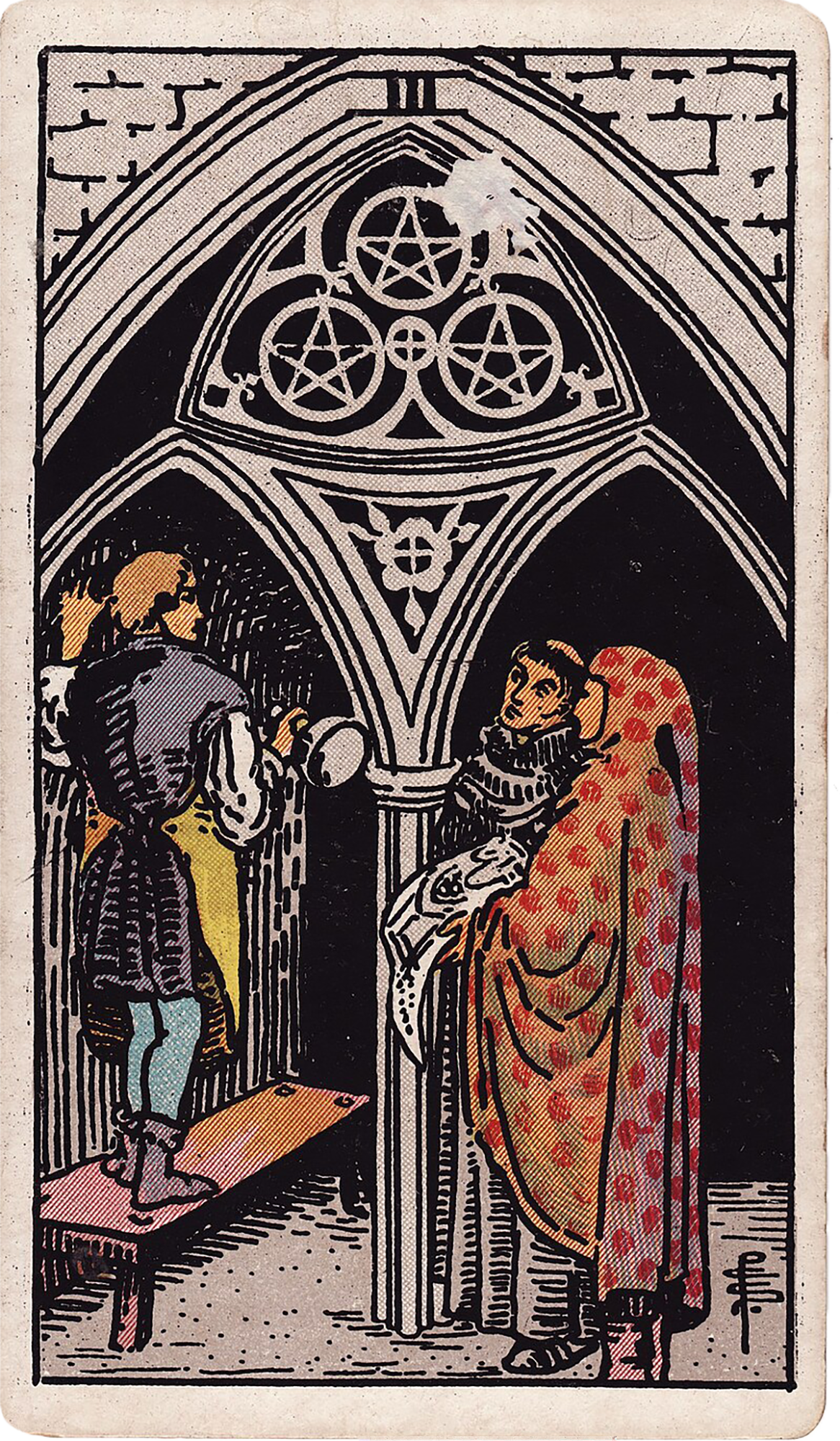 3 of Pentacles
Introduction and scope
This article is a practical, learner‑focused exploration of the supplied 3 of Pentacles card. Use it as a single‑card lesson: in each context you draw the same image and interpret it for that specific question. The supplied upright description emphasizes collaboration: "Upright, 3 of Pentacles highlights skill becomes stronger through collaboration, feedback and respect for different forms of expertise..." The supplied reversed description highlights blockages around teamwork or standards: "Reversed, 3 of Pentacles draws attention toward poor teamwork, low standards, lack of recognition, weak planning or difficulty accepting constructive feedback." Throughout this guide I repeatedly anchor meaning to the observable imagery on the Rider‑Waite‑Smith‑style supplied card: three figures, a craftsman at work, architectural setting, tools, and the three pentacles carved into stonework. Treat these images as windows into the card’s practical lessons about craft, collaboration, and public recognition.
Read the imagery first: Rider‑Waite‑Smith symbolism on the supplied 3 of Pentacles
Start every reading by describing the supplied card image out loud or in writing. On the Rider‑Waite‑Smith 3 of Pentacles you see three people gathered around a building project: a skilled mason carving stone, a cloaked figure holding plans or a book, and a robed figure who appears to be a patron, cleric, or fellow collaborator pointing toward the work. Tools, the partially completed architectural arch, and the three pentacles embossed or inlaid in the stone emphasize material craft and visible accomplishment. Each figure’s clothing and posture signal different roles: manual skill, intellectual planning, and social or institutional recognition. The cathedral‑like setting suggests a larger project that requires standards, coordination, and a public result. In short, the card’s visual grammar names skill in service of a shared goal and recognition that arrives through competent, cooperative labor. Keep returning to these visible details when forming specific, grounded interpretations.
Core meanings: how the upright and reversed supplied texts guide interpretation
Use the supplied upright text as a default when the card appears upright: skill strengthened through collaboration, feedback, respect for diverse expertise, practicality, and handling situations through Pentacles’ concerns (work, money, routine, resources, the body, long‑term stability). The upright suggests a present‑stage response is needed, not an abstract ideal: ask what action fits now. When the card appears reversed, use the supplied reversed text to identify where the process is stuck: poor teamwork, low standards, lack of recognition, weak planning, difficulty taking feedback, or an issue mostly internal and unseen by others. Important technique: do not treat the reversed as simply the upright “negative.” Instead, map where the constructive process—planning, practicing, acknowledging—has broken down and what practical step will restore forward movement. Always correlate these textual cues with the concrete imagery: who looks active, who looks sidelined, which tools are present or unused, and whether the building around them feels stable or incomplete.
Practical reading method for a single‑card 3 of Pentacles pull
1) Clarify the question and context. Decide which of the following contexts you are reading for: love, career, money, advice, challenge, person, outcome, or spiritual reflection. Phrase the question concretely (e.g., "What will help my collaboration with X?" or "How should I approach recognition at work?"). 2) Observe the supplied card image closely. Name the figures, tools, and setting. Note posture, gaze, clothing, and the three pentacles carved into the structure. 3) Read the supplied upright/reversed text as lens. If upright, emphasize collaboration, skill, and practical response. If reversed, search for stuck processes, standards or communication problems. 4) Translate image + text into the specific context. Ask: Who plays which role in this situation? Who is the craftsman, the planner, and the patron? Which role am I in? 5) Generate an action‑oriented sentence: what concrete step does this card recommend now? For example: "Ask for a demonstration or bring a plan to the next meeting" (upright) or "Simplify the task and ask for clear responsibilities" (reversed). 6) Confirm by drawing or consulting surrounding cards when possible. Since this is a single‑card lesson, mentally list two possible follow‑up questions to deepen clarity (timing, barriers, next concrete action). This stepwise approach keeps interpretations anchored to the supplied image and its practical ethos.
Contextual interpretations: love and relationships
Upright: The supplied 3 of Pentacles in a love reading highlights teamwork and growing relational skills through shared projects and mutual support. Read the three figures as roles partners may take: one brings skill or practicality, one brings shared plans or values, and one offers social or emotional recognition. The card asks: where are you practicing your relationship? Are you doing concrete tasks together (home projects, financial planning, caregiving) that build trust and visible results? The upright suggests success when you attend to details, seek constructive feedback, and respect different contributions. Example action: schedule a planning session or negotiate roles for household tasks so each skill is used. Reversed: The supplied reversed text points to low standards, poor coordination, or lack of appreciation in the relationship. Maybe one partner’s efforts go unseen, or the couple has never agreed on practical responsibilities. The reversal invites simplifying expectations, asking for acknowledgment, and practicing giving and accepting constructive feedback. Incompatibility is not the immediate implication; rather, the card asks you to repair process and communication around shared work.
Contextual interpretations: career and workplace recognition
Upright: In career questions the supplied 3 of Pentacles is one of the clearest indicators of positive professional skill development through collaboration. The imagery—craftsman, planner, and patron—maps directly to roles in a workplace: the talented worker, the project manager, and the sponsor or reviewer. Upright, the card suggests that skill, consistency, and respectful collaboration will produce visible results and likely lead to recognition or advancement. Practical steps: seek feedback, present your work in a finished or demonstrable form, volunteer for collaborative projects that show your abilities, and document standards or outcomes. Reversed: The supplied reversed text warns of poor teamwork, weak planning or unacknowledged work. This could mean you are doing good work but it’s not visible, standards are slipping, or you are resisting feedback. Tactical moves include simplifying deliverables so quality can be seen, asking for specific feedback or expectations, and clarifying responsibilities. The reversal is often remedial: fix process before expecting recognition.
Contextual interpretations: money and resources
Upright: When money or resources are the question, the supplied 3 of Pentacles emphasizes practical budgeting, investment in skill, and collaborative resource management. The image of the built structure suggests allocating resources toward durable outcomes—training, tools, or partnerships that increase earning capacity. In financial terms the card recommends concrete planning and standards: written agreements, shared budgets, or clear accounting. Reversed: The supplied reversed text signals poor financial coordination, unclear budgeting, or low standards that lead to waste. You might be investing in the wrong place, failing to ask for price quotes, or not aligning partners around shared financial goals. The remedy: simplify finance‑related processes, request clear documentation, and set minimum quality standards to prevent loss.
Contextual interpretations: advice and practical steps
Upright advice derived from the supplied card: document your work, invite feedback, join or form a team where your craft is respected, and prioritize learning through collaboration. Be specific: bring plans or prototypes to meetings, ask for a trial period, or volunteer to lead a component where you can show mastery. Reversed advice from the supplied text: look for where standards have slipped. Reduce complexity, ask for explicit expectations, and accept small practice opportunities rather than waiting for perfect conditions. Both positions emphasize action: the card is practical and asks for a stage‑appropriate response rather than abstract ideals. Translate that into daily tasks (e.g., rehearse a presentation once a day, create a checklist for shared responsibilities) and measure progress with visible outcomes.
Contextual interpretations: the challenge and obstacles
Upright as a challenge: even when the 3 of Pentacles is upright in a challenge position, it points to the need for structured teamwork rather than solo heroics. The obstacle may be coordinating diverse expertise or keeping standards high under time pressure. The image suggests instituting rituals that support workmanship: regular check‑ins, peer review, and explicit criteria for completion. Reversed as a challenge: the supplied reversed text directly maps to the challenge: poor teamwork, lack of recognition, weak planning, or inability to accept feedback. The diagnostic task is to find the choke point—communication, role clarity, or confidence—and design a small, concrete experiment to test a fix. Because the card is about craft and visible work, test changes with a tangible deliverable.
Contextual interpretations: who this person could be
When the 3 of Pentacles represents a person in a reading, anchor the description to the supplied imagery. Upright, the person is someone skilled, reliable, and oriented toward collaboration—a craftsman, teacher, supervisor, or organized colleague. They value standards, documentation, and reputation and are likely to give or request helpful feedback. Reversed, the person might be a poor collaborator, someone with inflated or deflated standards, or a person who fails to acknowledge contributions. The reversed person might be a micromanager, a distracted team member, or someone who intellectually understands process but does not practice it. In all cases, use concrete behavioral descriptors rather than vague labels: what do they do in meetings? How do they respond to drafts or prototypes?
Contextual interpretations: outcome and timing
Outcome upright: The supplied 3 of Pentacles upright often points to a measurable, public outcome—completion of a phase of work, public recognition, a successful collaborative deliverable, or a step toward long‑term stability. Because it’s a Pentacles card, outcomes are material or practical rather than ephemeral. Timing implications: it rewards investment in process and practice, so outcomes follow deliberate effort rather than instant inspiration. Outcome reversed: The supplied reversed text warns the outcome may be delayed or compromised by poor coordination, unclear standards, or invisible work. The solution is pragmatic: reassign tasks, draft clear acceptance criteria, or create small milestones that can be completed and celebrated to restore forward motion.
Contextual interpretations: spiritual reflection and inner craftsmanship
Upright spiritual reflection: On a spiritual level, the supplied 3 of Pentacles invites you to view your inner life as a craft. The three figures become aspects of self: skill (habit and discipline), planning or study (inner frameworks), and acknowledgment (community or tradition). The card asks you to practice spiritual skills—ritual, discipline, compassionate correctness—and to seek teachers or peers who will offer feedback. Reversed spiritual reflection: The supplied reversed text suggests that the inner work is not integrated; you may know spiritual ideals intellectually but have not built them into daily routine. The instruction is not mystical: simplify practice, ask for mentoring, and measure spiritual progress through consistent acts rather than grand experiences.
Common mistakes and how to avoid them
1) Ignoring the image: learners often default to canned meanings. Instead, start by describing the supplied card image out loud. 2) Treating reversed as purely negative: avoid the shorthand that reversal equals 'bad.' Use the supplied reversed text as a diagnostic tool—look for where craft or process is stuck. 3) Overgeneralizing from the card alone: because this is a single‑card lesson, always tie advice to a concrete step and two follow‑up questions. 4) Confusing recognition with entitlement: upright recognition is earned through standards and demonstration; do not assume the card promises external praise without evidence of consistent workmanship. 5) Not specifying roles: when you interpret collaborative imagery, assign roles in the querent’s reality (who fulfills the mason role, who is the patron, etc.). This keeps readings practical and actionable.
Exercises and practice readings
Exercise 1 — Single‑context practice: Pull the supplied 3 of Pentacles for eight consecutive days, each day using a different context (love, career, money, advice, challenge, person, outcome, spiritual reflection). For each pull write: one sentence describing the image, one sentence applying upright or reversed text, and one concrete action step. Exercise 2 — Role mapping: Look at the three figures and map them onto people in your life or team. Write down duties for each role and one improvement per role. Exercise 3 — Mini experiment: If reversed qualities appear, design a two‑week remediation plan with weekly milestones and a visible deliverable to measure improvement. Practice reading these experiments back to yourself using the supplied card imagery to validate whether the remedy resembles the card’s upright posture. These exercises train you to move from symbolic description to practical action.
Sample mini‑readings anchored to the supplied 3 of Pentacles
Example A — Career upright: Question: "Will my contribution to the project be noticed?" Observation: the craftsman is actively carving and there are plans visible. Interpretation: the supplied upright text and image suggest visible, demonstrable skill will be recognized if presented. Action: prepare a concise demonstration of your work and request a review meeting. Example B — Relationship reversed: Question: "Why am I frustrated with housework division?" Observation: the card’s collaboration is incomplete; one figure may seem sidelined. Interpretation: the supplied reversed text points to lack of recognition and poor planning. Action: create a simple chore rota and ask for written agreement on tasks for two weeks. Example C — Money upright: Question: "Should I invest in a course?" Observation: the building represents long‑term structure. Interpretation: the upright card supports investing in skill that leads to durable income improvement. Action: choose a course with measurable outcomes and documented credentials. In each example, note how visual details determined precise action steps.
Putting it together: interpretation logic and teacher’s checklist
Interpretation logic: 1) Image > 2) Supplied upright/reversed text > 3) Contextual mapping > 4) Role assignment > 5) Concrete action > 6) Follow‑up question. Use this order so your reading remains grounded in what is visible and practical. Teacher’s checklist for every reading: Did I describe the supplied image? Did I use the supplied upright or reversed text verbatim as a lens? Did I assign roles and responsibilities? Did I derive one measurable action? Did I create at least one follow‑up question? If any answer is no, refine your reading. This checklist helps learners avoid common interpretive shortcuts and keeps readings useful rather than vague.
Final notes and ethical considerations
This guide is aimed at learners and not a guarantee of outcomes. The supplied 3 of Pentacles highlights dynamics that are often under your control: craft, communication, and systems. Use readings to inform practical experiments rather than to predict fixed destinies. Ethically, when readers identify workplace or relationship problems, recommend consented, respectful interventions—asking for feedback, clarifying responsibilities, or proposing trial changes—rather than confrontational or invasive actions. Keep records of interventions to evaluate whether the card’s advice produced measurable change. Over time, this empirical approach trains accuracy and integrity in readings.
Practice questions
• When I look at the supplied 3 of Pentacles image, which of the three figures most closely matches my current role and why?
• What small, stage‑appropriate action can I take this week that would make my work or contribution visibly better?
• Where in my projects or relationships have standards slipped, and what one simplified process would help restore quality?
• If I drew the card reversed, what single diagnostic question would identify the choke point (communication, recognition, planning, or practice)?
• How will I document progress for two weeks to test whether applying the 3 of Pentacles’ practical advice improves outcomes?
Comments
Sign in to comment.
Continue learning
Exploring The High Priestess in Career Relationships and Personal Growth
The High Priestess card in the tarot deck invites readers to explore intuition, hidden knowledge, and inner wisdom across various life contexts. This article examines how The High...
The Fool in Life Transitions and New Beginnings
The Fool card embodies the spirit of beginnings, curiosity, and the leap of faith required during life transitions. This article explores The Fool’s meanings across various reading...
Understanding The Chariot Card in Personal Ambition and Overcoming Obstacles
The Chariot card represents the power of focused will, disciplined action, and choosing a clear direction amid competing impulses. Upright, it encourages decisive steps forward usi...
Understanding The Hermit in Self Discovery and Spiritual Enlightenment
The Hermit card in the Rider-Waite-Smith deck embodies themes of introspection, solitude, and spiritual wisdom. This article examines how The Hermit's upright and reversed position...
Exploring The Hierophant in Modern Spiritual Practices and Personal Development
The Hierophant tarot card symbolizes structured wisdom, tradition, and the pursuit of knowledge through established systems. This article explores how The Hierophant’s upright and...
Applying The Star Card to Foster Hope and Renewal in Personal Growth
The Star card in Tarot symbolizes hope, authenticity, and the process of steady renewal. In a single-card reading, The Star encourages embracing what is present, cultivating openne...
Understanding The Wheel of Fortune in Tarot Readings for Life Cycles and Change
The Wheel of Fortune card in Tarot is a powerful symbol of cycles, change, and the dynamics of fate and free will. This article explores the card’s upright and reversed meanings, a...
Understanding The Hermit Card in Solitude Reflection and Guidance
This article offers an in-depth exploration of The Hermit tarot card as a single-card reading in different contexts such as love, career, money, advice, challenge, person, outcome,...
Understanding The Tower in Tarot for Navigating Sudden Change and Crisis
The Tower card in Tarot symbolizes sudden, often disruptive change that destroys false foundations and compels honest reassessment. This article provides a comprehensive exploratio...
Understanding The Hanged Man in Personal Sacrifice and Spiritual Growth
The Hanged Man tarot card embodies the themes of intentional pause, surrender, and gaining new perspectives that foster personal sacrifice and spiritual growth. In this article, we...