
Practical Guide to the Three of Wands for Scaling Projects and Timing Growth
This article teaches how to read the 3 of Wands in spreads focused on scaling projects and timing growth. Using the supplied 3 of Wands images and Rider–Waite–Smith symbolism, we translate the card’s vantage-point energy into practical interpretive moves across contexts: love, career, money, advice, challenge, person, outcome, and spiritual reflection. You’ll get actionable reading techniques, sample mini-readings, a troubleshooting guide for the reversed card, and a checklist of operations and questions to move from vision to sustained expansion.
Cards explored in this article
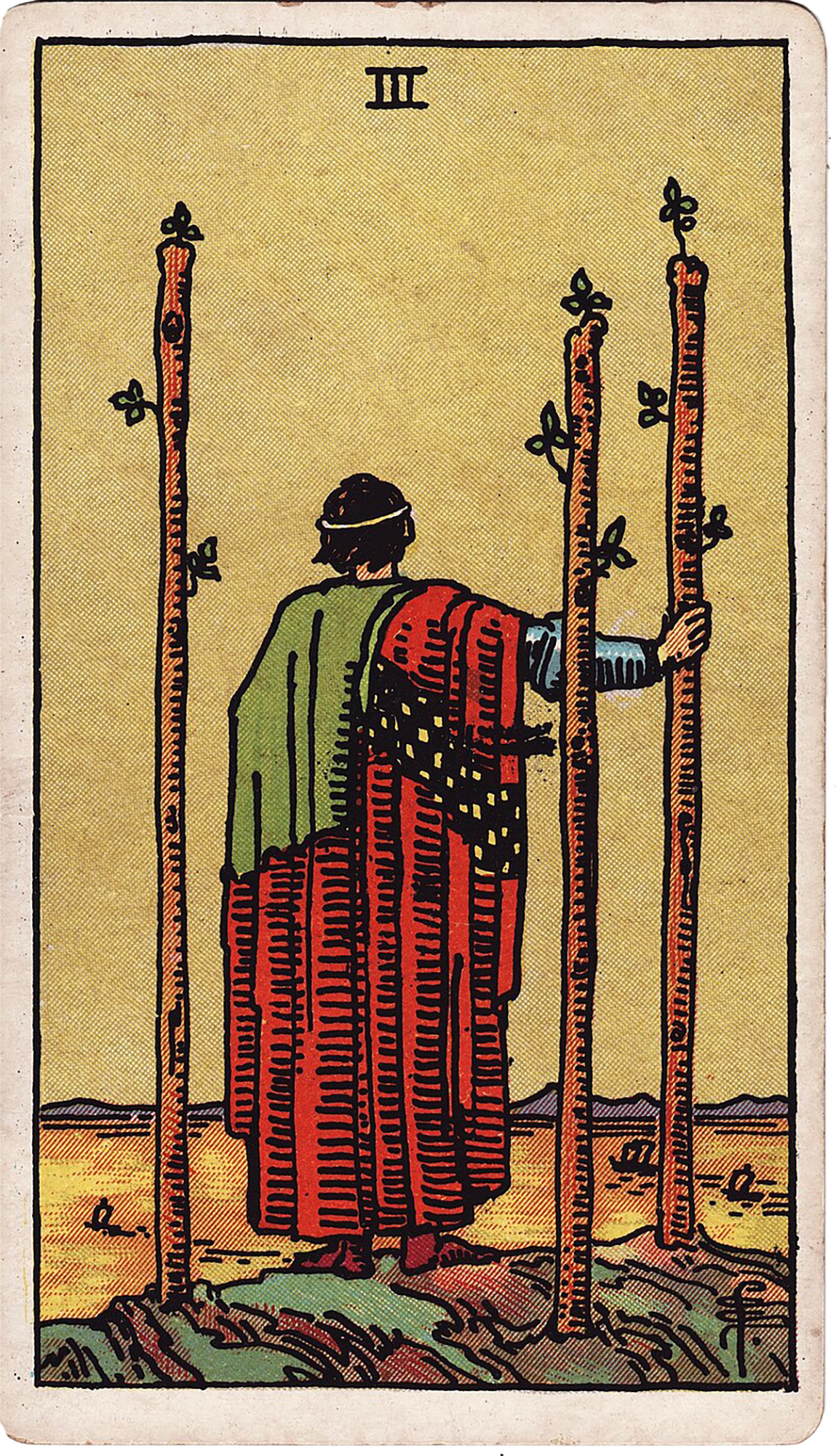 3 of Wands
Introduction and framing
This lesson centers on the supplied 3 of Wands Tarot images and their standard meanings. The 3 of Wands (upright) highlights results beginning to move beyond the starting point; the card favors perspective, patience and preparation for wider reach. The card is practical: it asks for a response that fits the present stage rather than an abstract ideal. Consider where this pattern is already visible and what action would strengthen its constructive side. In many spreads, the upright card shows that the situation can be handled through the skills associated with Wands: motivation, creativity, ambition, initiative, identity and the way energy is directed. It can still contain effort or discomfort, but it usually makes the core task easier to name. Use the surrounding cards to see whether this energy is beginning, developing, reaching pressure, or moving toward resolution. Reversed, the 3 of Wands draws attention toward delays, unrealistic expectations, weak follow-through or expansion attempted before foundations are ready. The reversal may show too much of the card's usual energy, too little of it, or a situation where the lesson is understood intellectually but not yet lived consistently. It can also indicate that the issue is occurring internally and is not obvious to other people. Rather than treating the reversed card as the opposite of the upright meaning, examine where the process has become stuck. Ask what needs to be simplified, acknowledged, practiced, released, or communicated before the healthier expression of Wands can return. From here we will use the supplied 3 of Wands imagery (the figure on a cliff, three staves, ships on the horizon, red cloak, distant mountains and sea) and these upright/reversed descriptions as the foundation for practical guidance about scaling, timing, and what to look for in readings.
Rider–Waite–Smith symbolism to anchor interpretation
Before applying the card across contexts, anchor your reading in the classic visual cues of the supplied 3 of Wands. Focus on these motifs and what they typically signal when you are reading for growth and timing: - The figure on the cliff: A vantage point. This person has moved away from the messy center and is now surveying possibilities. In project terms this often means initial launch is done and the client/reader must evaluate wider markets, partners, logistics and scale risks. - The three staves (wands): A stable but simple structure. Three suggests a triad—strategy, resources, and relationships; or product, distribution, and capital. It’s enough to stand but not yet a complex scaffold. For scaling, the three implies building on a small plane of stability before creating larger systems. - Ships in the distance: Opportunities, markets, partners or movement beyond current horizons. Ships suggest that results are not immediate at the feet of the project owner; they arrive through connection and travel — trade, outreach, distribution. - The red cloak: Energy, ambition and passion. It’s an internal drive that motivates expansion but can also suggest heat that must be channeled prudently. - Mountains and sea beyond the ships: Obstacles and the wider world. Mountains indicate challenges that will test the venture; the sea is the medium of exchange — uncertain but navigable. When you interpret the 3 of Wands upright or reversed, let these images guide the verbs you use: survey, reach, deploy, wait, dispatch, consolidate, partner, reinforce, hedge, and plan. The pictures support reading for timing (a stage beyond launch), scale (moving outward), and operational readiness (are the three supports solid?).
How the 3 of Wands (upright) behaves in specific contexts
This section takes the supplied 3 of Wands (upright) and translates it into readable, practice-focused interpretations for common spread contexts used when thinking about scaling and timing. Love and relationships: Upright, the 3 of Wands often appears when a relationship is moving from local or private development into a broader phase — planning a shared future, considering long-distance logistics, or introducing each other to wider circles. The figure on the cliff suggests looking ahead together: what needs to change to reach the next stage? Ships on the horizon can represent potential partners, long-distance possibilities, or external influences stepping toward you. Practically: discuss timelines, expectations about expansion (moving, cohabiting, career changes), and make a small action plan to test the logistics before fully committing. Career and projects: This is the classic scaling card: something beyond the initial prototype has appeared — new clients, a distribution channel, or a successful pilot. The 3 of Wands (upright) asks the querent to move from execution to strategy: secure partners, negotiate agreements, and formalize processes. The image of surveying suggests patience and oversight rather than frantic execution. Practically: audit your supply lines, delegation, deadlines, and KPIs; identify two to three measurable experiments to validate scale. Money and investment: The ships signify incoming value but not immediate cash in hand. Upright, the card suggests preparing for inflows by strengthening accounting, cash buffers, and contingency plans. It favors prudent reinvestment and staged scaling rather than all-in gambles. Use the triad implied by three wands to allocate capital among runway (operational reserves), marketing/expansion, and infrastructure. Advice position: When the 3 of Wands appears upright as advice, it says: take the long view and match action to stage. Don’t try to build the whole tower now — shore up the three supports you already have, then open outward channels. Use your vantage point to plan logistics, communications, and delegation rather than trying to personally do everything. Challenge position: Upright as a challenge asks: can you manage perspective and patience? The inherent challenge is to avoid impatience or impulsive expansion. You must wait for clearer signs from the horizon (partners, market feedback) and ensure your foundations will carry greater loads. Person (personality archetype): Upright the 3 of Wands profiles a forward-looking strategist or enterprising envoy — someone energetic, visionary and practical about growth. This person brings partnerships, negotiation skills, and a willingness to wait and watch. In readings, when the querent or a person in the situation resembles this card, expect someone who can think geographically and logistically. Outcome: Upright, the outcome suggested is measured expansion. If the card is placed as the likely result and the querent follows its advice — prepare, partner, and wait strategically — the result can be a successful outward move, new markets reached, and sustainable growth. Spiritual reflection: Spiritually, the 3 of Wands (upright) invites a patient, panoramic awareness: a recognition that inner work has created vantage and the next phase is to offer that work outward. It asks that you hold desire with discipline, and to trust a process of unfolding that requires both energy and restraint.
How the 3 of Wands (reversed) behaves in those same contexts
Work with the supplied reversed text: the 3 of Wands reversed draws attention toward delays, unrealistic expectations, weak follow-through or expansion attempted before foundations are ready. The reversal may show too much of the card's usual energy, too little of it, or a situation where the lesson is understood intellectually but not yet lived consistently. It can also indicate that the issue is occurring internally and is not obvious to other people. Rather than treating the reversed card as the opposite of the upright meaning, examine where the process has become stuck. Ask what needs to be simplified, acknowledged, practiced, released, or communicated before the healthier expression of Wands can return. Love and relationships: Reversed, the 3 of Wands can indicate plans that are premature (talk of moving in together before logistics are solved), wishful thinking about a partner or a future that hasn’t been tested, or poor follow-through on commitments. The ships may seem to be approaching but stall, or communications break down. Practical reading: encourage small, testable steps that expose hidden assumptions (financial expectations, caregiving plans, timelines) rather than sweeping declarations. Career and projects: Reversed this card signals growth attempts that outpace capacity: hiring before processes exist, scaling marketing when fulfillment can’t keep up, or misreading early interest as sustainable demand. It can also show poor delegation — everything depends on the original founder. In readings, look for bottlenecks, missing SOPs, and unmet dependencies. Money and investment: Beware of over-leveraging based on optimism. The reversed 3 of Wands flags cashflow mismatches, late payments, or investments into channels before results are validated. The practical reset is to build buffer runway, postpone major spend, and renegotiate terms until the inflows match operational needs. Advice position: As advice, the reversed card says simplify, consolidate, and be honest about readiness. You may need to shelve expansion plans or scale them back into a controlled experiment. Focus on basics: documentation, testing, and communication. Challenge position: As the challenge, the reversal invites you to diagnose where the gap between plan and practice exists. Is there a people, process, or product gap? Is the energy misdirected (too much PR, not enough shipping)? The card directs attention to the choke point. Person (personality archetype): The reversed 3 of Wands may represent someone with grand plans but poor follow-through, or a visionary burned out from trying to do everything alone. They may talk expansively about future horizons while avoiding the mundane labor required. Outcome: Reversed, the outcome risks stall or partial failure of expansion unless concrete fixes are made. However, it can also be an opportunity: the stall allows for essential corrections before larger losses occur. Spiritual reflection: Reversed, the card invites the querent to notice internal impatience, ego projections about success, or fear disguised as hurry. Spiritually, use the pause to practice restraint, humility, and honest inventory.
Practical reading method and step-by-step technique
Use this stepwise method when the 3 of Wands appears and your question is about scaling, timing, or expansion. 1) Clarify the question and horizon: Are you asking about immediate operational readiness (next 3 months), medium-term scaling (6–18 months), or a relationship-level change? Framing determines whether the ships on the horizon are weeks away or years. 2) Note orientation in the spread: If you pulled the supplied 3 of Wands upright, read as staged expansion; if reversed, look for bottlenecks. If the card sits in the present or as outcome, the timing and action advice differ. 3) Anchor to imagery: Verbally describe what you see on the supplied card(s): "the person stands on a cliff, watching ships—expansion is external; there are three wands—core supports must be checked." Saying this aloud in a reading clarifies whether the querent sees themselves as the watcher or as the ship. 4) Ask concrete clarifiers: Use targeted follow-ups. Examples: - "Which ‘ships’ are the most likely to arrive? (partners, customers, funders)" - "Which of the three supports needs shoring? (people, process, product)" - "What one test can you run in the next four weeks to validate demand?" 5) Diagnose readiness: Break readiness into triageable domains, mapping loosely to the card’s three wands. For example: - Structural: systems, SOPs, legal, and contract readiness. - Resource: cash, people, and supply. - Market/channel: distribution, partnerships, and communications. 6) Create an action ladder: Translate the card’s instruction into 3 to 5 specific, prioritized tasks with owners and deadlines. The 3 of Wands favors management over philosophy—assignable tasks win. 7) Time-check and follow-up draw: If you use follow-up draws, plan one after the proposed tasks are done to measure change. The 3 of Wands energy responds to staged checks rather than one-time declarations. 8) For reversals, run a "stop and test" protocol: stop expansion-related expenditures for a short, defined period, and run tests to measure product/fulfillment reliability, customer retention, and cashflow elasticity. Technique tips for learners: - Use the card’s visual metaphors to form concrete questions. - Translate panorama language into operational terms: "vantage" becomes metrics and oversight; "ships" becomes channels or partners; "three wands" becomes core triad to inspect. - Keep timeframes realistic; the 3 of Wands rarely signals instant change. It is positional and stage-based.
Example mini-readings
These concise examples show how to translate the supplied 3 of Wands into practice. Each is written as a short reader-to-querent script. Example 1: Career scaling (3-month horizon) You pull the 3 of Wands upright in a present-position reading. Script: "The 3 of Wands says you're stepping back to survey what’s arrived from your initial launch. The ships are interest from other markets/customers, but they’re not here yet. Before you sign big deals, list the three operational gaps that will break if demand doubles. Prioritize one automation and one delegation within 30 days, then measure fulfillment times. If those metrics hold, negotiate partnerships." Practical tasks: identify three likely partners, automate the highest-volume task, delegate fulfillment to a named person. Example 2: Startup investment (6–12 month horizon, reversed) You draw the 3 of Wands reversed in outcome. Script: "The reversal flags that expansion attempts have outpaced your systems. Investors may see growth but also chaos. Pause big hires and run a 60-day cleanup: document core processes, reconcile cashflow, and run a pilot that simulates 2x demand. If the pilot works, re-open expansion; if not, adjust expectations and re-architect." Practical tasks: create a pilot, freeze hiring, and publish SOPs for the core product. Example 3: Relationship planning (upright) In a future-position reading, the 3 of Wands upright appears. Script: "This card suggests planning and perspective. You're ready to consider moving in together or longer-term commitments, but the ships show external variables—jobs, family, relocation. Make a logistical checklist (money, job security, living space) and set a 6-month test period before finalizing the move." Practical tasks: craft a shared budget, agree on an exit plan for the test period, and book a trial cohabitation month.
Common mistakes and how to avoid them
Learners often misapply the 3 of Wands in specific ways. Here are frequent errors and corrective practices. Mistake 1: Treating the upright card as a guarantee of success. Correction: Read it as readiness with conditions. The ships suggest potential; they still need docking. Always enumerate what must be in place for success. Mistake 2: Reading the reversed card as fatalistic. Correction: The reversal is often a diagnostic pause. Use it to create a remediation plan rather than predict collapse. Mistake 3: Focusing only on big vision and ignoring the mundane. Correction: The 3 of Wands asks for practical steps. Translate panoramic vision into three concrete tasks and owners. Mistake 4: Using vague timing. Correction: The card is stage-based; map it to realistic windows (weeks to months for operational adjustments; months to a year for significant market expansion). Mistake 5: Overlooking who the "watcher" is. Correction: Ask whether the querent is the watcher on the cliff or one of the ships. That changes the advice: watchers must plan and wait, ship operators must work to reach the shore. Mistake 6: Confusing activity with progress. Correction: Scaling requires metrics. Replace 'busy' with 'validated outcomes' — retention, on-time delivery, margin preservation. Use the card as a reminder to measure.
Practical checklist for scaling aligned with the 3 of Wands
If the 3 of Wands appears in any growth or timing reading, run this checklist. Treat the three headings as the three wands—each must be functional to support scale. Structural (process & systems): - Document the core customer path (from lead to delivery) in 1–2 pages. - Identify single points of failure and assign backups. - Create simple escalation rules for exceptions. Resource (people & capital): - Calculate runway for 3–6 months under 1.5x demand. - Identify the one role whose hire would most improve throughput. - Implement a short-term cross-training plan. Market/channel (demand & partners): - Validate demand with a controlled pilot (small geographic or demographic slice). - List two partnership targets and draft a one-page outreach plan. - Prepare clear terms for any partnership to avoid scope creep. Communication & timing: - Set a cadence for review (weekly KPI check; monthly strategic review). - Assign a single coordinator for external communications. - Define three measurable goals for the next quarter and an exit criterion if they fail. If reversed appears, add a ‘‘stop and test’’ line: freeze large-scale commitments for a defined period and run the pilot above. Document learnings before proceeding.
Exercises for learners and practice protocol
Practice builds interpretive confidence. Use these exercises to train your reading against real project situations. 1) Image-to-operations translation: Look at the supplied 3 of Wands image and write one-sentence operational advice for a startup, one for a married couple, and one for a freelancer. Try to keep each sentence concrete (task + metric). 2) Reversal diagnosis drill: Pull the reversed 3 of Wands in a mock reading. List five possible choke points (people, cash, logistics, legal, market), then prioritize them with a short rationale. 3) Role swap practice: With a partner, take turns being the watcher (project owner) and the ship (external opportunity). The reader must ask three clarifying questions and produce a 30-day task list. 4) Follow-up simulation: Start a project planning doc based on the upright card’s checklist. After 30 days, draw one card (or imagine the card’s energy) and evaluate which item moved and which didn’t. Practice adjusting plans accordingly. These exercises turn the 3 of Wands from symbolic image into a working decision tool.
Conclusion and interpretive logic recap
The 3 of Wands is a stage card about watching opportunity approach and preparing the supports that will carry growth. Upright, it favors perspective, measured expansion, partnership and practical preparation. Reversed, it asks for diagnosis and consolidation: what is blocking movement? In every context relevant to scaling and timing, anchor readings in the supplied imagery (vantage, three supports, ships, red cloak, sea and mountains) and translate them into concrete operational frameworks: what must be documented, who must be empowered, what pilot must run, and what buffers are needed. Interpretive logic recommendation: always map the card’s visual metaphors to discrete actions and metrics. Avoid abstract encouragement without operational detail. Use the three-wand triad as a mnemonic to check systems, resources and channels. Read the reversed card as a prompt to pause and correct, not as a final verdict. Teach querents to treat the 3 of Wands as a manager’s card—one that favors planning, delegation, measurement and staged outreach.
Practice questions
• Where on your project’s timeline do you currently stand: pre-launch, initial launch, or beyond the first public release? How does the 3 of Wands’ vantage point match that stage?
• Which three supports (people, process, product or other triad) are currently holding your project together? Which is weakest?
• What would a 30-day pilot to validate expansion look like for your project? What metric will determine success?
• If the 3 of Wands is reversed for you today, what single thing could you pause for 60 days to reduce risk?
• Who plays the role of the watcher in your situation, and who are the ships coming toward you (partners, customers, funders)?
• What practical documentation or process would most reduce friction in the next phase of growth?
• How do you tend to respond to long views versus short windows: do you rush, or do you over-wait? How could you balance those tendencies?
• After taking one recommended step inspired by the 3 of Wands, what follow-up time point will you use to re-assess progress?
Comments
Sign in to comment.
Continue learning
Exploring The High Priestess in Career Relationships and Personal Growth
The High Priestess card in the tarot deck invites readers to explore intuition, hidden knowledge, and inner wisdom across various life contexts. This article examines how The High...
The Fool in Life Transitions and New Beginnings
The Fool card embodies the spirit of beginnings, curiosity, and the leap of faith required during life transitions. This article explores The Fool’s meanings across various reading...
Understanding The Chariot Card in Personal Ambition and Overcoming Obstacles
The Chariot card represents the power of focused will, disciplined action, and choosing a clear direction amid competing impulses. Upright, it encourages decisive steps forward usi...
Understanding The Hermit in Self Discovery and Spiritual Enlightenment
The Hermit card in the Rider-Waite-Smith deck embodies themes of introspection, solitude, and spiritual wisdom. This article examines how The Hermit's upright and reversed position...
Exploring The Hierophant in Modern Spiritual Practices and Personal Development
The Hierophant tarot card symbolizes structured wisdom, tradition, and the pursuit of knowledge through established systems. This article explores how The Hierophant’s upright and...
Applying The Star Card to Foster Hope and Renewal in Personal Growth
The Star card in Tarot symbolizes hope, authenticity, and the process of steady renewal. In a single-card reading, The Star encourages embracing what is present, cultivating openne...
Understanding The Wheel of Fortune in Tarot Readings for Life Cycles and Change
The Wheel of Fortune card in Tarot is a powerful symbol of cycles, change, and the dynamics of fate and free will. This article explores the card’s upright and reversed meanings, a...
Understanding The Hermit Card in Solitude Reflection and Guidance
This article offers an in-depth exploration of The Hermit tarot card as a single-card reading in different contexts such as love, career, money, advice, challenge, person, outcome,...
Understanding The Tower in Tarot for Navigating Sudden Change and Crisis
The Tower card in Tarot symbolizes sudden, often disruptive change that destroys false foundations and compels honest reassessment. This article provides a comprehensive exploratio...
Understanding The Hanged Man in Personal Sacrifice and Spiritual Growth
The Hanged Man tarot card embodies the themes of intentional pause, surrender, and gaining new perspectives that foster personal sacrifice and spiritual growth. In this article, we...