
The Seven of Pentacles as a Career Checkpoint and Patience Practice
This article is a learner-focused, image-anchored study of the 7 of Pentacles used as a career checkpoint and as a practice in patience. Using the supplied 7 of Pentacles imagery and the provided upright and reversed meanings, it explains how the card’s symbolism — the worker leaning on a tool, the pentacles on the growing shrub, the distant homes — maps onto questions of effort, review, and long-term investment. The piece translates that meaning across contexts (career, money, love, advice, challenge, person, outcome, spiritual reflection), gives practical reading techniques, sample interpretations, exercises for cultivating useful patience, and common interpretive mistakes to avoid.
Cards explored in this article
 7 of Pentacles
Introduction and learning goals
This lesson uses the supplied 7 of Pentacles cards and their provided descriptions as the single source for interpretation. The aim is not prediction but skill-building: learn how to read a card that asks for careful assessment rather than dramatic action. You will learn how to: 1) anchor meanings to the card’s Rider-Waite-Smith imagery; 2) distinguish upright and reversed signals in context; 3) apply the card as a career checkpoint; 4) turn the card’s energy into concrete reading techniques and patience practices for clients or yourself. Throughout, refer back to the supplied upright text—"Upright, 7 of Pentacles highlights long-term effort reaching a point of review; patience is useful when paired with honest assessment of whether the investment still makes sense"—and the supplied reversed text—"Reversed, 7 of Pentacles draws attention toward impatience, poor return on effort, sunk-cost thinking..."
Imagery and core symbolism in the supplied 7 of Pentacles
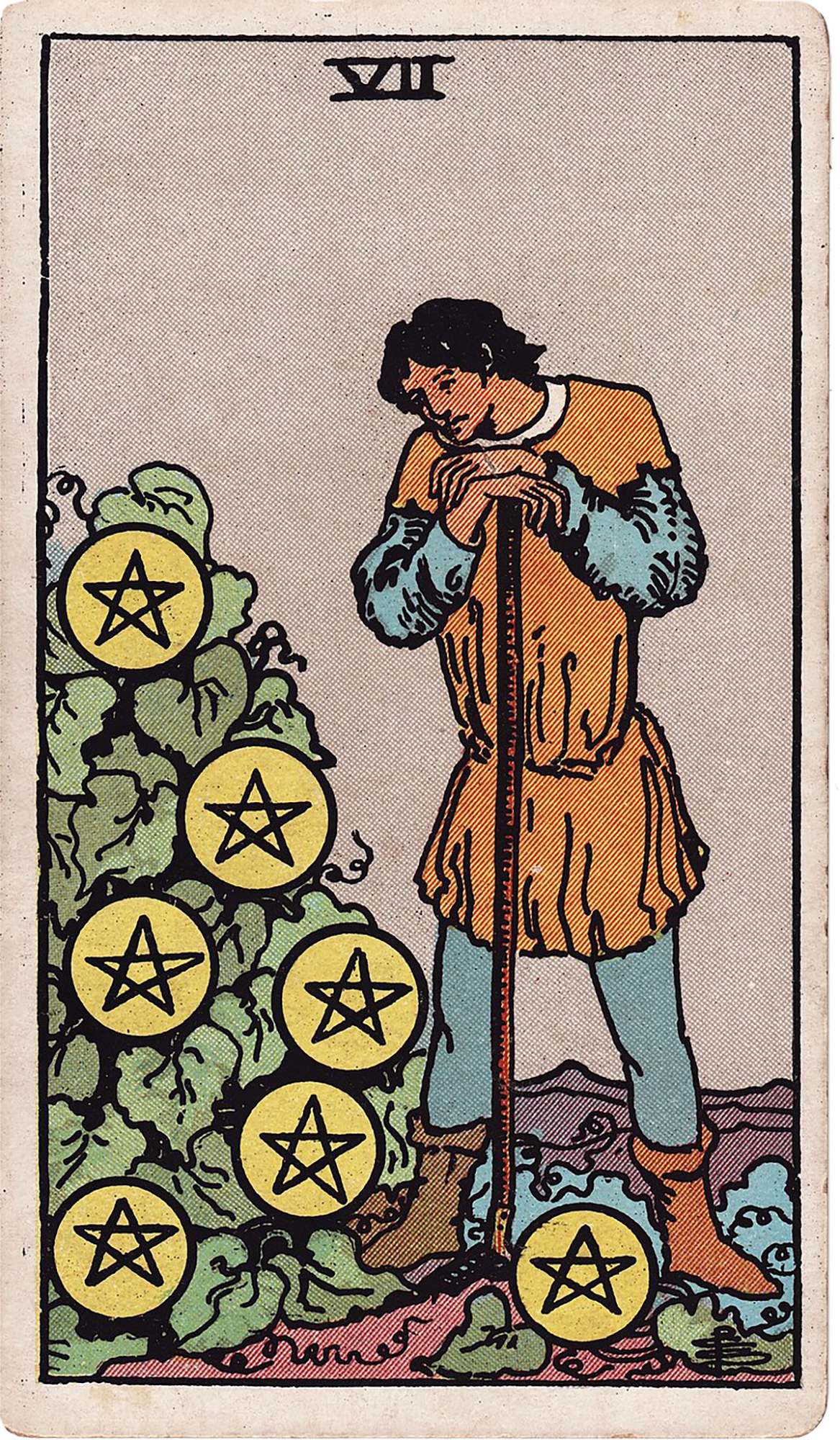
Begin with the picture: the supplied 7 of Pentacles shows a solitary figure leaning on a hoe (or staff), paused in a plot where pentacles appear like fruit on a shrub. Houses or a distant town sit on the horizon. The posture is reflective rather than celebratory. In Rider-Waite-Smith language this image emphasizes work, cultivation, and delayed fruiting. The tool suggests ongoing labor; the pentacles on the bush highlight that the investment has produced visible results, but the yield is not yet harvested. The distant buildings remind you that this is part of a larger life or career landscape, not a closed system. Map these elements to reading keywords: effort, gradual growth, review, patience, practical assessment, long-term resource management. Use the supplied upright description to remind yourself that the card invites “an honest assessment of whether the investment still makes sense” and that the energy is practical: "ask for a response that fits the present stage rather than an abstract ideal." The supplied reversed description directs you toward blockages: impatience, poor ROI, sunk-cost thinking, or a process that is understood intellectually but not embodied. Always let the image guide the tone of your interpretations. Is the figure attentive and calm, or tired and frustrated? Are the pentacles abundant or sparse? Those visual details help you nuance the basic upright/reversed meanings offered in the supplied text.
Interpreting upright versus reversed in practice
Readers often treat reversal as simply the opposite of upright meaning. With the supplied 7 of Pentacles text, the better method is to ask: where is this process stuck? Upright emphasizes a healthy review point: there has been steady effort, measurable progress, and now a stage requires assessment. Use questions such as "What milestones exist?" and "What would strengthen the constructive side of this pattern?" The upright card encourages practical steps: tweak the plan, continue tending, or prepare to harvest when mature. Reversed, the supplied description tells us to look for impatience or misapplied persistence. Ask questions like "Are we continuing because of loyalty to sunk costs?" or "Is the person thinking about growth as an ideal but not making the daily changes?" Reversal can mean the problem is internal—someone may be restless or privately doubtful even if everything looks fine externally. It can also mean the energy is excessive (overworking without rest) or deficient (not investing enough). The reading task is to locate the blockage and name a concrete remedy: simplify the workflow, set measurable goals, release a failing project, or deepen practice to make the lesson lived instead of merely intellectual.
Technique: how to read the supplied 7 of Pentacles in a spread
1) Note position and question: A 7 of Pentacles in a career position differs from the same card in a love position. Anchor every interpretation to the job the position asks the card to perform. 2) Anchor to imagery: Describe the card to the querent ("notice the worker pausing, the tool, the pentacles on a bush, the distant town") and ask which detail resonates. That response tells you whether patience, reassessment, or concern about effort will be the most useful direction. 3) Ask clarifying questions: "What metrics are you using to measure progress?" "What would a fair harvest look like in six months?" "What are you willing to change?" 4) Use timeframe cues: Pentacles deal with long-term processes. Expect weeks, months, or years for substantial change; short-term impatience is a red flag. 5) Check the surrounding cards: the supplied upright text says use neighbors to see whether energy is beginning, developing, reaching pressure, or resolving. If adjacent cards signal completion, the 7 may mean 'almost there'; if they show obstacles, it may mean 'reassess.' 6) Consider reversals as process-focused, not moral judgments: name the stuck place and offer a pragmatic next step. Reading tip: When the 7 of Pentacles appears, ask the querent to quantify one indicator of progress (revenue, client retention, skill hours, emotional milestones). This moves the session from abstraction toward measurable decisions.
The 7 of Pentacles as a career checkpoint (deep dive)
Treat the supplied upright 7 of Pentacles as a literal checkpoint. Career questions the card answers well: "Is this job worth continuing?" "Should I stay in this profession?" "Is my current project on track?" The card says: you’ve worked, you’re seeing growth, and now you must assess. Steps for a career reading using the supplied card: - Take inventory: List investments (time, money, relationships, reputation) and visible returns (skills learned, clients acquired, portfolio pieces, incremental income). The imagery of the pentacles-on-a-bush encourages counting visible fruits rather than speculating on invisible rewards. - Apply the 'present stage' test: The supplied upright description emphasizes responses that fit the present stage. If the bush shows small fruits, the appropriate response is continued tending with small milestones, not a major career pivot. If the bush is abundant in the image, you may prepare to harvest and negotiate promotions, transitions, or scaling. - Ask about alternatives: Reversed energy often shows sunk-cost thinking—are you staying because leaving would mean admitting a loss? The supplied reversed text warns against persisting where adjustment is needed. Use a cost-benefit list to compare staying and leaving. - Consider resourcing: Pentacles include money and material stability. Is the querent financially able to continue investing? If not, the card's pause may signal practical restructuring (reduce overhead, freelance, part-time study). - Look at skill vs. role: The 7 often appears when skill-building is progressing but the current role doesn’t reward it yet. The reading should address whether to shift to roles that better monetize or acknowledge the growing skill. Example career reading (upright): A mid-level engineer draws the supplied 7 of Pentacles in career position. Imagery: the worker is paused, the pentacles are visible but unharvested. Interpretation: you have the skills and some outcomes; this is a review point. Action: document completed projects, quantify impact, request a performance check or create a six-month plan with measurable goals. Example career reading (reversed): Same querent draws the supplied reversed 7. Interpretation: impatience and a feeling of under-return. Ask whether you’re staying because of loyalty or fear. Action: identify one low-value activity to stop, and one experiment to test alternative paths for three months.
Practicing useful patience: exercises and client prompts
The 7 of Pentacles often invites a disciplined patience rather than passive waiting. Practical exercises: 1) Micro-metrics: pick one measurable output (e.g., number of proposals, hours on craft, sales calls) and track it for 30–90 days. The imagery of the bush with visible pentacles maps to tracking visible output rather than vague feelings of progress. 2) Review ritual: schedule monthly checkpoints to evaluate the metric and adjust tactics. 3) The 'small harvest' experiment: select one deliverable you can finish within a month to create feedback and confidence. 4) Sunk-cost audit: make a two-column list of investments vs. returns to counter wishful persistence. 5) Embodiment practice: the supplied reversed text notes intellectual understanding without embodied habit. Create a daily 10–20 minute ritual that practices the desired skill (coding, writing, pitch practice) until it moves from idea to habit. Client prompts to use when the supplied 7 appears: - "Show me one visible sign you can point to that indicates progress." - "What would a fair assessment of this project look like in three months?" - "If we set one measurable goal for the next month, what would it be?" - "What are you afraid of losing if you stop investing?" These prompts convert the card's slow, practical energy into tangible action plans.
Interpretations across common reading contexts
Below are short, image-anchored interpretations using only the supplied 7 of Pentacles meanings. Love (upright): The 7 shows a relationship in progress. The work has been put in; there are visible signs that the partnership can bear fruit, but it’s time for honest assessment. Ask whether both partners are contributing and whether the current investment aligns with long-term goals. The tool and tending imagery encourages couples to agree on shared chores and growth steps. Love (reversed): Impatience about relationship returns, or clinging because of invested history rather than present health. The supplied reversed text suggests examining whether one partner is staying for comfort or habit. Action: clarify needs and set a short test period to see if both will match effort. Money (upright): A practical money card. You’ve invested; returns are visible but not fully realized. The image says to keep records, budget for the medium term, and avoid speculative gambles. If you’re saving for something, this is a sign the plan is working but requires continued discipline. Money (reversed): Poor return on effort or mismatched investments. Watch for sunk-cost behavior—continuing to fund an underperforming investment because you’ve already put money in. The remedy is to re-evaluate thresholds for acceptable return and cut losses where necessary. Advice (upright): Take a careful audit. The card’s posture suggests stepping back to review the work. Give yourself a practical to-do list that fits the current stage; don’t leap to grand solutions or ignore incremental maintenance. Advice (reversed): The advice is to stop pretending the process is fine. Clarify where impatience or overcommitment is harming outcomes. Simplify procedures, delegate, or pause to avoid burnout. Challenge (upright): The challenge may be to trust slow progress. The worker’s pause is the healthy challenge: to keep going while making sensible adjustments. Challenge (reversed): The challenge is internal: impatience, discouragement, or over-investment in a failing approach. The card asks you to name the error and experiment with a small change. Person (upright): Someone steady, practical, and willing to do the work. They may be a gardener type—methodical, patient, and concerned with results over glamour. Describe the person with the supplied imagery: hands-on, observant, and realistic. Person (reversed): A nervous or restless person who either abandons projects prematurely or persists in ways that ignore changing evidence. They might be defensive about their past investments. Outcome (upright): Incremental, practical improvement and a harvest that aligns with effort and time. The image’s distant houses indicate that this outcome fits into a wider life pattern—not a sudden overthrow. Outcome (reversed): Stalled results, wasted effort, or a necessary pivot. The outcome requires intervention—simplifying, pausing, or redirecting resources. Spiritual reflection (upright): Contemplative patience: spiritual growth often looks like cultivation rather than revelation. Use the supplied image to meditate on steady tending, asking what small daily practices are bearing fruit. Spiritual reflection (reversed): Spiritual impatience or the ritual equivalent of sunk-cost thinking—performing rituals mechanically without inner change. The remedy is to simplify practice and reconnect intention to action.
Sample readings and scripts
Short sample reading 1 — Career checkpoint, upright 7 of Pentacles: Reader: "You drew the supplied 7 of Pentacles in career. Notice how the figure is paused, leaning on a tool while the pentacles are visible on the plant. What detail draws your attention?" Querent: "The way they’re looking at the plants — like they’re waiting." Reader: "Yes. That looking is the card’s main job: a review. You’ve been planting ideas and doing the work. The card asks for a practical inventory. Let’s list three measurable results from the last six months and decide one change you’ll test for the next 90 days." Short sample reading 2 — Career checkpoint, reversed 7 of Pentacles: Reader: "You drew the supplied reversed 7 of Pentacles. The card often points to impatience or staying too long in something because of what you’ve already invested. Tell me what you feel you’ve already committed that would be difficult to give up." Querent: "I’d lose seniority and a steady paycheck." Reader: "The card asks you to test whether the cost of staying exceeds the benefit. Let’s make a two-column list of what staying gives you and what it costs. Then we’ll pick one low-risk experiment to test alternatives — perhaps a side project two evenings a week — and set a deadline to evaluate." These scripts model how to anchor meaning in the image, invite client responses, and translate the card’s slow energy into measurable next steps.
Common interpretive mistakes and how to avoid them
1) Mistake: Treating upright as only positive and reversed as only negative. The supplied texts make clear: upright asks for review and practical action, reversed asks you to find the stuck process. Avoid moralizing. 2) Mistake: Advising 'wait' without specifying what waiting means. The 7 of Pentacles invites active patience. Always give concrete measures for the pause (metrics, dates, experiments). 3) Mistake: Ignoring surrounding cards. The supplied upright description instructs using neighbors to determine stage. Without that context you may misread whether the card means beginning, steep development, pressure, or resolution. 4) Mistake: Confusing persistence with stubbornness. The imagery is about cultivation; ask whether continued investment is strategic or a sunk-cost trap. 5) Mistake: Reading reversal as the querent’s character trait rather than a situational blockage. The reversed 7 often indicates a process issue, sometimes not visible to others. Phrase interpretations as offers of focus rather than identity labels ("you tend to..." becomes "this process shows signs of..."). 6) Mistake: Forgetting time scales. Pentacles usually reflect medium- to long-term cycles. If a querent expects instant results, use the card to re-align expectations and set realistic timeframes.
Putting it together: a step-by-step practical reading method
Use this checklist whenever the supplied 7 of Pentacles appears: 1) Describe the image to the querent and ask which detail resonates. Keep them involved in the interpretive process. 2) State the supplied core meaning after they respond (upright: long-term effort at review; reversed: impatience, poor ROI, sunk-cost patterns). 3) Translate to position: apply the meaning to the spread position (career, finances, love, etc.). 4) Ask for measurable indicators of progress relevant to the question (numbers, milestones, behaviors). 5) Propose a small experiment or review period (30–90 days) with specific metrics. 6) Identify one thing to stop (if reversed) or one small maintenance step to continue (if upright). 7) Schedule a follow-up if possible, or suggest journaling prompts to track outcomes. 8) If surrounding cards exist, use them to define whether the 7 is beginning, mid-process, or nearing resolution. This method turns the 7’s conservative energy into actionable, time-bound steps.
Conclusion and how to continue practicing with the supplied 7 of Pentacles
The supplied 7 of Pentacles is a practice card: it trains readers and querents to replace drama with disciplined review. Keep returning to the image: the paused worker, the visible pentacles, the distant town. Ask practical questions, set measurable experiments, and watch for signs of sunk-cost thinking. Practice readings where the 7 appears in different positions until you can move quickly from image to question to action plan. Over time you’ll learn to use this card to cut through wishful thinking and shape realistic paths forward.
Practice questions
• Which detail of the supplied 7 of Pentacles image draws your attention first, and why might that detail be significant to the situation?
• What measurable indicator could you choose to represent progress in the area the card addresses?
• When have you stayed in a project because of past investment rather than present value? How would the reversed 7 of Pentacles help you evaluate that pattern?
• What one small experiment could you run for 30–90 days to test whether continued investment is justified?
• How can you translate passive waiting into active, practical patience in your current work or relationship?
• What surrounding evidence would make you see the supplied upright 7 of Pentacles as 'almost ready to harvest' versus 'needs more tending'?
• Which habits need to become embodied (not just intellectually understood) to change the reversed 7 of Pentacles into its healthier expression?
• How would you explain the 7 of Pentacles’ message to a client who wants immediate results?
Comments
Sign in to comment.
Continue learning
Exploring The High Priestess in Career Relationships and Personal Growth
The High Priestess card in the tarot deck invites readers to explore intuition, hidden knowledge, and inner wisdom across various life contexts. This article examines how The High...
The Fool in Life Transitions and New Beginnings
The Fool card embodies the spirit of beginnings, curiosity, and the leap of faith required during life transitions. This article explores The Fool’s meanings across various reading...
Understanding The Chariot Card in Personal Ambition and Overcoming Obstacles
The Chariot card represents the power of focused will, disciplined action, and choosing a clear direction amid competing impulses. Upright, it encourages decisive steps forward usi...
Understanding The Hermit in Self Discovery and Spiritual Enlightenment
The Hermit card in the Rider-Waite-Smith deck embodies themes of introspection, solitude, and spiritual wisdom. This article examines how The Hermit's upright and reversed position...
Exploring The Hierophant in Modern Spiritual Practices and Personal Development
The Hierophant tarot card symbolizes structured wisdom, tradition, and the pursuit of knowledge through established systems. This article explores how The Hierophant’s upright and...
Applying The Star Card to Foster Hope and Renewal in Personal Growth
The Star card in Tarot symbolizes hope, authenticity, and the process of steady renewal. In a single-card reading, The Star encourages embracing what is present, cultivating openne...
Understanding The Wheel of Fortune in Tarot Readings for Life Cycles and Change
The Wheel of Fortune card in Tarot is a powerful symbol of cycles, change, and the dynamics of fate and free will. This article explores the card’s upright and reversed meanings, a...
Understanding The Hermit Card in Solitude Reflection and Guidance
This article offers an in-depth exploration of The Hermit tarot card as a single-card reading in different contexts such as love, career, money, advice, challenge, person, outcome,...
Understanding The Tower in Tarot for Navigating Sudden Change and Crisis
The Tower card in Tarot symbolizes sudden, often disruptive change that destroys false foundations and compels honest reassessment. This article provides a comprehensive exploratio...
Understanding The Hanged Man in Personal Sacrifice and Spiritual Growth
The Hanged Man tarot card embodies the themes of intentional pause, surrender, and gaining new perspectives that foster personal sacrifice and spiritual growth. In this article, we...