
The World Card as Closure and Launchpad for Crafting Your Next Chapter
This article explores The World card as a dual symbol of closure and new beginnings, anchored to the supplied The World card image and its upright and reversed descriptions. It explains how the card's Rider-Waite-Smith imagery supports interpretations, and then applies the card across contexts—love, career, money, advice, challenge, person, outcome, and spiritual reflection. Readers will learn a step-by-step single-card technique, common pitfalls, practical examples, and exercises to use The World as a launchpad for intentional next steps rather than a deterministic prediction.
Cards explored in this article
 The World
Introduction: The World as Completion and Propulsion
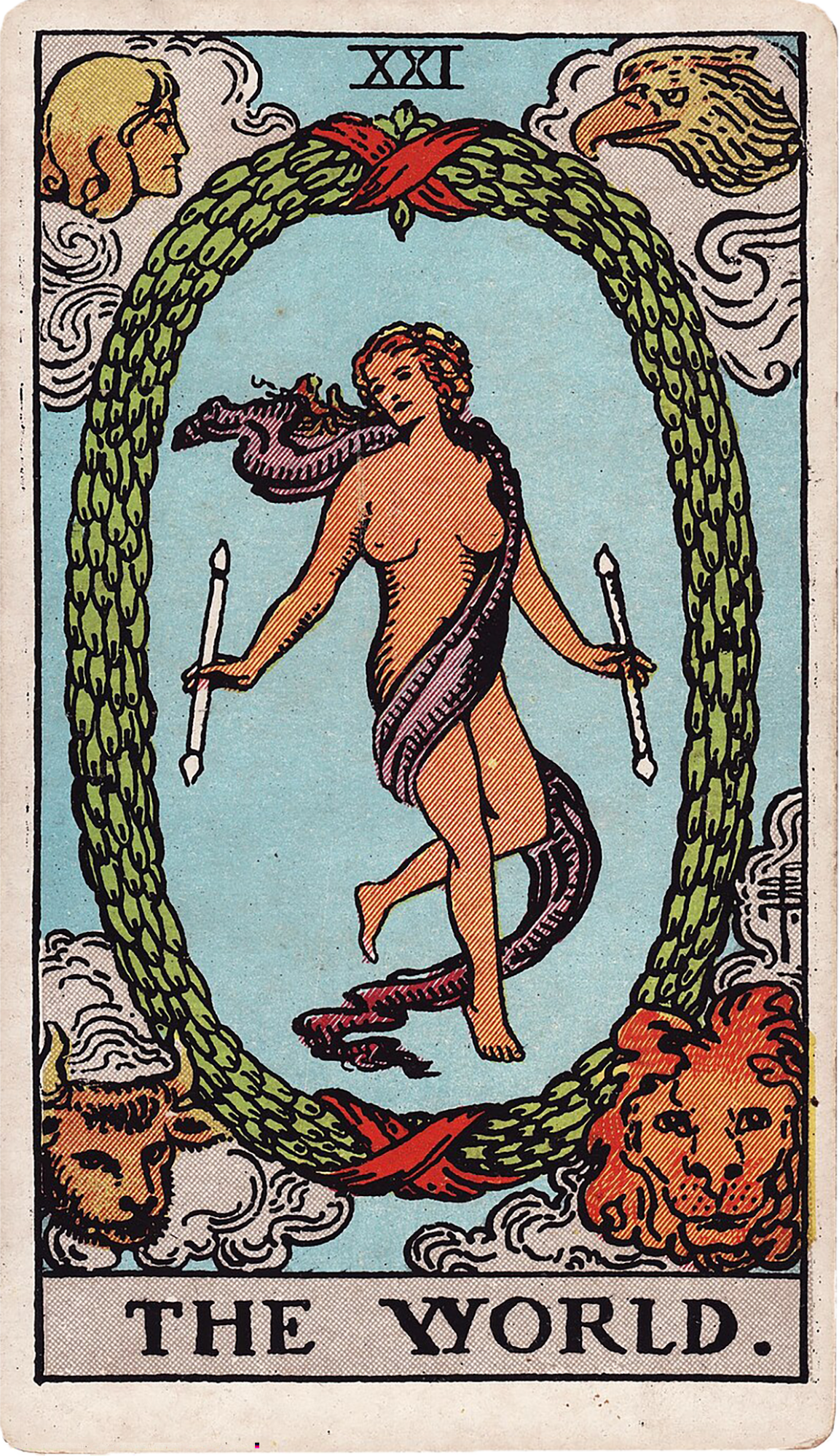
The supplied The World card image presents the classic Rider-Waite-Smith scene: a central figure within a wreath, dancing with two wands, surrounded by the four living creatures in the corners. Use that exact image and its two provided orientations as the basis for all interpretation. Upright, the supplied text states: "Upright, The World emphasizes recognizing completion, integrating what has been learned, and allowing achievement to become a foundation for the next cycle." Reversed, the supplied text states: "Reversed, The World often turns attention toward incomplete business, delayed closure, perfectionism, or difficulty recognizing that enough has been accomplished to move on." Keep both formulations in mind: the card names completion, synthesis, and the threshold where achievement becomes launchpad; its reversal names blockage, delay, and over-attention to what is unfinished. This article treats The World as a single-card study: how the card reads by itself across multiple life contexts and how you can use it practically to craft your next chapter.
Reading the Imagery: Rider-Waite-Smith Symbols and How They Anchor Meaning
Anchor every interpretation to what you can see in the supplied card. In the Rider-Waite-Smith composition: the dancer is enclosed by a wreath (completion, cycle), holding two wands (balance, control of polarity), and posed mid-step (movement that already contains completion). The four creatures in the corners — often read as angel (air), eagle (scorpio/water), bull (taurus/earth), and lion (leo/fire) — represent the four fixed signs, the idea of stability within change, and the four corners of human experience. When you read The World upright, these visual elements support the card's textual directive: integration, visible achievement, and readiness to step into a new cycle while holding balance. When reversed, the same images can appear stalled: the wreath may feel like a cage, the dance like hesitation, the wands like tools unused or grasped too tightly. Always describe aloud or in your notes what you literally see in the supplied image before moving to abstract meaning. This habit helps avoid projection and keeps your reading grounded in the card's concrete symbols.
How to Use The World as a Single-Card Oracle: Technique and Method
Single-card readings demand precision because one card must hold context, advice, outcome, and nuance. Use this practical method when The World is the card you draw: 1) Pause and anchor. Look at the supplied The World card image carefully for at least 60 seconds. Note the dancer, wreath, wands, and the four creatures. Describe these aloud or in your head. 2) Read the orientation. Decide if the card is upright or reversed and recall the supplied text. Upright: completion, integration, foundation for the next cycle. Reversed: incomplete business, perfectionism, delay in recognizing 'enough.' 3) Set context. Ask the specific question you want answered (love, career, money, advice, challenge, person, outcome, spiritual). Keep the question narrow. Single-card readings amplify ambiguity when questions are vague. 4) Translate imagery to context. Use the steps in this article to map the wreath, dance, wands, and creatures to your question. For example, in career, the wreath might be a finished project; the dancer's balance could be a readiness to accept a new role. 5) Identify the action. The supplied upright text prompts a practical question: "Where would a direct response, clearer boundary, deeper honesty, or more deliberate choice move the situation forward?" Pick one actionable next step that fits proportionally with the scope of completion signaled by the card. 6) Anchor outcome vs. process. The World often signals endpoint plus doorway. Decide whether the emphasis is on celebrating achieved completion or on preparing the practical logistics for a next move. 7) Note shadow elements. If reversed, list what remains unfinished or over-polished, and plan one micro-step to reduce paralysis (e.g., a deadline, a short conversation, a small milestone). This method keeps your single-card reading usable and ethical: specific enough to be practical, cautious enough to avoid deterministic claims.
The World Upright Across Contexts
Below are concise readings of the supplied upright wording and imagery in specific contexts. Each reading begins from the supplied upright description: "Upright, The World emphasizes recognizing completion, integrating what has been learned, and allowing achievement to become a foundation for the next cycle." The emphasis is on using what is already present. Love and Relationships: When The World appears upright in a love question, the wreath and dancer suggest a relationship that has reached a significant milestone — an integration of lessons and a mature alignment between partners. This can indicate a relationship ready to move to a next phase (commitment, new patterns of communication) or a dignified ending that leaves both people intact and whole. Use the supplied upright prompt: ask where clearer boundaries or deliberate choice would move the relationship forward. Example action: have the conversation that honours what was built and clarifies what next means for both. Career and Work: In career contexts the upright card signals a finished project, recognition, or a felt competency that allows a person to pivot. The dancer holding two wands suggests being able to direct energy between roles or priorities. Practically, this reading encourages the querent to consider which achievements can be documented, leveraged, or celebrated to open new doors. Example action: update your portfolio or request a performance review that formalizes your completed contributions. Money and Finances: Upright The World can indicate that a budget cycle, debt repayment, or savings goal is coming to completion — or has reached a new level of visibility. The wreath symbolizes a closed loop; the next step is to use financial stability as a base for risk that is proportionate to resources (investment, education). Ask: what small, deliberate step aligns with my long-term cycle now that a near-term goal is met? Advice and Guidance: The supplied upright instruction urges conscious engagement with what is available. As advice, The World tells the querent to act on what is visible and integrated. Don't wait for perfect clarity; pick the next proportionate step, and ensure it honors the completion that has just occurred. The dancer's motion suggests momentum that wants channeling, not stalling. Identified Challenge: As a positive upright sign, The World can nevertheless illuminate challenges related to choice and transition. Even when things are complete, the challenge is not automatic comfort. The card asks the reader to examine whether they are ready to claim the result or whether they are minimizing it. The useful task is to name one boundary or decision that will convert completion into a launchpoint. Person or Role: Upright, The World as a person archetype describes someone who has integrated experience and now acts with measured confidence: perhaps a mentor, an accomplished colleague, or the client who feels whole after a transformation. In a reading, adopt a stance of respect for completion and listen to what such a person would recommend. Outcome: Upright outcome readings are encouraging: closure that leads to clear opportunities. The outcome is not automatic ease; rather, it is a stable place from which the querent can choose intentionally. The supplied wording asks readers to look for which lesson is already present in behaviour — the outcome often surfaces as a recognizable pattern repeated but now usable. Spiritual Reflection: Spiritually, The World upright is integration of lessons into selfhood — a sense that diverse experiences are woven into meaning. The wreath and the four creatures indicate wholeness. Use ritual, journaling, or symbolic acts to mark the end of a cycle and to consciously set intention for the next.
The World Reversed Across Contexts
Now read the supplied reversed description as the anchor: "Reversed, The World often turns attention toward incomplete business, delayed closure, perfectionism, or difficulty recognizing that enough has been accomplished to move on." Reversal is not automatically bad; it is a diagnostic. It tells you where the upright quality is blocked or distorted. Love and Relationships: Reversed, the wreath may feel like a trap rather than completion. This can indicate a relationship stuck in rehashing, perfectionistic standards, or an inability to acknowledge that a phase has genuinely ended. The reading's work is to identify what 'unfinished business' requires a small, specific closure. Example action: write and deliver a short letter that names the change you both face. Career and Work: In career matters a reversed World suggests projects that never get filed as complete, repeated edits, or refusal to accept a final product. It might also indicate inner resistance to promotion or change. The practical move is to define a cutoff: a final version, a sign-off, or a simple portfolio update that marks completion. Money and Finances: Financial reversal points to ongoing renegotiation, perfectionism in planning, or a refusal to accept a 'good enough' savings plan. The card nudges the querent to create a minimal viable financial step — a small auto-transfer to savings, a capped experimental investment — to break analysis paralysis. Advice and Guidance: As advice, reversed The World recommends diagnostic curiosity: Where is completion being thwarted? What boundary or explicit end needs communicating? Test for over-internalization — is this something you're processing mentally instead of acting on? The most effective move is a micro-decision that reduces uncertainty. Identified Challenge: Reversed, the challenge is internal: difficulty acknowledging what is done, or perfectionism that prevents forward movement. The card may also imply delayed closure because of external constraints. The reader must distinguish between external delay and inner perfectionism; this determines whether the solution is negotiation or psychological reframing. Person or Role: A reversed World-person often appears as someone who is still stuck in process, perhaps a colleague who cannot declare a project finished, or an individual who publicly celebrates less than they have achieved. In the reading, consider whether this person needs explicit permission to close or an accountability structure. Outcome: The reversed outcome often suggests a pause rather than a permanent failure. It invites the querent to design an intervention that converts incompletion into a manageable end. The reading should outline one or two micro-actions that will clarify whether the delay is temporary or requires deeper restructuring. Spiritual Reflection: Spiritually, reversed The World signals that lessons feel unresolved. Ritual, naming grief, or small closure ceremonies can help. The emphasis is on noticing what has not yet been integrated and treating that discovery as the first step toward completion rather than a final verdict.
Practical Examples and Mini Readings
Example 1 — Love (Upright): A querent draws the supplied The World upright after asking whether their long-term partnership can shift into cohabitation. Anchor to image: the wreath as a milestone, dancer as readiness. Interpretation: The relationship has reached a maturity that supports a new phase; the next practical step is a conversation to set timelines and mutual expectations. Micro-action: pick a date to discuss logistics; list three non-negotiables each. Example 2 — Career (Reversed): A professional keeps reworking the same report and feels stalled. The supplied reversed text indicates perfectionism and delayed closure. Anchor to image: the wreath may be experienced as a loop. Interpretation: The project is close enough to complete; the block is internal. Micro-action: set a two-hour deadline to finalize and submit the current version, then schedule a reflection on what to change in the next iteration. Example 3 — Money (Upright): A saver draws The World upright when asking about their emergency fund. Anchor to image: the wreath as a closed goal. Interpretation: The fund is reaching completion; now use this stability to plan a conservative investment or to set a new financial goal. Micro-action: open a separate account for the next goal and automate a small monthly transfer. Example 4 — Spiritual (Reversed): A person feels their spiritual practice is stagnant. The reversed reading suggests incomplete integration. Anchor to image: the dancer is mid-step but not moved forward. Interpretation: the practice needs a ritual that marks an ending or renewal. Micro-action: design a short ritual that names what you are releasing and commit to a three-week new practice to test integration. These examples show how to keep interpretations practical, anchored to the supplied image, and proportionate to the question.
Common Mistakes and How to Avoid Them
1) Treating The World as either always good or always bad. Avoid binary thinking. The supplied text explicitly shows duality: upright invites action and integration; reversed invites diagnostic work. Use orientation and imagery together. 2) Ignoring the supplied wording. The card's upright and reversed descriptions are your primary anchors. Repeating the supplied phrases in your notes can help you stay aligned. 3) Making grand predictions. The World signals cycle transition, not guaranteed outcomes. Use micro-actions and probabilities rather than deterministic statements. 4) Neglecting proportionality. The World may indicate completion of a phase, but not necessarily the end of life’s work. Keep responses proportionate to the scope of the question. 5) Forgetting to look for resistance. When The World is reversed, the real story is often internal: shame about celebrating, fear of judgment, or perfectionism. Ask what small step reduces the pain of finishing. 6) Over-relying on imagery without context. The Rider-Waite-Smith details are crucial, but always tie imagery back to the querent’s concrete situation. Don’t let symbolic richness replace the client’s lived facts.
Interpretation Logic and How to Form Judgments Ethically
Interpretation of The World should follow a clear logic chain: observation → orientation → context mapping → actionable inference → ethical framing. Observation: Describe the supplied image: dancer, wreath, wands, creatures. Orientation: Note upright or reversed and recall the supplied exact descriptions. Context Mapping: Translate the symbols into the question’s domain by asking how 'completion,' 'integration,' 'delayed closure,' or 'perfectionism' appear there. Actionable Inference: Offer one or two concrete, proportionate actions. Keep them small and testable. Ethical Framing: Use language that preserves agency: "This card suggests..." rather than "This will happen." The World is a tool for empowerment: it either asks you to seal what is done or to clear what prevents sealing. This chain reduces speculative reading and increases useful outcomes for querents.
Exercises to Practice with the Supplied The World Card
1) Visual Description Practice: Spend five minutes writing an objective description of the supplied image. No meanings, just what you see. Then add a one-sentence interpretation. Compare to the supplied upright and reversed texts. 2) Micro-Action Planning: Draw The World for a current small decision. Use the method in this article to define a single micro-action. Commit to that action for one week and journal the result. 3) Reversal Diagnosis Drill: When The World appears reversed, list five things that could be keeping closure from happening. For each, write one immediate experimental step you could test in 48 hours. 4) Context Switching: Pull the supplied card and run quick one-minute readings across the eight contexts used in this article. Practice keeping answers to one sentence each while anchoring to the imagery. These exercises train you to read the supplied card quickly and responsibly.
Bridging Closure to Launch: Rituals and Practical Habits
A useful way to translate The World’s energy into life is to combine a small ritual with practical habit design. For closure rituals choose something symbolic: write a short statement naming what you finished and either keep it in a jar or burn it safely. For launch habits choose a small repeating action that embodies the next cycle (a five-minute planning practice, a weekly check-in). The supplied upright description emphasizes using what is available now; therefore choose rituals and habits that fit into existing routines. If the card is reversed, use a brief ritual specifically for identifying stuck places (e.g., a written list of 'unfinished business') paired with a practical habit that addresses one item per week. The World encourages integration of symbolic and pragmatic acts — the wreath is symbolic; the wands are tools. Use both.
Conclusion: The World as a Compass for the Next Chapter
The supplied The World card image and the upright/reversed texts provide a high-quality single-card lens for endings that matter and beginnings that are intentional. Upright, The World invites you to recognize what is complete and to use that completion as a secure stepping stone. Reversed, it asks you to diagnose what prevents you from crossing the threshold. In practical reading work, always anchor to the image, speak in proportional actionable steps, and treat the card as an invitation to agency rather than as destiny. Use the methods and exercises in this article to turn symbolic insight into measurable change when crafting your next chapter.
Practice questions
• What visible elements of the supplied The World image (dancer, wreath, wands, four creatures) most resonate with your current life situation and why?
• If The World appears upright for one area of your life, what is one proportionate micro-action you can take this week to convert completion into momentum?
• If The World appears reversed, which piece of unfinished business is most likely to be contributing to your delay and what is one three-step plan to test whether it is internal or external?
• How would you design a small ritual and a simple habit that together honor an ending and begin a new practice?
• When you feel tempted to wait for certainty, how can the supplied upright wording prompt you to choose a deliberate next step instead?
Comments
Sign in to comment.
Continue learning
Understanding the Synergy Between The Empress and The Emperor in Tarot Card Combinations
This article delves into the intricate synergy between The Empress and The Emperor cards in Tarot, focusing on how their combined energies modify and enrich readings across various...
Using the Career Five Card Spread to Identify Growth Opportunities and Challenges
This article explores the Career Five Card Spread, a practical tarot method designed to spotlight growth opportunities, strengths, and obstacles within a career context. By analyzi...
Advanced Techniques for Combining The Moon and The Star to Enhance Intuition in Tarot Readings
This article explores advanced techniques to combine the symbolism and energy of The Moon and The Star Tarot cards to enhance intuition during Tarot readings. Drawing from traditio...
Unlocking Life Insights with the Celtic Cross Tarot Spread
This article offers a thorough exploration of the Celtic Cross Tarot Spread, focusing on its application within family and practical life contexts. Using a worked example featuring...
Decoding Transformation and Renewal with Death and The Star in Tarot Combinations
This article delves into the card combination of Death and The Star, two powerful Major Arcana cards from the Rider-Waite-Smith deck. It explores how their imagery and meanings int...
Enhancing Clarity in Complex Choices with the Five Card Cross Tarot Spread
The Five Card Cross Tarot Spread is a practical tool designed to clarify complex choices by breaking down the decision into manageable parts. This article explores each position in...
Using the Five Card Cross Tarot Spread to Navigate Career Changes with Confidence
The Five Card Cross Tarot Spread is a versatile and insightful tool for navigating career changes. This article guides learners through the method step-by-step using a practical ex...
Unlocking Personal Insight with the Seven Card Horseshoe Spread
The Seven Card Horseshoe Spread is a practical and insightful Tarot layout ideal for exploring personal and family dynamics. This article breaks down each position—Past, Present, H...
Finding Emotional Healing and Renewal with The Star and The Moon Tarot Combination
This article examines the rich interplay between The Star and The Moon tarot cards when they appear together in a reading. Using the traditional Rider-Waite-Smith symbolism and the...
Using the Career Five Card Spread to Uncover Professional Strengths and Opportunities
This article presents a comprehensive guide to the Career Five Card Spread, designed to help learners explore professional strengths and opportunities using five specific Tarot car...