
Uncovering the Historical Origins and Symbolism of the Wheel of Fortune Card in Tarot Tradition
The Wheel of Fortune tarot card is a powerful symbol rooted in ancient history and layered with complex symbolism. This article delves into its origins, traditional Rider-Waite-Smith imagery, and how to interpret the card’s upright and reversed positions thoughtfully. By understanding the card’s historical context and symbolic language, readers can approach it as a tool for recognizing change, timing, and personal responsibility rather than deterministic prediction. Practical techniques for reading the card in tarot spreads are included to guide learners in incorporating its lessons effectively.
Cards explored in this article
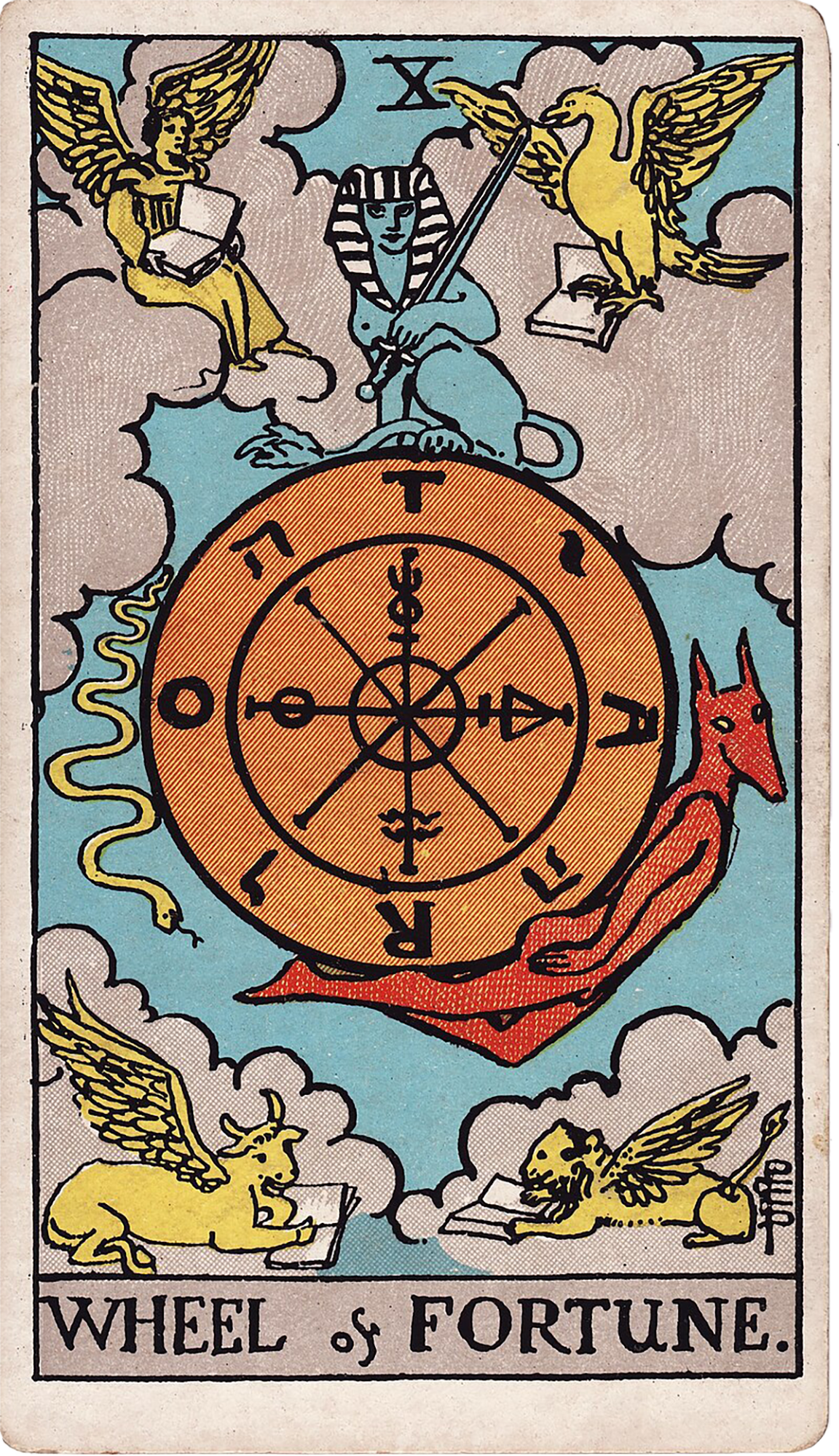 Wheel of Fortune
The Historical Origins of the Wheel of Fortune Card
The Wheel of Fortune card finds its roots deeply embedded in ancient philosophical and religious traditions long before tarot decks were created. The concept of the wheel as a symbol of fate and cyclical change dates back to antiquity, appearing prominently in Greco-Roman thought and Eastern philosophies such as Buddhism’s Wheel of Dharma. The medieval Christian tradition also adopted the wheel as a symbol to illustrate the unpredictable nature of fortune and the rise and fall of earthly powers. When tarot decks emerged in the 15th century, this imagery was incorporated to convey the idea that life's circumstances are in constant flux, governed by forces beyond human control. The Rider-Waite-Smith deck, designed in the early 20th century by A.E. Waite and Pamela Colman Smith, visually synthesizes these historical influences into a single, iconic image: a large wheel surrounded by symbolic figures representing the forces of fate, knowledge, and transformation.
Symbolism Embedded in the Wheel of Fortune Card
Examining the Rider-Waite-Smith Wheel of Fortune card reveals a layered network of symbols that communicate its themes. The central wheel itself is divided into sections containing alchemical symbols for mercury, sulfur, water, and salt—elements associated with transformation and the building blocks of life. Surrounding the wheel are four winged creatures: a man, an eagle, a bull, and a lion. These figures correspond to the four Evangelists in Christian iconography and also represent the fixed signs of the zodiac (Aquarius, Scorpio, Taurus, and Leo), suggesting stability amid change. The sphinx atop the wheel holds a sword, representing wisdom and knowledge overseeing the turning cycles. A snake descends on one side symbolizing the fall or descent of fortune, while the Anubis figure rising on the other side signifies rebirth and renewal. This combination highlights the dual nature of fortune—it can rise and fall but remains part of a continuous process.
Interpreting the Upright Wheel of Fortune Card
When the Wheel of Fortune card appears upright in a reading, it emphasizes recognizing a turning point or a moment of change that calls for adaptation and wise timing. The card does not promise ease or guaranteed success but rather highlights the quality of openness to circumstances and using what is available constructively. Practically, this means acknowledging the present situation with clarity and deciding the next appropriate step without waiting for perfect certainty. For example, if you draw the upright Wheel of Fortune during a reading about career, it may suggest that external conditions are shifting and you should be ready to adjust your plans or seize emerging opportunities. The lesson is to work with current energies consciously, identifying where honesty, clearer boundaries, or deliberate choices can move things forward. This approach respects the card’s symbolism of cycles and transformation without assuming total control over fate.
Understanding the Reversed Wheel of Fortune Card
The reversed Wheel of Fortune card often draws attention to resistance to change, repeated unproductive patterns, or poor timing. It is important to note that reversal is not inherently negative but indicates a blockage or distortion in the card’s upright energy. In some cases, the reversal points to internalized struggles where the individual is beginning to recognize old habits or fate’s influence but has not yet integrated the lessons. For instance, a reversed Wheel of Fortune in a relationship reading could suggest repeating the same conflicts or blaming external circumstances rather than taking responsibility. The card encourages reflection: where is this energy becoming difficult to access or misaligned? Reversal can also mark a psychological or private phase of change, signaling a pause before recovery or correction. Observing surrounding cards in a spread can clarify whether resistance, excess, or healing is occurring.
Common Mistakes in Reading the Wheel of Fortune Card
A frequent error is interpreting the Wheel of Fortune as a simple indicator of luck or fate without considering its deeper symbolic meaning. This can lead to a passive approach, expecting external forces to dictate outcomes rather than recognizing one’s role in timing and response. Another mistake is viewing the reversed card as purely negative or disastrous. Instead, the reversal invites nuanced exploration of where energies may be blocked or require internal adjustment. Additionally, ignoring the card’s imagery—such as the alchemical symbols and the four creatures—can cause readers to miss important context about cycles, balance, and interconnectedness. Finally, failing to ask practical, constructive questions like those suggested in the upright and reversed meanings reduces the card’s value as a guide for deliberate action.
Practical Techniques for Reading the Wheel of Fortune Card
To integrate the Wheel of Fortune card effectively in readings, begin by closely observing the card’s imagery and colors. Note the central wheel and its segments, the four winged creatures in the corners, and the figures of Anubis, the sphinx, and the snake. Reflect on what these elements suggest about cycles, stability, wisdom, and transformation. If the card is upright, ask: What turning point is becoming visible? Where can I adapt or use timing wisely? What practical step can be taken now without waiting for certainty? If reversed, inquire: Where is resistance or poor timing blocking progress? What repeated patterns need recognition? How might this energy be internalized or exaggerated? Use these questions to frame the reading’s narrative rather than relying on deterministic predictions. Consider the card’s position in the spread and its relationship to neighboring cards for deeper insight.
Anchoring Interpretation in the Wheel of Fortune’s Imagery
Returning to the supplied Wheel of Fortune card image throughout the reading enriches understanding by anchoring abstract concepts in concrete symbolism. The alchemical symbols on the wheel remind readers that transformation is ongoing and elemental. The four winged creatures emphasize that amidst constant change, there are stable forces or principles that can be trusted. The sphinx’s poised presence atop the wheel encourages thoughtful discernment and wisdom in navigating cycles. The snake and Anubis illustrate the inevitability of descent and ascent in fortune, reflecting the cyclical nature of experience. By repeatedly connecting meanings to these visual elements, readers can cultivate a more holistic, nuanced interpretation that respects both history and personal insight.
Common Questions About the Wheel of Fortune Card in Family and Tradition Contexts
Many learners ask how the Wheel of Fortune relates to family history and traditions. The card’s theme of cyclical change resonates strongly with family patterns, inherited behaviors, and generational shifts. Upright, it can suggest a pivotal moment where awareness of family dynamics allows for positive adaptation or breaking unhelpful cycles. Reversed, it may highlight resistance to changing entrenched family patterns or repeated issues affecting relationships. Another frequent question involves destiny versus free will: The card teaches that while some forces are beyond control, conscious response and timing are crucial, especially in family contexts where choices can affect multiple generations. Finally, learners often seek practical advice on how to use the card when facing uncertainty in family matters—the guidance is to observe what is currently visible and take proportionate, honest steps rather than waiting for perfect clarity.
Practice questions
• In what areas of your life do you notice cycles of change similar to those suggested by the Wheel of Fortune card?
• How can recognizing turning points help you make more deliberate choices instead of reacting passively to circumstances?
• When the Wheel of Fortune appears reversed, what internal blocks or repeated patterns might you explore for deeper understanding?
• How do the symbolic figures on the card—the sphinx, snake, and four winged creatures—reflect aspects of stability and transformation in your experience?
• What practical next step can you identify today by working constructively with your current situation, as advised by the upright Wheel of Fortune?
Comments
Sign in to comment.
Continue learning
Understanding the Synergy Between The Empress and The Emperor in Tarot Card Combinations
This article delves into the intricate synergy between The Empress and The Emperor cards in Tarot, focusing on how their combined energies modify and enrich readings across various...
Using the Career Five Card Spread to Identify Growth Opportunities and Challenges
This article explores the Career Five Card Spread, a practical tarot method designed to spotlight growth opportunities, strengths, and obstacles within a career context. By analyzi...
Advanced Techniques for Combining The Moon and The Star to Enhance Intuition in Tarot Readings
This article explores advanced techniques to combine the symbolism and energy of The Moon and The Star Tarot cards to enhance intuition during Tarot readings. Drawing from traditio...
Unlocking Life Insights with the Celtic Cross Tarot Spread
This article offers a thorough exploration of the Celtic Cross Tarot Spread, focusing on its application within family and practical life contexts. Using a worked example featuring...
Decoding Transformation and Renewal with Death and The Star in Tarot Combinations
This article delves into the card combination of Death and The Star, two powerful Major Arcana cards from the Rider-Waite-Smith deck. It explores how their imagery and meanings int...
Enhancing Clarity in Complex Choices with the Five Card Cross Tarot Spread
The Five Card Cross Tarot Spread is a practical tool designed to clarify complex choices by breaking down the decision into manageable parts. This article explores each position in...
Using the Five Card Cross Tarot Spread to Navigate Career Changes with Confidence
The Five Card Cross Tarot Spread is a versatile and insightful tool for navigating career changes. This article guides learners through the method step-by-step using a practical ex...
Unlocking Personal Insight with the Seven Card Horseshoe Spread
The Seven Card Horseshoe Spread is a practical and insightful Tarot layout ideal for exploring personal and family dynamics. This article breaks down each position—Past, Present, H...
Finding Emotional Healing and Renewal with The Star and The Moon Tarot Combination
This article examines the rich interplay between The Star and The Moon tarot cards when they appear together in a reading. Using the traditional Rider-Waite-Smith symbolism and the...
Using the Career Five Card Spread to Uncover Professional Strengths and Opportunities
This article presents a comprehensive guide to the Career Five Card Spread, designed to help learners explore professional strengths and opportunities using five specific Tarot car...