
Understanding The Wheel of Fortune in Navigating Life Cycles and Personal Transformation
The Wheel of Fortune card in the Rider-Waite-Smith deck represents cycles, change, and the interplay of fate and personal responsibility. This article unpacks its upright and reversed meanings, focusing on its application in different life contexts such as relationships, career decisions, financial matters, and spiritual reflections. By examining the card’s imagery—wheel, sphinx, snake, and figures—learners are guided on how to interpret turning points, timing, and adaptation. The article offers practical reading advice, highlights common interpretative pitfalls, and encourages using the card’s lessons to navigate personal transformation consciously rather than passively accepting fate.
Cards explored in this article
 Wheel of Fortune
Introduction to the Wheel of Fortune and Its Symbolism
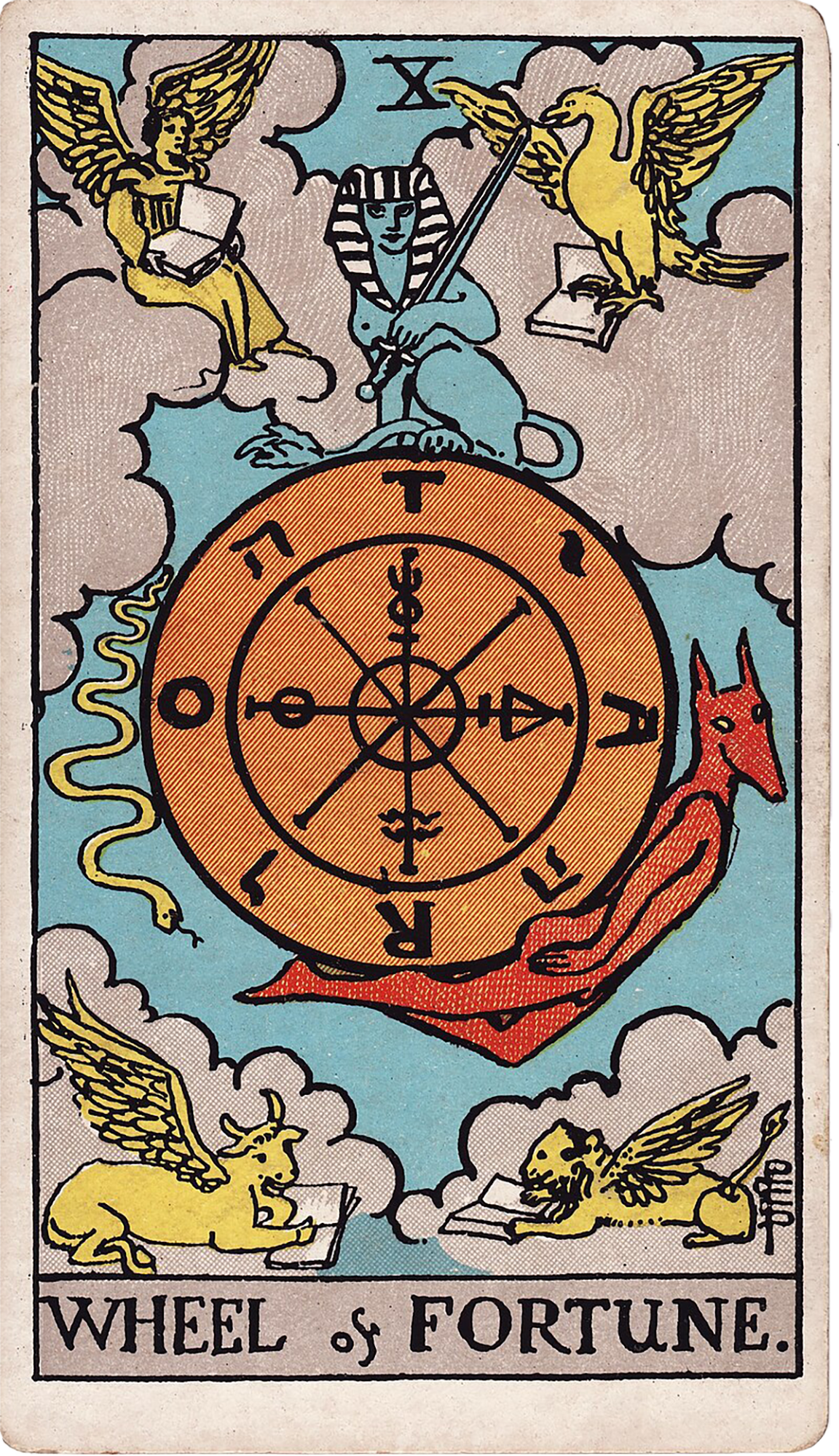
The Wheel of Fortune, as depicted in the classic Rider-Waite-Smith tarot deck, is rich with symbolic imagery: a large wheel inscribed with alchemical symbols and Hebrew letters, a sphinx perched atop holding a sword, a descending snake, and four winged creatures representing the fixed signs of the zodiac. This card embodies the cyclical nature of life, change, destiny, and the intersection between fate and free will. The wheel itself signifies constant motion, the inevitability of change, and the rise and fall inherent in all life cycles. Understanding this card’s symbolism is key to unlocking its meanings in various reading contexts, particularly in recognizing when a turning point is present and how to consciously engage with change.
Upright Wheel of Fortune in Different Contexts
When the Wheel of Fortune appears upright, it signals a pivotal moment where circumstances shift, offering an opportunity for adaptation and growth. In Love: The upright card indicates a turning point in relationships. It may signify the emergence of new romantic possibilities or a shift in an existing partnership's dynamic. It encourages embracing change rather than resisting it, suggesting that timing and openness to transformation are crucial. Rather than expecting effortless ease, the card advises a proactive attitude toward communication and boundary setting to move forward. In Career: The upright Wheel suggests a change in job status, new opportunities, or a shift in professional direction. It advises working with current circumstances rather than waiting for ideal conditions. Recognizing timing and embracing flexibility can help you capitalize on emerging chances. The card encourages asking what direct actions or choices can align you better with this new phase. In Money: Financial cycles are highlighted. The upright card can mean the end of a difficult period or the beginning of improved circumstances but cautions against complacency. It suggests conscious management of resources and awareness of market timing. The card invites reflection on where deliberate choices can stabilize finances amidst fluctuating conditions. As Advice: The Wheel of Fortune upright encourages acceptance of change, adaptability, and working with the flow of life’s cycles. It is a call to recognize when you can influence outcomes and when to relinquish control, focusing on next right steps rather than certainty. As Challenge: Here, the card challenges resistance to change or indecision. It asks the querent to notice where impatience or a desire for control blocks progress and to develop deeper honesty with oneself about the reality of the situation. As a Person: The upright Wheel person is someone adaptable, aware of timing, and open to life's cycles. This person accepts uncertainty as part of growth and uses change constructively. As Outcome: The card signals a turning point outcome, where the situation will likely progress but not necessarily become easier. It indicates movement and transformation but highlights the need for conscious engagement to realize positive results. In Spiritual Reflection: The card invites contemplation of cycles, karma, and the balance of destiny and free will. It encourages mindfulness of how inner attitudes influence outer circumstances and the importance of aligning actions with higher timing.
Reversed Wheel of Fortune in Various Contexts
When reversed, the Wheel of Fortune points to obstacles in the flow of change or distorted energies. In Love: The reversal may show repeated relationship patterns, difficulties in embracing change, or blaming external forces for stagnation. It invites introspection on resistance or denial of necessary transformations in love life. In Career: It could indicate delays, poor timing, or a reluctance to adapt professionally. The reversal warns against blaming fate for missed opportunities and encourages taking responsibility for choices. In Money: Financial instability, cycles of loss, or unconscious repetition of poor financial habits may be present. The card calls attention to internal blockages preventing progress and suggests reassessing attitudes toward money. As Advice: The reversed card advises examining where resistance to change exists and encourages patience and inner work to unblock energy. It signals a need to identify where control issues or distorted perceptions interfere with growth. As Challenge: It represents struggle with cycles, perhaps feeling trapped in repeating patterns or external circumstances outside control. The challenge is to recognize these dynamics and begin conscious change. As a Person: This individual may be struggling with acceptance of life's cycles, prone to fatalism, or caught in repetitive behaviors. They may need support to regain balance and flexibility. As Outcome: The reversal suggests a pause, setback, or correction period. While not necessarily negative, it highlights the need for awareness and adjustment rather than forced progress. In Spiritual Reflection: Reversed, the card turns inward, inviting deep psychological work to confront shadow patterns and resistance to transformation. It emphasizes the importance of timing and patience on a spiritual path.
Reading Technique and Practical Application
To effectively interpret the Wheel of Fortune, start by carefully observing the card’s imagery. Notice the central wheel with its letters T-A-R-O and alchemical symbols, which hint at the interconnectedness of elements and destiny. The sphinx atop, holding a sword, symbolizes clarity and the importance of intellectual balance during change. The snake descending (Typhon) suggests the release of old, destructive habits, while the four winged creatures connect the card to divine forces and stability amidst motion. When reading this card in a single-card spread, consider the following steps: 1. Identify if the card appears upright or reversed to establish the baseline reading. 2. Reflect on the querent’s question or life context to connect the card’s themes to their situation. 3. Ask what cycles or turning points are present and where adaptation is needed. 4. Use the card as a prompt to explore timing—what is ready to change, what requires patience, and where deliberate choices can shift momentum. 5. Avoid assuming the card guarantees immediate improvement or disaster; instead, focus on its lesson about the nature of change and personal responsibility. Common reading mistakes include: - Treating the Wheel purely as luck without acknowledging free will. - Overlooking the need for conscious engagement and assuming fate will solve problems. - Ignoring timing considerations and pushing for forced outcomes. - Misreading the reversal as purely negative rather than as a signal of blockage or internal process. By grounding interpretation in both the card’s rich symbolism and the querent’s context, the Wheel of Fortune becomes a powerful tool for navigating life cycles and transformation.
Examples of Single-Card Readings Featuring Wheel of Fortune
Example 1: Love Reading Upright A querent asks about the future of a long-term relationship. The Wheel of Fortune upright advises that a turning point is imminent. The reading suggests opening to change and honest conversations rather than resisting shifts. The card encourages recognizing which patterns need release (symbolized by the descending snake) and embracing new phases with clarity (the sphinx’s sword). Example 2: Career Reading Reversed A client wonders why job prospects are stalled. The reversed Wheel of Fortune highlights resistance to adapting skills or mindset. The advice is to examine unconscious blocks and stop blaming external forces. The card points to the need for patience and inner reflection before new opportunities arise. Example 3: Financial Outlook Upright Asked about improving finances, the upright card suggests a turning point is visible but financial stability requires deliberate management. The client is encouraged to take the next proportional step rather than waiting for full certainty, using awareness of cycles to avoid impulsive decisions. Each example ties back to the card’s imagery and core meanings, showing how the Wheel’s universal themes manifest uniquely depending on life area and card orientation.
Common Pitfalls and How to Avoid Them
One common pitfall is oversimplifying the Wheel of Fortune as a ‘luck’ card and assuming it means good or bad fortune will happen without effort. This undermines the card’s deeper lesson about cycles, timing, and personal responsibility. Another error is neglecting the reversal’s subtlety and treating it as purely negative or ominous. The reversal often indicates internal delays or blocked energies needing awareness rather than fatal outcomes. Failing to connect the card’s symbolic elements—like the sphinx’s sword or the four creatures—can lead to shallow interpretations that miss the card’s balance between fate and free will. To avoid these mistakes, always anchor your reading in the card’s detailed imagery and ask questions that reveal where conscious choice can influence the cycle rather than resigning to fate.
Integrating the Wheel of Fortune into Personal Growth Practices
Beyond readings, the Wheel of Fortune serves as a metaphor for personal transformation. Meditating on the card’s imagery can deepen understanding of life’s impermanence and the importance of timing and adaptability. Keeping a journal of life cycles and noting when turning points occur can help integrate the card’s lessons. Reflect on moments when you’ve resisted change and what allowed breakthroughs. Use the Wheel to cultivate acceptance of uncertainty while strengthening deliberate choice-making. This balanced approach fosters resilience and conscious evolution rather than passivity or panic. Spiritually, the card invites exploration of karma and cycles beyond the individual, encouraging awareness of collective patterns and personal responsibility within them.
Practice questions
• Where in my life am I currently experiencing a turning point or cycle?
• How do I typically respond to change and uncertainty?
• What patterns might I be repeating that block my progress?
• In what areas can I better align timing with my actions for more effective results?
• How can I balance acceptance of fate with personal responsibility in my decisions?
• What does the imagery of the Wheel of Fortune reveal to me about my current situation?
Comments
Sign in to comment.
Continue learning
Understanding the Synergy Between The Empress and The Emperor in Tarot Card Combinations
This article delves into the intricate synergy between The Empress and The Emperor cards in Tarot, focusing on how their combined energies modify and enrich readings across various...
Exploring The High Priestess in Career Relationships and Personal Growth
The High Priestess card in the tarot deck invites readers to explore intuition, hidden knowledge, and inner wisdom across various life contexts. This article examines how The High...
Using the Five Card Cross Tarot Spread to Navigate Career Changes with Confidence
The Five Card Cross Tarot Spread is a versatile and insightful tool for navigating career changes. This article guides learners through the method step-by-step using a practical ex...
Exploring The Hierophant in Modern Spiritual Practices and Personal Development
The Hierophant tarot card symbolizes structured wisdom, tradition, and the pursuit of knowledge through established systems. This article explores how The Hierophant’s upright and...
Unlocking Personal Ambition and Emotional Balance with The Chariot and Queen of Cups
The Chariot and Queen of Cups together represent a compelling combination of disciplined ambition and emotional maturity. This article guides learners through understanding how the...
Understanding The Tower in Tarot for Navigating Sudden Change and Crisis
The Tower card in Tarot symbolizes sudden, often disruptive change that destroys false foundations and compels honest reassessment. This article provides a comprehensive exploratio...
Understanding The Hanged Man in Personal Sacrifice and Spiritual Growth
The Hanged Man tarot card embodies the themes of intentional pause, surrender, and gaining new perspectives that foster personal sacrifice and spiritual growth. In this article, we...
Discovering The Hermit in Meditation and Self Reflection Practices
The Hermit tarot card, a symbol of introspection and deliberate solitude, offers profound lessons for meditation and self-reflection practices. This article unpacks its upright and...
Unlocking Emotional Balance with The Lovers and Temperance in Tarot Combinations
This article explores the dynamic interplay between The Lovers and Temperance cards in Tarot readings, focusing on how their combination unlocks emotional balance and integration....
Understanding the Court Cards of Pentacles for Practical Wisdom and Grounded Ambition
The Court Cards of Pentacles—Page, Knight, Queen, and King—offer a rich framework for understanding practical wisdom, grounded ambition, and stewardship of material resources. Anch...