
Using the Three of Swords to Guide Compassionate Tarot Readings on Heartbreak Grief and Healing
This article teaches how to use the 3 of Swords as a single-card focal point for compassionate, skillful readings about heartbreak, grief and healing. It anchors interpretation repeatedly to the card's imagery — a heart pierced by three swords beneath stormy clouds and rain — and connects that imagery to the Swords suit's skills: thought, communication, truth, and consequence. You will learn how the upright and reversed 3 of Swords shift meaning across practical contexts (love, career, money, advice, challenge, person, outcome, spiritual reflection), a step-by-step reading method for single-card practice, concrete example readings, common mistakes to avoid, and how to hold space ethically and effectively while working with painful material.
Cards explored in this article
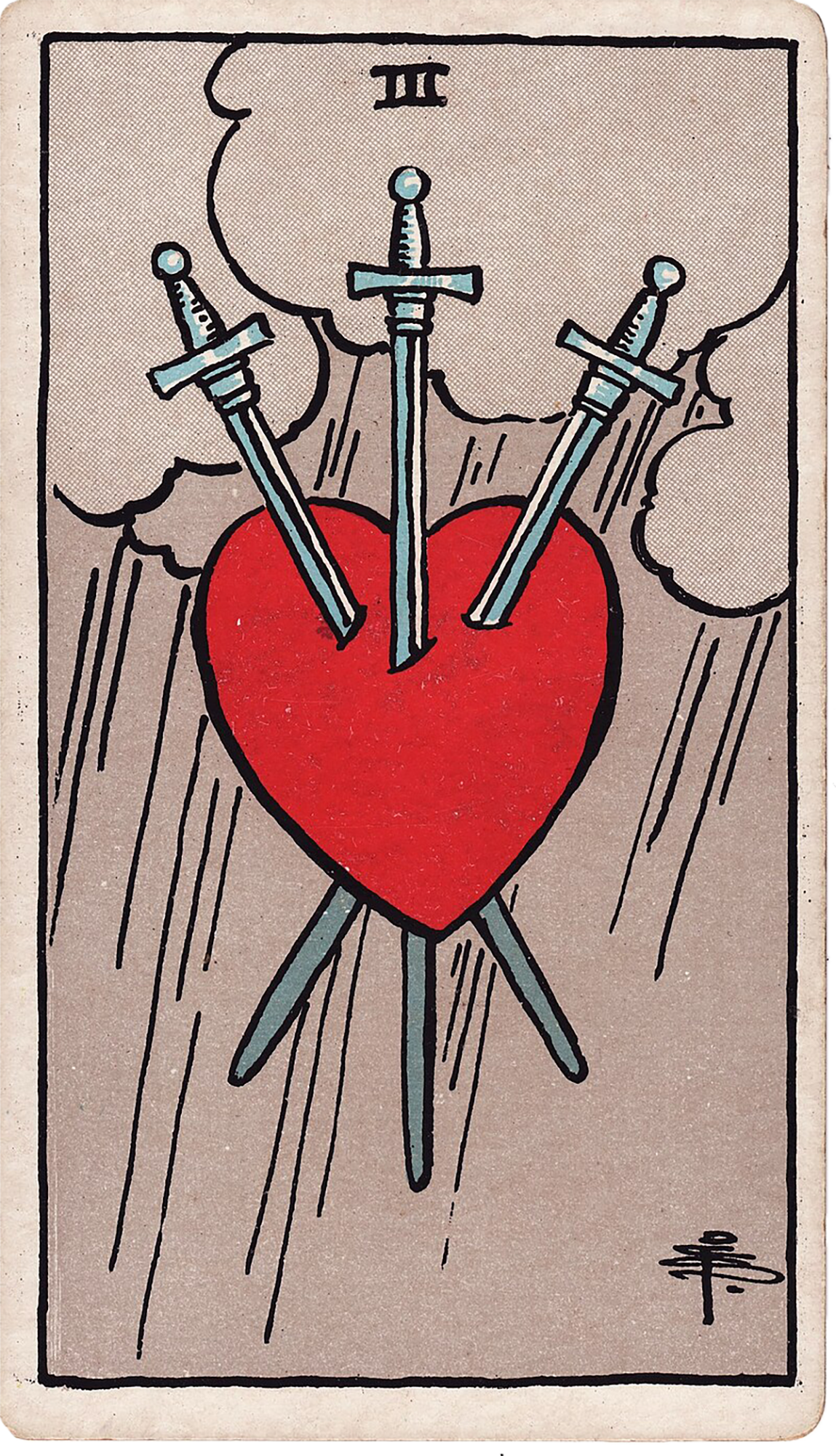 3 of Swords
Introduction
The 3 of Swords is one of the Tarot's most recognizable images: a heart pierced by three swords, set against storm clouds and rain. That visual shorthand has made the card notorious as a symbol of heartbreak, but its language is more precise than a single label. In the Rider-Waite-Smith tradition that most readers learn from, the image names an emotional truth that is being seen clearly. The card refuses sentimental smoothing; it insists that naming pain honestly is the first step toward ethical action. This article treats the supplied 3 of Swords as a tool for compassionate readings. It shows how upright and reversed placements guide different responses and how to translate the card's energies across love, career, money and other practical contexts. The emphasis is on technique: how to read, what to ask, how to hold space, and where interpretation can go wrong.
Visual Symbolism and Core Meanings
Begin with what you see. The supplied 3 of Swords image shows a heart skewered by three swords. Behind it, dark clouds and rain sweep across the sky. Each visual element is a clue: the heart denotes emotion and attachment; the swords represent Swords' domain — thought, communication, conflict, judgment, and consequence; the stormy sky and rain suggest catharsis, release, or a difficult climate that will pass. In Rider-Waite-Smith symbolism, Swords are mental and communicative tools. When they pierce the heart in this card, the image describes a painful truth delivered or recognized. This isn't melodrama for its own sake. Upright, the 3 of Swords highlights pain that is clear enough to name; it asks for appropriate action rather than abstract ideals about "moving on." Reversed, the card steers attention toward recovery, suppressed grief, recurring pain, forgiveness, or a wound that is not yet integrated. The reversal asks: where is the process stuck, and what small, practical step will unstick it?
Interpretation Logic: From Image to Advice
Interpreting the 3 of Swords is an exercise in translating visual metaphor into applied meaning. Ask three sequential questions for any reading: 1) What is the pain or truth named by the imagery? 2) Which Sword skill is most relevant — communication, boundary-setting, decision, or analysis? 3) What practical action fits the client's immediate capacity? For example, the image may name a recent break-up (heart + swords), a truth recognized about a toxic project (swords + heart = emotional cost), or a personal boundary that was violated (swords = decision/clearing). The Swords focus means the solution will often be communicative or cognitive: a clarifying conversation, a decisive boundary, reframing a belief, or respectful acknowledgement of grief. But because the image includes rain and clouds, the card also holds emotional process: allow tears, create ritual, and name the loss. Compassionate technique weaves both mental steps and embodied grieving.
Upright 3 of Swords Across Contexts
When the supplied 3 of Swords appears upright as the single card, its message is candid pain that is now visible. Apply that core to different contexts by asking targeted clarifying questions about who, what, and when. - Love: Upright, the card often signals a breakup, betrayal, or frank acknowledgement that a relationship is not meeting needs. The image of the pierced heart tells you a wound has been opened — naming it helps. Practical counsel: validate the client's hurt, encourage clear communication about boundaries or terms of separation, and plan immediate self-care steps (sleep, food, safety). Ask: Has this been acknowledged aloud? Is the client safe? What practical support is needed this week? - Career: The upright 3 of Swords can point to disappointment at work — a project loss, harsh feedback, or an ethical realization that the job harms personal values. The swords represent the decisions or communications that created the hurt (a firing, a failed proposal, a truth revealed). Advice: name the professional loss, document what happened, consider negotiation or professional boundary changes, and plan realistic next steps rather than platitudes. - Money: Financial heartbreak might show as debt mandates, a sudden expense, or betrayal in a financial partnership. The card asks for clear accounting: itemize losses, check contracts, and prioritize immediate obligations. Emotional recognition matters: grief about money loss is real and affects decisions. - Advice: As guidance, the upright card says: name the wound so you can respond. The action should match the stage of pain — sometimes that means grieving, sometimes it means decisive boundary-setting. The Swords' competence suggests communication or a plan; compassion suggests holding space for emotion alongside action. - Challenge: As the challenge, the card highlights the need to face uncomfortable truth. The client may be avoiding an honest conversation, or an old disappointment may be blocking forward movement. The task is to bring the issue into the light and make a practicable plan. - Person: If representing a person, an upright 3 of Swords is not normally a physical person archetype but rather a role or a dynamic: someone who causes or embodies painful truth — a blunt messenger, an ex-partner, a supervisor who delivers bad news, or the client's own critical mind. Ask: is the card reflecting an external person or the client's inner critic? - Outcome: Upright as an outcome often means that a painful but clarifying truth will be acknowledged. This leads to a clearer path forward, though not instantly comfortable. The most compassionate forecast is to expect emotional processing and eventual reorganization of priorities. - Spiritual reflection: The upright card in a spiritual context can be a call to honest examination — shadow work where a painful insight is required for growth. It asks for integrating sorrow rather than bypassing it.
Reversed 3 of Swords Across Contexts
When the supplied card appears reversed, the reading emphasizes recuperation, suppression, recurring pattern, or intellectual but not embodied understanding. The reversal invites a different line of questioning: where is healing stalled, or where is the pain hidden? - Love: Reversed, the card can indicate suppressed grief after a breakup, an attempt to prematurely "forgive" without processing, or recurring relational patterns. If the client says "I'm fine," the reversal asks you to check for buried hurt. Practical steps include grief rituals, therapy referrals, timelines for contact-limitation, or incremental trust-rebuilding if reconciliation is attempted. - Career: The reversed 3 of Swords may point to a wounded professional identity that hasn't been processed — staying in a role out of fear, repeating the same boundary failures, or intellectualizing a setback. The remedy: small corrective practices (asserting a limit in one meeting, documenting roles), and noticing somatic signs of stress. - Money: Financially, reversal can show denial about losses, repeated overspending as a coping mechanism, or difficulty letting go of financial attachments. Suggest concrete bookkeeping, a support person or financial counselor, and attention to emotional triggers for spending. - Advice: As advice, reversed asks you to ask: what needs completion? It often recommends grief work, ceremonies of letting go, or regular practices to release recurring pain. It can also counsel patience: healing is not linear and may need time. - Challenge: The reversed 3 of Swords as a challenge highlights stuckness. The client may understand the lesson intellectually but hasn't changed behavior. The remedy is micro-practice: one small communicative act, one boundary enforced, one mournful ritual. - Person: Reversed might represent someone who is privately grieving or someone who is avoiding the conversation — a person who seems 'fine' but is wounded. It can also reflect the client's role as someone who buffers pain for others. - Outcome: Reversed as an outcome suggests partial recovery or the need for continued work: not complete closure but movement toward integration. Outcomes tend to be incremental rather than dramatic. - Spiritual reflection: Reversed in a spiritual reading invites compassionate integration: honoring the wound, listening to the body, and creating practices that allow feelings to complete their arc.
Practical Single-Card Reading Method
Use this step-by-step method when the 3 of Swords is drawn as a single-card prompt. 1) Ground and frame. Ask the querent to name a specific domain or question. Single-card readings are most useful when the question is narrow (e.g., "What do I most need to know about my breakup this week?"). 2) Observe the image. Invite the querent to describe what they notice first about the supplied 3 of Swords. This centers the reading on their embodied response and reduces overinterpretation from the reader. 3) Clarify orientation. Is the 3 of Swords upright or reversed? Read the supplied upright and reversed descriptions in tandem: upright names present clarity; reversed points to recovery, suppression, or repetition. 4) Ask specific follow-ups. Depending on context, typical clarifying questions include: "Who is grieving and what is being lost?" "What needs to be said or acknowledged?" "What small, concrete step will respect both the pain and agency?" 5) Offer compassionate action steps. Combine a mental skill from Swords (communication, boundaries, decision) with an emotional practice (ritual, journaling, seeking support). For instance: hold a short conversation to set a boundary (Swords) and schedule one evening of self-care to process tears (rain imagery). 6) Check for safety and resources. Especially with heartbreak and grief, determine whether the client needs immediate practical supports (safety plan, mental health referral). The 3 of Swords names hurt; do not treat it as a purely symbolic concern if safety is an issue. 7) Close with contingency. Suggest a follow-up check to see how the chosen action affected the emotional climate. The card often points to a process rather than a single event; plan to revisit.
Concrete Example Readings
Below are concise examples of single-card readings using the supplied 3 of Swords in both orientations. These are practice vignettes for learners, not predictive claims. Example 1 — Love, Upright Question: "Should I talk to my partner about this betrayal?" Reader notes: The upright 3 of Swords names a clear breach. Suggested response: validate the querent's hurt, prepare for a direct conversation with clear boundaries, and plan immediate post-conversation support. Interpretation logic: the image's pierced heart indicates an opened wound that needs honest language (Swords) and containment (safety, a friend waiting afterward). Example 2 — Money, Reversed Question: "Is it time to stop trying to recoup money from an ex-business partner?" Reader notes: The reversed card shows lingering attachment and possibly denial. Counsel: assess whether the energy of pursuing returns more pain than gain; create a checklist for what recovery would require; consider letting go if costs outweigh benefits. Interpretation logic: reversal suggests the process is stuck; the remedy is a practical completion ritual and a clear boundary for future interaction. Example 3 — Career, Upright Question: "What is the immediate lesson from my layoff?" Reader notes: The upright 3 of Swords points to a professional loss that clarifies values and priorities. Advice: document the reasons, identify what was learned, and take one communicative action (update resume, reach out to three contacts). Interpretation logic: Swords give the tools to strategize; the storm allows space to grieve. Example 4 — Spiritual Reflection, Reversed Question: "How do I integrate recurring grief?" Reader notes: Reversed 3 of Swords invites practices to complete mourning (journaling, small ritual, therapy). Interpretation logic: the reversal signals incomplete processing; integration requires embodiment and repetition rather than a one-time intellectual acknowledgment.
Common Mistakes and How to Avoid Them
When working with the 3 of Swords, readers often fall into a few predictable errors. Learn to spot them and respond differently: 1) Over-dramatizing the image. The heart-and-swords is dramatic, which tempts readers to escalate any discomfort into catastrophe. Avoid that by asking clarifying questions and seeking proportional action. 2) Treating reversed as simply the opposite. The supplied reversed meaning is nuanced: it draws attention to recovery, suppression, recurring pain, or intellectualization without embodied change. Ask where the process is stuck rather than flipping the upright meaning. 3) Ignoring immediate safety. Because the card often points to emotional wounds, do not assume symbolic distance. If a querent mentions self-harm, abuse, or imminent danger, switch to safety protocol. 4) Offering only platitudes. "It will get better" is less helpful than specific actions: call a friend, schedule therapy, set a no-contact period, or write a goodbye letter. 5) Overemphasizing destiny. The 3 of Swords names a state or task, not an irreversible fate. Emphasize agency and small steps. 6) Neglecting cultural and personal grief practices. People process loss differently; ask about their cultural norms and personal coping strategies before prescribing rituals. 7) Reading the card as always external. Sometimes the 3 of Swords represents the client's internal critical voice. Distinguish between external betrayal and internalized narrative by exploring timeline and agency questions.
Holding Compassion in Readings
Working with heartbreak and grief requires specific ethical and relational skills. The 3 of Swords is a card that can re-traumatize if handled clumsily. Here are practical guidelines for compassionate practice: - Slow down. Allow silence. Let the querent feel their response to the image. - Use grounding practices. Invite breath exercises, a short sensory check, or a glass of water before interpreting. - Offer small, concrete next steps. Emotional validation matters, but people feel steadier with simple plans. - Maintain boundaries. Don't become the querent's therapist. Offer referral language when appropriate. - Language matters. Use verbs that emphasize capacity and process: "You are processing," "This is a wound that needs attention," rather than fatalistic or minimizing phrases. - Follow up. If working with clients regularly, schedule a check-in. Grief work benefits from containment and continuity. - Respect privacy and consent. Ask before offering exercises like journaling prompts or rituals, and be mindful of spiritual frameworks that may not fit the querent's worldview.
Practice Exercises for Learners
To build fluency with the 3 of Swords, practice these exercises: 1) Single-card journaling. Pull the supplied 3 of Swords and write a one-page reflective response to the image: what arises in your chest? Which Sword skill is being called for? 2) Role-play readings. Work with a partner. One person is querent with a narrow question; the other offers a single-card reading using the method above. Debrief on how language landed emotionally. 3) Reversal nuance drill. Draw the 3 of Swords reversed and list ten distinct ways the reversal can show up in life beyond "lesser pain." This trains you away from binary thinking. 4) Compassion checklist. Create a one-sheet to use when you draw the 3 of Swords: safety, immediate step, referral, grounding, follow-up. Use it until the steps become habitual.
Conclusion and Ethical Reminder
The supplied 3 of Swords is a powerful single-card teacher: it insists that honest naming of pain is both difficult and necessary. Whether upright or reversed, it points toward action that is both pragmatic and tender — using Swords skills (communication, decision, boundary) alongside mourning and embodied practices. As a reader, your task is to translate the card's imagery into useful, proportionate steps, to check for safety, and to hold the querent's suffering without minimizing or dramatizing it. Use the methods outlined here to temper clarity with compassion so the 3 of Swords becomes a guide toward integration rather than a judgment.
Practice questions
• When you look at the supplied 3 of Swords image, what physical sensation arises in your body and where?
• Is the pain the card names something that requires action (boundary, conversation) or something that requires ceremony and feeling? How do you know?
• If the 3 of Swords represents your inner critic rather than an external person, what small communicative act could you practice to shift that internal dynamic?
• How would you translate the card's advice into one immediate, realistic step a querent could take in the next 24 hours?
• What are your personal tendencies when you see this card: do you minimize, catastrophize, or intellectualize? How can you adjust your default to better serve a grieving querent?
Comments
Sign in to comment.
Continue learning
Exploring The High Priestess in Career Relationships and Personal Growth
The High Priestess card in the tarot deck invites readers to explore intuition, hidden knowledge, and inner wisdom across various life contexts. This article examines how The High...
The Fool in Life Transitions and New Beginnings
The Fool card embodies the spirit of beginnings, curiosity, and the leap of faith required during life transitions. This article explores The Fool’s meanings across various reading...
Understanding The Chariot Card in Personal Ambition and Overcoming Obstacles
The Chariot card represents the power of focused will, disciplined action, and choosing a clear direction amid competing impulses. Upright, it encourages decisive steps forward usi...
Understanding The Hermit in Self Discovery and Spiritual Enlightenment
The Hermit card in the Rider-Waite-Smith deck embodies themes of introspection, solitude, and spiritual wisdom. This article examines how The Hermit's upright and reversed position...
Exploring The Hierophant in Modern Spiritual Practices and Personal Development
The Hierophant tarot card symbolizes structured wisdom, tradition, and the pursuit of knowledge through established systems. This article explores how The Hierophant’s upright and...
Applying The Star Card to Foster Hope and Renewal in Personal Growth
The Star card in Tarot symbolizes hope, authenticity, and the process of steady renewal. In a single-card reading, The Star encourages embracing what is present, cultivating openne...
Understanding The Wheel of Fortune in Tarot Readings for Life Cycles and Change
The Wheel of Fortune card in Tarot is a powerful symbol of cycles, change, and the dynamics of fate and free will. This article explores the card’s upright and reversed meanings, a...
Understanding The Hermit Card in Solitude Reflection and Guidance
This article offers an in-depth exploration of The Hermit tarot card as a single-card reading in different contexts such as love, career, money, advice, challenge, person, outcome,...
Understanding The Tower in Tarot for Navigating Sudden Change and Crisis
The Tower card in Tarot symbolizes sudden, often disruptive change that destroys false foundations and compels honest reassessment. This article provides a comprehensive exploratio...
Understanding The Hanged Man in Personal Sacrifice and Spiritual Growth
The Hanged Man tarot card embodies the themes of intentional pause, surrender, and gaining new perspectives that foster personal sacrifice and spiritual growth. In this article, we...