
Community
Self-Discovery
The Inner Eye: Ripples of Awareness
A surreal blue portrait exploring inner vision, the layers of perception, and the quiet awareness beneath passing thoughts.

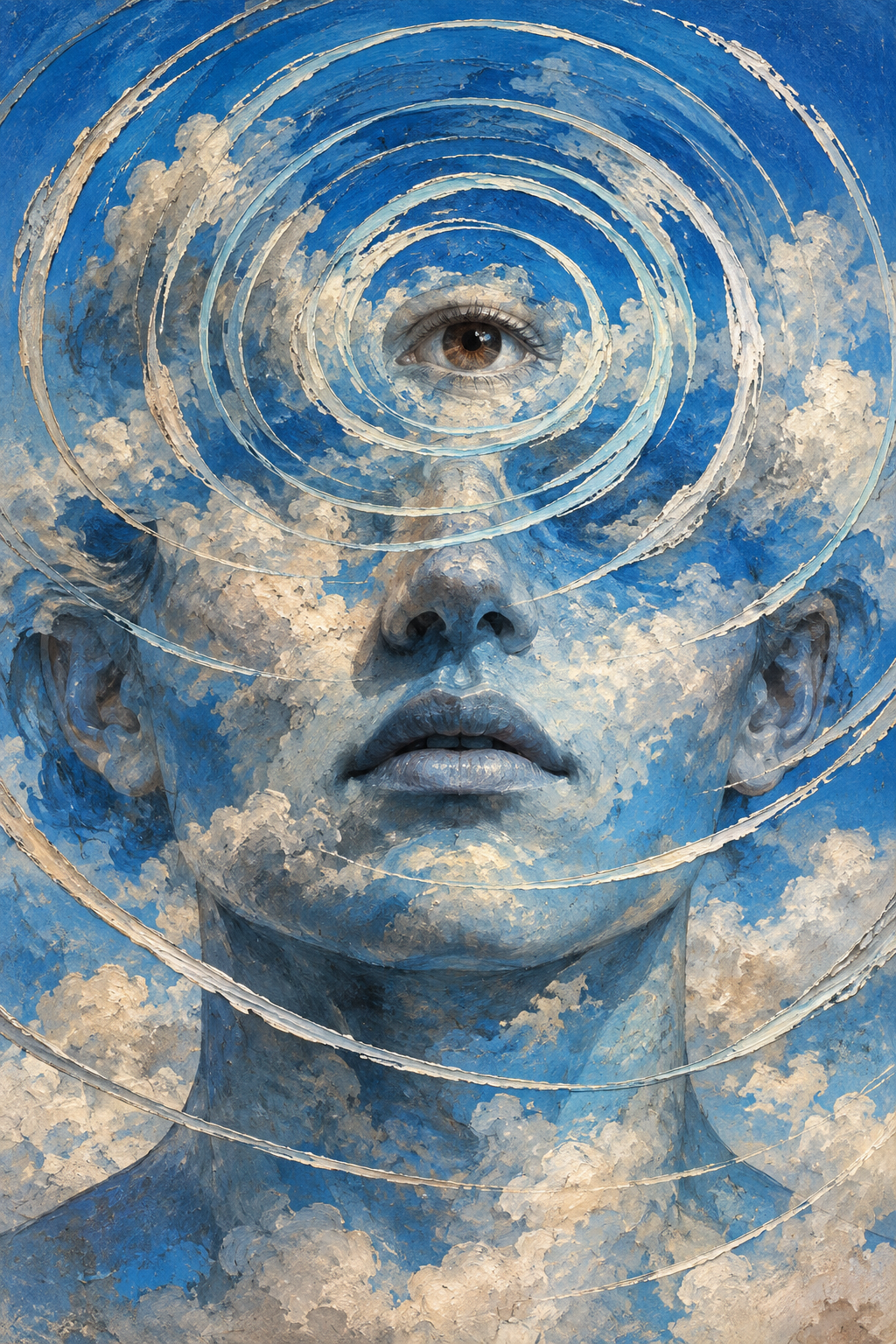
The Inner Eye: Ripples of Awareness presents the mind as an open sky: spacious, changing, and filled with movements that cannot be held still. A blue human face emerges through cloudlike textures, while a single eye rests above the bridge of the nose. Pale circular lines spread outward from this focal point, connecting the portrait to the surrounding space. Together, these elements offer a visual reflection on inner vision, self-awareness, and the many layers through which we experience the world.
The eye can be understood as a symbol of looking inward. Rather than suggesting a supernatural ability, it represents the familiar human capacity to notice our own experience: to recognize a thought as a thought, to name an emotion, or to question an assumption before treating it as truth. Its direct, attentive gaze gives the composition a still center. Around it, the painted surface remains restless, as if awareness can be steady even while the contents of the mind continue to change.
The clouds suggest passing thoughts, memories, expectations, and emotions. They drift across the face and surrounding blue field, softening the boundary between the person and the sky. This overlap reflects how easily inner narratives become part of our sense of identity. A worry may briefly color everything we see; a memory may shape the meaning of a present moment. Yet the clouds also imply movement. What occupies attention now does not have to define the whole of who we are.
The rings radiating from the eye resemble ripples spreading across water. They can be read as the widening effects of attention: one moment of recognition leading to another, a small insight changing how we understand a familiar situation. Their uneven, textured edges keep them from feeling mechanical or complete. Self-discovery often unfolds in this way, through repeated encounters and revised understanding rather than a single final revelation.
These circles also evoke layers of perception. We first encounter an appearance, then attach a feeling, a memory, an interpretation, or a judgment. Looking more closely may reveal that these layers are related but distinct. The image invites us to consider what is actually present and what we bring to it. The eye is therefore both an observer and a reminder that seeing always involves perspective.
Blue holds the composition together, suggesting distance, quiet, and the depth of an expansive sky. Cream-colored clouds and pale rings introduce warmth and contrast, while the visible paint texture gives the abstract symbolism a physical presence. The face remains recognizably human beneath these layers, grounding the work in lived experience rather than an ideal of perfect clarity.
Within a contemplative or spiritual reading, the inner eye may serve as a metaphor for reflection, intuition, and the search for meaning. Here, intuition is an impression to examine with curiosity, not an infallible source of knowledge. The artwork leaves room for uncertainty and encourages thoughtful attention instead of promising hidden powers or absolute answers.
Ultimately, the portrait asks a quiet question: can we notice what moves through the mind without immediately becoming absorbed in it? The clouds continue to pass, and the ripples continue to widen. At the center is the possibility of pausing, observing, and meeting experience with greater openness. The Inner Eye is a meditation on that possibility—the ordinary, patient practice of becoming more aware of how we see, think, and understand.
The eye can be understood as a symbol of looking inward. Rather than suggesting a supernatural ability, it represents the familiar human capacity to notice our own experience: to recognize a thought as a thought, to name an emotion, or to question an assumption before treating it as truth. Its direct, attentive gaze gives the composition a still center. Around it, the painted surface remains restless, as if awareness can be steady even while the contents of the mind continue to change.
The clouds suggest passing thoughts, memories, expectations, and emotions. They drift across the face and surrounding blue field, softening the boundary between the person and the sky. This overlap reflects how easily inner narratives become part of our sense of identity. A worry may briefly color everything we see; a memory may shape the meaning of a present moment. Yet the clouds also imply movement. What occupies attention now does not have to define the whole of who we are.
The rings radiating from the eye resemble ripples spreading across water. They can be read as the widening effects of attention: one moment of recognition leading to another, a small insight changing how we understand a familiar situation. Their uneven, textured edges keep them from feeling mechanical or complete. Self-discovery often unfolds in this way, through repeated encounters and revised understanding rather than a single final revelation.
These circles also evoke layers of perception. We first encounter an appearance, then attach a feeling, a memory, an interpretation, or a judgment. Looking more closely may reveal that these layers are related but distinct. The image invites us to consider what is actually present and what we bring to it. The eye is therefore both an observer and a reminder that seeing always involves perspective.
Blue holds the composition together, suggesting distance, quiet, and the depth of an expansive sky. Cream-colored clouds and pale rings introduce warmth and contrast, while the visible paint texture gives the abstract symbolism a physical presence. The face remains recognizably human beneath these layers, grounding the work in lived experience rather than an ideal of perfect clarity.
Within a contemplative or spiritual reading, the inner eye may serve as a metaphor for reflection, intuition, and the search for meaning. Here, intuition is an impression to examine with curiosity, not an infallible source of knowledge. The artwork leaves room for uncertainty and encourages thoughtful attention instead of promising hidden powers or absolute answers.
Ultimately, the portrait asks a quiet question: can we notice what moves through the mind without immediately becoming absorbed in it? The clouds continue to pass, and the ripples continue to widen. At the center is the possibility of pausing, observing, and meeting experience with greater openness. The Inner Eye is a meditation on that possibility—the ordinary, patient practice of becoming more aware of how we see, think, and understand.

Comments
Comments appear after approval.
Log in to comment