
Community
Self-Discovery
A Thousand Ways of Seeing
Blue eyes emerge from a vivid red field in a surreal ink study of perspective, attention, and the uneasy feeling of seeing and being seen.

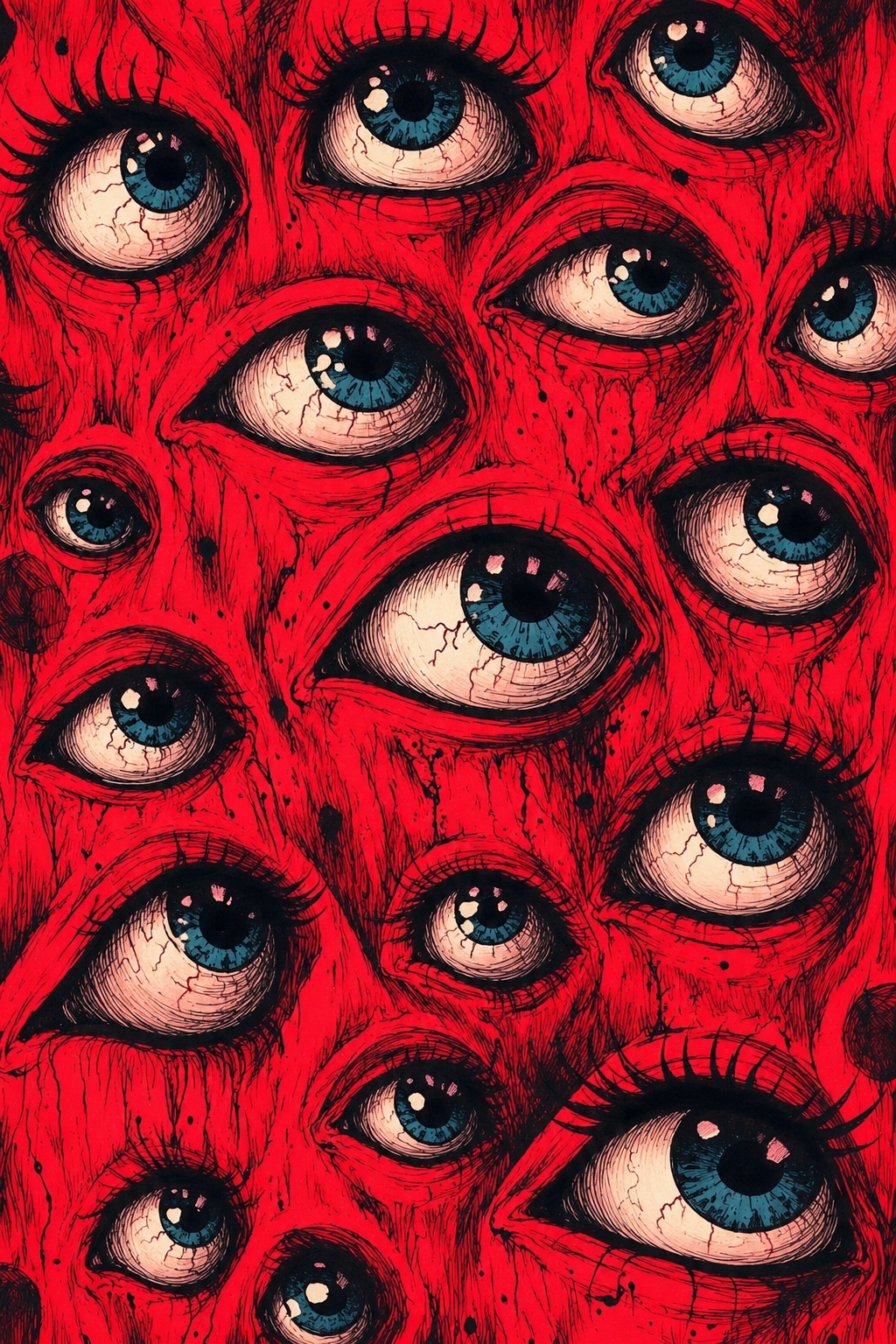
A Thousand Ways of Seeing fills the frame with eyes. Some are large and open, others smaller or partly cropped, and their gazes turn in different directions. Pale ivory surfaces and blue irises stand against an intense red ground, while scratchy black lines give the image its restless rhythm. The title is a metaphor for many perspectives, rather than a literal count of the eyes depicted.
Repetition transforms an ordinary feature into something unfamiliar. One eye might suggest a portrait; many eyes create a field of attention with no single face to explain it. The viewer moves between individual details and the overall pattern, repeatedly finding a new point of focus. That movement makes the act of looking part of the image’s subject.
The different directions of the gazes suggest that perception is never gathered into one complete view. Each eye can stand for a perspective shaped by experience, memory, expectation, or mood. Together they invite reflection on how much of a situation may remain outside our own immediate understanding. More viewpoints can introduce complexity without automatically producing certainty.
The composition also holds the tension between seeing and being seen. A direct gaze may feel engaging, curious, or unsettling, especially when repeated across the entire surface. That ambiguity leaves room to consider the difference between attentive presence and the feeling of scrutiny. The eyes are fictional visual motifs, not a claim that the viewer is watched by hidden forces.
Red gives the background emotional force. It may evoke urgency, heightened feeling, or a crowded moment of awareness. Blue provides a cooler counterpoint within the irises, creating small areas of depth inside the busy field. These colors work as an artistic contrast rather than a fixed code for particular emotions or states of mind.
Black hatching and irregular ink marks connect the separate eyes. Their roughness keeps the illustration from feeling polished or detached. Lines gather around lids, lashes, and the spaces between them, giving even the background a sense of movement. The image feels alert, as if attention is continually being pulled toward another detail.
Small highlights add a softer note. Against dark pupils, their pale shapes suggest reflected light and give each eye a distinct presence. The repeated motif remains varied through these minor differences. This balance between similarity and individuality can serve as a metaphor for shared human experience: familiar features, interpreted through different lives.
Viewed as an invitation to self-reflection, the work asks how we choose where to look. A busy inner or outer environment can offer more signals than we can attend to at once. Pausing to recognize what has captured our attention may help us examine an impression before treating it as the whole story. The artwork presents that question visually without prescribing a technique or promising a particular outcome.
Ultimately, A Thousand Ways of Seeing explores the abundance and limits of perspective. Its crowded gazes can feel playful, intense, or disquieting, depending on the viewer. The image allows those responses to coexist, inviting curiosity about how we look, what we notice, and what it means to meet another point of view.
Repetition transforms an ordinary feature into something unfamiliar. One eye might suggest a portrait; many eyes create a field of attention with no single face to explain it. The viewer moves between individual details and the overall pattern, repeatedly finding a new point of focus. That movement makes the act of looking part of the image’s subject.
The different directions of the gazes suggest that perception is never gathered into one complete view. Each eye can stand for a perspective shaped by experience, memory, expectation, or mood. Together they invite reflection on how much of a situation may remain outside our own immediate understanding. More viewpoints can introduce complexity without automatically producing certainty.
The composition also holds the tension between seeing and being seen. A direct gaze may feel engaging, curious, or unsettling, especially when repeated across the entire surface. That ambiguity leaves room to consider the difference between attentive presence and the feeling of scrutiny. The eyes are fictional visual motifs, not a claim that the viewer is watched by hidden forces.
Red gives the background emotional force. It may evoke urgency, heightened feeling, or a crowded moment of awareness. Blue provides a cooler counterpoint within the irises, creating small areas of depth inside the busy field. These colors work as an artistic contrast rather than a fixed code for particular emotions or states of mind.
Black hatching and irregular ink marks connect the separate eyes. Their roughness keeps the illustration from feeling polished or detached. Lines gather around lids, lashes, and the spaces between them, giving even the background a sense of movement. The image feels alert, as if attention is continually being pulled toward another detail.
Small highlights add a softer note. Against dark pupils, their pale shapes suggest reflected light and give each eye a distinct presence. The repeated motif remains varied through these minor differences. This balance between similarity and individuality can serve as a metaphor for shared human experience: familiar features, interpreted through different lives.
Viewed as an invitation to self-reflection, the work asks how we choose where to look. A busy inner or outer environment can offer more signals than we can attend to at once. Pausing to recognize what has captured our attention may help us examine an impression before treating it as the whole story. The artwork presents that question visually without prescribing a technique or promising a particular outcome.
Ultimately, A Thousand Ways of Seeing explores the abundance and limits of perspective. Its crowded gazes can feel playful, intense, or disquieting, depending on the viewer. The image allows those responses to coexist, inviting curiosity about how we look, what we notice, and what it means to meet another point of view.




Comments
Comments appear after approval.
Log in to comment