
Community
Self-Discovery
The Radiant Mind: A Spectrum of Awareness
A vivid silhouette and symbolic inner eye unfold into a spectrum of color, exploring attention, creative energy, and the many shades of self-discovery.

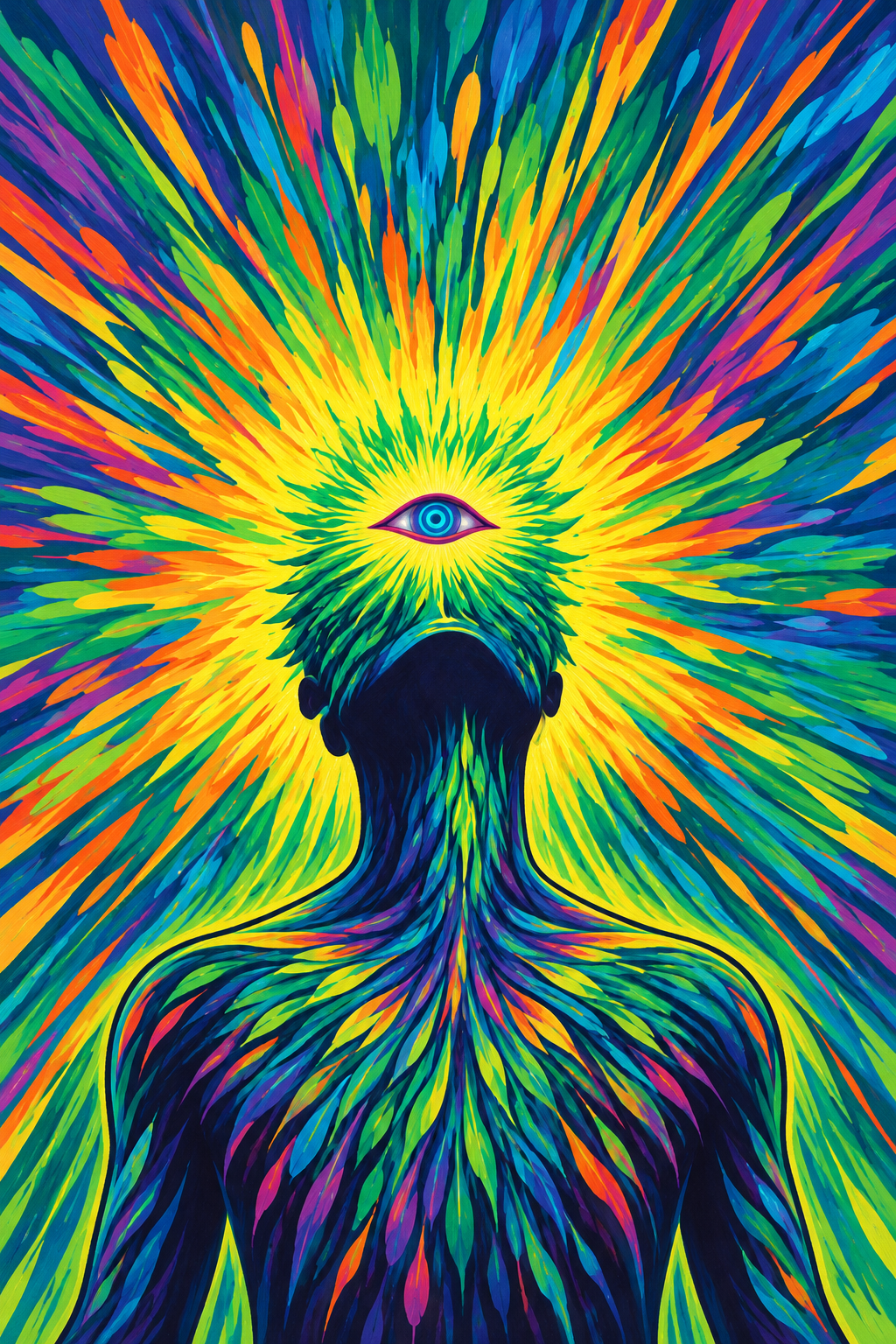
The Radiant Mind: A Spectrum of Awareness turns an inward moment into an outward burst of color. A dark human silhouette rises through streams of green, blue, violet, and orange, while a small symbolic eye rests at the forehead. Around this focal point, bright yellow opens into sweeping rays that fill the composition. The result is a visual metaphor for the richness of perception: one person, one moment of attention, and many possible ways of seeing.
The forehead eye represents reflective awareness. It invites us to consider the part of experience that notices a thought, recognizes a feeling, or becomes curious about a familiar reaction. In this artwork, the eye is an imaginative symbol rather than a claim about supernatural sight. Its small, concentrated shape provides a center within the surrounding movement, suggesting that a moment of clear attention can exist amid a busy inner life.
The radial brushstrokes can be read as thoughts, sensations, associations, and creative possibilities spreading from that center. Their different lengths and directions give the image an energetic rhythm. Some marks feel sharp and urgent, while others form broader currents. Together they reflect how experience rarely arrives as a single simple impression. We perceive through overlapping memories, expectations, emotions, and immediate sensations.
Color gives these layers a visible language. Yellow creates the brightest area near the eye, offering an impression of recognition or sudden understanding. Greens and turquoise extend that brightness into a wider field, while blues and violets provide depth. Orange and magenta introduce warmth and contrast. These are artistic associations, open to interpretation; the colors are not presented as a diagnostic map or a measurable energy system.
The dark silhouette is equally important. Its quieter areas allow the surrounding colors to remain distinct, while the upward angle of the head suggests receptivity, curiosity, or wonder. The figure does not disappear into the burst. It remains a recognizable presence within it, holding together the tension between an individual sense of self and the many influences moving through awareness.
Streaks flowing across the neck and chest connect the head to the rest of the body. Visually, they suggest that reflection is not only an abstract activity. A thought can be accompanied by a tightening jaw, an emotion by a shift in breathing, or curiosity by a sense of alertness. The image invites attention to this relationship without claiming that the painted lines depict literal pathways inside the body.
The composition also offers a perspective on creativity. A new idea may begin as something small and difficult to name before branching into possibilities. The expanding rays give that process a dramatic form. Their apparent movement can suggest discovery, but the central eye keeps returning the viewer to observation: what are we noticing, what are we assuming, and what else might become visible if we look again?
Within a contemplative reading, the artwork is an invitation to approach inner experience with openness. Awareness does not have to mean controlling every thought or reaching a permanent state of clarity. It may begin with recognizing the changing colors of a moment—interest, uncertainty, joy, tension—and allowing them to be examined with patience.
The Radiant Mind ultimately celebrates the variety of human experience. Its bright center and many surrounding hues suggest that self-discovery is an ongoing process of noticing, questioning, and making meaning. The image leaves its interpretation open, offering a vivid space in which viewers can consider their own relationship with attention, imagination, and the world they perceive.
The forehead eye represents reflective awareness. It invites us to consider the part of experience that notices a thought, recognizes a feeling, or becomes curious about a familiar reaction. In this artwork, the eye is an imaginative symbol rather than a claim about supernatural sight. Its small, concentrated shape provides a center within the surrounding movement, suggesting that a moment of clear attention can exist amid a busy inner life.
The radial brushstrokes can be read as thoughts, sensations, associations, and creative possibilities spreading from that center. Their different lengths and directions give the image an energetic rhythm. Some marks feel sharp and urgent, while others form broader currents. Together they reflect how experience rarely arrives as a single simple impression. We perceive through overlapping memories, expectations, emotions, and immediate sensations.
Color gives these layers a visible language. Yellow creates the brightest area near the eye, offering an impression of recognition or sudden understanding. Greens and turquoise extend that brightness into a wider field, while blues and violets provide depth. Orange and magenta introduce warmth and contrast. These are artistic associations, open to interpretation; the colors are not presented as a diagnostic map or a measurable energy system.
The dark silhouette is equally important. Its quieter areas allow the surrounding colors to remain distinct, while the upward angle of the head suggests receptivity, curiosity, or wonder. The figure does not disappear into the burst. It remains a recognizable presence within it, holding together the tension between an individual sense of self and the many influences moving through awareness.
Streaks flowing across the neck and chest connect the head to the rest of the body. Visually, they suggest that reflection is not only an abstract activity. A thought can be accompanied by a tightening jaw, an emotion by a shift in breathing, or curiosity by a sense of alertness. The image invites attention to this relationship without claiming that the painted lines depict literal pathways inside the body.
The composition also offers a perspective on creativity. A new idea may begin as something small and difficult to name before branching into possibilities. The expanding rays give that process a dramatic form. Their apparent movement can suggest discovery, but the central eye keeps returning the viewer to observation: what are we noticing, what are we assuming, and what else might become visible if we look again?
Within a contemplative reading, the artwork is an invitation to approach inner experience with openness. Awareness does not have to mean controlling every thought or reaching a permanent state of clarity. It may begin with recognizing the changing colors of a moment—interest, uncertainty, joy, tension—and allowing them to be examined with patience.
The Radiant Mind ultimately celebrates the variety of human experience. Its bright center and many surrounding hues suggest that self-discovery is an ongoing process of noticing, questioning, and making meaning. The image leaves its interpretation open, offering a vivid space in which viewers can consider their own relationship with attention, imagination, and the world they perceive.







Comments
Comments appear after approval.
Log in to comment