
Community
Self-Discovery
The Eye Within the Waves: Patterns of Perception
A rainbow-centered eye rests within flowing monochrome waves, inviting reflection on perception, contrast, and the patterns that shape attention.

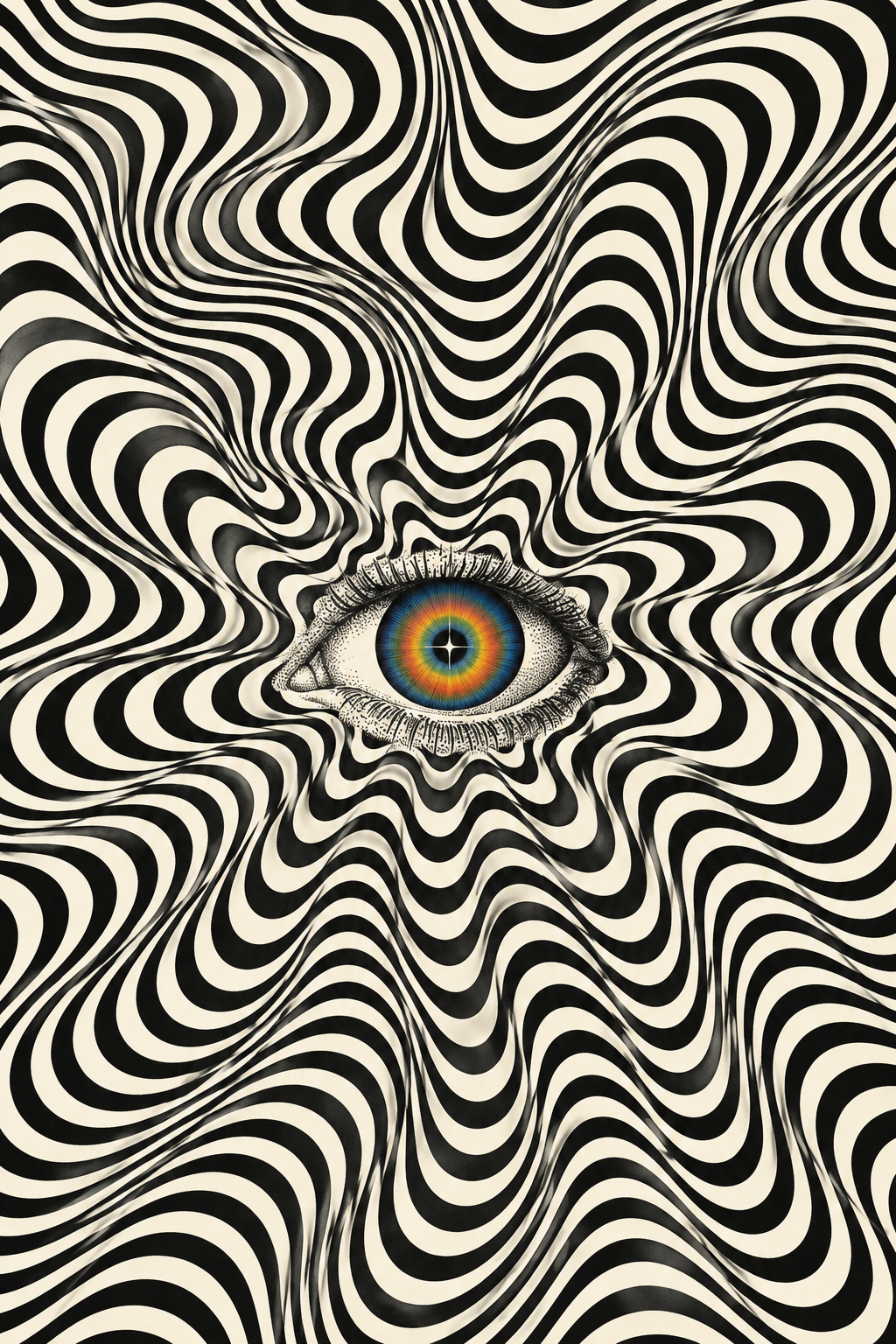
The Eye Within the Waves: Patterns of Perception places a single detailed eye inside a field of flowing black and ivory lines. The bands bend, widen, and gather around the center, creating a strong impression of movement within a still image. Against this restrained background, the rainbow iris becomes a small but vivid point of color. The composition invites a closer look at the relationship between what we see and how our attention moves.
The eye provides a recognizable anchor within the abstract pattern. It can represent observation, curiosity, or the capacity to examine our own perspective. Its direct gaze seems to meet the viewer, turning the act of looking into part of the artwork itself. We are looking at an eye while becoming more aware of our own experience of seeing.
The surrounding waves suggest the many influences that shape perception. A memory, an expectation, a passing mood, or a familiar assumption can alter the meaning we give to the same event. The lines do not depict these processes literally; they offer an artistic analogy for an experience that is rarely as simple as receiving a neutral picture of the world.
Black and ivory create the structure of the image through contrast. Each band becomes legible because of the space beside it, and the repeating alternation gives the surface its rhythm. Symbolically, this relationship can prompt reflection on how we organize experience into categories: light and dark, clear and uncertain, familiar and strange. The fluid curves keep these contrasts from settling into a rigid grid.
The rainbow iris introduces variety into that two-tone field. Its concentric colors can be read as different interpretations, feelings, or possibilities held within one point of view. A single eye does not have to imply a single fixed answer. Here, its color suggests that careful attention may reveal more nuance than an initial judgment allows.
The tiny highlight near the pupil gives the eye a sense of focus. It is a simple visual detail, yet it draws attention inward through the colored rings. As a metaphor, it may suggest a moment of recognition: noticing an assumption, becoming aware of a reaction, or seeing a familiar situation from a slightly different angle. It makes no promise of extraordinary insight or supernatural vision.
The wave pattern also creates a tension between motion and stillness. The surface is static, but its changing curves guide the gaze along paths that seem to expand and contract. This visual play is central to the artwork. It gives viewers an opportunity to notice their own looking—where attention settles, where it wanders, and how the image feels different as focus shifts.
Read contemplatively, the central eye can stand for remaining attentive while thoughts continue to move. The waves do not need to be flattened for observation to become possible. That idea offers a gentle approach to self-reflection: noticing experience without assuming that awareness requires total control or a perfectly quiet mind.
Ultimately, The Eye Within the Waves is a meditation on perspective through pattern. Its monochrome rhythms and concentrated color invite curiosity about the habits through which we interpret the world. The image leaves room for the viewer to pause, look again, and consider what might become visible when a familiar pattern is approached with fresh attention.
The eye provides a recognizable anchor within the abstract pattern. It can represent observation, curiosity, or the capacity to examine our own perspective. Its direct gaze seems to meet the viewer, turning the act of looking into part of the artwork itself. We are looking at an eye while becoming more aware of our own experience of seeing.
The surrounding waves suggest the many influences that shape perception. A memory, an expectation, a passing mood, or a familiar assumption can alter the meaning we give to the same event. The lines do not depict these processes literally; they offer an artistic analogy for an experience that is rarely as simple as receiving a neutral picture of the world.
Black and ivory create the structure of the image through contrast. Each band becomes legible because of the space beside it, and the repeating alternation gives the surface its rhythm. Symbolically, this relationship can prompt reflection on how we organize experience into categories: light and dark, clear and uncertain, familiar and strange. The fluid curves keep these contrasts from settling into a rigid grid.
The rainbow iris introduces variety into that two-tone field. Its concentric colors can be read as different interpretations, feelings, or possibilities held within one point of view. A single eye does not have to imply a single fixed answer. Here, its color suggests that careful attention may reveal more nuance than an initial judgment allows.
The tiny highlight near the pupil gives the eye a sense of focus. It is a simple visual detail, yet it draws attention inward through the colored rings. As a metaphor, it may suggest a moment of recognition: noticing an assumption, becoming aware of a reaction, or seeing a familiar situation from a slightly different angle. It makes no promise of extraordinary insight or supernatural vision.
The wave pattern also creates a tension between motion and stillness. The surface is static, but its changing curves guide the gaze along paths that seem to expand and contract. This visual play is central to the artwork. It gives viewers an opportunity to notice their own looking—where attention settles, where it wanders, and how the image feels different as focus shifts.
Read contemplatively, the central eye can stand for remaining attentive while thoughts continue to move. The waves do not need to be flattened for observation to become possible. That idea offers a gentle approach to self-reflection: noticing experience without assuming that awareness requires total control or a perfectly quiet mind.
Ultimately, The Eye Within the Waves is a meditation on perspective through pattern. Its monochrome rhythms and concentrated color invite curiosity about the habits through which we interpret the world. The image leaves room for the viewer to pause, look again, and consider what might become visible when a familiar pattern is approached with fresh attention.














Comments
Comments appear after approval.
Log in to comment