
How to Read the Seven of Swords Across Relationships Career and Personal Ethics
This article is a focused, practice-oriented guide to reading the 7 of Swords as a single-card lesson across multiple life contexts. Using the supplied 7 of Swords imagery and the card's upright and reversed definitions, it explains how to translate the visual symbolism into concrete questions and practical interpretations for relationships, career, money, advice, challenges, characterization of a person, possible outcomes, and spiritual reflection. You will learn a step-by-step reading method, sample mini-readings, how to spot common mistakes, and exercises to build confidence with this slippery but precise Sword energy.
Cards explored in this article
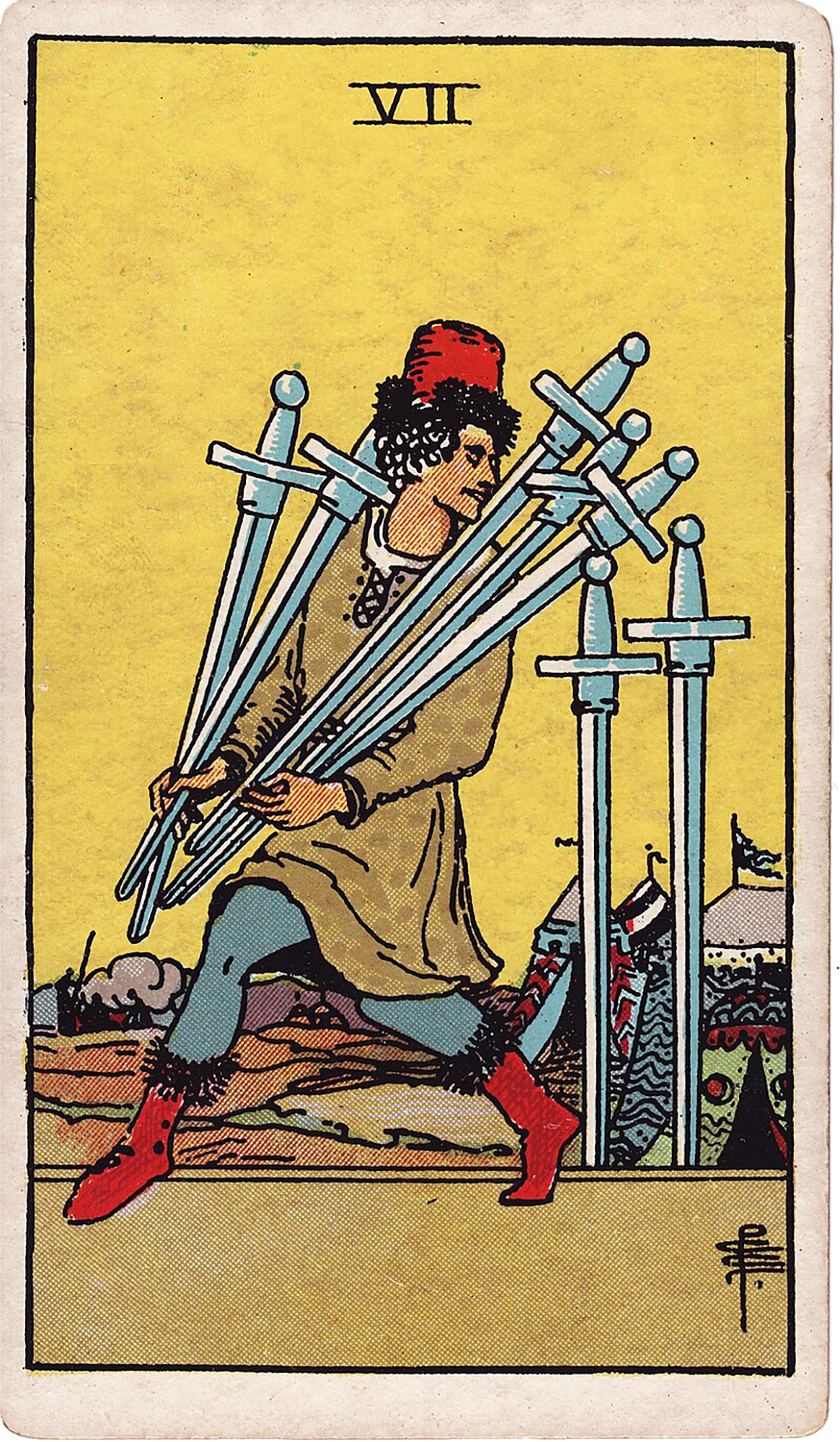 7 of Swords
Introduction
This lesson centers on the supplied 7 of Swords and uses the single-card approach: one card pulled into a named context (for example love or career) and interpreted using the card's imagery and conventional meanings. The supplied card descriptions are our anchor: Upright, 7 of Swords highlights strategy and acting independently can be useful, but the card tests the line between discretion and deception. The card is practical: it asks for a response that fits the present stage rather than an abstract ideal. Reversed, 7 of Swords draws attention toward confession, exposure, poor strategy, self-deception or the realization that a hidden plan is no longer sustainable. Keep these supplied notes in mind as you read. This article is for learners: it shows technique, logic, and practice examples rather than issuing fixed predictions.
Card at a glance: upright and reversed
Refer repeatedly to the supplied 7 of Swords. Upright, the card emphasizes strategy, independent action, and the razor-edge between discretion and deception. It sits within the Swords suit, so its core tools are mental: thought, communication, decision, conflict and the shaping power of ideas. Reversed, the 7 of Swords draws attention to exposure, confession, failed or poor strategy, or a process that has become stuck—perhaps understood intellectually but not yet embodied. Treat the reversal not as a simple opposite but as a diagnostic flag: where is the mental process jammed, and what must be acknowledged, simplified, or practiced for healthier Swords energy to return? Always let the card's posture—one figure leaving with a handful of swords, glancing back—inform whether the situation asks for tact, stealth, or honest confrontation.
Imagery and symbolism: reading the picture on the supplied 7 of Swords
When you look at the supplied 7 of Swords image, notice these classic Rider-Waite-Smith elements and their reading implications: - The stealthy figure carrying five swords and looking back: strategy, sneakiness, or tactical withdrawal. The glance backward asks whether the actor is aware of consequences or living with stealth as habit. - The two swords left standing in the ground: what has been abandoned or left unresolved? Two left behind can signal something intentionally left to distract or something that cannot be taken without cost. - The tents and camp in the background: there is a community or relationship context being left behind; the action happens in social space, not isolation. - The moon or waning light: mental fog, partial clarity, or subconscious motives. - The clothing and posture: the figure's readiness to move and distance themselves suggests autonomy, cunning, or avoidance. Use these visual anchors when you interpret the card across contexts: name what corresponds to the five swords being carried, the two left behind, the camp, and the glance back. Those correspondences turn imagery into actionable detail.
Reading technique: how to convert image into meaning
This is a single-card reading method tuned to the 7 of Swords. Step 1 — Ask a focused question or define the context (love, career, money, advice, challenge, person, outcome, spiritual reflection). Step 2 — Note orientation: upright or reversed. Use the supplied descriptions to label the card's headline energy. Step 3 — Describe the scene in present-tense sensory terms using the imagery anchors above: who is doing what, what is being carried away, what is left, who else is present or absent? Step 4 — Map the image onto the client's situation: the carried swords = choices, resources, secrets, or responsibilities being taken; the remaining swords = unresolved obligations; the camp = social ties or system. Step 5 — Form two practical prompts: one action to strengthen the constructive side (strategy, honest discretion) and one caution about the destructive side (deception, avoidance, poor planning). Step 6 — Use clarifying questions to test whether the reading is resonating (see Practical reading method section for suggested questions). This technique keeps reading anchored to the supplied 7 of Swords artwork and the supplied upright/reversed definitions.
Core logic for interpretation
Interpretation logic for the 7 of Swords is centered on the relationship between tactics and ethics, independence and community, and intellect and consequence. Ask: Is the intelligence being applied to protect or to hide? Is the independence necessary for effectiveness, or is it a cover for avoidance? Upright emphasizes that strategy and independent action can be useful; the ethical question is whether the method fits the situation's stakes. Reversed spotlights the failure points: the strategy is collapsing, secrets are exposed, or the querent is deceiving themselves. In practice, weigh the card's tone: a calm, purposeful posture in the image signals planned, ethical discretion; a furtive, anxious posture signals self-serving stealth. Also weigh the context you pulled for: in relationships, the moral dimension is more salient; in career, the tactic/strategy dimension may dominate. Use the supplied upright and reversed texts as diagnostic labels rather than final verdicts.
How to read the 7 of Swords across contexts: relationships and love
Upright in relationships: The supplied 7 of Swords upright suggests that a partner or the querent is using strategy or independent action to handle relationship matters. This could be a stealthy withdrawal for self-protection (taking time alone), a tactful omission intended to avoid harm, or an attempt at negotiation behind the scenes. Look to the imagery: the figure glancing back suggests awareness of consequences—ask whether they are being discreet or deceptive. Practical prompt: if the card is upright, ask what communication can be strategic without being dishonest (for example timing a difficult talk, setting boundaries, or planning a mutual break to gain perspective). Reversed in relationships: The supplied reversed meaning often reads as exposure, confession, or that a hidden plan is no longer sustainable. This could appear as secrets coming to light, someone admitting dishonesty, or realizing that the tactic of avoidance has caused damage. The reversed card is a call to simplify, acknowledge, or practice new, steadier behaviors. Practical prompt: what needs to be admitted or asked for directly to restore trust? Example pairings: If the querent pulled 7 of Swords upright about a partner's behavior, ask whether they sense evasiveness; if reversed, ask whether something has been revealed or whether the querent is ready to reveal a truth.
How to read the 7 of Swords across contexts: career and work
Upright in career: The supplied upright 7 of Swords points to strategy, cunning, and working independently—perhaps a stealthy project, a tactical pivot, or a decision made quietly to protect one’s interests. The image’s man walking away with swords can represent moving with intellectual assets or confidential knowledge. Ask: Is the querent operating ethically in their tactics? The upright may validate strategic confidentiality or suggest that solitary initiative will be effective. Reversed in career: The reversed 7 of Swords warns of poor strategy, exposure, or plans that are failing. This could be an ethics breach being discovered, a short-sighted shortcut backfiring, or internal self-deception about how safe a tactic really is. Practically, reversed invites accountability: tidy up loose ends, correct missteps, tell the truth where necessary. Use the card to recommend whether to continue a private plan (upright) or to stop and repair (reversed).
How to read the 7 of Swords across contexts: money and resources
Upright for finances: The supplied 7 of Swords points to tactical financial moves—rearranging resources quietly, saving in secret, or choosing independent investment without consulting others. The image carrying most swords suggests prioritizing certain resources to protect them. This can be prudent, but check whether secrecy is ethically or practically risky. Reversed for finances: The reversed card may signal discovered mismanagement, theft, poor budgeting practices exposed, or self-deception about the sustainability of financial choices. The reversal asks: what must be confessed, simplified, or restructured for financial health? Practical action: create transparent records, seek accountability, or renegotiate financial arrangements rather than relying on secrecy.
How to read the 7 of Swords across contexts: advice and challenge positions
As advice (upright): The supplied upright 7 of Swords can counsel tactical discretion, planning, or acting independently when conditions require it. Advice form: be strategic—choose what to keep private and what to share; use intellect and timing to move safely. As advice (reversed): The supplied reversed 7 of Swords advises confession, exposure, or course-correction; step out with honesty and tidy up failed strategies. As challenge: Upright can appear as the challenge of balancing necessary discretion with integrity—are you hiding too much? Reversed as challenge flags a stuck process: either you cannot sustain secrecy or you are deluded about your plan's viability. The challenge is to decide whether to continue tactically or to come clean and rebuild trust or structure.
How to read the 7 of Swords across contexts: person and characterization
When the supplied 7 of Swords describes a person, anchor in the imagery. Upright person: someone who is strategic, independent, resourceful, possibly private and comfortable acting alone. They may be clever and quick-thinking; they can be an asset if their tactics are aligned to group ethics. Reversed person: someone whose tactics have been exposed, who may be confessing or struggling with self-deception. They might also be someone who internally understands the lesson but cannot change behavior. In both cases, emphasize behavior over moral judgement. Ask: what patterns of secrecy or tactical avoidance show up in this person's routine? What does the 'glance back' tell you about their awareness of consequences?
How to read the 7 of Swords across contexts: outcome and spiritual reflection
As an outcome (upright): The supplied upright 7 of Swords can mean successful stealth or a clean tactical withdrawal that preserves key assets. Outcome nuance: success is measured by whether the tactic served the highest priorities without irreparable harm. As outcome (reversed): the supplied reversed 7 of Swords warns that the strategy crumbles, exposure happens, or the plan proves unsustainable. Spiritually: Upright asks whether you are using strategic discernment in service of inner truth or merely avoiding growth. Reversed invites confession, integration, and the dismantling of self-deceptive mental habits. The card in spiritual reflection teaches you to inspect whether your mental strategies support genuine integrity or are armor against honest transformation.
Sample single-card readings: short examples using the supplied 7 of Swords
Example 1 — Relationship question: "Should I bring up the issue with my partner now?" Card: 7 of Swords upright. Reading anchored to the supplied image: the card suggests strategic timing and measured disclosure rather than blunt confrontation. Action: prepare your words, choose the time, avoid ambush methods, and keep motives transparent. Caution: avoid crafting a narrative that hides important facts. Example 2 — Career question: "Is this covert project wise?" Card: 7 of Swords reversed. Reading: the reversal signals that the covert plan may be failing or liable to exposure. Action: stop, review ethics and legal risk, and consider bringing stakeholders in to limit damage. Example 3 — Money question: "Can I reallocate funds without telling the household?" Card: 7 of Swords reversed. Reading: reversal warns of exposure and the moral cost of secret financial moves. Action: choose transparency or prepare to repair trust if discovery is likely. Each example uses the supplied upright/reversed themes and matches imagery to practical steps.
Common mistakes learners make with the 7 of Swords
1) Equating the card always with criminality: The supplied 7 of Swords can indicate stealth or dishonesty, but it often points to legitimate discretion or necessary strategy; context matters. 2) Treating reversed as simply 'good': Reversal signals exposure or internal blockage, not automatic relief. It often means the issue must be addressed. 3) Over-personalizing: The image shows behavior or process; avoid making moral pronouncements without evidence. 4) Ignoring posture and gaze: The glance back in the illustration is information—use it to read awareness, regret, or calculation. 5) Forgetting the Swords suit: Interpretations should respect that the card's tools are mental—communication, thought, decisions—not purely material events. Avoid these mistakes by referencing the supplied imagery and the upright/reversed descriptions at each step.
Practical step-by-step reading method (checklist for live sessions)
1) Clarify the context or question clearly (love, career, money, advice, challenge, person, outcome, or spiritual reflection). 2) Place the supplied 7 of Swords and note orientation upright or reversed. 3) Describe what you see in the image aloud: who, what, where, what is being carried, what’s left behind, the direction of movement, and facial expression. 4) Label the card with the supplied headline energy: 'Upright: strategy/discretion vs deception' or 'Reversed: exposure/confession/poor strategy.' 5) Map image-to-situation: identify the 'swords' that the querent is carrying (secrets, responsibilities, resources, ideas), the 'camp' they are leaving, and what the two left behind might mean. 6) Ask two clarifying questions to the querent: (a) "What are you protecting or avoiding?" (b) "What would happen if this were exposed?" 7) Offer two practical steps: a constructive action (e.g., plan a careful conversation, document decisions) and a risk mitigation step (e.g., stop a tactic if it's unethical, disclose when necessary). 8) Invite reflection: "Does this fit what you know? If not, what detail is missing?" This checklist keeps the reading grounded and repeatable.
Advanced considerations: timing, intensity, and integration
Timing: The 7 of Swords rarely points to sudden miraculous change; its tempo is tactical and deliberate. A move implied by the card often requires preparation and careful timing. Intensity: Read the card's emotional tone in the image. A calm, purposeful figure suggests controlled strategy; a furtive, tense posture suggests anxiety and higher risk. Integration: The supplied reversed description asks whether the lesson is mentally understood but not integrated. When reversed, recommend small practice steps to build consistent, honest habits—this is a card of doing, not only thinking. Finally, balance the card's Swords logic with context: in relationships the ethical dimension may outrank efficiency; in career, practical fallout and reputation matter more. Always weigh the domain.
Practice exercises for learners
1) Pull the supplied 7 of Swords for three different contexts in a row: love, career, money. Write a one-paragraph reading for each, anchored to the imagery. 2) Flip the card intentionally reversed and practice diagnosing what is stuck: list three behaviors that must be acknowledged, simplified, or released. 3) Role-play: one student is the querent with a secret, another uses the supplied card to advise. Emphasize wording questions about consequences and repair. 4) Visual mapping: draw four elements from the image (the five swords being carried, the two left, the camp, the glance back) and label what each corresponds to in a real situation. These exercises train you to translate picture to advice quickly and ethically.
Conclusion and ethical note
The supplied 7 of Swords is a sophisticated card of mind, strategy, and moral choice. Upright it validates necessary discretion, strategic independence, and practical problem-solving—while warning of the temptation to slip into deception. Reversed it highlights exposure, confession, poor strategy, or internal stuckness requiring confession or structural change. As a single-card lesson, the 7 of Swords asks readers to anchor interpretations in the image: name the carried swords, the left swords, the camp, and the glance back. Emphasize behavior and consequence over fixed moral labels and always offer practical next steps: a constructive action and a repair or accountability move depending on orientation. Use the supplied upright and reversed descriptions as diagnostic tools, and prioritize accountability and clarity when the card points to secrecy or failed strategy.
Practice questions
• When you look at the supplied 7 of Swords image, what feels closest to your current situation: the swords taken, the swords left, or the glance back?
• If the 7 of Swords appears upright in your love life, what tactical move could be honest and constructive rather than evasive?
• If the 7 of Swords appears reversed for a career question, what would you need to disclose or correct to stop a failed strategy?
• Where in your life are you applying 'strategy' as a protective skill and where is it being used to avoid responsibility?
• What small, concrete habit can you practice this week to move a reversed 7 of Swords energy toward integration?
Comments
Sign in to comment.
Continue learning
Interpreting the Dance of Justice and The Devil: Balancing Morality and Temptation in Tarot Readings
The combination of Justice and The Devil in tarot presents a profound exploration of morality, temptation, and personal accountability. This article unpacks how these cards influen...
Advanced Techniques for Combining The Moon and The Star to Enhance Intuition in Tarot Readings
This article explores advanced techniques to combine the symbolism and energy of The Moon and The Star Tarot cards to enhance intuition during Tarot readings. Drawing from traditio...
Unlocking Life Insights with the Celtic Cross Tarot Spread
This article offers a thorough exploration of the Celtic Cross Tarot Spread, focusing on its application within family and practical life contexts. Using a worked example featuring...
Unlocking Hidden Meanings with The Hermit and The Hanged Man for Spiritual Growth
This article offers an in-depth exploration of The Hermit and The Hanged Man Tarot cards focusing on their roles in spiritual growth. It guides readers through beginner and advance...
Unlocking Personal Insight with the Seven Card Horseshoe Spread
The Seven Card Horseshoe Spread is a practical and insightful Tarot layout ideal for exploring personal and family dynamics. This article breaks down each position—Past, Present, H...
Mastering the Court Cards of Wands for Unlocking Personal Drive and Leadership
The Court Cards of Wands represent a dynamic spectrum of personal energy, ambition, and leadership potential within the Minor Arcana. This article offers a comprehensive exploratio...
Tracing the Origins and Evolution of The Fool Card in Tarot History
The Fool card holds a foundational place in tarot tradition, symbolizing beginnings, openness, and the embrace of uncertainty. This article traces its origins from early European d...
Techniques for Reading Court Cards to Unlock Personality Insights
Court cards in Tarot often represent people, personality traits, or energy patterns within a situation. This article offers a structured approach for beginners and advanced readers...
Unlocking Emotional Transformation with Death and The Moon Tarot Combination
This article explores the rich and complex interaction between the Death and The Moon tarot cards within the Rider-Waite-Smith tradition, focusing on their combined potential to un...
Applying The Star Card to Foster Hope and Renewal in Personal Growth
The Star card in Tarot symbolizes hope, authenticity, and the process of steady renewal. In a single-card reading, The Star encourages embracing what is present, cultivating openne...