
Nine of Swords Across Love Career and Nighttime Anxiety
This article is a focused single-card lesson using the supplied 9 of Swords (upright and reversed) image and text. It explains how to translate the Rider‑Waite‑Smith symbolism of the card into precise reading choices across love, career, money, advice/challenge, person, outcome and spiritual reflection contexts. You will learn a step-by-step practical method, common errors to avoid, and short examples showing how the same card can point to different actions depending on spread position and surrounding evidence.
Cards explored in this article
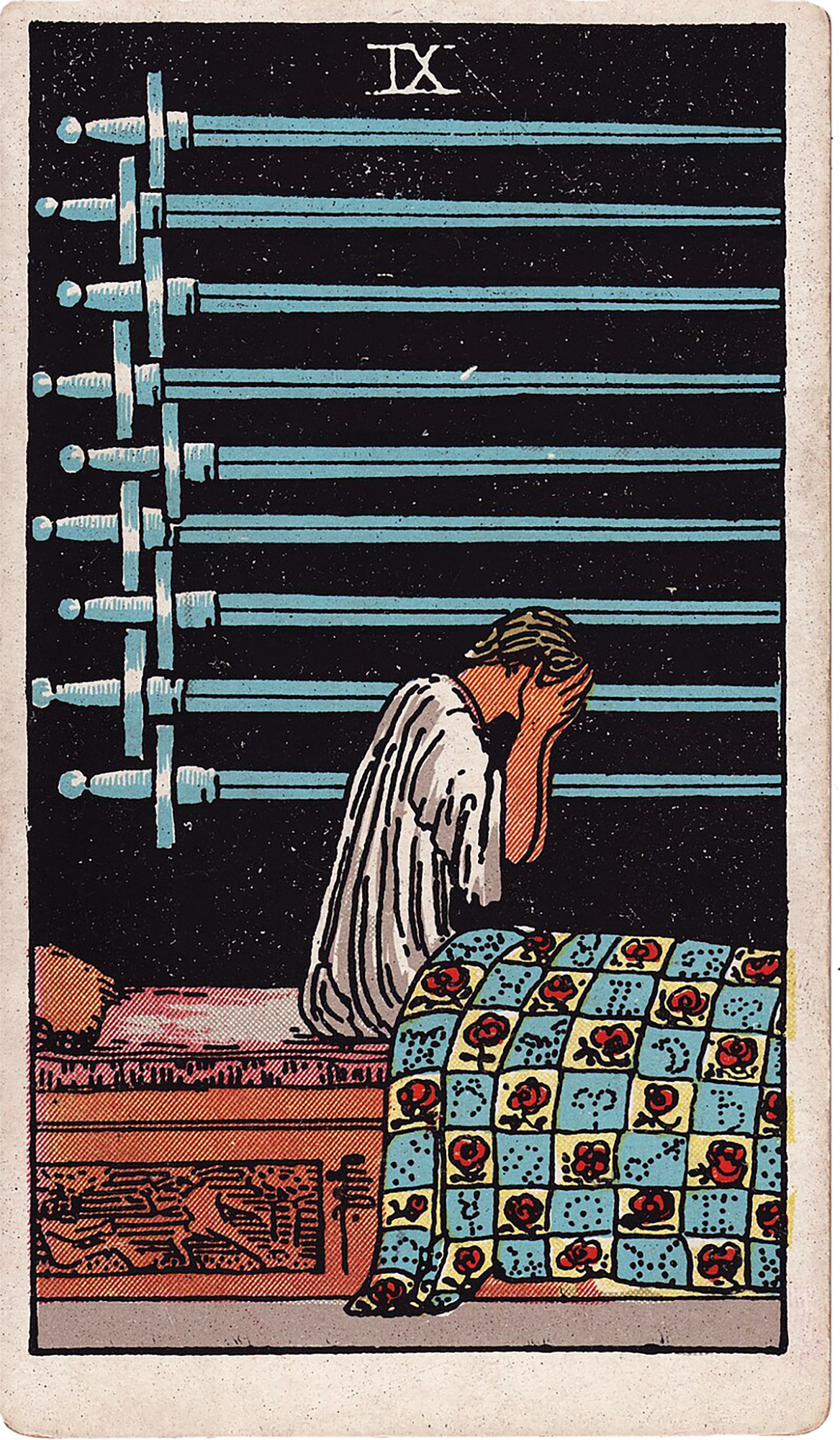 9 of Swords
Introduction to a single-card lesson
We are working with one specific Tarot card: the 9 of Swords, as provided in the upright and reversed texts you were given. Treat this as a single-card context lesson: when that card appears by itself in a position (love, career, outcome, etc.), the reader must build the story from the card's imagery, elemental suit skills, and the question asked. The supplied upright description highlights the mind amplifying fear during vulnerable hours and asks for practical responses that fit the present stage. The supplied reversed description draws attention toward relief, seeking help, and where the process has become stuck. Throughout this article I anchor interpretations to the Rider‑Waite‑Smith symbolism visible on the supplied 9 of Swords: a figure sitting up in bed with hands over their face, nine swords mounted on the wall, a dark bedroom, and a window showing distant mountains or a moonlit landscape. Those visual elements are your evidence when translating the card into context-specific guidance.
Key visual symbolism and interpretive logic
Start from image elements and the Swords suit. Visual cues on the supplied 9 of Swords: a solitary person sitting upright in bed with a posture of despair or sleeplessness; nine swords on the wall above or behind them; a dark room suggesting night hours and private inner thought; a small window with a distant landscape. How to read these reliably: link posture to psychological state (worry, insomnia), swords to the mind and communication, and the window to perspective—there is external reality outside this room that the figure may not be seeing clearly. The upright text you were given already frames the card practically: fear amplified at vulnerable hours, requiring care, evidence, and support rather than automatic belief. The reversed text invites careful examination of where relief, help, or stuck processes appear. When you interpret in a context, ask: where is the mind creating pressure, who is isolated, what evidence is available outside the 'night room,' and which Swords skills (thought, truth, decision, communication) are needed?
Technique for single-card context readings
Use a three-step micro-method when a single 9 of Swords appears: 1) Anchor to image and supplied text: name what you literally see on the supplied 9 of Swords and recite the concise upright or reversed prompt (e.g., 'mind amplifying fear at night' or 'relief and help are needed'). 2) Apply suit logic: Swords bring thinking, words, decisions, conflict and consequences of mental habits—choose which of these is most salient for the question. 3) Translate to the position: map those meanings to love, career, money, advice, person, outcome or spiritual reflection. Always ask what evidence would disconfirm the anxious interpretation (this counters catastrophizing) and whether action at the level of communication, boundary, or cognitive strategy can shift the situation. Keep the reading learner-focused: offer possible actions rather than deterministic predictions.
Upright 9 of Swords in love and relationships
When the supplied upright 9 of Swords appears for love, read the image as nighttime worries about the relationship—rumination, imagined scenarios, or guilt. The swords above the bed show thoughts piling up; the late hour suggests isolation or private fear. Practical interpretation: the core issue is mental, not necessarily an objective crisis. Ask whether the querent has evidence for the worst-case story, or if they're rehearsing fears. Advice tied to the upright 9 of Swords in love: bring fears into honest, gentle communication (a Swords skill), seek reassurance or mediation, and test assumptions before acting. Use journaling or a calm conversation rather than letting the mind run through night anxieties. If reading for outcome, upright suggests current stress that can be named and managed—resolution is possible if mental habits are addressed.
Upright 9 of Swords in career and money
In career contexts, the supplied upright 9 of Swords most often points to working yourself into worry over performance, deadlines, or financial what‑ifs—especially at off-hours. The swords indicate internal critique, strategies that become self-sabotaging, or overanalysis blocking action. Practical steps include distinguishing solvable problems from hypothetical catastrophes, creating a prioritized plan (strategy, a Swords strength), and communicating boundaries about availability to managers or clients. For money, the card warns against panic-driven financial decisions; count facts first. The upright energy makes the core task easier to name: identify one decision, one conversation, or one corrective action that reduces the mental load.
Advice and challenge readings with the upright card
As advice, the supplied upright 9 of Swords asks for careful mental hygiene: collect evidence, articulate fears, make a strategy, and speak what must be said. As a challenge, it warns that anxious thinking itself is the obstacle—recognize catastrophic narratives and stop feeding them. Use concrete Swords techniques: list pros and cons, set communication scripts, rehearse difficult conversations, or schedule a limited worry period to contain rumination. The card's upright text instructs the reader to respond to the present stage rather than an abstract ideal—so focus on incremental, achievable actions.
Reversed 9 of Swords: relief, help, or persistent inner shame
When the supplied reversed 9 of Swords appears, the core motions shift. The reversed text you were given highlights relief, seeking help, persistent anxiety, shame, or hidden worries that are not obvious to others. In practice, reversal often signals one of three dynamics: 1) emerging relief — the worst part of the night has passed but continues to echo; 2) stuck process — the querent understands the worry intellectually but cannot enact new habits; 3) hiddenness — anxiety is happening privately and is not yet communicated. Read the image inverted: the same swords and the same dark room, but now the question is about what needs to be simplified, acknowledged, spoken, or released before healthier thought patterns return.
Reversed 9 of Swords across contexts
Love: reversed can indicate someone is beginning to seek help, confess a fear, or feel shame about needs. Encourage small, safe disclosures and normalizing help (therapy, couples work). Also watch for minimization—reversed may mean the other person thinks 'it's fine' but the issue is unresolved. Career and money: reversed often points to asking for support (mentorship, a second opinion, financial counseling) or to anxiety that has become chronic because no one has simplified the problem. Advice/challenge: the reading suggests creating structures that make relief practical—delegation, schedule changes, boundary enforcement, or speaking up. Person/outcome: a reversed 9 of Swords can describe someone prone to internalized shame or someone who will reach out; interpret according to position and whether the querent feels seen.
Practical reading examples and common mistakes
Examples: 1) Love position: If a querent with a late-night worry dream asks about reconciliation, the upright 9 of Swords suggests their fear is real but likely amplified—recommend honest conversation, a small first step. The reversed card in the same position would suggest they are ready to speak or need help to do so. 2) Career position: upright shows a burnout pattern—prioritize tasks, delegate; reversed shows they have started to ask for help or are stuck in persistent anxiety despite knowing what to do. Common mistakes to avoid: assuming the 9 of Swords always means doom, reading it only as external betrayal (it is primarily mental), or prescribing action before assessing whether the anxiety is grounded. Another error is treating the reversed card automatically as 'good'—it often points to subtle work needed to convert insight into habit.
Putting it into practice: a short method to use now
When the supplied 9 of Swords appears, follow this quick checklist: 1) State whether it's upright or reversed from the supplied cards and read the corresponding supplied text aloud. 2) Describe three visible image elements (person in bed, nine swords, window) and tie each to a reading clue (inner fear, thoughts piling up, external perspective). 3) Ask the querent for one concrete piece of evidence that supports their fear and one that contradicts it—this balances interpretation. 4) Recommend one Swords action appropriate to the context (talk, set a boundary, make a decision, write a list). 5) If reversed, add one help-seeking or simplification step (ask for help, schedule therapy, practice nightly grounding). This method keeps readings practical and evidence-based.
Conclusion and learning focus
The supplied 9 of Swords is a powerful single-card teacher about how the mind can amplify suffering and also how verbalizing and structuring responses can reduce it. Across love, career, money, advice, and spiritual reflection the core interpretive logic stays consistent: identify whether the issue is largely cognitive, name the specific mental habit, choose a Swords‑level corrective (thought work, truthful communication, strategy), and check for evidence outside the 'night room.' Remember: this is a learning exercise for readers and not a deterministic prediction. Keep your interpretations anchored in the image and the supplied upright/reversed prompts and always pair insight with practical next steps.
Practice questions
• When you look at the supplied 9 of Swords image, which single visual detail feels most true to your question and why?
• In your situation, what evidence supports your worst worry and what evidence contradicts it?
• Which Swords skill (thought, communication, decision, strategy) would make the most immediate difference if applied right now?
• If the card is reversed for you, what practical help could you ask for this week?
• How would you distinguish between an emotion that needs action versus an emotion that needs containment or time?
• What small nightly ritual could you use to keep anxious thinking from intensifying after dark?
Comments
Sign in to comment.
Continue learning
Interpreting the Dance of Justice and The Devil: Balancing Morality and Temptation in Tarot Readings
The combination of Justice and The Devil in tarot presents a profound exploration of morality, temptation, and personal accountability. This article unpacks how these cards influen...
Advanced Techniques for Combining The Moon and The Star to Enhance Intuition in Tarot Readings
This article explores advanced techniques to combine the symbolism and energy of The Moon and The Star Tarot cards to enhance intuition during Tarot readings. Drawing from traditio...
Unlocking Life Insights with the Celtic Cross Tarot Spread
This article offers a thorough exploration of the Celtic Cross Tarot Spread, focusing on its application within family and practical life contexts. Using a worked example featuring...
Unlocking Hidden Meanings with The Hermit and The Hanged Man for Spiritual Growth
This article offers an in-depth exploration of The Hermit and The Hanged Man Tarot cards focusing on their roles in spiritual growth. It guides readers through beginner and advance...
Unlocking Personal Insight with the Seven Card Horseshoe Spread
The Seven Card Horseshoe Spread is a practical and insightful Tarot layout ideal for exploring personal and family dynamics. This article breaks down each position—Past, Present, H...
Mastering the Court Cards of Wands for Unlocking Personal Drive and Leadership
The Court Cards of Wands represent a dynamic spectrum of personal energy, ambition, and leadership potential within the Minor Arcana. This article offers a comprehensive exploratio...
Tracing the Origins and Evolution of The Fool Card in Tarot History
The Fool card holds a foundational place in tarot tradition, symbolizing beginnings, openness, and the embrace of uncertainty. This article traces its origins from early European d...
Techniques for Reading Court Cards to Unlock Personality Insights
Court cards in Tarot often represent people, personality traits, or energy patterns within a situation. This article offers a structured approach for beginners and advanced readers...
Unlocking Emotional Transformation with Death and The Moon Tarot Combination
This article explores the rich and complex interaction between the Death and The Moon tarot cards within the Rider-Waite-Smith tradition, focusing on their combined potential to un...
Applying The Star Card to Foster Hope and Renewal in Personal Growth
The Star card in Tarot symbolizes hope, authenticity, and the process of steady renewal. In a single-card reading, The Star encourages embracing what is present, cultivating openne...