
Reading the Ace of Cups for Fresh Starts in Love Creativity and Healing
This article teaches how to read one card—the Ace of Cups—as a powerful indicator of emotional openings and blockages. Using the supplied Ace of Cups images and their upright and reversed meanings, you will learn how to anchor interpretations in Rider-Waite-Smith symbolism (the hand from the cloud, the overflowing cup, the dove and five streams), adapt the card across contexts (love, creativity, healing, career, money, advice, a person, outcome, spiritual reflection), run practical single-card readings, avoid common mistakes, and practice clarifying questions and follow-ups. The approach treats readings as skillful reflection rather than fortune-telling and gives concrete exercises to build confidence.
Cards explored in this article
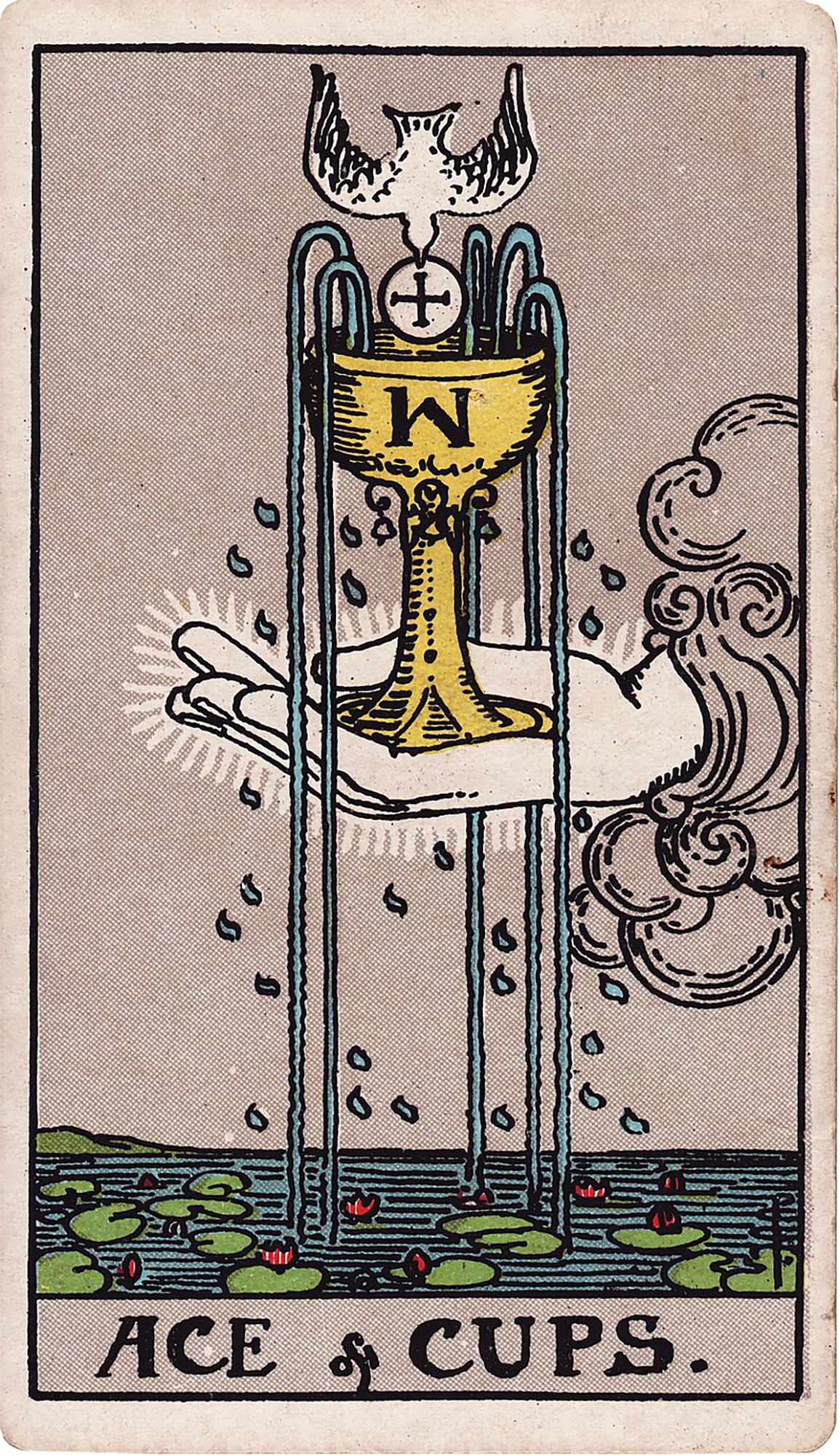 Ace of Cups
Introduction to the Ace of Cups as a single-card lesson
When you place the supplied Ace of Cups alone on the table you are asking: Where is the emotional or creative field opening right now? The Ace of Cups is fundamentally an opening card. In the upright position the supplied card highlights "an opening of the emotional field: affection, compassion, intuitive receptivity or creative feeling that wants to be received and expressed." It is practical: it asks for a response that fits the present stage rather than an abstract ideal. In the reversed position the supplied card draws attention to "emotional blockage, depletion, fear of vulnerability or feelings that are present but not being given a healthy channel." This lesson shows how that single image—hand emerging from a cloud holding an overflowing cup, a dove, and five streams—can be read in many contexts. We'll rely on the exact Ace of Cups imagery and on the upright/reversed descriptions you have so that every interpretation remains anchored to the card you see.
Core symbolism you must see in the image
Before interpreting contexts, train your eyes on the Rider-Waite-Smith details that give the Ace of Cups its voice. Use these motifs as levers for meaning rather than as fixed sentences. Key elements to observe on the supplied Ace of Cups: - The hand from the cloud: a gift, a sudden offering, something that appears beyond the querent's ordinary control. It locates the moment as initiation rather than consequence. - The cup itself, overflowing: emotional abundance or surplus that is ready to pour into life. The overflow suggests that the feeling is meant to be shared and to fertilize the environment. - The five streams of water: multiple channels of feeling, memory, or creativity. They represent variety and flux rather than a single, rigid emotional line. - The dove descending, usually bringing a wafer or symbolizing spirit: a connection of love and spirit, the quiet entry of grace or intuition. - The calm river and water lilies below: a receptive landscape ready to receive what is poured. Lilies speak to purity, memory, and often healing. - The surrounding land and distant structures: context and potential for growth; not everything is immediate. In a reading, point at these details and ask how each relates to the querent's question. The upright card tends to emphasize reception and actionable feeling; the reversed card asks you to look for stoppages in these same symbols—clogged streams, a cup held too tightly, a dove that hesitates. Always describe what you literally see first, then move to meaning.
Interpretation logic: how to move from image to context
A reliable interpretive pipeline turns visual cues into useful advice: 1) Describe literally: "I see a hand offering an overflowing cup, a dove, five streams, lilies." 2) Translate to suit logic: Cups = emotion, relationships, intuition, memory, receptivity. An Ace = seed, opening, potential. 3) Apply upright/reversed overlay from the supplied meanings: upright = opening/affection/creative feeling; reversed = blockage/depletion/fear of vulnerability or mis-channeling. 4) Contextualize to the question domain (love, career, money, etc.). Ask: Where can this seed appear? What needs to be expressed? 5) Offer practical next steps: small actions that match the card's stage (e.g., offer a conversation, create a brief piece of art, practice a private ritual of feeling). 6) Check for resonance: invite the querent to say whether the image or suggested action feels plausible now. This method prevents overreading and keeps the Ace of Cups a prompt for concrete change rather than a vague promise.
Technique: single-card reading process
Single-card readings are deceptively deep. Treat the Ace of Cups as a microscope for the present emotional field. Here is a step-by-step process that works for learners: 1) Set a clear question: narrow is better ("How can I open to new affection in the next month?" not just "Will I find love?"). 2) Decide whether reversals are active in your system. If yes, observe orientation. If not, read blockage as a contextual nuance. 3) Look: name five literal things you notice on the supplied Ace of Cups image. 4) Feel: name one immediate visceral response the card evokes. 5) Translate: apply the upright or reversed meaning from the supplied card text. 6) Anchor: place the meaning into the specific context (see the next section for formulas). 7) Action: propose one practical next step that matches the card’s stage and the querent's capacity. 8) Clarify: if the querent wants more detail, ask one clarifying question and draw a second single card only if you allow more cards. Keep the work iterative and reflective rather than deterministic.
Contextual readings: Love and relationships
Upright in love: The supplied Ace of Cups upright points to an opening in the emotional field: new affection, a renewed capacity to receive love, or the start of a relationship founded on genuine feeling. Use the imagery: the hand from the cloud is a gift—someone or something may come into the querent's life offering affection. The overflowing cup suggests abundance; the five streams suggest feelings flowing into different aspects of life (friendship, romance, family, self-love, creative intimacy). Practical reading: encourage small reciprocations—a vulnerable message, an invitation to spend undemanding time together, or a symbolic offering (a note, a shared meal). Reversed in love: The supplied reversed Ace of Cups highlights blockage or fear of vulnerability. The same cup is present but not pouring in a healthy way. Ask whether the querent is closing channels, experiencing depletion, or intellectually understanding love but not feeling it. Practical reading: work on safe expression—small, low-risk disclosures; journaling to witness blocked feelings; therapy or supportive conversation if fear is pervasive. Avoid promising instant romantic payoff; the reversal points to process work.
Contextual readings: Creativity and artistic projects
Upright for creativity: The Ace of Cups upright often announces a creative surge: an idea that arrives as a felt impulse, the kind of inspiration that feels like a gift. Use the dove and overflowing cup as metaphors for a muse or intuitive message. The five streams speak to different mediums or facets—sound, color, words, movement, and mood—so the card can mean that the querent has many entry points into a project. Practical action: begin with a small practice (10 minutes daily), accept imperfect output, and notice which stream wants priority. Reversed for creativity: Blocked creativity looks like depletion or fear of offering work. The reversal may indicate a creative block caused by perfectionism, emotional burnout, or a mismatch between internal desire and external demands. The task is not to force productivity but to remove obstacles: simplify the conditions, reduce pressure, and restore receptivity through small pleasures that refill the cup (walks, music, sensory play).
Contextual readings: Career and workplace
Upright at work: In a career question the Ace of Cups upright can signal a new collaborative opportunity, an emotionally resonant project, or a role where intuition and relationship skills matter. Read the hand-from-cloud as an offer: perhaps a manager gives a project with heart, or a chance to mentor appears. The overflowing cup suggests that emotional intelligence will be an asset. Advice: accept roles that align with values, propose people-centered initiatives, or say yes to tasks that feel meaningful rather than merely lucrative. Reversed at work: The reversed Ace of Cups indicates emotional depletion at work, boundary erosion, or fear of vulnerability in professional relationships. There can be an outpouring that has left the querent drained. Practical steps: renegotiate boundaries, delegate, request specific support, or schedule rest. Consider whether the job aligns with deeper values; if not, this card flags the need for recalibration rather than immediate resignation.
Contextual readings: Money and practical resources
Upright for finances: The Ace of Cups is not a money card by suit, but upright it can indicate generosity or income that arrives through relationships—gifts, supportive networks, or creative monetization of what the querent loves. The imagery says: an offering appears; the landscape is receptive. Advice: consider low-risk ways to turn meaningful skills into modest income (commissioned creative work, emotional labor that is fairly compensated, collaborative side projects). Reversed for money: The reversed Ace of Cups warns against emotionally-driven financial decisions that lead to depletion (giving beyond your means, supporting others at your expense) or feeling cut off from abundance. Practical remedy: set simple budgetary boundaries, ask for transparency in exchanges, and detach emotional approval from financial choices. The lesson is to bring Cups' receptivity under practical governance.
Contextual readings: Advice and challenge
As advice, upright the supplied Ace of Cups asks: Where can you open your heart now in a way that fits your life? The card is practical—choose a response that suits the stage: a small offer rather than sweeping declarations. Use the five streams as a checklist of channels you can strengthen: listen more, write what you feel, practice a ritual, ask for help, or create. As challenge, reversed the supplied card asks: What emotional habit is blocking you? The reversal is an invitation to simplify, acknowledge, practice, release, or communicate. Re-read the card's imagery for stuckness: is the cup held too rigidly? Are the streams obstructed? Name the block and prescribe a simple practice: 5 minutes of naming feelings, a scripted honest line for an upcoming conversation, or a commitment to a replenishing activity.
Contextual readings: A person and outcome
If the querent asks "Who is this person?" and the Ace of Cups appears upright, read the person as someone emotionally open, generous, perhaps new in the querent's life or offering a fresh emotional start. Anchor the reading visually: this person resembles the card's gift—they arrive rather than pursue; they may be kind, intuitive, and spiritually inclined. Reversed, the person could be emotionally closed, wounded, or someone who floods with feeling unpredictably. Outcome readings: upright, the Ace of Cups outcome suggests a beginning that grows—authentic connection, a healed creative impulse, or a renewed receptivity over time. Reversed, the outcome indicates work still required: either the emotional field needs tending, or the opening will be delayed until blockages are addressed. Frame outcomes as tendencies not guarantees and name the first small step that would shift the trajectory.
Contextual readings: Spiritual reflection and healing
Spiritually, the Ace of Cups upright points to grace, initiation into compassion, or the softening of the heart that allows deeper feeling or intuitive knowing. Use the dove as sign of spiritual blessing or a gentle message from within. Practically, the card invites contemplative practices that cultivate receptivity: breathwork, loving-kindness practices, journaling into the heart, or creating altar offerings that feel intimate. Reversed spiritually, the card signals spiritual dryness, numbness, or an intellectualized faith that is not lived. Healing here is slow and practical: small rituals that re-sensitize the body (sensory baths, touch, music), and attention to grief or past wounding that has closed streams. The supplied reversal advice—examine where process became stuck and what must be simplified or acknowledged—applies directly.
Examples and sample readings
Example 1 — Love daily draw (upright): Querent asks "What energy should I bring to dating this week?" You read the Ace of Cups upright: literal observation (hand, cup, dove, streams), takeaway (an opening of the emotional field), practical action (offer a small vulnerability: reveal a favorite song or memory). Explain why: the card's overflow invites sharing, not grand gestures. Example 2 — Creative block (reversed): Querent asks "Why can't I finish my paintings?" The Ace of Cups reversed suggests emotional depletion and fear of offering work. Visual anchor: the cup is not pouring in a healthy way. Action: schedule two short, nonjudgmental paint sessions, and track which small pleasure refills the cup. Example 3 — Job offer decision (upright): Querent considers a people-focused role. Ace of Cups upright suggests the role will satisfy emotional and value-driven needs. Ask: Does the day-to-day include relational contact that refills you? If yes, accept; if not, negotiate for those components. Each sample keeps attention on the image and the upright/reversed supplied meanings, and closes with an actionable next step.
Common mistakes and how to avoid them
1) Focusing only on wishful outcomes: The Ace of Cups asks what can be opened now—read it as a prompt to act, not a promise of instant bliss. 2) Equating Cups with romance only: Cups cover emotion, memory, intuition and creativity. Name the precise emotional domain in the querent's life before assuming "romance." 3) Ignoring the literal image: Always describe what you see first; students often skip this step and rely on memorized meanings. 4) Treating reversal as merely "bad": The reversed supplied card is process-oriented; ask what is stuck rather than declaring doom. 5) Over-advising dramatics: The Ace of Cups wants responses that fit the present stage. Teach small, staged actions. 6) Reading without follow-up: Single-card readings invite follow-through; recommend a tiny practice and check back. These corrections will keep readings grounded and useful.
Practice exercises to build skill
1) Daily single-card journal: Draw the supplied Ace of Cups each morning and write five literal observations plus one action based on upright or reversed meaning. 2) Imagery mapping: For each motif (dove, hand, streams, lilies), write three modern metaphors (e.g., dove = quiet message, unexpected kindness, inner prompt). 3) Role-play readings: Practice reading the card for classmates or friends across different contexts (love, job, money) and ask for feedback on usefulness. 4) Reversal drills: Shuffle intentionally and practice naming how a blockage might look in each domain. 5) Action log: When you give an action step in a reading, follow up in 7–14 days and note whether the step changed anything. These exercises reinforce seeing, translating, and advising from the Ace of Cups image.
Practice questions
• When you look at the supplied Ace of Cups image, which single motif (hand, cup, dove, streams, lilies) most captures your attention and why?
• In an issue you currently face, where is there a possibility for a small opening rather than a big solution?
• If the Ace of Cups appears reversed in your life, what single habit or routine might be blocking the 'streams' from flowing?
• How can you create a low-risk action that aligns with an upright Ace of Cups offer (e.g., brief vulnerability, small creative practice, a replenishing ritual)?
• Which of the five streams could you prioritize this week (listening, writing, making, talking, solitude) and commit to a 10-minute daily practice?
Comments
Sign in to comment.
Continue learning
Interpreting the Dance of Justice and The Devil: Balancing Morality and Temptation in Tarot Readings
The combination of Justice and The Devil in tarot presents a profound exploration of morality, temptation, and personal accountability. This article unpacks how these cards influen...
Advanced Techniques for Combining The Moon and The Star to Enhance Intuition in Tarot Readings
This article explores advanced techniques to combine the symbolism and energy of The Moon and The Star Tarot cards to enhance intuition during Tarot readings. Drawing from traditio...
Unlocking Life Insights with the Celtic Cross Tarot Spread
This article offers a thorough exploration of the Celtic Cross Tarot Spread, focusing on its application within family and practical life contexts. Using a worked example featuring...
Unlocking Hidden Meanings with The Hermit and The Hanged Man for Spiritual Growth
This article offers an in-depth exploration of The Hermit and The Hanged Man Tarot cards focusing on their roles in spiritual growth. It guides readers through beginner and advance...
Unlocking Personal Insight with the Seven Card Horseshoe Spread
The Seven Card Horseshoe Spread is a practical and insightful Tarot layout ideal for exploring personal and family dynamics. This article breaks down each position—Past, Present, H...
Mastering the Court Cards of Wands for Unlocking Personal Drive and Leadership
The Court Cards of Wands represent a dynamic spectrum of personal energy, ambition, and leadership potential within the Minor Arcana. This article offers a comprehensive exploratio...
Tracing the Origins and Evolution of The Fool Card in Tarot History
The Fool card holds a foundational place in tarot tradition, symbolizing beginnings, openness, and the embrace of uncertainty. This article traces its origins from early European d...
Techniques for Reading Court Cards to Unlock Personality Insights
Court cards in Tarot often represent people, personality traits, or energy patterns within a situation. This article offers a structured approach for beginners and advanced readers...
Unlocking Emotional Transformation with Death and The Moon Tarot Combination
This article explores the rich and complex interaction between the Death and The Moon tarot cards within the Rider-Waite-Smith tradition, focusing on their combined potential to un...
Applying The Star Card to Foster Hope and Renewal in Personal Growth
The Star card in Tarot symbolizes hope, authenticity, and the process of steady renewal. In a single-card reading, The Star encourages embracing what is present, cultivating openne...