
Tracing the Historical Origins and Common Questions About the Hierophant Card in Tarot Tradition
The Hierophant card is one of tarot's most historically rich and symbolically dense cards, traditionally representing established wisdom, spiritual guidance, and societal structures. This article traces its origins from religious and cultural contexts, explains the card’s symbolism using the Rider-Waite-Smith imagery, and addresses common interpretative questions. Readers are guided on practical ways to work with the card in a reading, discerning its upright and reversed aspects while avoiding frequent pitfalls. Anchored in the supplied Hierophant card image, this article deepens understanding for tarot learners seeking to engage meaningfully with tradition and personal insight.
Cards explored in this article
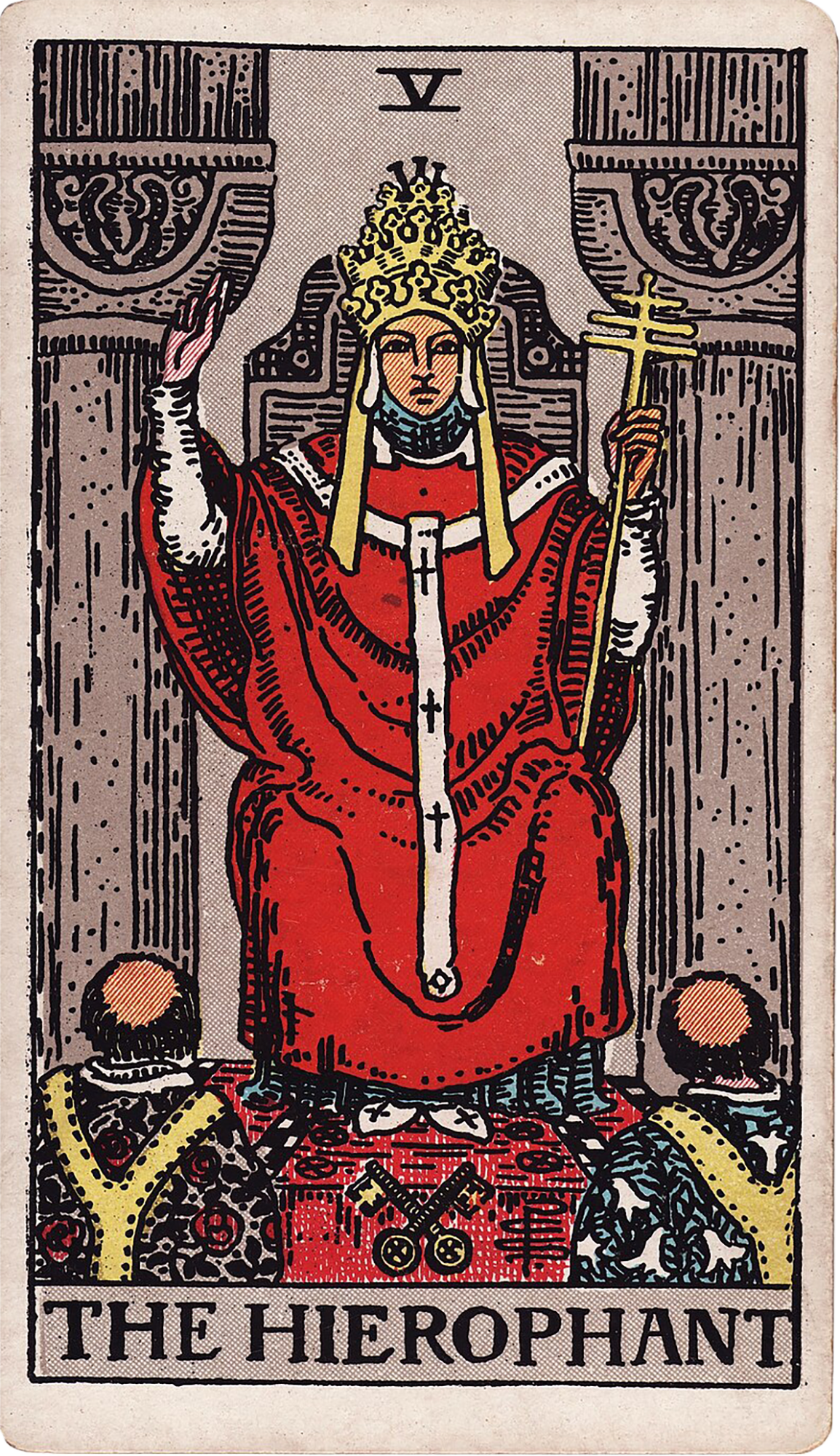 The Hierophant
Historical Origins of the Hierophant Card in Tarot Tradition
The Hierophant card, known as the fifth card of the Major Arcana in traditional tarot decks such as the Rider-Waite-Smith, has deep historical roots tied closely to religious, cultural, and societal frameworks. The term "hierophant" itself originates from ancient Greek, meaning "one who reveals sacred things," often referring to priests who interpreted divine mysteries in the Eleusinian Mysteries. This historical connection aligns the card with figures of spiritual authority, guardianship of esoteric knowledge, and ritualistic tradition. In the context of tarot’s development, the Hierophant replaced the papal figure seen in older decks, notably the Tarot de Marseille, which visually echoed the Pope or a religious leader. This substitution highlights tarot’s early role as a reflection of established societal hierarchies and the transmission of moral and spiritual knowledge through sanctioned authorities. Over centuries, the Hierophant has evolved into a symbol of structured wisdom and conformity, embodying traditional knowledge systems, religious institutions, and the role of mentorship.
Symbolism in the Rider-Waite-Smith Hierophant Card
The supplied Hierophant card image draws heavily on Rider-Waite-Smith symbolism to communicate its layered meaning. Central to the card is the figure of the Hierophant, seated between two pillars that echo the architecture of sacred temples, symbolizing stability and guardianship of spiritual law. He wears a triple crown, signifying authority over the earthly, spiritual, and celestial realms, and holds a triple cross staff, underscoring his role as an intermediary between divine knowledge and human understanding. Two acolytes kneel before him, emphasizing the theme of structured teaching and learning from an established source. The crossed keys at the Hierophant’s feet represent access to hidden wisdom and the unlocking of spiritual mysteries through proper guidance. The card’s upright posture and coloring reinforce themes of clarity, order, and tradition. Observing these details guides readers to see the Hierophant not merely as an authority figure, but as a symbol of learning from established systems, engaging with clear boundaries, and consciously choosing when or whether to follow established rules.
Understanding Upright Hierophant Meanings and Practical Reading Techniques
When the Hierophant appears upright in a reading, it invites the querent to consider the value of structured learning, mentorship, and ethical guidance. This card encourages engagement with existing traditions or institutions rather than immediate rebellion or innovation. It suggests that the current situation benefits from consultation with experienced teachers, adherence to proven methods, or deeper exploration of foundational principles. Practically, readers should ask questions such as "Where is a direct response needed?" or "What rules or systems must be understood before moving forward?" The card does not promise ease, but emphasizes the quality of deliberate choice and conscious engagement with established wisdom. In the supplied card’s imagery, note how the acolytes’ attentive posture models openness to guidance, signaling that humility and receptivity can be keys to progress. Common reading mistakes include rigidly interpreting the card as dogmatic submission or assuming it mandates unquestioned conformity. Instead, consider it a prompt to evaluate where tradition is useful and where personal discernment can be applied. The Hierophant upright signals the readiness to work with what is present now and to take next steps informed by clear ethical boundaries.
Decoding the Reversed Hierophant and Its Complex Interpretations
The reversed Hierophant often challenges readers to examine where the positive upright qualities are blocked or distorted. Unlike an automatic negative reading, a reversed Hierophant encourages exploration of dogma that has become empty ritual, blind conformity, or rebellion without understanding. It can indicate internalized beliefs that limit growth or institutions demanding obedience without wisdom. In practical readings, the reversal may mark a shift from external authority to an internal psychological process—questioning inherited patterns or societal pressures. It may also signal a necessary correction, where the querent begins to recognize outdated conditioning but has not yet fully released it. Interpreting the reversal requires attention to surrounding cards and context. Is the querent resisting tradition, recovering from past conditioning, or experiencing excess rigidity? The supplied Hierophant card’s symbolism, when mentally inverted, reminds us of the tension between institutional power and personal autonomy. Avoid common pitfalls such as assuming the reversal means outright rejection of tradition; instead, view it as a nuanced phase of reassessment or rebalancing.
Common Questions About the Hierophant Card in Family and Tradition Contexts
The Hierophant frequently appears in readings concerning family history, tradition, and cultural heritage. Common questions include: How do inherited beliefs shape current decisions? When should one honor family traditions versus challenge them? What role do mentors or elders play in navigating life’s challenges? The upright Hierophant suggests respectful engagement with family customs and wisdom passed through generations. It encourages learning from elders and understanding the rules that govern family or community life. Conversely, the reversed card may indicate generational conflict, questioning of inherited values, or the need to break free from limiting family dogma. Practitioners should use the card as a tool to inquire where tradition supports growth and where it may hinder authenticity. The visual cues in the supplied card—such as the keys and acolytes—serve as metaphors for unlocking and sharing family wisdom thoughtfully, rather than blindly following. When reading for family matters, balance the Hierophant’s message with sensitivity to individual autonomy and the evolving nature of tradition.
Integrating the Hierophant Card Into Personal and Group Readings
Working with the Hierophant card effectively requires attuning to its dual roles as a symbol of external authority and internalized wisdom. For personal readings, it can highlight areas where seeking advice, formal study, or engagement with spiritual practice is beneficial. It encourages deliberate, informed steps rather than impulsive action. In group settings or community readings, the Hierophant can point to the importance of shared values, ethical frameworks, and collective responsibility. It may highlight the role of leadership, education, or rituals that unify members. A practical technique is to focus on the card’s questions: Where is structure needed? Where is blind obedience to be avoided? How can tradition be honored while allowing space for innovation? Using the supplied card’s imagery as a focal point, encourage querents to visualize themselves as either the Hierophant or the acolytes, exploring roles of teacher, student, or seeker. Avoid over-reliance on fixed interpretations. Instead, use the card as a dynamic invitation to dialogue between past wisdom and present choice.
Summary and Best Practices for Learning the Hierophant Card
In summary, the Hierophant card embodies the interplay between tradition, authority, and personal discernment. Its historical origins ground it in sacred revelation and institutional wisdom. The Rider-Waite-Smith imagery richly conveys its themes through pillars, keys, triple crowns, and the presence of disciples. Best practices for learners include: - Study the card’s symbols closely to connect their meanings with reading contexts. - Approach upright Hierophant as encouragement to engage with established knowledge systems constructively. - Interpret the reversed card as a nuanced signal of tension with tradition or internal transformation, not simply a negative omen. - Use reflective questions to clarify how the card applies to the situation, especially concerning family and cultural traditions. - Balance respect for authority with personal ethical boundaries and openness to change. By integrating these approaches, the Hierophant can serve as a powerful guide for navigating the complex relationships between history, tradition, and individual growth.
Practice questions
• In what areas of your life do you currently rely on established wisdom or traditions?
• How do you differentiate between meaningful guidance and rigid dogma?
• When faced with the Hierophant reversed, how might you explore internalized beliefs holding you back?
• What role do mentors or elders play in your personal or family journey?
• How can you balance honoring tradition with making deliberate, authentic choices?
Comments
Sign in to comment.
Continue learning
Interpreting the Dance of Justice and The Devil: Balancing Morality and Temptation in Tarot Readings
The combination of Justice and The Devil in tarot presents a profound exploration of morality, temptation, and personal accountability. This article unpacks how these cards influen...
Advanced Techniques for Combining The Moon and The Star to Enhance Intuition in Tarot Readings
This article explores advanced techniques to combine the symbolism and energy of The Moon and The Star Tarot cards to enhance intuition during Tarot readings. Drawing from traditio...
Unlocking Life Insights with the Celtic Cross Tarot Spread
This article offers a thorough exploration of the Celtic Cross Tarot Spread, focusing on its application within family and practical life contexts. Using a worked example featuring...
Unlocking Hidden Meanings with The Hermit and The Hanged Man for Spiritual Growth
This article offers an in-depth exploration of The Hermit and The Hanged Man Tarot cards focusing on their roles in spiritual growth. It guides readers through beginner and advance...
Unlocking Personal Insight with the Seven Card Horseshoe Spread
The Seven Card Horseshoe Spread is a practical and insightful Tarot layout ideal for exploring personal and family dynamics. This article breaks down each position—Past, Present, H...
Mastering the Court Cards of Wands for Unlocking Personal Drive and Leadership
The Court Cards of Wands represent a dynamic spectrum of personal energy, ambition, and leadership potential within the Minor Arcana. This article offers a comprehensive exploratio...
Tracing the Origins and Evolution of The Fool Card in Tarot History
The Fool card holds a foundational place in tarot tradition, symbolizing beginnings, openness, and the embrace of uncertainty. This article traces its origins from early European d...
Techniques for Reading Court Cards to Unlock Personality Insights
Court cards in Tarot often represent people, personality traits, or energy patterns within a situation. This article offers a structured approach for beginners and advanced readers...
Unlocking Emotional Transformation with Death and The Moon Tarot Combination
This article explores the rich and complex interaction between the Death and The Moon tarot cards within the Rider-Waite-Smith tradition, focusing on their combined potential to un...
Applying The Star Card to Foster Hope and Renewal in Personal Growth
The Star card in Tarot symbolizes hope, authenticity, and the process of steady renewal. In a single-card reading, The Star encourages embracing what is present, cultivating openne...