
Unraveling the Seven of Cups Symbols for Choices Imagination and Illusion
This VoxFati Tarot Library article offers an in-depth study of the supplied 7 of Cups card images, connecting Rider-Waite-Smith symbolism with practical reading techniques. Using the supplied upright description—"many possibilities compete for attention; imagination is valuable, but discernment is needed"—and the supplied reversed description—"clarity after confusion, narrowed options, disillusionment"—we map how each cup image, the number seven, and the suit of Cups combine to ask readers to balance imagination and reality. The article provides a visual breakdown of each cup, interprets upright and reversed energies, outlines a step-by-step reading method, gives examples across life areas, lists common mistakes readers make with this card, and supplies concrete practice exercises. Intended for learners, not as deterministic fortune-telling, the article emphasizes observation, context, and iterative practice to transform the 7 of Cups from a confusing spectacle into a tool for discernment and emotional clarity.
Cards explored in this article
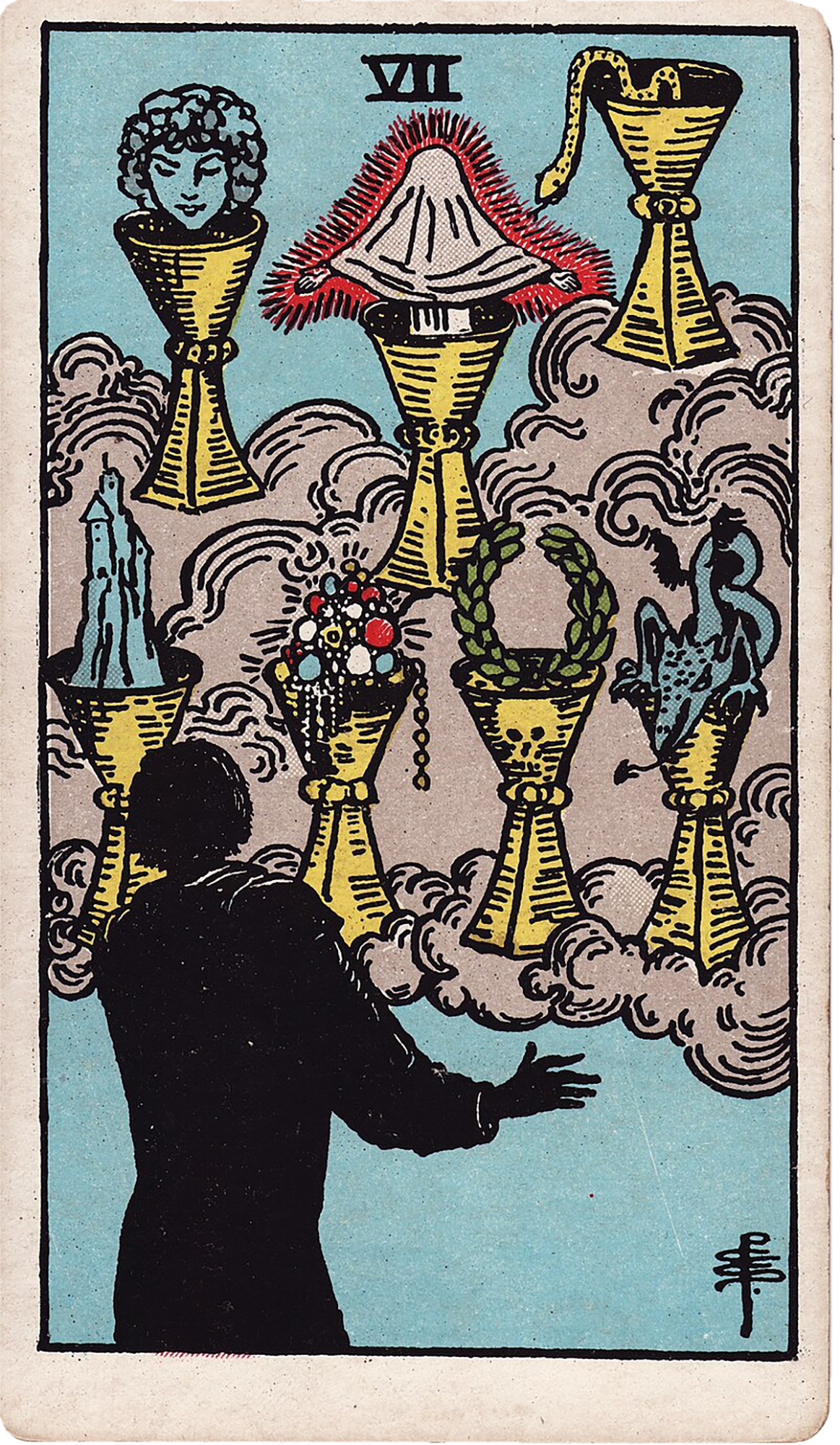 7 of Cups
Introduction and learning goals
This article is a focused study of the supplied 7 of Cups card images and their symbolic resources for reading choices, imagination, and illusion. Our goals are practical: to learn how to read the card visually, to translate that imagery into working questions for a querent, to distinguish constructive imagination from projection, and to recognize when the card signals overwhelm versus an invitation to explore. The supplied upright description states that "many possibilities compete for attention; imagination is valuable, but discernment is needed" and instructs readers to respond practically to the present stage. The supplied reversed description draws attention to "clarity after confusion, narrowed options, disillusionment or choosing reality after a period of fantasy." We will repeatedly anchor the teaching to those supplied texts and to the visual details of the card so you can practice with the images you see.
Quick card overview from the supplied texts
Treat the supplied upright 7 of Cups as an image of possibility and perceptual risk. As the upright summary says, this card shows "many possibilities compete for attention; imagination is valuable, but discernment is needed to separate meaningful options from projection." Practically, it indicates emotional and relational skills (intuition, receptivity, memory, processing feelings) are the appropriate tools to handle the situation. The supplied reversed text asks you to look for increasing clarity: "clarity after confusion, narrowed options, disillusionment or choosing reality after a period of fantasy." The reversal is not simply the opposite of the upright; instead, it signals a point where the card's process—exploration of options—has become stuck, overdone, or interiorized. Throughout this article we will move back to those two supplied framings and connect them to the card's visuals.
Visual breakdown: reading the scene and the seven cups
Start every reading by describing what you actually see on the supplied 7 of Cups image. In the traditional Rider-Waite-Smith arrangement, a figure stands looking at seven cups arranged in the clouds, each cup containing a different image. Use neutral, specific language first: observe the clouds, the solitary figure, the positions of the cups, and the contents. Then move to symbolic associations. A reliable way to work is to list each cup and give one to three keywords for common associations. Typical Rider-Waite-Smith imagery in the cups is (observed on the supplied card): - A human head: desire for an ideal partner or projected person; fixation on a face/identity; fantasy of relationship or persona. - A shrouded/veiled figure: mystery, unknown fate, spiritual calling, or inner shadow material; invitation and potential danger in the unknown. - A snake: temptation, sexual energy, knowledge, or a tricky offer; both wisdom and deception can be present. - A castle or tower: ambition, longed-for security, a dream of status or permanence. - A wreath or crown: victory, recognition, egoic reward; an appealing but possibly hollow prize. - Piles of treasure/jewels: material reward, sensual pleasure, or distraction by wealth. - A glowing or supernatural apparition: spiritual revelation, psychic experience, or elusive fantasy. When you identify each cup, connect it to the querent's situation. Ask: which of these images fits how the querent talks about their options? Which images feel attractive but vague? Which feel dangerous? The clouds themselves matter: they show that options are not yet solidified; many shapes are projections. The figure looking up is pivotal—are they in awe, confused, or calculating? That posture guides your tone: sympathetic exploration vs. firm grounding.
Number and suit: what the seven and Cups add to the picture
Interpretation logic depends on layering the card's basic categories. The suit of Cups consistently points toward emotion, relationships, intuition, memory, and the interior life. When the 7 appears in a suit, it carries the theme of testing, choices, or trial. Seven often marks a stage of evaluation: a threshold between temptation and discernment, when many possible directions must be sorted. Applied to the supplied 7 of Cups, combine those layers: emotional options are multiplying; the querent faces internal or relational choices rather than purely material ones. The card asks for emotional clarity—figuring out which feeling-based option is meaningful rather than a wishful projection. In readings, this suggests that the primary work may be psychological: sorting fantasies from feelings, clarifying desire, or testing commitments.
Upright 7 of Cups in practice: reading the supplied upright meaning
Use the supplied upright text as a starting rule: "many possibilities compete for attention; imagination is valuable, but discernment is needed to separate meaningful options from projection." In a spread, treat the card as a prompt rather than a verdict. Practical steps: 1) Inventory the options visually: name which cup-images correspond to real-world choices the querent is considering. Avoid vague labels—use specific proposals or attractions. 2) Ask a set of clarity questions: Which option aligns with long-term values? Which option requires unrealistic sacrifices? Which feelings are projection of past needs or external expectations? Because the upright card emphasizes Cups' skills (emotion, relationships, intuition, memory), encourage the querent to use emotional evidence: how do they feel after imagining each choice? What memories does each choice activate? What does their body say? 3) Locate the stage of process using context: The supplied upright text advises considering whether this energy is "beginning, developing, reaching pressure, or moving toward resolution." Read surrounding cards or positions to place the 7 in a timeline. If analysis shows beginning, emphasize exploration. If it shows pressure, emphasize prioritization and triage. 4) Turn imagination into experiment: the upright 7 rewards small, grounded tests—imagine a short trial, set time-limited commitments, or simulate outcomes to reveal which options are sustainable. Keep the language for the querent practical: this card is not asking for an immediate final decision but for discernment and a response that "fits the present stage rather than an abstract ideal."
Reversed 7 of Cups in practice: working with the supplied reversal text
The supplied reversed description points to narrowing and clarity: "clarity after confusion, narrowed options, disillusionment or choosing reality after a period of fantasy." But the reversal can signal different processes depending on context. Reversal reading logic: - Resolution phase: The querent is moving from exploration into selection. This is often constructive—options are being pruned and a practical choice is emerging. - Disillusionment phase: The querent has discovered that certain options were illusory. Reversed, the card can be painful as fantasies collapse. Attend to emotional processing: grief and disappointment are legitimate parts of choosing. - Stuck phase: The reversal may also mean the 7's energy is stuck inside the querent—intellectually understood but not integrated emotionally. Ask what needs to be simplified, acknowledged, practiced, released or communicated. For example, someone may know which option is best but keeps fantasizing about an impossible alternative. Practical reading moves: help the querent inventory what has been dropped and why. Use concrete criteria to evaluate remaining options. If the reversal indicates interior work, suggest practices to integrate insight into behavior—journaling focused on commitments, small boundary-setting tasks, or speaking the decision aloud to a trusted person.
Step-by-step reading method for interpreting the supplied 7 of Cups
This is a reproducible method you can apply each time the supplied 7 of Cups appears. 1) Describe neutrally: Start by saying out loud what is present on the supplied image—figure, clouds, seven cups, and their contents. Keep it factual for a minute. 2) Match images to options: Ask the querent to name real-world equivalents for each cup image. If they cannot, offer plausible labels: relationship, career ambition, money, spiritual search, temptation, recognition, mystery. Be explicit about uncertainties. 3) Check emotional resonance: For each labeled option, ask: how does imagining this make you feel immediately? Which images increase anxiety, which expand curiosity, which feel numb? 4) Stage assessment: Use the supplied upright text’s prompt to identify process stage—beginning, developing, pressure, resolution. Note whether the card is upright or reversed and apply the supplied reversal frameworks. 5) Reality check: Test for projection vs. reality. Ask what evidence supports the option and what is wishful thinking. Invite the querent to list external constraints and enablers. 6) Priority filter: Use pragmatic criteria—values, feasibility, emotional cost, timeline—to narrow options. If reversed, this step may already be happening; assist in articulating criteria. 7) Actionable next steps: Convert insight into 1–3 small actions that gather information or commit to a trial. The upright 7 favors small experiments; the reversed 7 favors clarifying commitments or grieving illusions. 8) Follow-up language: Close with a sentence that frames the card as a process, not a fate. Example: "The supplied 7 of Cups shows a moment of sorting—let’s pick two options to explore with brief tests over the next month."
Three practical reading examples anchored to the supplied imagery
Example A — Relationship crossroads (upright): A querent draws the supplied 7 of Cups upright while asking about a romantic choice. Map the human head cup to an idealized image of a partner, the castle to long-term security, the snake to a tempting but risky attraction, and the jewels to comfort. Use the upright guidance: highlight that imagination is active—ask the querent which images are fantasies tied to past patterns. Recommend scenarios to test emotional responses: author a conversation, try a weekend visit, or request a concrete plan from the other person. Emphasize discernment rather than immediate commitment. Example B — Career options (reversed): The querent has multiple job offers and the supplied 7 of Cups appears reversed. Here the reversal suggests narrowing or disillusionment. Ask which offers have dropped away and why—were they ruled out by logistics or ethical reasons? If the reversal signals interior stuckness, the querent may say, "I know which job is best, but I keep imagining the 'perfect' role." Use pragmatic criteria (salary, commute, growth) and small actions like negotiating an offer or asking for a trial project to integrate choice into action. Example C — Spiritual or creative path (upright to reversed transition): A creative person sees the supplied 7 of Cups upright in one reading and reversed in a later reading. Upright, they are flooded with artistic possibilities (the glowing apparition, the treasure). Reversed later, they experience disillusionment—some projects feel hollow. Interpret this as a normal pruning: support them to complete one piece and show it publicly as a reality check. The card sequence shows invention then refinement.
Common mistakes readers make with the supplied 7 of Cups and how to avoid them
Mistake 1 — Over-dramatizing the images: Readers sometimes treat each cup as a deterministic fate. Avoid predicting fixed outcomes. Instead, use the cups as metaphorical options to be tested. Mistake 2 — Failing to ground imaginative items: The 7 invites imagination; readers can forget to ask for feasibility. Always ask for concrete evidence, timelines, and resources for the options suggested by the imagery. Mistake 3 — Reversals as simply ‘bad’: The supplied reversed text is nuanced. Don’t assume reversal is negative; it may indicate useful clarity. Mistake 4 — Ignoring the querent’s bodily data: The Cups suit is emotional—ask how each option feels somatically. Emotional data can be more reliable than rationalizing in these situations. Mistake 5 — Not using position or surrounding cards for stage. The supplied upright suggests different stages (beginning, pressure, resolution); use adjacent cards or spread positions to place the 7 correctly. To avoid these errors, practice the step-by-step method above and keep interpretation provisional: always propose an experiment or small action rather than an unquestioned conclusion.
Practice exercises to deepen visual and interpretive skill
Exercise 1 — Cup labeling drill: Look at the supplied 7 of Cups image and give each cup a one-word label within 60 seconds. Then spend five minutes writing what real-life choice each label could map to. Exercise 2 — Feelings inventory: For each labeled cup, note the first three bodily sensations you feel when you imagine choosing it. Associate sensations with short verbs (tighten, expand, sink). Exercise 3 — Upright/Reversed role-play: Do two mini-readings for a friend—first with the 7 upright, encouraging exploration and experiments; second with the 7 reversed, focusing on pruning and emotional integration. Note how action suggestions differ. Exercise 4 — Evidence checklist: For one option suggested by a cup, make an evidence list supporting it and a list undermining it. See which list is more substantial and decide on a one-week test. Practice these weekly. Keep a learning log to track how your interpretations shift when you focus on the actual imagery of the supplied card.
Conclusion and study tips
The supplied 7 of Cups is a dense card: it invites imagination but warns against mistaking projection for reality. Use the supplied upright text—"many possibilities compete for attention; imagination is valuable, but discernment is needed"—as a procedural rule: generate possibilities, then test and prune. Use the supplied reversal as a signpost for integration: "clarity after confusion, narrowed options, disillusionment or choosing reality after a period of fantasy." Read the image carefully, map images to concrete choices, prioritize emotional evidence and practicality, and always finish with an experiment or a small commitment. Over time, working with the card’s visual vocabulary trains you to recognize when a querent is exploring versus when they need a firmer reality check. Keep practicing with the exercises and revisit the supplied texts as anchor points for interpretation logic.
Practice questions
• Which cup image on the supplied 7 of Cups most strongly drew your attention and why?
• When you imagine choosing the option associated with that cup, what three bodily sensations do you notice first?
• How does the supplied upright description (many possibilities; need for discernment) change the way you would advise a querent who is overwhelmed?
• If the supplied card appears reversed to you, what are three signs that it indicates constructive pruning rather than bitter disillusionment?
• What small experiment could you recommend for one of the cups' options that would produce clear evidence in two weeks?
• Which cultural or personal projections might you be imposing on the imagery, and how can you check them?
• How would you phrase a single-sentence summary of the supplied 7 of Cups for a querent who wants quick guidance?
• After working through the evidence and feelings, what realistic constraint might prevent the most attractive cup from being chosen, and how can the querent address it?
Comments
Sign in to comment.
Continue learning
Interpreting the Dance of Justice and The Devil: Balancing Morality and Temptation in Tarot Readings
The combination of Justice and The Devil in tarot presents a profound exploration of morality, temptation, and personal accountability. This article unpacks how these cards influen...
Advanced Techniques for Combining The Moon and The Star to Enhance Intuition in Tarot Readings
This article explores advanced techniques to combine the symbolism and energy of The Moon and The Star Tarot cards to enhance intuition during Tarot readings. Drawing from traditio...
Unlocking Life Insights with the Celtic Cross Tarot Spread
This article offers a thorough exploration of the Celtic Cross Tarot Spread, focusing on its application within family and practical life contexts. Using a worked example featuring...
Unlocking Hidden Meanings with The Hermit and The Hanged Man for Spiritual Growth
This article offers an in-depth exploration of The Hermit and The Hanged Man Tarot cards focusing on their roles in spiritual growth. It guides readers through beginner and advance...
Unlocking Personal Insight with the Seven Card Horseshoe Spread
The Seven Card Horseshoe Spread is a practical and insightful Tarot layout ideal for exploring personal and family dynamics. This article breaks down each position—Past, Present, H...
Mastering the Court Cards of Wands for Unlocking Personal Drive and Leadership
The Court Cards of Wands represent a dynamic spectrum of personal energy, ambition, and leadership potential within the Minor Arcana. This article offers a comprehensive exploratio...
Tracing the Origins and Evolution of The Fool Card in Tarot History
The Fool card holds a foundational place in tarot tradition, symbolizing beginnings, openness, and the embrace of uncertainty. This article traces its origins from early European d...
Techniques for Reading Court Cards to Unlock Personality Insights
Court cards in Tarot often represent people, personality traits, or energy patterns within a situation. This article offers a structured approach for beginners and advanced readers...
Unlocking Emotional Transformation with Death and The Moon Tarot Combination
This article explores the rich and complex interaction between the Death and The Moon tarot cards within the Rider-Waite-Smith tradition, focusing on their combined potential to un...
Applying The Star Card to Foster Hope and Renewal in Personal Growth
The Star card in Tarot symbolizes hope, authenticity, and the process of steady renewal. In a single-card reading, The Star encourages embracing what is present, cultivating openne...