
When the Four of Cups Appears Practical Guidance for Love Career and Inner Renewal
This article uses the supplied 4 of Cups card image and the provided upright and reversed card texts as the anchor for a deep single-card lesson. It explains Rider-Waite-Smith symbolism on the card, shows how to read the 4 of Cups in multiple contexts (love, career, money, person, outcome, spiritual reflection), offers a step-by-step practical reading method, common mistakes to avoid, and short example readings. The emphasis is on learning interpretive technique rather than making predictions: notice what the figure sees, what is being offered, and how withdrawal functions as both a tool and a pitfall.
Cards explored in this article
 4 of Cups
Introduction: Why study a single card closely
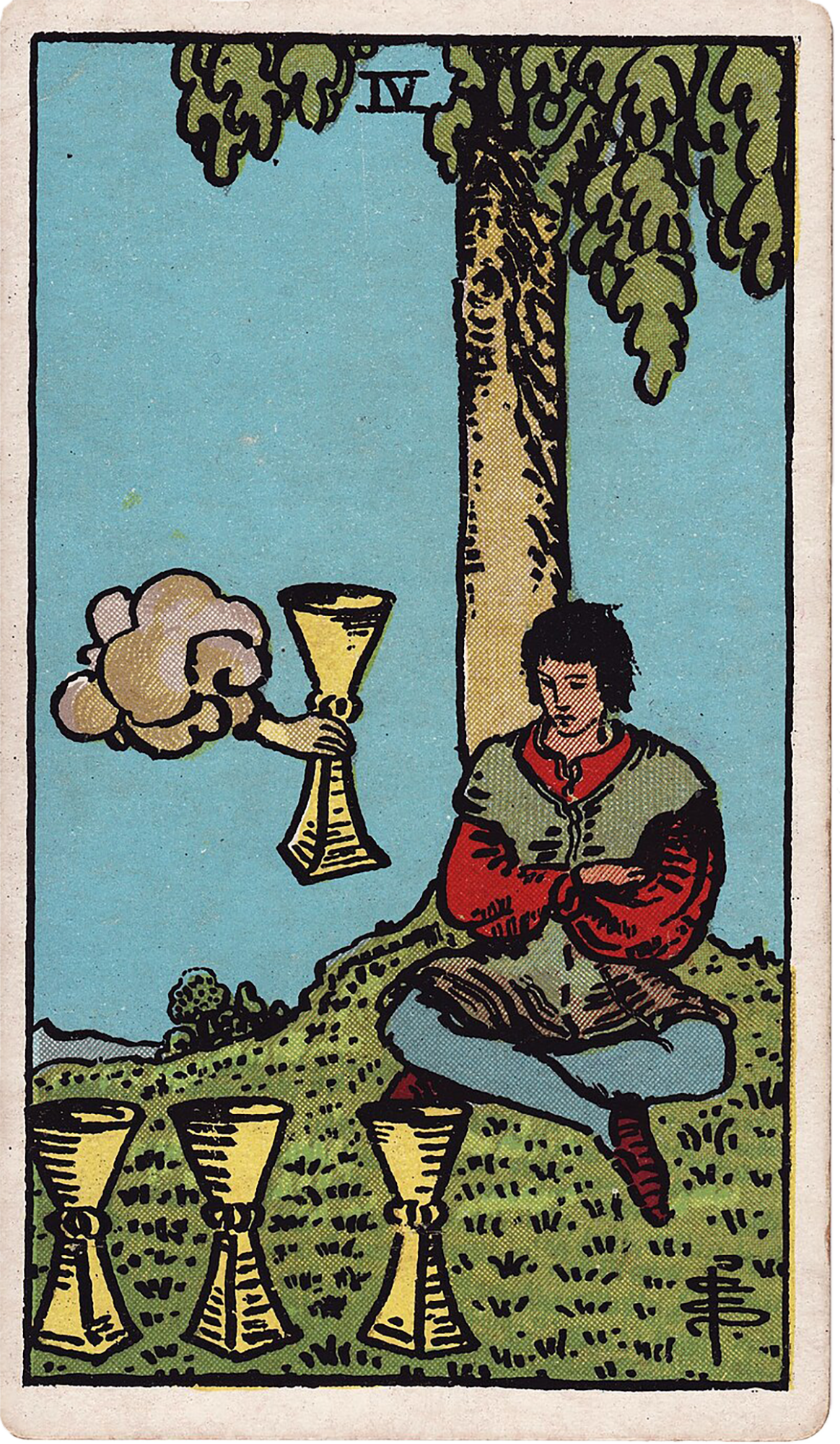
Working with one card in depth trains observational skill, contextual thinking, and disciplined interpretation. The supplied 4 of Cups card image gives a compact scene with clear symbols: a seated figure, three cups on the ground, and a hand offering a fourth. The verbal texts you were given for the card (upright and reversed) provide the core meanings to work from: upright, the card highlights emotional pause and reevaluation and asks for a response that fits the present stage rather than an abstract ideal; reversed, it draws attention to renewed interest, restlessness, or finally noticing an emotional possibility that was ignored. This article teaches you how to connect those statements to the card's imagery and to different reading contexts such as love, career, money, advice, challenge, person, outcome, and spiritual reflection.
Reading basics for a single-card context
Always start with what you see on the supplied 4 of Cups image before you bring in keywords. Describe the scene out loud or in writing: the body posture, direction of the figure's gaze, the placement of the cups, the environment, light and shadow, and the single hand delivering a cup. Use the supplied upright and reversed explanations to frame questions: "Is this a moment of deliberate pause or is it avoidance?" "Is the person finally noticing what was there?" Then ask the context question you need answered (for example, "What is the emotional dynamic in this relationship?" or "What is the best next step at work?"). Keep the reading anchored to the image and the supplied texts; that prevents generic-sounding interpretations.
Symbolism in the Rider-Waite-Smith 4 of Cups image
The Rider-Waite-Smith-derived image used on the supplied 4 of Cups shows a solitary figure seated beneath a tree, arms crossed, staring at three cups arranged at the figure's feet. A hand emerges from a cloud offering a fourth cup. Key symbolic elements to notice and use in interpretation: - The seated figure: posture of withdrawal, introspection, and physical stillness. Crossed arms signal emotional protectiveness or closed-off energy. - The three cups on the ground: known, familiar emotional assets, or memories. Their placement on the ground suggests they belong to the figure's present life but are currently unappreciated. - The offered cup: an external opportunity, invitation, or perspective that the querent hasn't yet accepted or seen. Coming from a cloud implies timing, providence, chance, or an unconscious prompting. - The tree and landscape: stability and the slow passage of time; the environment encourages patience but also marks stagnation if there is no change. - The figure's gaze: often downward or turned inward, indicating that inner focus blocks seeing new offers. Use each visible detail to refine whether the card points toward constructive reassessment or avoidance.
Upright 4 of Cups: interpretive logic and practical meaning
Use the supplied upright description as the starting frame: "Upright, 4 of Cups highlights emotional pause and reevaluation; dissatisfaction may contain useful information, but withdrawal can also hide opportunities. The card is practical: it asks for a response that fits the present stage rather than an abstract ideal. Consider where this pattern is already visible and what action would strengthen its constructive side." From the image, ask: is the figure resting to process feelings or shutting down from pain? Upright readings often show a need to sit with emotions and name what is missing. Practically, the card asks the querent to inventory what they have (the three cups), notice the new possibility (the offered cup), and choose whether to accept, decline, or wait. Emotionally mature usage: set a time limit on withdrawal, journal to clarify dissatisfaction, or make a short list of concrete steps that won't compromise personal boundaries. Use surrounding cards (if any) to determine whether this is a beginning pause, a developing issue, a pressure point, or moving toward resolution. Upright 4 of Cups rarely means easy passive waiting; rather, it points to an active interior process that requires honest naming and a decision that matches present limits.
Reversed 4 of Cups: nuance and where the process is stuck
Anchor this section to the supplied reversed description: "Reversed, 4 of Cups draws attention toward renewed interest, restlessness, inability to appreciate what is present, or finally noticing an emotional possibility that was ignored. The reversal may show too much of the card's usual energy, too little of it, or a situation where the lesson is understood intellectually but not yet lived consistently. It can also indicate that the issue is occurring internally and is not obvious to other people." When the card is reversed in your reading, ask whether the querent is emerging from isolation or falling out of helpful reflection into anxiety. Reversal can mean: - A sudden willingness to engage, which may be tentative or fearful. - Restlessness that undermines the benefits of reflection. - A late recognition of something that was always available. Practically, reversed 4 of Cups can call for small tests of engagement: accept a minor invitation, make a short commitment to explore an option, or practice gratitude for immediate supports. Also ask whether the reversal signals a private shift that hasn't been communicated; if so, prompt the querent to find one trusted person to share what they've noticed.
Love and relationships: reading the 4 of Cups
When the supplied 4 of Cups appears for a love question, keep imagery front and center. The seated figure can represent one partner's introspective phase. Upright: the relationship is in a reflective pause. Dissatisfaction is meaningful data—what emotional needs are unmet? The three cups on the ground are existing relationship resources (companionship, history, shared routines) that aren't currently satisfying the querent. The offered cup is either a new romantic possibility or a different way to receive what's already there. Practical guidance: pause to inventory needs, communicate one honest observation, and avoid swift exits driven by transient boredom. Reversed: notice whether the querent is suddenly more open or simply restless. It could mean renewed interest in the existing partnership, or an impulse toward new options once they finally notice them. Caution: reversed energy can lead to reactive decisions. Use small experiments (a date night, a candid conversation, couples reflection exercise) rather than grand gestures. In either orientation, ask: who in the image are you—are you the seated figure, or the source of the offered cup?
Career and workplace: interpreting the card practically
In career readings, the three cups stand for current projects, responsibilities, or relationships at work; the offered cup is a role, task, or change being proposed. Upright 4 of Cups suggests a period of reassessment: you may feel disengaged, under-stimulated, or dissatisfied despite reasonable work conditions. Instead of leaping to resignation, use the upright card's guidance: assess what specifically is missing (challenge, recognition, autonomy), experiment with small changes that fit the present stage (request a new task, ask for feedback), and avoid making decisions based on an idealized future. Reversed 4 of Cups in career context often signals renewed curiosity or impatience. You may be about to take an opportunity you previously ignored—check whether it's because the offer truly fits your values or because you're escaping boredom. Practical steps include: setting a 30–90 day trial period for any change, talking to mentors, and documenting what you want from work to prevent repeating the same pattern.
Money and resources: reading the 4 of Cups for finances
Financially, the ground-level cups represent current assets, income streams, or budgeting structures you already possess. Upright 4 of Cups indicates dissatisfaction or worry about money that could contain practical clues: perhaps you feel your income is insufficient compared to expectations, or you are fixating on what you don't have. The offered cup could be an alternate income idea, a budgetary tweak, or advice from someone else. Practical guidance: inventory your current resources, make a modest experiment (small side project, micro-savings), and avoid large financial moves driven by restlessness. Reversed 4 of Cups may show surprising interest in a financial possibility you ignored or a restless impulse to spend or change investments. Before acting, run simple risk calculations and set a short trial window. In all cases, attention to basic bookkeeping and small tests protects against decisions rooted in emotional agitation.
Advice: what the 4 of Cups asks you to do
Treat the supplied upright and reversed texts as two modes of advice. Upright guidance: name your dissatisfaction, give yourself a defined period for reflection, and choose an action consistent with your present capacity. For example, set a two-week reflection period to journal about the sources of unhappiness, then choose one small change to test. Reversed guidance: test your renewed interest before sweeping changes. If excitement pulls you outward, make a low-cost trial (a meeting, a class, a short conversation) rather than a long commitment. Specific techniques useful for either orientation: - Grounded journaling: list three things you have and three things you want to change, with concrete next steps. - Sensory checking: use the image—what would it feel like to reach for the offered cup? Does your body relax or tense? - The five-minute acceptance test: accept a minor invitation and see how your mood shifts over five minutes. These concrete practices convert the card's interior emphasis into measurable experiments.
Challenge and blockage: where the 4 of Cups becomes problematic
The card's blockage lies in prolonged withdrawal that hides opportunities and in restless movement that prevents integration. Upright becoming problematic: when pausing turns into isolation, missed deadlines, or emotional numbness. The image then shows avoidance rather than healthy processing—three cups ignored while life continues. Reversed becoming problematic: when restlessness or new attraction leads to scattering attention or making impulsive choices. To detect the blockage in a reading, ask: how long has this pattern been in place? Who else in the querent's life notices the change? Practical interventions: set boundaries on the duration of a pause (e.g., no more than 30 days for indecision), create accountability (share your plan with a friend), and use physical actions (daily 10-minute walk, structured creative work) to break stasis without abandoning reflection.
Person and role: who can the 4 of Cups represent
When the supplied 4 of Cups references a person, look for someone who appears emotionally withdrawn, contemplative, or disengaged—often a querent themselves or a romantic partner. Upright persona: thoughtful, possibly melancholic, someone who needs emotional space to sort priorities. Reversed persona: someone who is becoming restless, ready to re-engage, or suddenly noticing an option they had missed. Ask whether the person is open about their inner life; the reversed card warns that changes may be experienced internally before they are visible externally. Use the figure's posture in the image to discuss communication style: crossed arms suggest guardedness; averted gaze suggests privacy. Practical reading tip: if the card represents another person, confirm with the querent whether that person has been withdrawn, and suggest one small, nonconfrontational step to invite communication.
Outcome and timing: what the 4 of Cups implies
As an outcome card, the upright 4 of Cups often indicates a slow, inward resolution rather than an immediate external change. Outcomes are likely to be internal clarity, a recommitted relationship after honest appraisal, or the decision to refuse an unsuitable offer. Timing tends to be measured in weeks to months because interior work rarely resolves overnight. Reversed as outcome indicates renewed engagement, often beginning with a single small step—someone accepts an invitation, tries a new role briefly, or publicly acknowledges a change. Caution: reversed outcomes can also be a false start if not anchored. Recommend testing periods and visible accountability to stabilize outcomes.
Spiritual reflection and inner renewal
Spiritually, the supplied 4 of Cups invites contemplative practice and discernment. Upright, it asks: what feelings need witnessing? Use the image as a meditation object—sit like the figure for a short time and watch the stream of emotions. The offered cup symbolizes grace, insight, or a new understanding appearing when you stop compulsively seeking external validation. Reversed, the card can indicate an awakening moment: restlessness opens into renewed curiosity or the sudden recognition of spiritual resources you previously overlooked. Practices to cultivate healthy expression: daily brief sitting meditations focused on 'what is present,' gratitude lists that include small concrete supports, and service-oriented acts that move you from inwardness to gentle outward engagement. Over time, these practices shift the 4 of Cups pattern from chronic dissatisfaction or flighty restlessness toward integrated receptivity.
Common mistakes readers make with the 4 of Cups
Several frequent errors undercut useful readings: 1) Treating the card as universally negative. The supplied upright text makes it clear the pause is practical and potentially productive. 2) Ignoring imagery: failing to notice the offered cup or the figure's posture leads to shallow advice. 3) Over-assuming who is the figure: always verify whether the seated figure represents the querent or someone else. 4) Equating reversed with a simple opposite: the supplied reversed text stresses examining where the process has become stuck—don't rush to 'good news' or 'bad news' labels. 5) Recommending dramatic changes without small experiments: the card favors stage-fitting actions. Avoid these mistakes by anchoring to the image, using the supplied upright/reversed frames, and proposing low-risk tests.
Practical step-by-step reading method
Use this method when the 4 of Cups appears alone in a single-card draw: 1) Describe: Verbally catalog the image—figure, cups, offered cup, environment, posture. 2) Orient: Note whether the card is upright or reversed and read the supplied text aloud. 3) Ask the context question you are answering (love, career, money). 4) Connect image to context: map the three ground cups to existing resources and the offered cup to a new possibility. 5) Diagnose: Is this a helpful pause or avoidance? If reversed, is this the beginning of re-engagement or restless scattering? 6) Advise: Give one concrete short-term test and one boundary (for example, "Try a single honest conversation this week; don't change jobs until you've tried a three-month project variation"). 7) Check for accountability: who will you tell about your test? 8) Follow-up: schedule when to reassess (two weeks, one month). This method keeps interpretations practical and learner-focused.
Two brief examples to practice reading the card
Example 1 — Love (upright): A querent pulls the supplied 4 of Cups asking about their long-term relationship. Describe the image: the seated figure appears withdrawn. Using the upright text, diagnose: a period of reevaluation has begun. Advice: inventory unmet needs in writing, then request a single focused conversation about one issue in the next week. Boundary: avoid making final decisions until you both have had space to respond. Example 2 — Career (reversed): A querent asks about a job offer and the supplied 4 of Cups appears reversed. The reversed text suggests renewed interest or restlessness; perhaps the querent is finally noticing this offer. Test: accept an informational meeting rather than immediately accepting or rejecting the offer; set a 30-day trial to evaluate fit. These examples show the card guiding small, measured experiments grounded in the image and supplied texts.
Conclusion: making the 4 of Cups a tool for learning
The supplied 4 of Cups image and its upright/reversed descriptions give you a precise vocabulary: pause, reevaluation, potential missed opportunity, renewed interest, and stuck processes. Always let the image lead—observe the figure, the three cups, and the offered cup—and then apply the supplied meanings to the specific context you are asked to consider. Favor small experiments, time-limited pauses, and clear communication in both upright and reversed cases. Over time, repeated practice with this method will sharpen your ability to differentiate healthy reflection from avoidance and to suggest concrete next steps that respect the querent's present stage of life.
Practice questions
• When you look at the supplied 4 of Cups image, which element draws your attention first and why?
• In your current life, what are three 'cups' you already have that you might be overlooking?
• Are you currently pausing to process (upright) or about to re-engage/feeling restless (reversed)? What bodily sensations accompany that state?
• What is one small, time-limited experiment you can run to test an emotional or practical possibility?
• Who can you tell about your test to create gentle accountability?
• How would you know the pause has been productive rather than avoidance?
Comments
Sign in to comment.
Continue learning
Interpreting the Dance of Justice and The Devil: Balancing Morality and Temptation in Tarot Readings
The combination of Justice and The Devil in tarot presents a profound exploration of morality, temptation, and personal accountability. This article unpacks how these cards influen...
Advanced Techniques for Combining The Moon and The Star to Enhance Intuition in Tarot Readings
This article explores advanced techniques to combine the symbolism and energy of The Moon and The Star Tarot cards to enhance intuition during Tarot readings. Drawing from traditio...
Unlocking Life Insights with the Celtic Cross Tarot Spread
This article offers a thorough exploration of the Celtic Cross Tarot Spread, focusing on its application within family and practical life contexts. Using a worked example featuring...
Unlocking Hidden Meanings with The Hermit and The Hanged Man for Spiritual Growth
This article offers an in-depth exploration of The Hermit and The Hanged Man Tarot cards focusing on their roles in spiritual growth. It guides readers through beginner and advance...
Unlocking Personal Insight with the Seven Card Horseshoe Spread
The Seven Card Horseshoe Spread is a practical and insightful Tarot layout ideal for exploring personal and family dynamics. This article breaks down each position—Past, Present, H...
Mastering the Court Cards of Wands for Unlocking Personal Drive and Leadership
The Court Cards of Wands represent a dynamic spectrum of personal energy, ambition, and leadership potential within the Minor Arcana. This article offers a comprehensive exploratio...
Tracing the Origins and Evolution of The Fool Card in Tarot History
The Fool card holds a foundational place in tarot tradition, symbolizing beginnings, openness, and the embrace of uncertainty. This article traces its origins from early European d...
Techniques for Reading Court Cards to Unlock Personality Insights
Court cards in Tarot often represent people, personality traits, or energy patterns within a situation. This article offers a structured approach for beginners and advanced readers...
Unlocking Emotional Transformation with Death and The Moon Tarot Combination
This article explores the rich and complex interaction between the Death and The Moon tarot cards within the Rider-Waite-Smith tradition, focusing on their combined potential to un...
Applying The Star Card to Foster Hope and Renewal in Personal Growth
The Star card in Tarot symbolizes hope, authenticity, and the process of steady renewal. In a single-card reading, The Star encourages embracing what is present, cultivating openne...