
Work with the Ten of Wands to Release Overload and Rebalance Your Life
This article is a focused, learner-centered exploration of the 10 of Wands as a single-card context lesson. Using the Rider-Waite-Smith imagery and the supplied upright and reversed descriptions, it explains how to recognize and work with patterns of overload, misplaced responsibility, and near-completion pressure. The piece maps how the card shifts across common reader contexts—love, career, money, advice, challenge, person, outcome, and spiritual reflection—and gives step-by-step practical techniques, example readings, interpretation logic, and exercises to practice releasing burden and rebalancing life. Readers leave with concrete tools for spotting when energy needs redirecting, when to delegate, how to simplify, and how to help querents transform weight into manageable, meaningful work.
Cards explored in this article
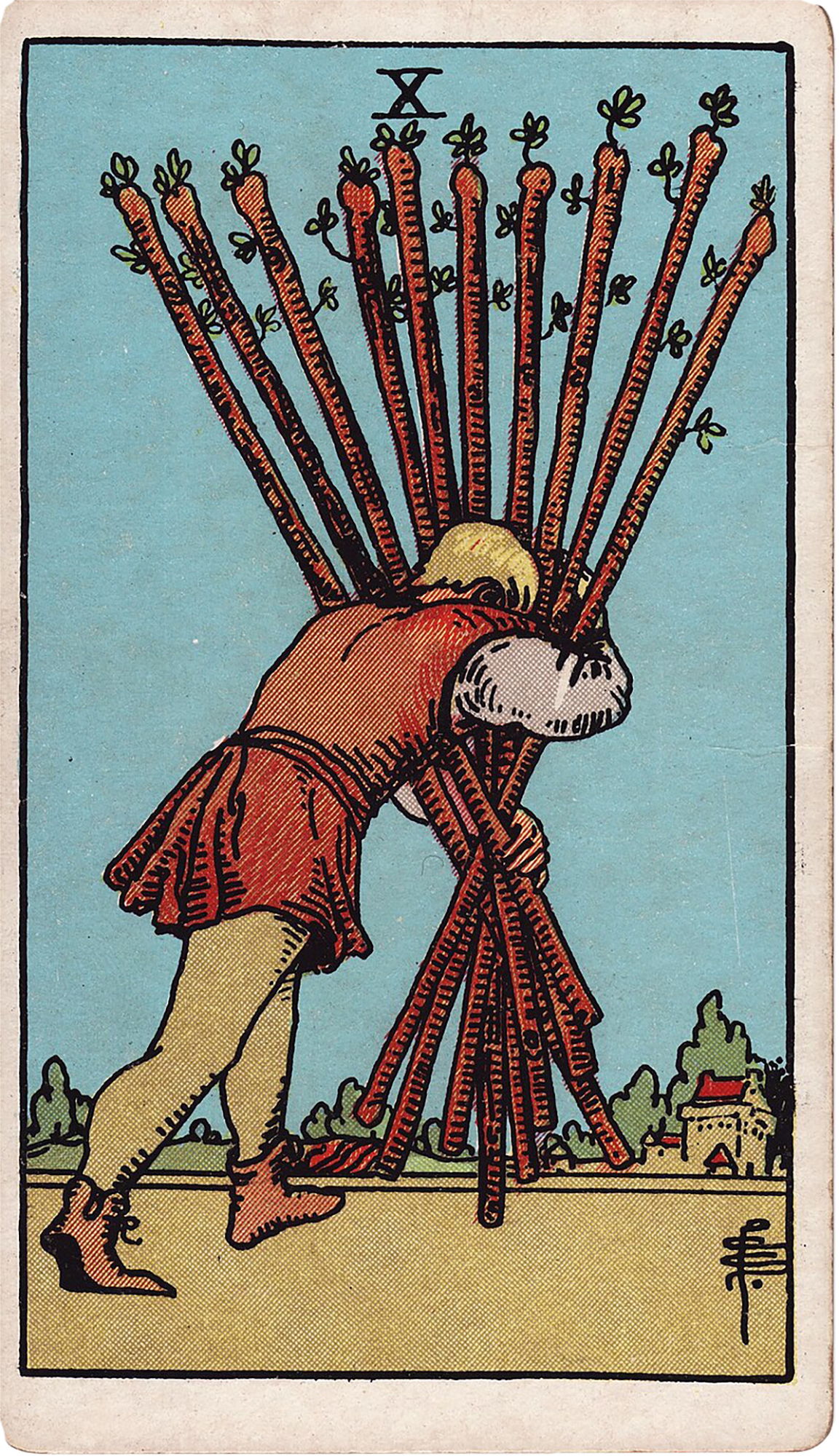 10 of Wands
Introduction to the single-card focus
The 10 of Wands is an ideal single-card study because it condenses a clear life-situation into an immediately legible image: effort under strain, nearing a destination, and the urgent question of what to keep and what to set down. This article treats only the supplied card—the 10 of Wands—and its upright and reversed descriptions. We do not bring in other cards. Instead we use the card's imagery and the two supplied meanings to explore how that single symbol changes with context. This approach trains you to turn a single symbol into a nuanced reading without adding more cards. The aim is practical: learn to see workload and responsibility patterns, help querents choose strategies (delegate, simplify, finish, or release), and avoid common interpretive errors.
Visual vocabulary and Rider-Waite-Smith symbolism
Look carefully at the image of the 10 of Wands: a figure bent forward beneath the weight of ten wooden wands. He clutches them tightly and moves toward a town on the horizon. The road is narrow and the posture is strained. Key symbolic notes to anchor every interpretation: the number ten—completion and culmination of a cycle; the bundle—accumulated responsibilities that may be awkward to carry; the forward movement—progress toward a goal but with a cost; the town—support, destination, or required surrender of burdens to enter community. In Rider-Waite-Smith tradition, Wands are about energy, creative drive, identity and initiative. The 10, then, shows energy that has been stretched to its limits to carry an enterprise to its close. When you read the card upright, use those visible cues: the weight presses the shoulders, the man is not resting, the destination is visible but the final steps will be hard. When reversed, imagine the same figure stumbling, dropping the wands, or finally loosening the grip. The supplied upright description highlights accumulated responsibility and a practical call to organize or delegate. The supplied reversed description highlights collapse under pressure, refusal or inability to delegate, martyrdom through overwork, or sometimes the relief of finally releasing duties. Always let the image guide whether the scene reads as steadied burden, imminent collapse, or intentional release.
Core meanings and interpretation logic
Start with the supplied upright and reversed definitions as your interpretive scaffolding. Upright: responsibility has accumulated into weight; completion may be close, but the load must be organized, delegated or reduced. Reversed: attention toward collapse under pressure, refusal to delegate, martyrdom through overwork, or finally releasing duties. Interpretation logic is a stepwise process: 1) Identify the dominant theme (burden, nearing completion, need to delegate, possible martyrdom). 2) Ask clarifying questions internally or of the querent: Who is carrying this load? Is it chosen? Is it temporary? 3) Anchor to image details: are there signs of hope (town ahead) or of desperation (bent, stumbling posture)? 4) Read context: the same image in a love question will emphasize different actors and outcomes than in a career question. 5) Translate into practical moves: reallocate, prioritize, ask for help, say no, finish and then rest, or release a role. Avoid treating the card as fatalistic—this is a lens for action. Remember a key interpretive rule from the supplied reversed note: do not simply take reversed as the opposite of upright. Instead, see reversal as a stuck process—too much of the card's theme or a related internal blockage. Ask what needs simplifying, acknowledged, practiced, released, or communicated before the healthier expression of Wands can return.
Reading the 10 of Wands for love and relationships
Upright love reading: When this supplied 10 of Wands shows up upright for a relationship question, read the image as one partner (or the relationship itself) carrying too much. The ten wands can signify emotional labour, domestic responsibilities, emotional caretaking, or one-sided planning. The town ahead suggests a possible goal—shared life, commitment, or reconciliation—but the way forward is strained. Practical interpretations include: one partner is overloaded by expectations; chores and logistics have eclipsed romance; the relationship is near a milestone but needs redistribution of duties to survive the final push. Ask: Who is carrying the bundle? Is the weight self-imposed to prove worth? Where can tasks be delegated? Encourage specific actions: divide responsibilities, ask for help, clarify expectations, or set boundaries around who does what. Reversed love reading: The supplied reversed meanings give several shades. It can show collapse—an emotional burn-out or the breakdown of a role (e.g., an exhausted caregiver reaching a breaking point). It can indicate refusal to delegate—someone clings to martyrdom and resents the lack of appreciation. Or, positively, it can indicate the act of releasing duties: the querent is finally able to let a role go or stop rescuing their partner. Ask: Is the querent exhausted but afraid to let go? Are they stuck in martyr mode? Recommend small experiments: say no to one request this week, request one concrete support action from the partner, or schedule a rest day. Always clarify that reversal often points to what’s stuck—identify what must be simplified, acknowledged, or communicated.
Reading the 10 of Wands for career and work life
Upright career reading: The 10 of Wands often appears when someone shoulders too many projects, role drift occurs, or a promotion increases responsibilities without support. The Rider-Waite image of carrying a heavy load toward a town suggests work that is near completion or a job that expects full-capacity performance with insufficient help. Practical career interpretations: you may be completing a major project but the final phase is taxing; you've accepted additional responsibilities without formal recognition; you should inventory duties and delegate where possible. Action steps: prepare a prioritized task list, create a delegation plan, negotiate resources or deadline extensions, and document accomplishments for review. Reversed career reading: In reversal, consider collapse or refusal to delegate. A reversed 10 of Wands can warn of burnout, sick leave, or a sudden drop in performance because the workload was unsustainable. It can also show someone who refuses to hand things off out of fear they'll be seen as dispensable. Alternatively, the reversal can be liberating: quitting a job that no longer fits, shedding an unnecessary title, or deciding to scale back freelance commitments. Ask: Is this temporary overload or structural burnout? Recommend concrete boundaries, a support audit (who can help and how), and an exit strategy if the role is irreparably toxic.
Reading the 10 of Wands for money and finances
Upright money reading: Financially, the 10 of Wands points to obligations that weigh the querent down—debt payments, promises to support others, or over-commitment to lifestyle choices. The town can symbolize creditors, social expectations, or material goals that require one final push. Interpretations include short-term heavy cash outflow that will end once obligations are resolved, or ongoing commitments that need renegotiation. Practical advice: make a budget focused on which 'wands' are essential, prioritize debt reduction on the highest-cost items, renegotiate payment terms, and explore ways to redistribute financial responsibility within household or business. Reversed money reading: Reversal can indicate collapse—missed payments, the stress of financial overload causing errors—or a refusal to continue carrying others' expenses. It can be a signal to release obligations (stop co-signing, decline loans to others) or a sign to restructure finances to avoid martyrdom. It may also indicate the relief that comes from releasing spending patterns that no longer serve you. Ask: Which obligations are chosen and which are imposed? Create an actionable financial simplification plan: cancel one subscription, stop one regular financial commitment to another person, or create an emergency buffer to prevent repeated collapse.
Advice, challenge and outcome readings with the 10 of Wands
Advice reading: As advice, the upright 10 of Wands is a practical prompt: organize, delegate, or reduce. Use the visual of the town: you do not have to carry everything into community alone. The card asks for a response that fits the present stage rather than an abstract ideal. Concrete advice steps: write a full list of responsibilities, mark which are delegated or optional, pick three that must change this month, and schedule one boundary conversation. Challenge reading: The card as a challenge often shows the querent’s tendency to take on too much or to value proving endurance over asking for help. The challenge may be internal (perfectionism, identity tied to being indispensable) or external (a workplace that rewards overwork). In reversal, the challenge could be denial of the problem—'I can handle it'—leading to collapse, or the difficulty of actually letting go. Outcome reading: Upright, the outcome can be completion reached with cost—a project finished but with exhaustion and possible resentment. The town implies arrival, but the question becomes: at what personal cost? Reversed, the outcome can be release or collapse. If release, the querent finds relief and clears space for new energy. If collapse, there's a forced shedding of responsibilities that may have been ignored for too long. In single-card outcomes, always encourage framing: if the card points to collapse, the reading should shift quickly into practical harm reduction and resource planning.
Reading the 10 of Wands as 'person' and psychological archetypes
When the 10 of Wands represents a person, think of someone who takes on heavy responsibility—often a 'carrier' or over-worker. The image evokes a person who defines themselves by duty, achievement, or sacrifice. Upright: the person is industrious, possibly a reliable organizer who may be exhausted but committed. Reversed: the person is overwhelmed, resentful, or in the process of breaking free from a caretaking identity. Psychologically, the card aligns with archetypes such as the Martyr, the Workhorse, or the Rescuer. Use sensitive, compassionate language with querents: this card can indicate deep patterns tied to self-worth. Ask about role, recognition, and the meaning attached to taking responsibility. Where possible, offer concrete rebalancing steps rather than moralizing advice.
Spiritual reflection and the 10 of Wands
Spiritually, the 10 of Wands asks where spiritual labor has become burden. Upright, the card suggests that the seeker has taken on many duties—religious, ethical, or service-oriented—to the point where practice is mechanical and joyless. The town in the image can be community practices that require integration, not martyrdom. Work with questions: Is spiritual practice motivation or obligation? Are you serving from overflow or deficit? Reversed, the card can signal spiritual burnout or the moment of dropping rituals that no longer nourish. It can also be a call to simplify practice to its core: one breath prayer, one act of service, one boundary. Use contemplative exercises: imagine setting down one wand each day and observe how that affects your attention; journal which spiritual duties feel aligned with your heart and which feel inherited. The goal is to move from 'carrying' practice as proof to 'exercising' practice as nourishment.
Practical single-card method and spreads
The single-card method for the 10 of Wands centers on clarifying who carries the load and what practical steps change the burden's size. A reliable protocol: 1. Sit with the image: name three concrete details you see (bent posture, ten wands, town ahead). 2. Ask the orientation question: Upright or reversed? Use the supplied definitions to frame the next questions. 3. Clarify actor: Who holds the wands—querent, someone else, the relationship, or the job? 4. Inventory: Ask the querent (or yourself) to list the major 'wands'—ongoing tasks, promises, or obligations. 5. Prioritize by impact: Which 20% of wands produce 80% of stress? Which can be delegated, postponed, or removed? 6. Action plan: Pick one small, testable action (delegate one task, say no to one request, renegotiate a term). 7. Follow-up: Schedule a check-in to reassess workload in two weeks. Mini single-card spread: Place the 10 of Wands in the center. Ask three clarifying positional questions verbally or in writing: A) What am I carrying? B) What should I drop? C) What practical next step will rebalance? Use imagery to shape answers: 'What am I carrying?' is answered by describing the bundle; 'What should I drop?' is answered by looking to the town and choosing what is not needed to enter community; 'Next step' is a realistic, small act to change the burden.
Example readings and interpretation walkthroughs
Example 1 — Career, Upright: A client draws the 10 of Wands upright when asking about a promotion. You note the figure struggling toward the town: a promotion may be attainable but will likely add unsustainable duties. Ask: What will change in daily tasks? Who will cover existing responsibilities? Ask the client to list current tasks, then map which can be delegated if they accept the promotion. Recommend negotiating support in writing before agreeing. Example 2 — Relationship, Reversed: A querent draws the 10 of Wands reversed about their caregiving relationship. The reversed card suggests collapse or release. You explore whether they are heading for burnout and whether they are clinging to a martyr identity. Suggest two small steps: (1) ask for one specific help at a set time, and (2) schedule one hour of personal time per week. Frame the reversal as an opportunity: either prevent collapse by delegating or make a planned release of duties with support. Example 3 — Money, Upright: A freelancer draws the 10 of Wands upright after accepting multiple short-term contracts. The card shows near completion but overload. Use the single-card method: inventory clients, estimate time per contract, and choose one to offload based on low ROI. Action: decline one future contract and reallocate that time to higher-paying work or rest. In each example anchor readings to the visual cues (figure's posture, town, number ten) and to the supplied upright/reversed definitions. Translate image into a measurable action and always confirm constraints and consent with the querent.
Common mistakes and how to avoid them
Mistake 1: Treating the card as fate. Fix: Use the card as a signal for action, not a prophecy. The 10 of Wands highlights dynamics you can change. Mistake 2: Reversed means 'good'. Fix: The reversed 10 of Wands is ambiguous; it can be relief or collapse. Ask clarifying questions to determine which. Mistake 3: Over-literal reading—assuming the querent literally has ten tasks. Fix: The number ten symbolizes a cycle or culmination; focus on quality of burden rather than its count. Mistake 4: Ignoring who holds the load. Fix: Always clarify actor and consent: is the burden self-imposed, socially mandated, or systemically enforced? Solutions differ accordingly. Mistake 5: Offering abstract advice without steps. Fix: Always convert interpretation into one or two concrete actions (delegate one task, say no once this week, draft a boundary script) and suggest a follow-up. Teaching tip: When practicing, have readers translate their interpretation into a single test action. If they cannot identify a small step, the reading is underdeveloped.
Practice exercises and further learning
Exercise 1 — Visual journaling: Spend five minutes describing the 10 of Wands image as if you were coaching the figure. Write what you would say to them and why. Practice this daily with different questions (relationship, work, money) and note how your advice differs. Exercise 2 — Inventory and reduction: Pick one domain (household, work, finances). List all ongoing responsibilities. For each, assign a value: essential, delegated, or eliminable. Use the 10 of Wands as a symbol—what would it look like to set down three wands this month? Exercise 3 — Role-play delegation: Practice a short script to delegate a task. Use empathetic language, clear request, and a timeline. Example script template: 'I need your help with X starting on Y. Can you take responsibility for Z and report back by date?' Feel the difference between vague asking and delegated asking. Exercise 4 — Reversal note: For a week, notice moments when you refuse to ask for help. Journal the thought that accompanied the refusal. This practice makes the reversed meaning concrete and prepares you to shift patterns. For additional learning, compare how the 10 of Wands feels as a single-card lesson versus when it appears with other Wands in multi-card spreads. Observe whether the same practical steps (delegate, prioritize, simplify) are still central.
Conclusion and how to integrate this into readings
The 10 of Wands is a direct, practical card about the limits of personal energy and responsibility. As a single-card tool, it trains you to move fast from image to action: identify the load, name who carries it, inventory the 'wands', and pick one small change. Always anchor your reading in the image (bent posture, ten wands, town ahead) and in the supplied upright and reversed frames. Remember reversal is not simply the opposite meaning but a sign of a stuck process that needs simplification or release. When you work with querents, prioritize compassion and concrete steps. The 10 of Wands asks you to shift from heroics to sustainability. Your role as a reader is to help translate burden into manageable plans, to suggest delegation where possible, and to support the choice to finish with integrity or to set down what no longer belongs to the querent.
Practice questions
• Who or what in my life resembles the figure carrying ten wands? Describe specifically one set of responsibilities.
• Which three 'wands' (tasks, promises, roles) could I realistically delegate or eliminate in the next month?
• When I feel compelled to carry everything myself, what belief about myself is driving that behavior?
• If the 10 of Wands is reversed for me, does it feel like collapse, martyrdom, or release? What evidence supports that feeling?
• How would I explain a single, small boundary to someone I normally accept work from? Draft the wording.
• What does the 'town ahead' represent in my current situation: community support, a goal, or external expectations?
• After completing a major obligation, what sustainable structure will I put in place to prevent the load from re-accumulating?
Comments
Sign in to comment.
Continue learning
Interpreting the Dance of Justice and The Devil: Balancing Morality and Temptation in Tarot Readings
The combination of Justice and The Devil in tarot presents a profound exploration of morality, temptation, and personal accountability. This article unpacks how these cards influen...
Advanced Techniques for Combining The Moon and The Star to Enhance Intuition in Tarot Readings
This article explores advanced techniques to combine the symbolism and energy of The Moon and The Star Tarot cards to enhance intuition during Tarot readings. Drawing from traditio...
Unlocking Life Insights with the Celtic Cross Tarot Spread
This article offers a thorough exploration of the Celtic Cross Tarot Spread, focusing on its application within family and practical life contexts. Using a worked example featuring...
Unlocking Hidden Meanings with The Hermit and The Hanged Man for Spiritual Growth
This article offers an in-depth exploration of The Hermit and The Hanged Man Tarot cards focusing on their roles in spiritual growth. It guides readers through beginner and advance...
Unlocking Personal Insight with the Seven Card Horseshoe Spread
The Seven Card Horseshoe Spread is a practical and insightful Tarot layout ideal for exploring personal and family dynamics. This article breaks down each position—Past, Present, H...
Mastering the Court Cards of Wands for Unlocking Personal Drive and Leadership
The Court Cards of Wands represent a dynamic spectrum of personal energy, ambition, and leadership potential within the Minor Arcana. This article offers a comprehensive exploratio...
Tracing the Origins and Evolution of The Fool Card in Tarot History
The Fool card holds a foundational place in tarot tradition, symbolizing beginnings, openness, and the embrace of uncertainty. This article traces its origins from early European d...
Techniques for Reading Court Cards to Unlock Personality Insights
Court cards in Tarot often represent people, personality traits, or energy patterns within a situation. This article offers a structured approach for beginners and advanced readers...
Unlocking Emotional Transformation with Death and The Moon Tarot Combination
This article explores the rich and complex interaction between the Death and The Moon tarot cards within the Rider-Waite-Smith tradition, focusing on their combined potential to un...
Applying The Star Card to Foster Hope and Renewal in Personal Growth
The Star card in Tarot symbolizes hope, authenticity, and the process of steady renewal. In a single-card reading, The Star encourages embracing what is present, cultivating openne...