
Community
Self-Discovery
What We Nurture in the Heart
Two hands cradle an anatomical heart as crimson and silver leaves unfold above it, reflecting on care, vulnerability, and the patient work of inner growth.

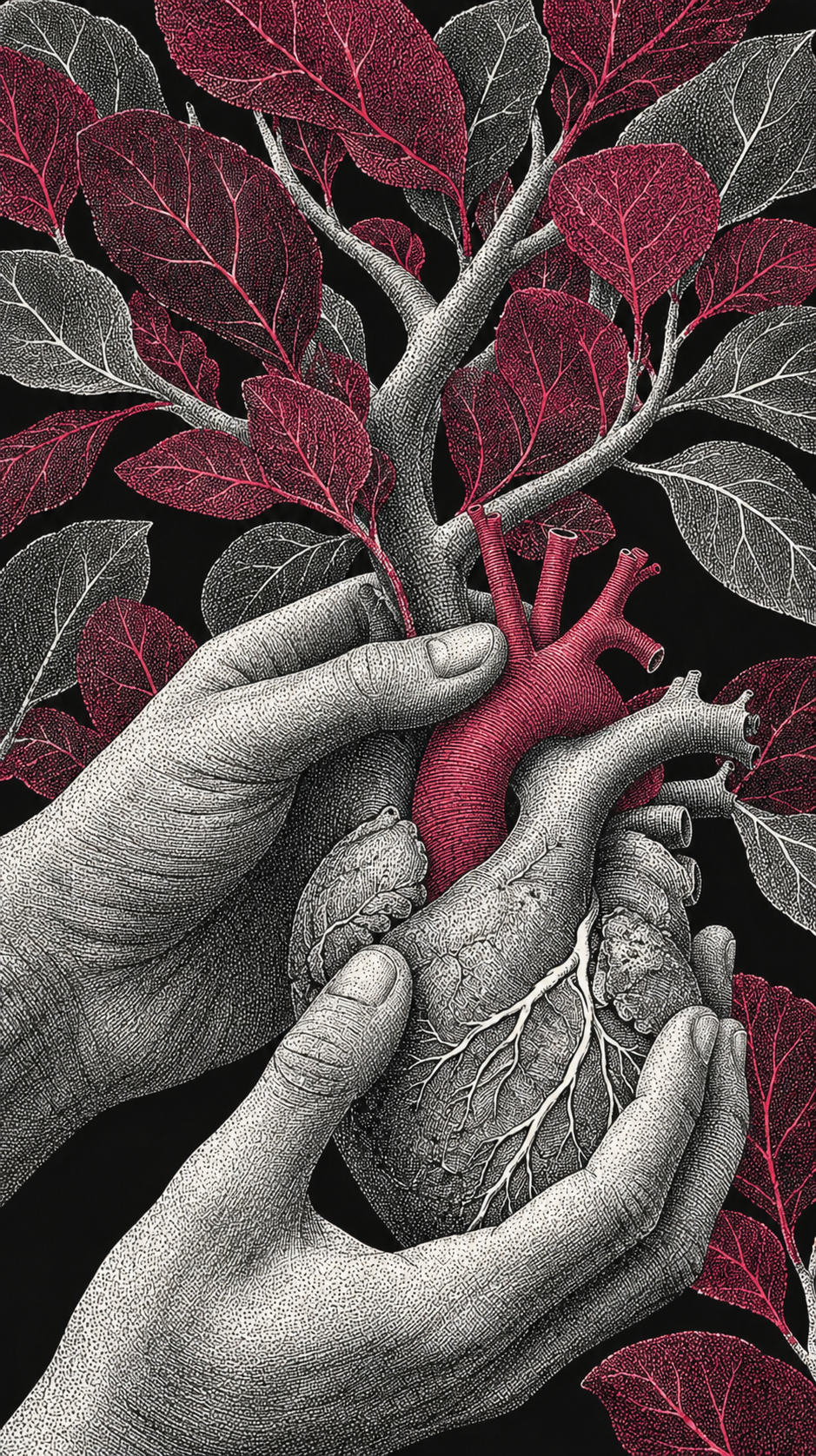
Two carefully rendered hands cradle an anatomical heart against a deep black background. From behind its vessels, a branching tree rises into a canopy of crimson and silver-gray leaves. Fine stippling and engraved lines give the hands, heart, and foliage a shared texture, joining human anatomy with the structures of a growing plant.
The heart is shown as a physical organ rather than a simplified emblem. Its visible vessels and uneven surfaces give familiar ideas of love and feeling a sense of weight and vulnerability. Held between the hands, it becomes something deserving of attention: a part of life that can be supported, handled gently, and taken seriously.
The tree extends this image of care into an image of growth. Its branches echo the vessels crossing the heart, while the veins within the leaves repeat the same branching pattern on a smaller scale. These visual connections suggest continuity between what sustains us inwardly and what we bring into the world through our choices, relationships, and creative work.
Crimson carries the eye from the prominent vessel into the surrounding foliage. Against the quieter gray forms, this restrained color can suggest warmth, intensity, and the persistence of feeling. The black background leaves little distraction, allowing the supporting hands and the upward movement of the branches to hold our attention.
The hands do not squeeze or conceal the heart. Their curved fingers offer a frame of support, making tenderness feel deliberate rather than passive. Read symbolically, the gesture invites reflection on how we care for our own emotional lives and how we hold the trust of others. Support need not mean controlling what grows; sometimes it means making room for it.
The leaves reach beyond the heart and hands, suggesting that the effects of care can extend farther than the moment in which it is given. Growth here is neither effortless nor guaranteed. It is presented as a possibility sustained by attention, patience, and a willingness to remain open while protecting what matters.
What We Nurture in the Heart brings these elements together in a quiet reflection on responsibility and renewal. It asks us to consider which feelings, habits, and connections we keep tending—and what those choices may allow to take root.

















Comments
Comments appear after approval.
Log in to comment