
Community
Self-Discovery
The Watchtower of Inner Vision
A serpent coils around a ruined tower beneath a radiant eye, while a lone traveler crosses a moonlit bridge in a gothic reflection on fear, perspective, and change.

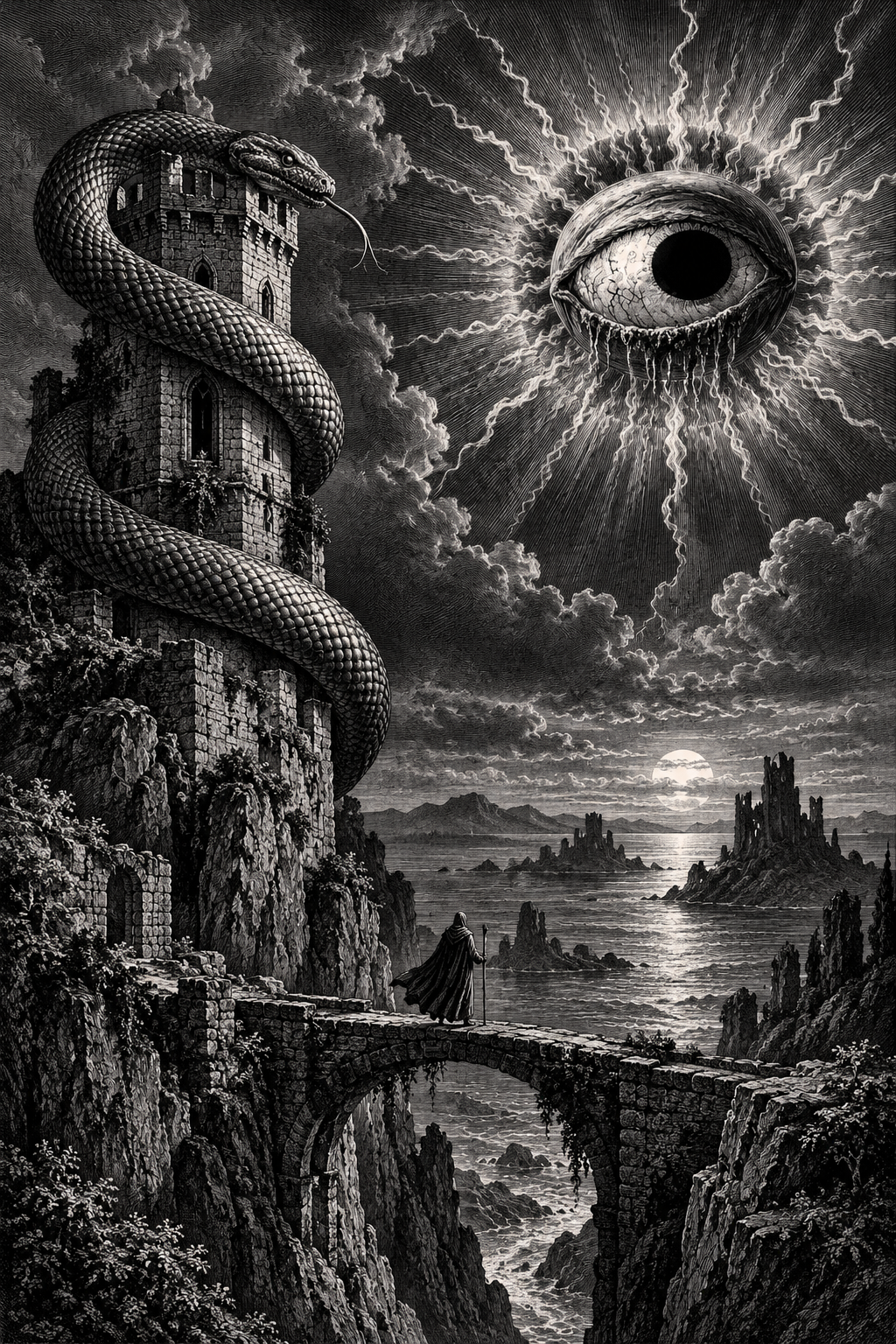
The Watchtower of Inner Vision unfolds as an imagined landscape of uncertainty. A great serpent winds around a weathered stone tower, an immense eye hangs in the storm-dark sky, and a small traveler pauses on a bridge above a rocky gorge. Beyond them, moonlight opens a path across the sea toward distant ruins. The scene combines the atmosphere of an antique engraving with the impossible scale of a dream.
The tower gives the composition a strong vertical anchor. Its worn masonry suggests structures built to endure, yet its damaged walls reveal the limits of permanence. As a metaphor, it may represent an established belief, a familiar identity, or a way of understanding the world that once offered security. The cracks leave room to consider what happens when that structure no longer feels complete.
The serpent follows a different rhythm. Its broad coils move around the rigid architecture, bringing an organic presence into contact with human construction. It can be read as instinct, fear, change, or a question that refuses to remain outside our defenses. The image leaves that meaning unresolved. The creature is neither a reliable omen nor a fixed emblem of evil; its role depends on the relationship the viewer sees between movement and resistance.
The oversized eye introduces the theme of observation. Suspended above the landscape, it makes looking feel powerful and potentially unsettling. It may suggest self-awareness, scrutiny, or the discomfort of seeing something we would prefer to avoid. Its radiant edges give it visual force, but they do not establish an all-knowing watcher. The eye belongs to the artwork’s imaginative language, where attention itself can become a presence in the sky.
The lone traveler provides a human measure for these enormous forms. Against the tower, serpent, and eye, the figure appears small, yet remains upright on a path that can be crossed. This contrast allows vulnerability and agency to exist together. A person does not need to understand the entire landscape before noticing the place where the next decision can be made.
The bridge is a particularly important counterpoint to the tower. Where the tower rises and encloses, the bridge connects separate edges. It can symbolize a transition between familiar and unfamiliar ground, or the practical work of moving through uncertainty. Its stone arch gives the traveler support without removing the depth of the gorge below. The image offers no guarantee about the destination; its interest lies in the act of crossing.
Moonlight and distant water introduce space beyond the immediate drama. The sea remains open, while ruined islands repeat the theme of structures changed by time. The pale reflection draws the gaze away from the threatening scale of the foreground toward a wider horizon. It suggests perspective rather than an easy escape: the scene contains more than the difficulty nearest to us.
Fine crosshatching gives stone, cloud, water, and scales their distinct surfaces. The monochrome palette allows these textures to carry the atmosphere. Bright rays, pale masonry, and reflected light emerge from dense shadows, creating a balance between what can be seen and what remains uncertain. This visual tension supports the work’s central questions about attention and interpretation.
Ultimately, The Watchtower of Inner Vision is a symbolic reflection on meeting an unfamiliar inner landscape. Its figures can prompt thoughts about fear, changing beliefs, and the courage to look again. They are offered as possibilities for reflection, not supernatural claims or predictions. The traveler’s quiet presence brings the vast scene back to a human scale, where a pause, a clearer view, and one considered step can still matter.
The tower gives the composition a strong vertical anchor. Its worn masonry suggests structures built to endure, yet its damaged walls reveal the limits of permanence. As a metaphor, it may represent an established belief, a familiar identity, or a way of understanding the world that once offered security. The cracks leave room to consider what happens when that structure no longer feels complete.
The serpent follows a different rhythm. Its broad coils move around the rigid architecture, bringing an organic presence into contact with human construction. It can be read as instinct, fear, change, or a question that refuses to remain outside our defenses. The image leaves that meaning unresolved. The creature is neither a reliable omen nor a fixed emblem of evil; its role depends on the relationship the viewer sees between movement and resistance.
The oversized eye introduces the theme of observation. Suspended above the landscape, it makes looking feel powerful and potentially unsettling. It may suggest self-awareness, scrutiny, or the discomfort of seeing something we would prefer to avoid. Its radiant edges give it visual force, but they do not establish an all-knowing watcher. The eye belongs to the artwork’s imaginative language, where attention itself can become a presence in the sky.
The lone traveler provides a human measure for these enormous forms. Against the tower, serpent, and eye, the figure appears small, yet remains upright on a path that can be crossed. This contrast allows vulnerability and agency to exist together. A person does not need to understand the entire landscape before noticing the place where the next decision can be made.
The bridge is a particularly important counterpoint to the tower. Where the tower rises and encloses, the bridge connects separate edges. It can symbolize a transition between familiar and unfamiliar ground, or the practical work of moving through uncertainty. Its stone arch gives the traveler support without removing the depth of the gorge below. The image offers no guarantee about the destination; its interest lies in the act of crossing.
Moonlight and distant water introduce space beyond the immediate drama. The sea remains open, while ruined islands repeat the theme of structures changed by time. The pale reflection draws the gaze away from the threatening scale of the foreground toward a wider horizon. It suggests perspective rather than an easy escape: the scene contains more than the difficulty nearest to us.
Fine crosshatching gives stone, cloud, water, and scales their distinct surfaces. The monochrome palette allows these textures to carry the atmosphere. Bright rays, pale masonry, and reflected light emerge from dense shadows, creating a balance between what can be seen and what remains uncertain. This visual tension supports the work’s central questions about attention and interpretation.
Ultimately, The Watchtower of Inner Vision is a symbolic reflection on meeting an unfamiliar inner landscape. Its figures can prompt thoughts about fear, changing beliefs, and the courage to look again. They are offered as possibilities for reflection, not supernatural claims or predictions. The traveler’s quiet presence brings the vast scene back to a human scale, where a pause, a clearer view, and one considered step can still matter.








Comments
Comments appear after approval.
Log in to comment