
Community
Self-Discovery
The Face We Shape with Our Hands
Three black hand silhouettes form an imagined face on warm ivory, exploring perception, gesture, and the part we play in shaping what we see.

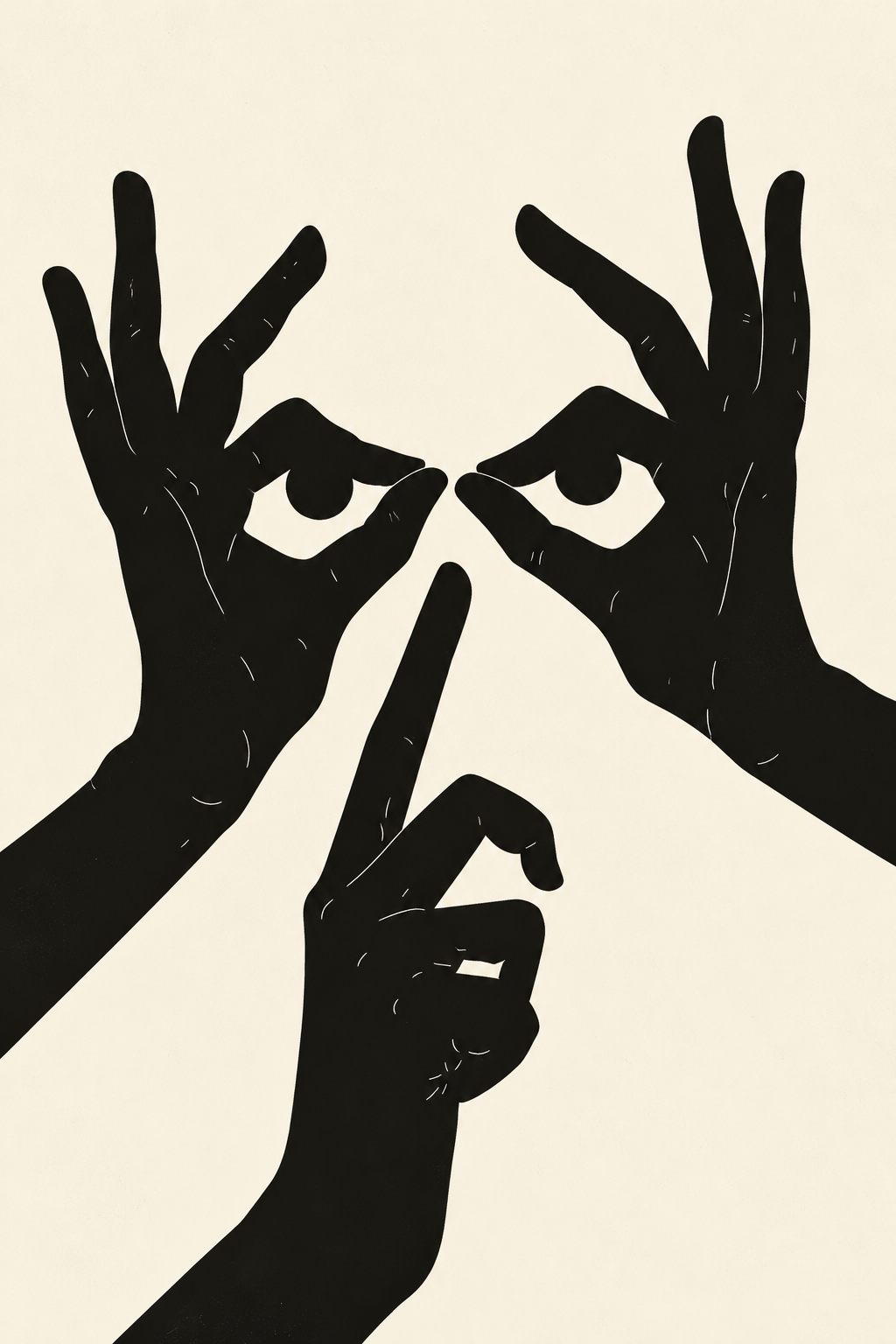
Three black hand silhouettes meet against a warm ivory background, and an imagined face begins to emerge. The two hands at the sides form the eyes, their curved fingers enclosing pale spaces around dark, rounded shapes. A third hand rises from below, suggesting a nose and mouth through the angle of an extended finger and the folds of the remaining fingers. Each hand remains recognizable, yet together they become something beyond their separate forms.
The image invites our attention to move between two readings. We see hands, then a face, then hands again. Nothing in the composition changes, but our perception does. This quiet shift suggests how flexible seeing can be: the mind connects fragments, recognizes familiar patterns, and gives a collection of gestures a shared identity.
The cream-colored space is as active as the black silhouettes. It separates the fingers, opens the eyes, and gives the suggested face room to appear. Without that surrounding emptiness, the shapes would lose much of their meaning. The composition can be read as a reflection on the importance of pauses and openness—the spaces that allow individual elements to relate to one another.
Hands are instruments of making, touching, communicating, and caring. Here, those same instruments become the features of a face, linking what we do with how we are seen. Identity appears as something shaped through gestures and relationships, rather than something contained within a fixed outline. The slight differences between the two sides keep the face expressive and prevent its balance from becoming rigid.
There is also a suggestion of collaboration. No single silhouette creates the whole portrait. The face emerges through their arrangement and through the viewer’s willingness to connect them. Meaning is shared between the forms on the page and the person looking at them.
The Face We Shape with Our Hands offers a simple invitation to look again. What seems obvious at first may hold another possibility, and what appears separate may become connected when we give it our attention.














Comments
Comments appear after approval.
Log in to comment