
Community
Self-Discovery
The Crimson Cabinet of Inner Reflection
A radiant eye, moon, open hand, books, and candlelight form a crimson cabinet of symbols exploring attention, learning, and the mysteries of inner life.

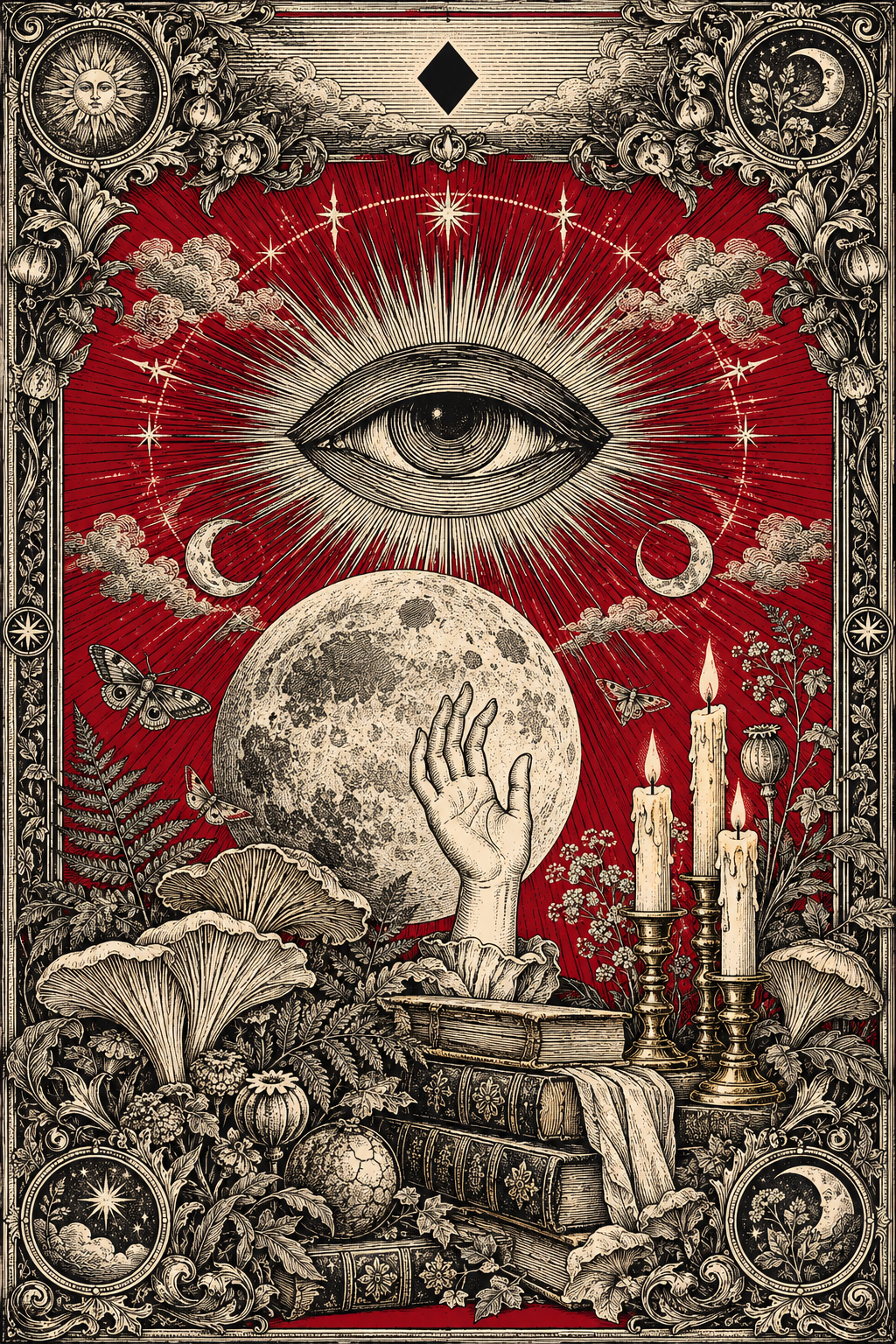
The Crimson Cabinet of Inner Reflection gathers an eye, a moon, an open hand, books, candles, and botanical forms into a richly patterned visual space. Black and ivory engraving emerges against deep red, giving the scene both the intimacy of an old print and the intensity of a theatrical backdrop. Its objects do not form a practical ritual. They create an imaginative arrangement through which to consider observation, knowledge, time, and personal meaning.
The eye draws attention upward. Surrounded by fine rays, it suggests the moment when looking becomes deliberate rather than automatic. It can represent discernment, curiosity, or the willingness to examine a familiar idea again. Its prominence gives the composition a point of focus, while the surrounding objects invite that attention to move outward into detail. The eye remains a symbolic image rather than a claim about supernatural perception.
The moon introduces a quieter visual center beneath the gaze. Its textured surface gives a sense of distance, while its round shape contrasts with the rectangular books and upright candles. In this artwork, it may suggest changing experience, reflection, or the parts of life we understand gradually. Its symbolic role does not imply that lunar phases determine a viewer’s emotions or future.
The raised hand brings a human gesture into the still life. Open fingers can evoke receptivity, a question, or the desire to reach toward understanding. Positioned among objects associated with study and reflection, the hand suggests participation: meaning is something we actively explore. It also offers a reminder that ideas become relevant through what we choose to do with them.
The books give the scene a foundation of accumulated thought. Their layered forms can stand for learning, inherited stories, memory, and the interpretations we carry forward. A stack of books may contain many perspectives rather than one final answer. Read this way, the image encourages a relationship with knowledge that remains curious and willing to revise.
Candlelight adds a different measure of attention. Each flame illuminates a small area, suggesting the value of a limited but useful view. We rarely see every part of a question at once; a small insight can still help us take the next considered step. The candles also introduce the passage of time through their uneven shapes and gathered wax. These are visual metaphors, not promises of cleansing or magical effects.
Mushrooms, fronds, and seed forms bring organic detail into the arrangement. Their varied surfaces interrupt the order of the books and the geometry of the frame. They can suggest growth, complexity, and the unnoticed processes that continue beyond our immediate awareness. Their role here is decorative and symbolic; the image offers no guidance about consuming or using any plant or fungus.
The ornate border contains the scene like a cabinet of collected curiosities. Small medallions reward closer looking, while the red field connects the separate elements. Red may evoke vitality, urgency, or emotional intensity; ivory and black keep the detail precise. The contrast allows feeling and careful observation to share the same composition.
Ultimately, The Crimson Cabinet of Inner Reflection invites viewers to make their own connections between the objects. The eye observes, the hand reaches, the books preserve, and the candles illuminate. Together they suggest a patient approach to self-discovery, in which attention and imagination work alongside questioning. The mystery remains an opening for reflection rather than a hidden certainty to be claimed.
The eye draws attention upward. Surrounded by fine rays, it suggests the moment when looking becomes deliberate rather than automatic. It can represent discernment, curiosity, or the willingness to examine a familiar idea again. Its prominence gives the composition a point of focus, while the surrounding objects invite that attention to move outward into detail. The eye remains a symbolic image rather than a claim about supernatural perception.
The moon introduces a quieter visual center beneath the gaze. Its textured surface gives a sense of distance, while its round shape contrasts with the rectangular books and upright candles. In this artwork, it may suggest changing experience, reflection, or the parts of life we understand gradually. Its symbolic role does not imply that lunar phases determine a viewer’s emotions or future.
The raised hand brings a human gesture into the still life. Open fingers can evoke receptivity, a question, or the desire to reach toward understanding. Positioned among objects associated with study and reflection, the hand suggests participation: meaning is something we actively explore. It also offers a reminder that ideas become relevant through what we choose to do with them.
The books give the scene a foundation of accumulated thought. Their layered forms can stand for learning, inherited stories, memory, and the interpretations we carry forward. A stack of books may contain many perspectives rather than one final answer. Read this way, the image encourages a relationship with knowledge that remains curious and willing to revise.
Candlelight adds a different measure of attention. Each flame illuminates a small area, suggesting the value of a limited but useful view. We rarely see every part of a question at once; a small insight can still help us take the next considered step. The candles also introduce the passage of time through their uneven shapes and gathered wax. These are visual metaphors, not promises of cleansing or magical effects.
Mushrooms, fronds, and seed forms bring organic detail into the arrangement. Their varied surfaces interrupt the order of the books and the geometry of the frame. They can suggest growth, complexity, and the unnoticed processes that continue beyond our immediate awareness. Their role here is decorative and symbolic; the image offers no guidance about consuming or using any plant or fungus.
The ornate border contains the scene like a cabinet of collected curiosities. Small medallions reward closer looking, while the red field connects the separate elements. Red may evoke vitality, urgency, or emotional intensity; ivory and black keep the detail precise. The contrast allows feeling and careful observation to share the same composition.
Ultimately, The Crimson Cabinet of Inner Reflection invites viewers to make their own connections between the objects. The eye observes, the hand reaches, the books preserve, and the candles illuminate. Together they suggest a patient approach to self-discovery, in which attention and imagination work alongside questioning. The mystery remains an opening for reflection rather than a hidden certainty to be claimed.




Comments
Comments appear after approval.
Log in to comment