
Tracing the Origins and Evolution of The Fool Card in Tarot Tradition and Practice
The Fool card stands as one of the most iconic and symbolically rich cards in the tarot tradition. This article traces its origins from early tarot decks through its evolution in the Rider-Waite-Smith tradition, highlighting its symbolic imagery and practical application in readings. Readers will discover the card's dual nature—embracing beginnings with openness and curiosity in the upright position, and confronting recklessness or internal blocks when reversed. The article offers practical advice for interpreting The Fool, clarifies common misunderstandings, and encourages a nuanced approach to integrating the card's lessons into your tarot practice.
Cards explored in this article
 The Fool
Historical Origins of The Fool Card in Tarot
The Fool card is one of the oldest cards found in tarot decks, dating back to the earliest European playing cards of the 15th century. Unlike other Major Arcana cards, which often depict figures with numbered sequences, The Fool traditionally is unnumbered or marked with a zero (0), symbolizing both nothingness and infinite potential. Historically, The Fool often represented the archetype of the trickster, the wanderer, or the madman—figures outside societal norms but essential for transformation and insight. In Renaissance Italy, where tarot cards originated as a game called tarocchi, The Fool was sometimes called "Il Matto" or "The Madman" and typically illustrated as a vagabond carrying his belongings loosely in a sack. This imagery connected The Fool with themes of unpredictability, freedom, and innocence, but also carelessness and folly. The card was not originally tied to divinatory purposes, which emerged later, but its symbolism lent itself naturally to psycho-spiritual interpretations.
Evolution Through Tarot Traditions Leading to Rider-Waite-Smith
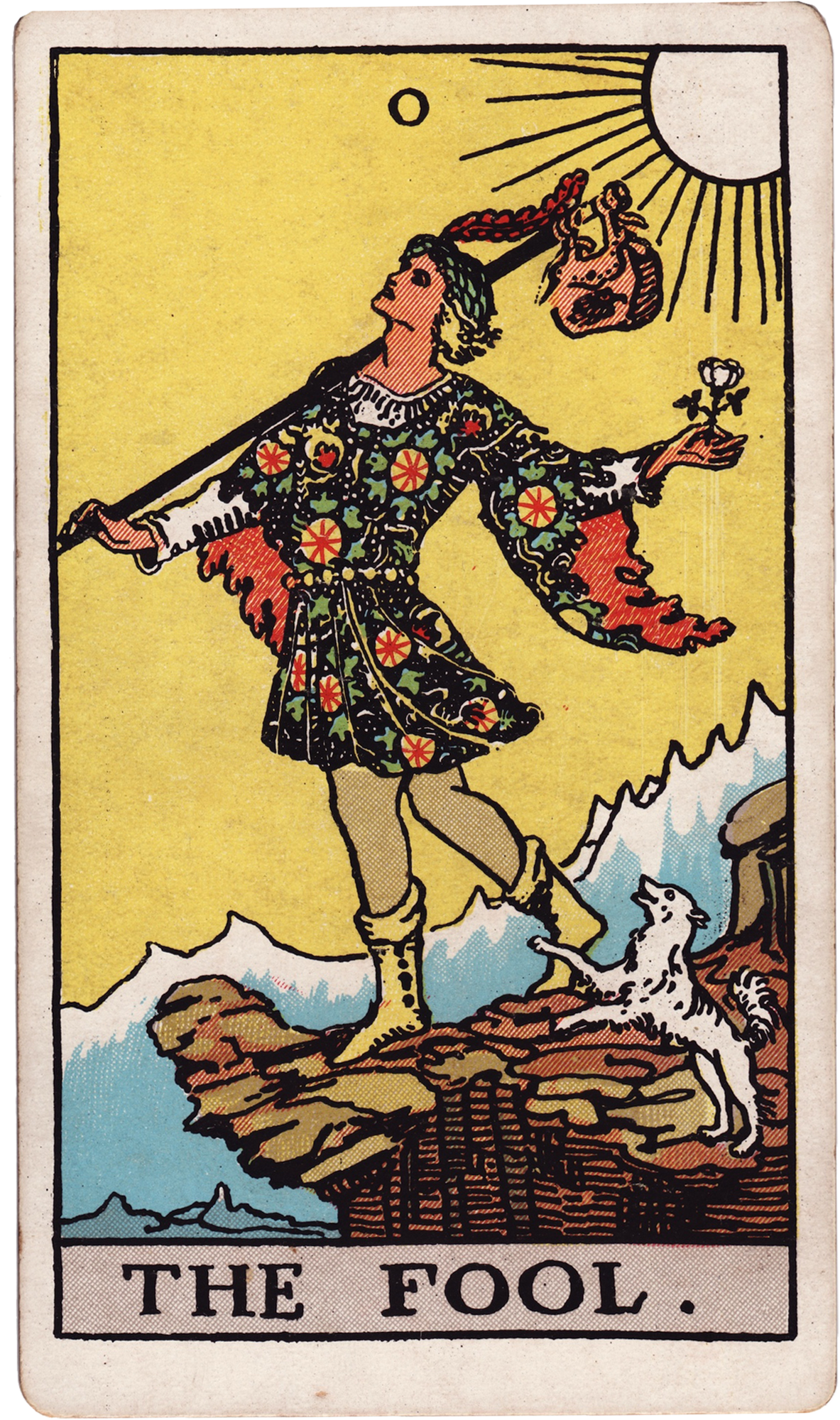
The transformation of The Fool’s meaning accelerated during the 18th and 19th centuries as tarot became associated with mysticism, divination, and psychology. By the time Arthur Edward Waite and artist Pamela Colman Smith created the Rider-Waite-Smith deck in 1909, The Fool had taken on profound esoteric significance. In the Rider-Waite-Smith image, The Fool is depicted as a young man standing on the edge of a cliff, gazing upward with a small white dog at his feet. He carries a small bundle on a stick, symbolizing experiences and lessons carried lightly. The sun shines brightly behind him, illuminating his path, yet the cliff’s edge warns of potential danger or naivety. This imagery conveys the card’s role as the beginning of a journey—open and curious, but also vulnerable. The dog traditionally symbolizes loyalty or instinct, sometimes interpreted as a guardian or a reminder of earthly realities. The white rose in The Fool’s hand represents purity of intention and innocence. These symbols collectively anchor The Fool in the Rider-Waite-Smith tradition as a card about embracing new beginnings with openness while remaining mindful of risks.
Key Symbolism and Interpretive Themes in The Fool Upright
When The Fool appears upright in a reading, it encourages starting a new chapter with curiosity rather than fear or hesitation. The card emphasizes action before every detail is known, urging the seeker to trust their intuition and inner guidance rather than waiting for perfect certainty. The Rider-Waite-Smith imagery supports this reading: the carefree stance near the cliff edge shows a willingness to leap into the unknown. The sun’s brightness suggests optimism, while the small bundle reminds the querent they carry knowledge and resources even if the path ahead is unclear. Practically, when The Fool is upright, readers should ask: where can the querent take a deliberate step forward? Are they ready to meet new experiences with honesty and openness? This card suggests working with what is present now and using curiosity as a constructive force. It is not an automatic guarantee of ease or success, but rather a quality to cultivate in the face of uncertainty. Common interpretive errors include reading The Fool only as naïve recklessness or disregarding the importance of preparation. Instead, The Fool upright balances innocence with an active, engaged mindset.
Understanding The Fool Reversed and Its Nuances
When The Fool appears reversed, it often signals that the upright qualities are blocked or distorted. This can manifest as recklessness without awareness, avoidance of necessary beginnings due to fear of uncertainty, or naivety that ignores consequences. The Rider-Waite-Smith imagery helps: the edge of the cliff may feel more like a fall, and the carefree spirit may hide denial or hesitation. However, a reversed Fool does not necessarily predict disaster. Instead, it invites reflection on where the Fool energy is becoming difficult to access or expressed without balance. In some readings, the reversal points to internal psychological processes—perhaps the querent is beginning to recognize an old pattern but has not fully transformed it. It may represent a temporary pause or resistance to change rather than outright failure. Interpreters should look to surrounding cards for further context to determine whether the reversed Fool suggests excess, recovery, or reflection. The key question shifts from “What will go wrong?” to “Where is the energy of new beginnings being blocked or misdirected?”
Practical Techniques for Reading The Fool in Context
When The Fool appears in a spread, it is crucial to integrate its symbolism with the specific question and other cards drawn. Start by observing the card’s orientation: upright or reversed. Then connect the image details—such as the dog, the cliff, the rose, and the sun—to the querent’s situation. Ask open-ended questions inspired by The Fool’s lessons: Where is a new beginning possible? What fears or hesitations might be limiting progress? How can curiosity be awakened and maintained? Avoid rushing to overly simplistic conclusions like “take a risk blindly” or “be reckless.” Instead, emphasize the card’s encouragement to engage consciously with uncertainty. For example, if a querent is contemplating a career change, The Fool upright can affirm that starting even without all answers is valuable, while the reversed may urge caution or preparation. Use journaling or reflective exercises to deepen understanding of The Fool’s message. Noticing which part of the Fool’s energy already exists in behavior can clarify how best to proceed. The card calls for active participation rather than passive waiting.
Common Mistakes and How to Avoid Them When Working with The Fool
One frequent mistake is treating The Fool only as a sign of recklessness or irresponsibility. This limits the card’s transformative potential and can discourage a healthy embrace of uncertainty. Another error is ignoring the reversed position’s nuanced meanings and assuming it always signals negative outcomes. Beginners sometimes overlook the importance of context, such as surrounding cards or the querent’s specific question. The Fool’s message shifts significantly with different themes—personal growth, relationships, or career. To avoid these errors, always anchor your interpretation in the card’s imagery and symbolism from the Rider-Waite-Smith tradition. Encourage querents to view The Fool as a dynamic quality rather than a fixed prediction. Remind yourself to balance enthusiasm with discernment, curiosity with honesty. Finally, practicing with sample spreads and journaling responses to The Fool can help deepen a practical, grounded understanding of this archetypal card.
Reflection on The Fool’s Role in Tarot’s Broader Tradition
The Fool functions as both the beginning and the potential of the entire tarot journey. Its zero number symbolizes a starting point outside the known sequence, embodying infinite possibilities and the leap of faith required to grow. Throughout tarot history, this card has represented the tension between innocence and experience, freedom and responsibility. In modern practice, The Fool invites readers and querents alike to engage with life's uncertainties creatively and courageously. It encourages a mindset that values process over outcome and openness over rigid control. The Rider-Waite-Smith symbolism serves as a vivid visual reminder of the journey’s first step—where the sun shines brightly, the dog offers companionship, and the cliff warns yet does not deter. By tracing The Fool’s origins and evolution, readers can appreciate its layered meanings and apply them thoughtfully in readings. The card’s enduring power lies in its ability to inspire beginnings infused with awareness, curiosity, and integrity.
Practice questions
• In what areas of your life could embracing The Fool’s openness and curiosity lead to positive change?
• How do you balance the need for preparation with the willingness to take risks symbolized by The Fool upright?
• When The Fool appears reversed, where might you be resisting new beginnings or acting without sufficient awareness?
• What role does innocence play in your personal growth, and how can it coexist with experience and responsibility?
• How does the imagery of the cliff, dog, and rose deepen your understanding of The Fool’s message in readings?
Comments
Sign in to comment.
Continue learning
Interpreting the Dance of Justice and The Devil: Balancing Morality and Temptation in Tarot Readings
The combination of Justice and The Devil in tarot presents a profound exploration of morality, temptation, and personal accountability. This article unpacks how these cards influen...
Advanced Techniques for Combining The Moon and The Star to Enhance Intuition in Tarot Readings
This article explores advanced techniques to combine the symbolism and energy of The Moon and The Star Tarot cards to enhance intuition during Tarot readings. Drawing from traditio...
Unlocking Life Insights with the Celtic Cross Tarot Spread
This article offers a thorough exploration of the Celtic Cross Tarot Spread, focusing on its application within family and practical life contexts. Using a worked example featuring...
Unlocking Hidden Meanings with The Hermit and The Hanged Man for Spiritual Growth
This article offers an in-depth exploration of The Hermit and The Hanged Man Tarot cards focusing on their roles in spiritual growth. It guides readers through beginner and advance...
Unlocking Personal Insight with the Seven Card Horseshoe Spread
The Seven Card Horseshoe Spread is a practical and insightful Tarot layout ideal for exploring personal and family dynamics. This article breaks down each position—Past, Present, H...
Mastering the Court Cards of Wands for Unlocking Personal Drive and Leadership
The Court Cards of Wands represent a dynamic spectrum of personal energy, ambition, and leadership potential within the Minor Arcana. This article offers a comprehensive exploratio...
Tracing the Origins and Evolution of The Fool Card in Tarot History
The Fool card holds a foundational place in tarot tradition, symbolizing beginnings, openness, and the embrace of uncertainty. This article traces its origins from early European d...
Techniques for Reading Court Cards to Unlock Personality Insights
Court cards in Tarot often represent people, personality traits, or energy patterns within a situation. This article offers a structured approach for beginners and advanced readers...
Unlocking Emotional Transformation with Death and The Moon Tarot Combination
This article explores the rich and complex interaction between the Death and The Moon tarot cards within the Rider-Waite-Smith tradition, focusing on their combined potential to un...
Applying The Star Card to Foster Hope and Renewal in Personal Growth
The Star card in Tarot symbolizes hope, authenticity, and the process of steady renewal. In a single-card reading, The Star encourages embracing what is present, cultivating openne...